


Meshtastic Firmware
Meshtastic firmware powers off-grid LoRa mesh devices, while selected WIZnet-enabled boards add Ethernet services for API, time sync, and gateway-style roles.
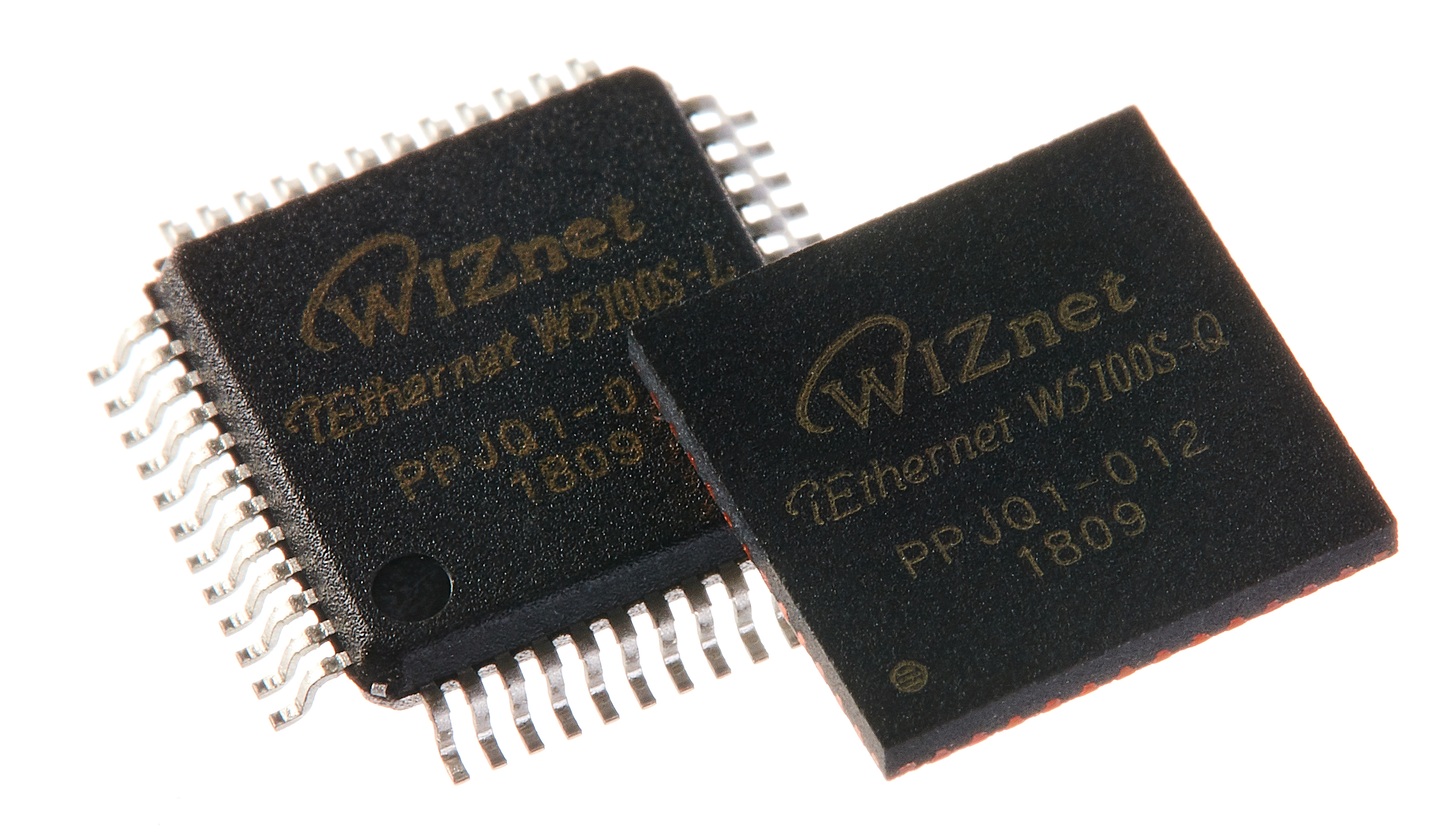
WIZnet - W5100S
x 1

Thumbnail Image: AI-generated image
Meshtastic firmware: an off-grid LoRa mesh stack that also grows into Ethernet gateways on selected WIZnet-based boards
Introduction
Meshtastic firmware is the official device software for Meshtastic, an open-source, off-grid communication system built around LoRa mesh networking. The project is designed for long-range, low-power communication without depending on cellular service or the public internet, and the official firmware supports multiple hardware families including ESP32, nRF52, RP2040/RP2350, and Linux-based devices. Its core user-facing functions are text messaging, location sharing, and telemetry over a decentralized mesh. (GitHub)
What is Meshtastic?

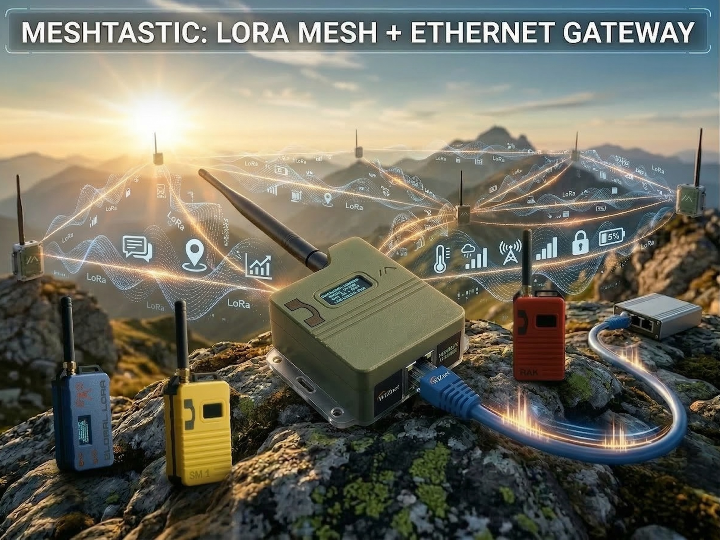
AI-generated image
Meshtastic is an open-source, decentralized communication system built for off-grid messaging. It uses affordable LoRa radios to form a long-range, low-power mesh network, so devices can exchange messages even in places with no cellular coverage or public internet. Rather than depending on one central access point, nearby nodes can relay packets for one another, allowing messages to travel farther than a single direct radio link. Meshtastic’s official project pages describe it as an off-grid mesh designed for text messaging, location sharing, and telemetry on low-power devices. (GitHub)
For readers unfamiliar with the underlying technology, LoRa is a radio method optimized for range and battery life, not high data throughput. In practical terms, that means Meshtastic is well suited to short messages, location updates, and lightweight device data in outdoor, remote, or infrastructure-limited environments. That is why the project is often associated with hiking groups, preparedness users, field teams, and other communities that want communication without relying on mobile networks. (GitHub)
Meshtastic is also more than just firmware on a radio board. It has grown into a broader ecosystem with official Apple apps, Android apps, a web client, and a Python CLI/SDK, plus documentation, public services, and an active open-source community. This wider ecosystem is important when evaluating the firmware repository, because the code is not an isolated board demo; it is the device-side foundation of a larger communication platform. (Meshtastic)
Quick background: what LoRa and “mesh” mean
For non-specialists, LoRa is a long-range, low-power radio technology. In practical terms, it trades bandwidth for reach and battery life, which makes it useful when messages need to travel far without Wi-Fi or cellular coverage. Semtech describes LoRa as a long-range, low-power wireless platform, and Meshtastic’s own site frames it as a way to communicate “with no cell towers” and “no internet.” (Semtech)
A mesh network means devices do not only talk directly to one central base station. Instead, nearby nodes can relay packets for each other. Meshtastic’s GitHub organization README explains this in plain terms: nodes automatically form a mesh and forward packets so that messages can reach members who are farther away than one direct radio hop. That is the key idea behind the project’s appeal for hiking groups, field teams, emergency-preparedness users, and remote operations. (GitHub)
What this project is
This repository is not just a board-specific demo. It is the main firmware platform for the wider Meshtastic ecosystem. Publicly, the repo shows 7.1k stars, 2.1k forks, 256 releases, and 407 contributors, which already places it far beyond a small personal firmware project. The latest public release visible on the repo page is Meshtastic Firmware 2.7.15.567b8ea Beta from November 19, 2025. (GitHub)
The uploaded ZIP snapshot reinforces that scale. The source tree includes:
- a large
src/firmware core, variants/for many device targets,monitor/anddata/static/for device tooling and UI assets,.github/workflows/for CI and packaging,.clusterfuzzlite/for fuzz testing,- and packaging/build artifacts for native and embedded targets.
That structure matters because it shows Meshtastic firmware behaves more like a portable embedded platform than a single-board application.
Author & ecosystem
AI-generated image
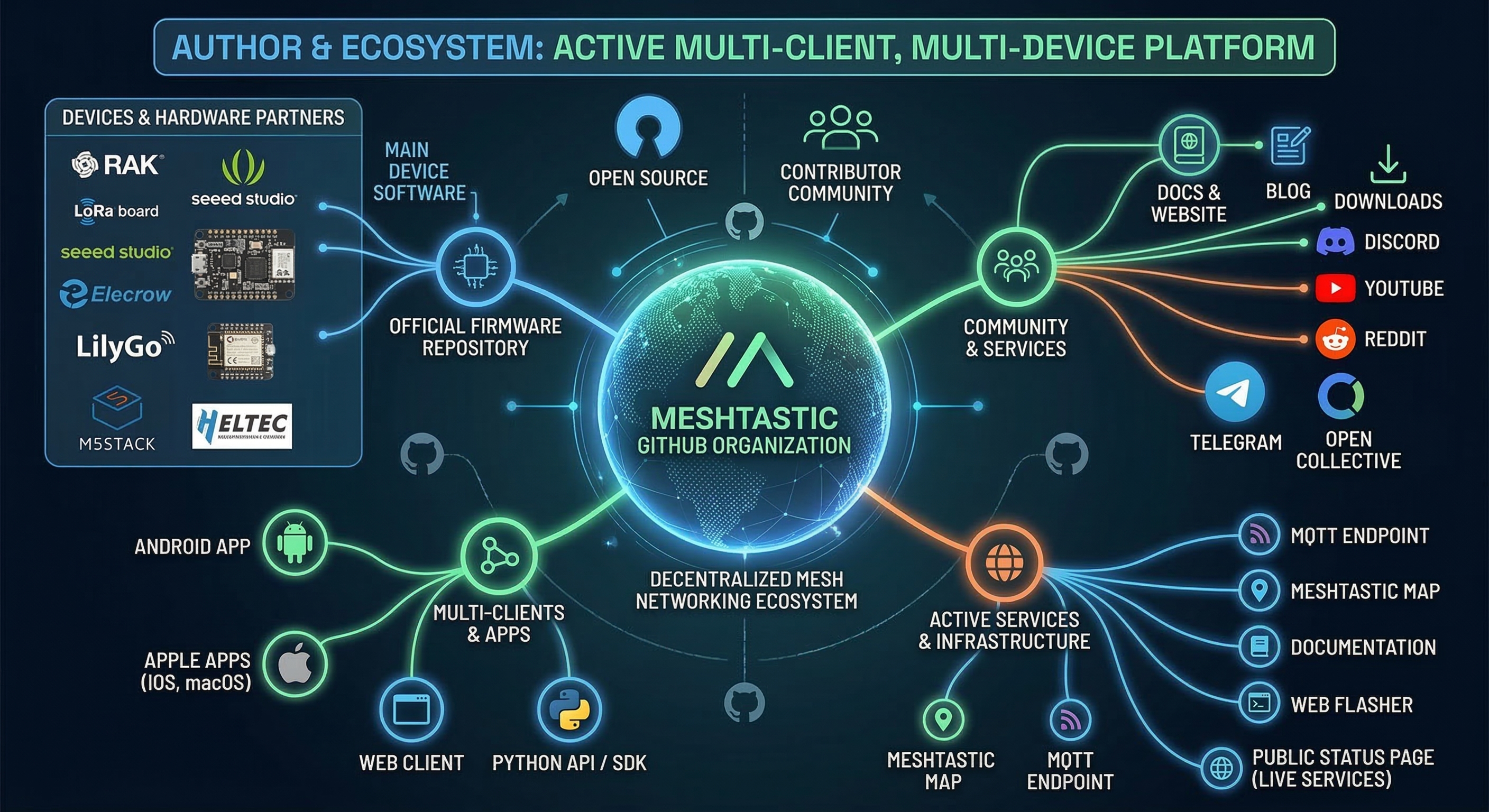
Meshtastic is not operating as a single firmware repo in isolation. The verified GitHub organization describes itself as an “Open Source, decentralized mesh networking ecosystem” and maintains not only the firmware, but also an Android app, Apple clients, a web client, an official web flasher, the website/documentation repo, and a growing list of related tools such as a simulator and API projects. (GitHub)
The official site reinforces that ecosystem view. It links Docs, Blog, Downloads, Discord, YouTube, Reddit, Telegram, and Open Collective, and it lists multiple hardware supporters such as RAK Wireless, Seeed Studio, Elecrow, LilyGo, M5Stack, and Heltec. It also runs public-facing online services including the web client, map, MQTT endpoint, documentation, and a public status page. That is important curator context: Meshtastic firmware sits inside an actively maintained multi-client, multi-device ecosystem rather than standing alone as “just firmware.” (Meshtastic)
How it works
AI-generated image
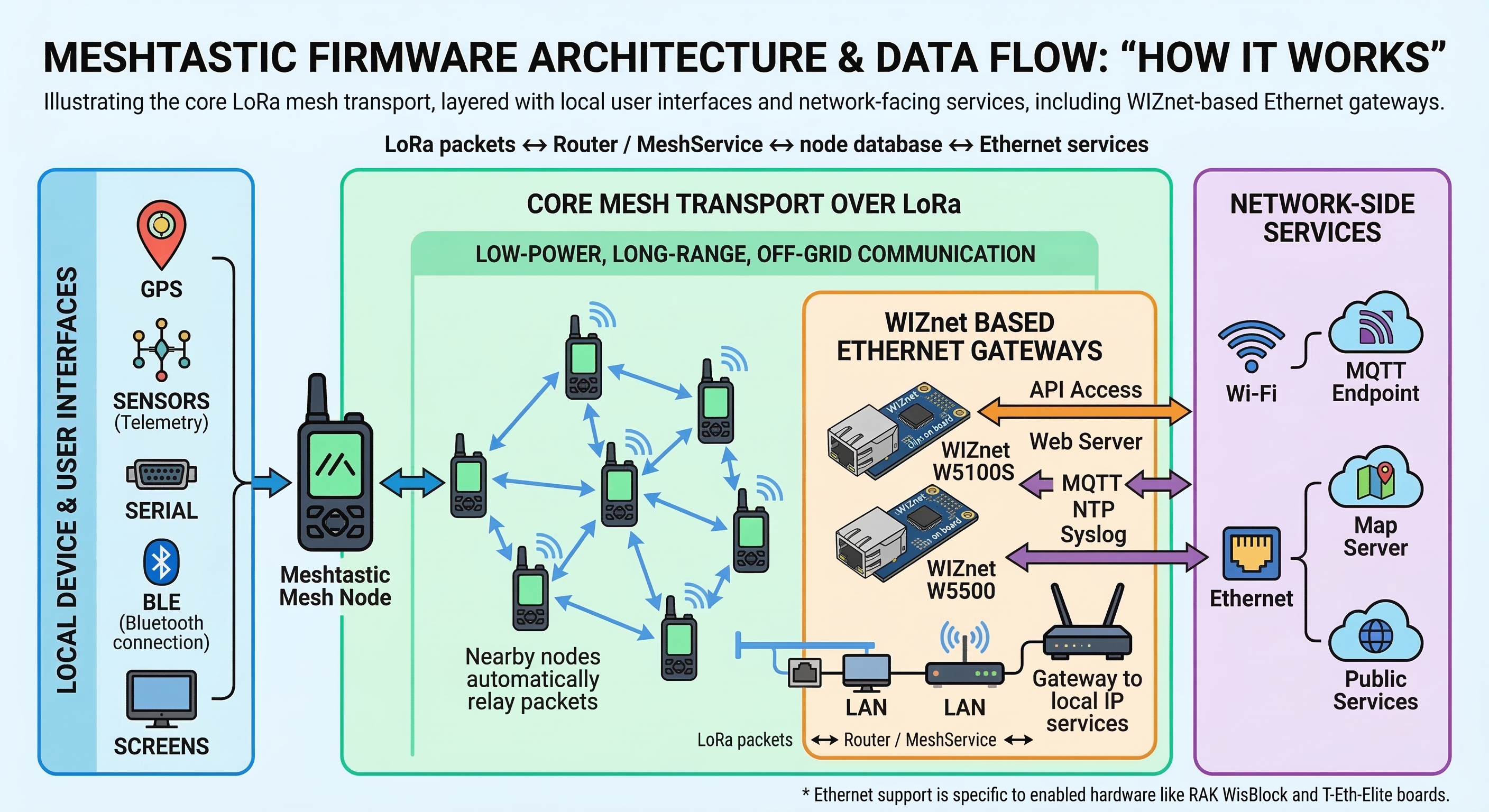
From a system point of view, Meshtastic firmware is easiest to understand as a stack with three main jobs:
- Radio mesh transport over LoRa
- Local device and user interfaces such as BLE, serial, screens, GPS, and sensors
- Network-side services such as Wi-Fi or Ethernet for APIs, web access, MQTT, NTP, syslog, and broadcast services on capable hardware
1) The LoRa mesh remains the core
In the uploaded ZIP snapshot, src/main.cpp initializes the radio path first with initLoRa(), then creates the runtime services around it, and finally attaches the radio interface to the router. The routing side is handled by classes such as Router and MeshService, which manage packet IDs, queueing, forwarding, node database updates, and delivery to local clients. In plain English, that means the firmware treats the LoRa link as the primary “over-the-air” transport, then layers local and network-facing interfaces around it.
2) The architecture is hybrid, not LoRa-only
At the firmware level, this is clearly a hybrid communications design. The mesh itself runs over LoRa, but the codebase also supports Bluetooth, serial, Wi-Fi, Ethernet, TCP API access, MQTT, web/HTTPS access, and UDP broadcast, depending on the target hardware and configuration. The public Python API documentation also reflects that multi-interface design by exposing SerialInterface, TCPInterface, and BLEInterface as first-class host-side interfaces. (Meshtastic)
The uploaded ZIP snapshot shows the same pattern in code: device metadata explicitly tracks whether a build has Bluetooth, Wi-Fi, and Ethernet, and the startup sequence conditionally initializes Wi-Fi and Ethernet alongside the radio path.
3) Where WIZnet fits
WIZnet is not the radio side of Meshtastic. The radio mesh still runs over LoRa transceivers. WIZnet shows up in the repository as the wired Ethernet expansion path on selected hardware variants.
Two distinct WIZnet paths are visible in the uploaded ZIP snapshot:
- W5100S path on selected RAK WisBlock / nRF52 / RP2040 Ethernet-capable variants
The code insrc/mesh/eth/ethClient.cppincludesRAK13800_W5100S.h, initializes Ethernet, supports DHCP or static IP, and then starts services such as NTP, syslog, a TCP API server, and optional UDP broadcast. The related PlatformIO configurations for boards such asrak4631_eth_gwandrak11310explicitly pull in the RAK13800-W5100S dependency. The RAK13800 module itself is sold by RAKWireless as a WisBlock Ethernet board based on WIZnet W5100S, with 10/100 Ethernet and optional PoE support via an add-on board. - W5500 path on the ESP32-S3 T-Eth-Elite variant
The variant files markHAS_ETHERNETandUSE_WS5500, andsrc/mesh/wifi/WiFiAPClient.cppstarts Ethernet withETH.begin(ETH_PHY_W5500, ...). Once the network comes up, that same path starts mDNS, NTP, syslog, the web server, the TCP API server, and optional UDP broadcast. W5500 itself is WIZnet’s hardwired Ethernet controller with 8 sockets, 32KB internal memory, and integrated 10/100 MAC/PHY, which makes it a natural fit for exactly this kind of embedded network service layer.
4) The practical data flow
On a WIZnet-enabled Meshtastic node, the flow is easiest to read like this:
LoRa radio packets ↔ Router / MeshService ↔ local clients and node database ↔ Ethernet services (API, MQTT, NTP, syslog, web, UDP broadcast)
That is the key architectural point. WIZnet is not replacing LoRa. It is extending selected Meshtastic devices into LAN-visible gateways or management nodes, which can bridge the radio mesh to higher-speed local IP services.
Why it matters
AI-generated image
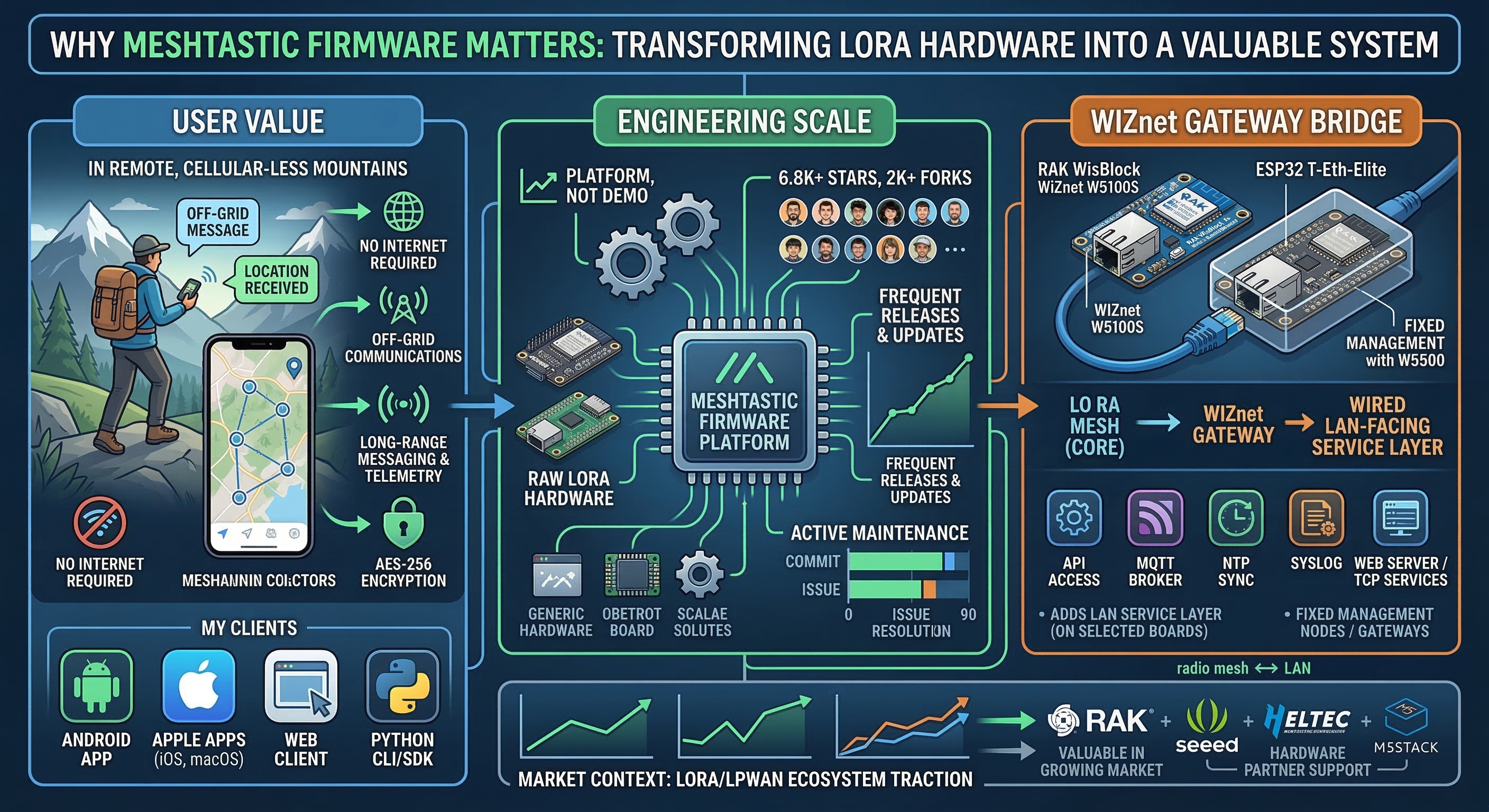
Meshtastic firmware matters because it turns long-range radio hardware into a usable communications system, not just a radio demo.
At the user level, the value is easy to explain. The official project positions Meshtastic as off-grid communication on affordable, low-power devices, with no cell towers and no internet required. It highlights long-range communication over several kilometers, AES-256 encryption, and multiple official client paths including Apple apps, Android, a web client, and a Python CLI/SDK. (Meshtastic)
At the engineering level, the repository shows the scale of a real platform rather than a single-board experiment. The public firmware repo currently shows 6.8k stars, 2k forks, 254 releases, and 397 contributors, and the release page shows frequent alpha/beta builds with large contributor lists across recent releases. That level of release cadence and contributor churn is a strong sign of active maintenance. (GitHub)
For WIZnet specifically, the important point is not that Meshtastic “becomes Ethernet.” The LoRa radio remains the mesh transport. What WIZnet adds on selected boards is a wired LAN-facing service layer: API access, time sync, syslog, web or TCP services, and gateway-style behavior on hardware that needs a stable IP link. In the uploaded ZIP snapshot, that is exactly how the W5100S and W5500 paths are used.
Market and industry context
AI-generated image
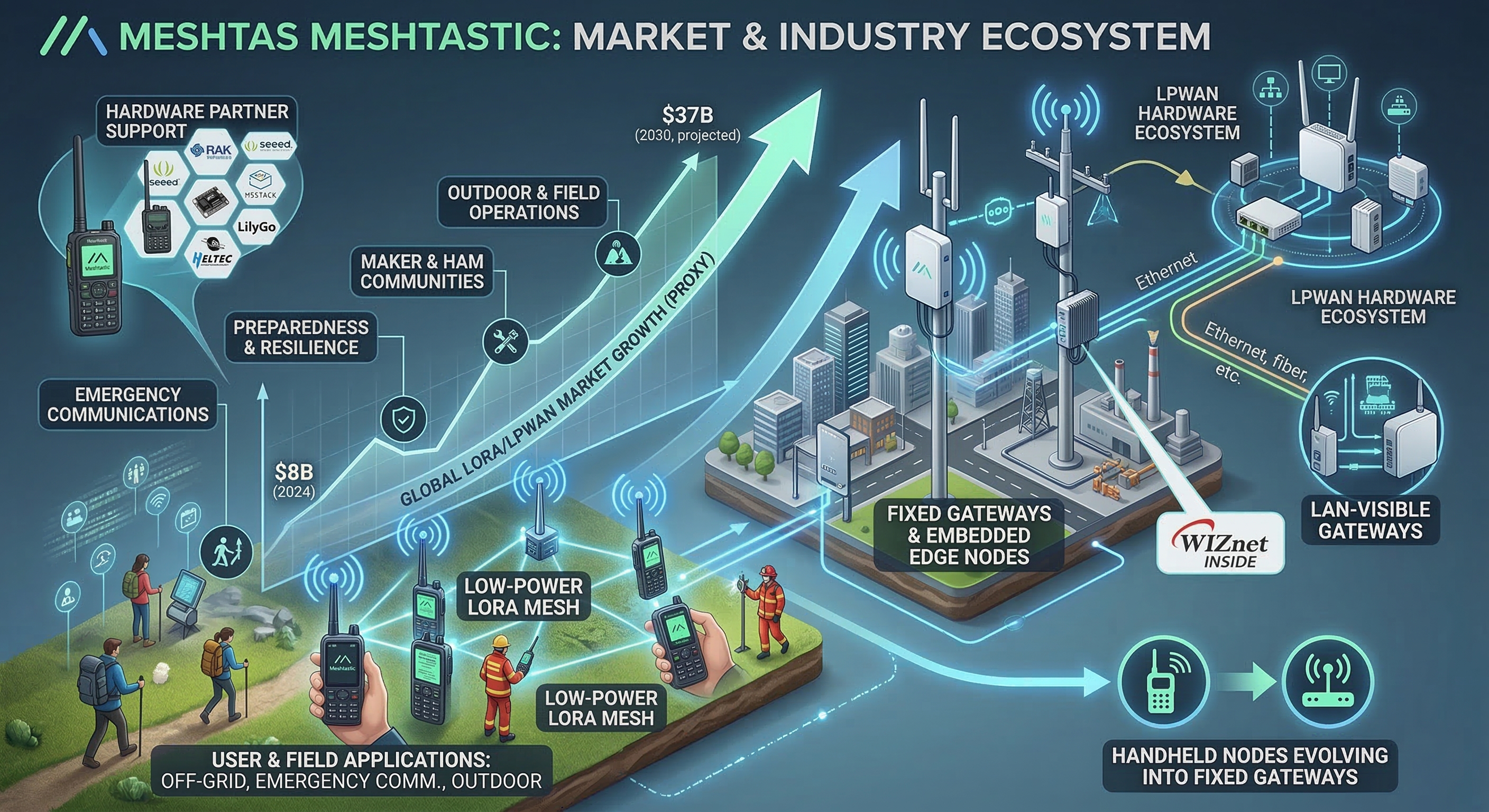
A precise public market size for Meshtastic itself is not available. The project sits at the intersection of several adjacent markets:
- off-grid and emergency communications
- LoRa / LPWAN hardware ecosystems
- outdoor and field operations
- maker, ham-radio-adjacent, and preparedness communities
- fixed gateways and embedded edge nodes
The safest market framing is therefore adjacent-market based, not “Meshtastic market size” as if it were a standalone product category.
The strongest adjacent reference is the broader LoRa / LoRaWAN IoT market. One recent public market report values that market at USD 8.07 billion in 2024 and projects it to reach USD 37.31 billion by 2030. Meshtastic is not LoRaWAN, so that figure should not be treated as a direct proxy for Meshtastic demand. But it does show that the wider commercial ecosystem around long-range, low-power radio hardware is already large and growing. (Research and Markets)
The project also has visible product-market traction through hardware partners and supported-device vendors. The official Meshtastic site lists support from RAK Wireless, Seeed Studio, Elecrow, LilyGo, M5Stack, and Heltec, among others. That matters because it shows Meshtastic is not floating above the hardware market; it already sits inside a real board-and-device ecosystem with vendors actively shipping compatible hardware. (Meshtastic)
From a WIZnet angle, the most credible market interpretation is this: selected Meshtastic nodes can evolve from handheld/off-grid radios into fixed LAN-visible gateways or management nodes. That does not redefine Meshtastic’s core radio value, but it does broaden where the firmware can be useful: base stations, indoor repeaters, lab networks, club infrastructure, shelters, field operations, or remote monitoring setups where a wired backhaul is preferable to Wi-Fi.
External value and ecosystem activity
Meshtastic has unusually strong external value for an open-source embedded firmware project because it is surrounded by a full operating ecosystem.
The official site links not only documentation and downloads, but also Discord, YouTube, Reddit, Telegram, Open Collective, a web client, and a public status page. The status page lists live services such as the main site, API, web client, MQTT service, map, and documentation endpoints. That is a meaningful signal: the project is operating public-facing infrastructure, not only shipping code. (Meshtastic)
The GitHub organization reinforces that ecosystem view. It maintains the main firmware alongside related repositories for Android, Apple clients, web tools, release pages, and other ecosystem software, while the Python API documentation exposes SerialInterface, TCPInterface, and BLEInterface as first-class connection models. (GitHub)
There is also evidence that Meshtastic is expanding beyond dedicated handheld boards into more infrastructure-like deployments. The official OpenWrt repository provides installable packages for OpenWrt-supported routers, which suggests a broader push into embedded gateway and router-class platforms. That is especially relevant when considering why wired Ethernet support matters on some variants. (openwrt-repo)
The uploaded ZIP snapshot adds another layer of external value: it includes CI workflows, fuzzing configuration, many board variants, and network-service modules. That does not by itself prove market success, but it does show engineering maturity and makes downstream reuse more realistic.
Quick notes
A few caveats are important for a fair reading.
First, WIZnet support is selective, not universal. The uploaded ZIP snapshot shows W5100S support on specific RAK Ethernet-capable variants and W5500 support on the ESP32-S3 T-Eth-Elite path, but most Meshtastic devices are still radio-first handheld or portable nodes without Ethernet.
Second, Ethernet does not replace LoRa in this project. The mesh itself still runs over LoRa. WIZnet is used to add LAN-side services on selected devices.
Third, the release stream is very active. That is a strength, but it also means production users and integrators should pin known-good versions rather than assume every alpha or beta release is a drop-in upgrade. The public releases page shows multiple recent pre-releases and frequent contributor turnover. (GitHub)
Finally, the broader commercial reference points around LoRa / LoRaWAN should be treated as adjacent market context, not as a literal Meshtastic revenue proxy. Meshtastic’s strongest commercial relevance comes from the hardware ecosystem, software ecosystem, and gateway potential visible today, rather than from a single clean market-size number.
Why W5500 appears on some Meshtastic builds
AI-generated image
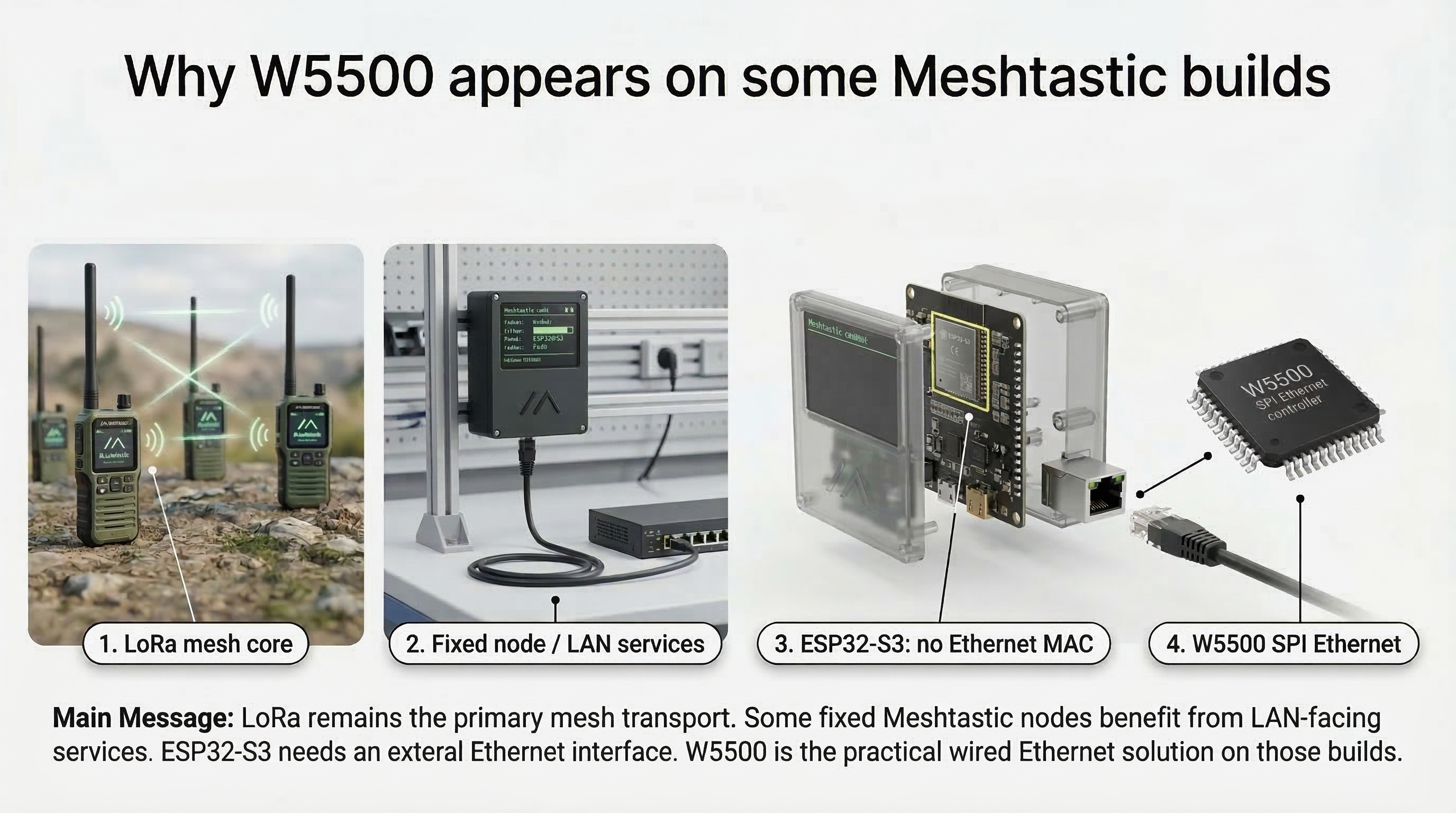
- LoRa remains the core.
Meshtastic is fundamentally an off-grid LoRa mesh system; Ethernet is not a requirement for every node. (meshtastic.org) - Ethernet becomes useful on fixed or infrastructure-style nodes.
In those cases, the goal is less “radio-only messaging” and more stable LAN-side integration — for example, connecting Meshtastic to MQTT/cloud workflows or exposing the node through a TCP interface from a local network. A concrete example is RAK’s commercially sold WisMesh Ethernet MQTT Gateway for Meshtastic, which uses Ethernet specifically to provide a stable bridge between Meshtastic and MQTT. (RAKwireless Store) - On ESP32-S3, wired Ethernet requires an external controller.
Espressif documents that ESP32-S3 has no integrated Ethernet MAC, so any wired-Ethernet design on ESP32-S3 needs an external Ethernet interface. (Espressif Systems) - W5500 fits that role cleanly in the ESP32 software stack.
ESP-IDF supports W5500 as an SPI-Ethernet device in MAC RAW mode, which means it can plug into the normal ESP32 networking path rather than forcing a separate custom stack. (Espressif Systems) - The actual ESP32-S3 hardware ecosystem already points to W5500.
LilyGO’s T-ETH-Lite-ESP32S3 and T-ETH-ELite-ESP32S3 both use W5500, so for Meshtastic’s Ethernet-capable ESP32-S3 path, W5500 is not an arbitrary chip choice — it is the Ethernet controller already established on the relevant target boards. (github.com) - So the reason is practical, not theoretical.
W5500 appears in Meshtastic not because LoRa is insufficient, but because some Meshtastic nodes take on infrastructure roles, and on ESP32-S3 hardware the most practical wired-Ethernet path is the existing W5500-based board ecosystem. (meshtastic.org)
Q. What is Meshtastic?
A. Meshtastic is an open-source, off-grid communication system. It uses low-power LoRa radios to create a decentralized mesh network, allowing devices to send texts and data without cellular service or the internet.
Q. Does it require the internet?
A. No. Devices automatically relay messages to each other over radio frequencies, making it ideal for remote, outdoor, or emergency environments.
Q. Why use WIZnet Ethernet chips with Meshtastic?
A. WIZnet chips add a wired LAN connection to specific Meshtastic boards. This turns a portable radio node into a stable fixed gateway, allowing you to bridge the radio mesh to your local network (for API, MQTT, or Web access). It does not replace the LoRa radio; it extends it.
Q. Which WIZnet chips and boards are supported?
A. Currently, the WIZnet W5100S is supported on Ethernet-capable RAK WisBlock variants (nRF52 / RP2040), and the WIZnet W5500 is supported on the ESP32-S3 T-Eth-Elite variant.
Q. Who is this for?
A. Hiking groups, emergency response teams, field operators, and makers who need reliable, long-range communication where traditional infrastructure fails.
References
https://github.com/meshtastic/firmware
https://github.com/meshtastic
https://meshtastic.org/
https://status.meshtastic.org/
https://python.meshtastic.org/
https://openwrt.meshtastic.org/
https://store.rakwireless.com/products/rak13800-wisblock-ethernet-interface
https://wiznet.io/products/ethernet-chips/w5500
https://www.researchandmarkets.com/reports/6093231/lora-lorawan-iot-market-global-industry-size