



MACHINE OLFACTION AND MULTI-MODE SENSOR FUSION ARCHITECTURES FOR NON-INVASIVE SENSING
This patent describes a machine-olfaction system using multi-modal sensors, SMOs, and an ESP32 + W5500 Ethernet edge device for non-invasive medical and securit

Thumbnail image generated by AI
A Next-Generation Non-Invasive Sensing Architecture Using Machine Olfaction and Synesthetic Memory Objects (SMOs)
— Analysis of RealNose Inc.’s PCT Patent Featuring an ESP32 + WIZnet W5500 Ethernet Edge Implementation
Introduction
This patent, WO2025/259428A1, filed by RealNose Inc., presents an end-to-end system architecture for non-invasive sensing and classification using Machine Olfaction combined with multi-modal sensor fusion.
The proposed system targets applications ranging from medical diagnostics (notably prostate cancer risk classification) to security and defense use cases such as chemical, biological, and explosive detection.
A key characteristic of this patent is that it goes beyond algorithmic concepts. It explicitly describes a deployable system architecture, spanning:
Sensors → Edge device (ESP32) → Wired Ethernet (W5500) → Server / Cloud → AI classification
This makes the disclosure particularly relevant for engineers and system designers interested in turning sensing research into real-world products.
In one sentence, this patent describes,
an artificial intelligence–based “electronic nose (e-nose)” technology
that, like humans or dogs,
can smell odors → remember them → and make judgments.
About the Company — Who Is RealNose Inc.?

Source: RealNose.ai Homepage
RealNose Inc. (RealNose.ai) positions itself as a company pioneering Machine Olfaction, aiming to replicate how humans and animals perceive scent—not as a list of molecules, but as holistic perceptual patterns.
According to publicly available descriptions, RealNose focuses on:
- Medical diagnostics: non-invasive disease detection (urine-based prostate cancer screening as an initial clinical focus)
- Security & defense: detection of chemical/biological weapons, explosives, narcotics, and human presence
- Robotics & autonomy: electronic olfaction for drones and robotic platforms
- Industrial applications: in-line quality and contamination monitoring in pharma and manufacturing
Rather than protecting a single algorithm, this patent reflects a platform-level IP strategy, covering hardware sensing, edge processing, data structures, learning pipelines, and system-level operation.
RealNose.ai : https://www.realnose.ai/
Quick Background — What Is Machine Olfaction?
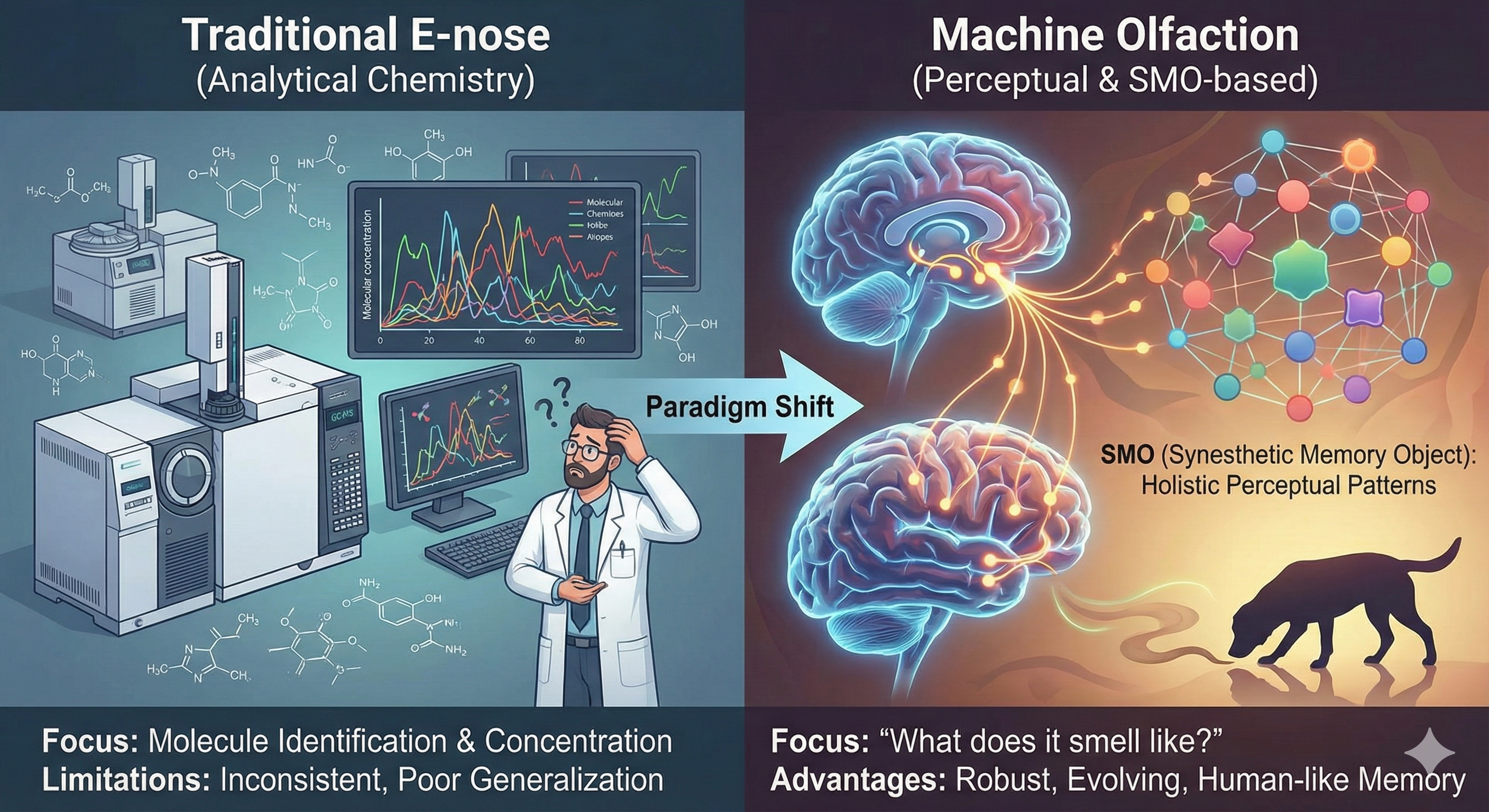
Limitations of traditional approaches
Generative AI–generated image
Conventional electronic nose systems typically rely on analytical chemistry workflows such as GC-MS, producing outputs in the form of:
- Identified molecules
- Concentration values
However, as the patent highlights, this approach faces major challenges:
- Different studies identify different VOC lists
- Results vary significantly with background odors, environment, and sampling location
- Generalization across datasets and institutions is poor
A perceptual shift
This patent reframes the problem entirely:
- ❌ “Which molecules are present, and at what concentration?”
- ✅ “What does this sample smell like?”
Instead of operating in chemical/analytical space, the system operates in perceptual space, closer to how trained canines or biological olfaction function. This shift underpins the entire architecture.
SMO (Synesthetic Memory Object) — The Core Invention
Generative AI–generated image
What is an SMO?
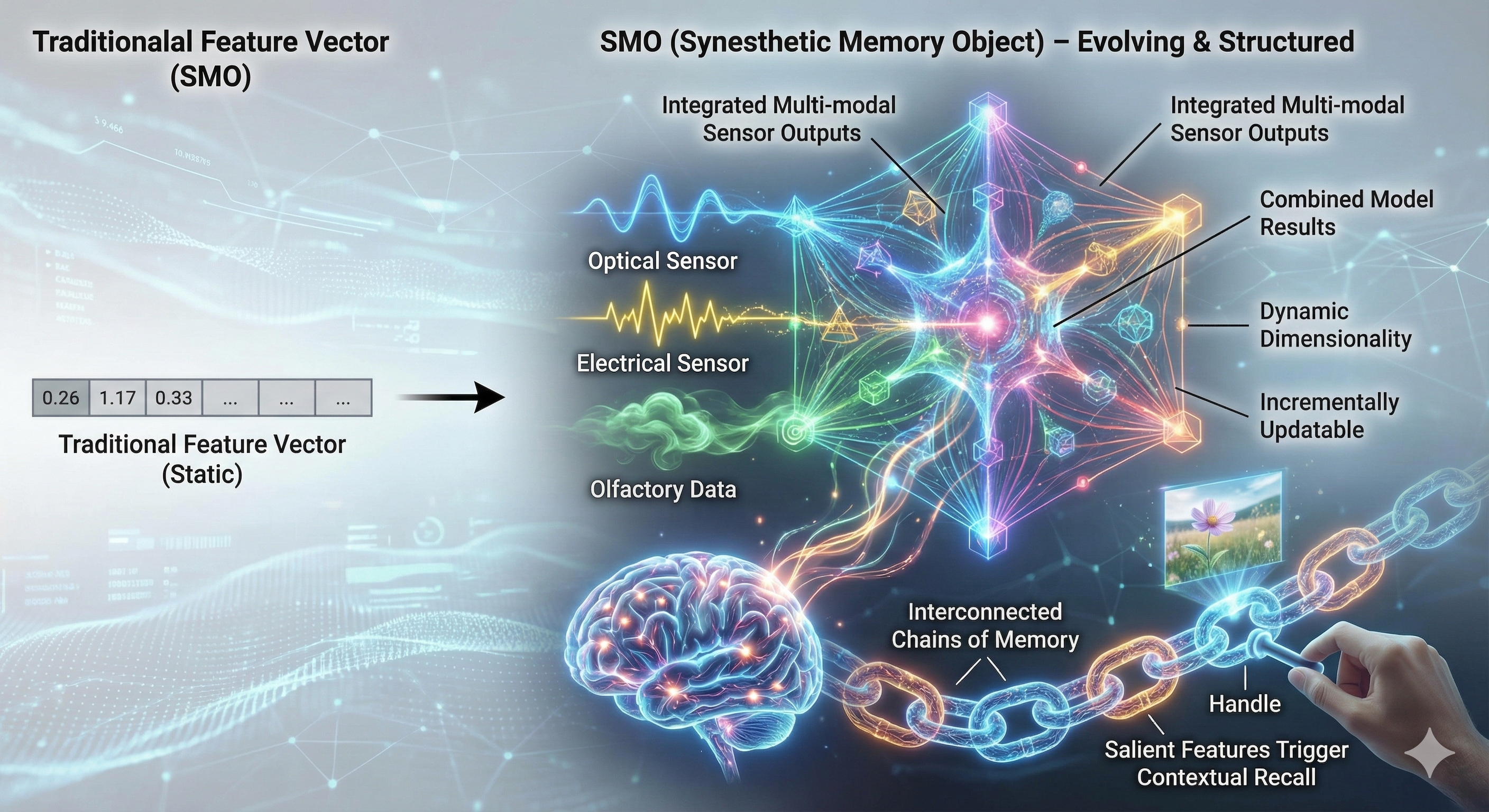
An SMO (Synesthetic Memory Object) is not a simple feature vector. It is a structured, evolvable data object that:
- Integrates outputs from multiple sensor modalities
- Combines results from multiple models and transformations
- Supports dynamic dimensionality and geometry
- Can be updated incrementally as new samples are acquired
A human-memory analogy
The patent likens SMOs to a pile of interconnected chains:
Pulling on a single “handle” activates related links and associated memories.
This allows salient features to trigger contextual recall—previous samples, environmental conditions, and correlated sensor responses—mirroring how biological memory works.
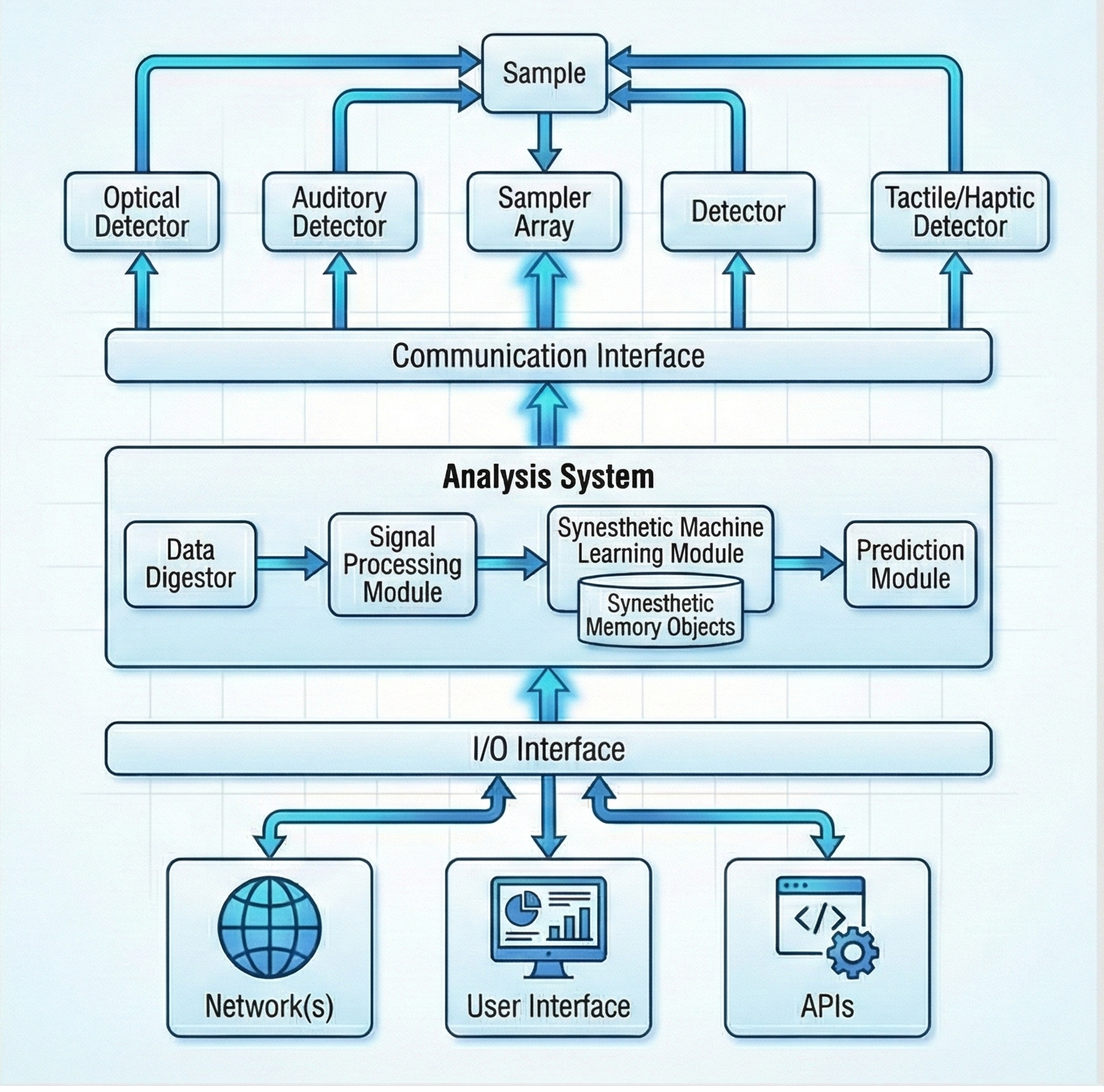
Architecture & Data Flow — A Mechanism-First View
Generative AI–generated image
1) Sensing Layer — Machine Olfaction Device
The example system includes a BioNano E-Nose built around:
- An 8-channel IDA sensor array functionalized with mammalian olfactory receptor proteins
- Dual sensing modalities applied to the same sample:
- MZI (Mach–Zehnder Interferometry) — optical sensing
- FET resistometry — electrical sensing
This multi-modal approach increases information density and robustness.
2) Edge Processing — ESP32 as a Sensor Orchestrator
In this patent, the ESP32 is not just a generic MCU. It acts as a sensor orchestration and data acquisition hub:
- Signal generation using:
- 3.3V DC
- 15 Hz square wave
- 15 Hz sawtooth wave
(implemented via a 555 timer and op-amp circuitry)
- MOSFET switching (BS170) to route excitation signals to sensors
- MUX (74HC4051) to sequentially scan 8 sensor channels
- ADC sampling to digitize conditioned analog signals
In short, the ESP32 coordinates sensor excitation, sampling, and preliminary data handling.
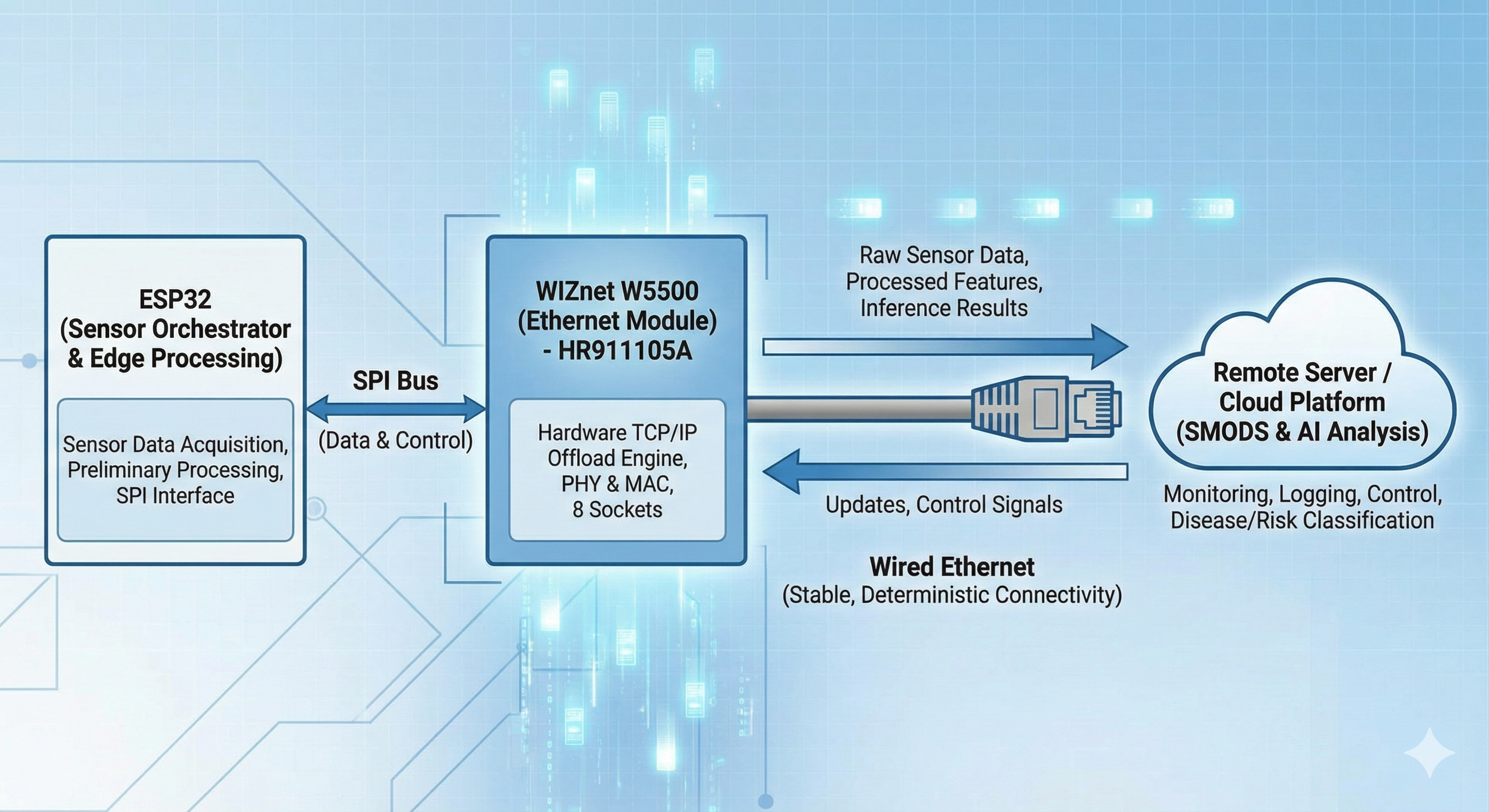
3) Network Layer — The Explicit Role of WIZnet W5500
Generative AI–generated image
Unlike many patents that leave networking abstract, this disclosure explicitly names the networking hardware:
ESP32 communicates via Ethernet using a WIZnet W5500 (HR911105A) Ethernet module.
Role of the W5500 in this system:
- Connected to the ESP32 via SPI
- Provides a wired Ethernet interface for:
- Raw sensor data
- Processed features
- Inference results
- Enables reliable transmission to remote servers or cloud platforms for:
- Monitoring
- Analysis
- Logging
- Control
Why W5500 makes sense in this context:
- Wired Ethernet is often preferred over Wi-Fi in medical, laboratory, and defense environments
- TCP/IP offloading reduces computational burden on the ESP32
- Deterministic and stable connectivity suits regulated and mission-critical deployments
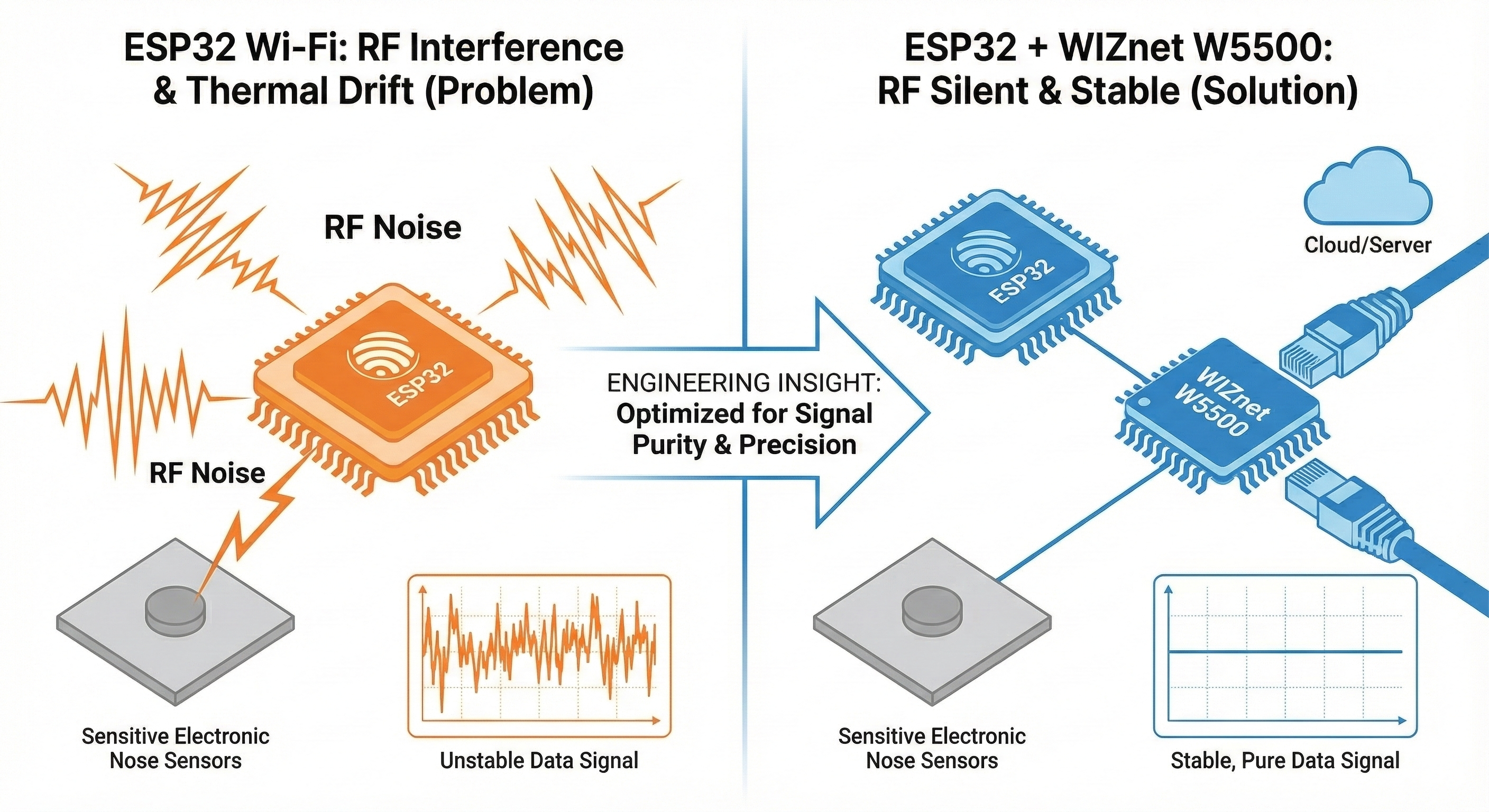
Engineering Insight: Why W5500 instead of ESP32’s Built-in Wi-Fi?
Generative AI–generated image
Developers might ask: "The ESP32 already has built-in Wi-Fi. Why add an external W5500 Ethernet chip?" In the context of high-sensitivity bio-sensing, this is a deliberate design choice, not a redundancy:
- RF Noise Reduction for Analog Sensors: The patent mentions using sensitive FET resistometry and optical sensors. Wi-Fi radios emit powerful RF bursts that can induce noise in these delicate analog signal lines, corrupting the "smell" signature. Using the W5500 allows the system to transmit data without generating local RF interference, ensuring the purity of the sensor data.
- Thermal Stability: Wi-Fi transmission generates heat on the ESP32 die. In bio-sensing, temperature fluctuations can alter sensor calibration. Offloading networking to the W5500 keeps the ESP32 cooler and the sensor environment more stable.
- Consistent Latency: For "Real-Time" olfactory recognition, data packets must arrive in the correct order with minimal jitter. Wired Ethernet provides the deterministic timing that wireless connections often struggle to maintain in crowded environments.
4) Server / Cloud Layer
Once data reaches the backend:
- SMO Databases (SMODS) store and manage perceptual memory objects
- Versioning and auditability are supported through ledger-style mechanisms
- AI models classify:
- Disease risk
- Weapon risk
- Other defined categories
Outputs may trigger:
- Physician or operator alerts
- EHR integration
- Robotic or autonomous system responses
Why This Matters
1) Medical diagnostics
- Enables non-invasive prostate cancer screening
- Supports repeated measurements and longitudinal monitoring through SMO updates
2) Security & defense (dual-use technology)
- Applicable to chemical, biological, and explosive detection
- Suitable for environments unsafe for humans or trained canines
3) Robotics and autonomy
- Electronic olfaction modules deployable on drones and robots
4) A new AI system design paradigm
- Shifts emphasis from model-centric to data-structure-centric learning
- SMOs act as durable, evolvable representations rather than static features
From a WIZnet perspective, this patent represents a concrete industrial example of:
A reliable wired data pipeline connecting sensors, edge intelligence, and cloud-scale AI.
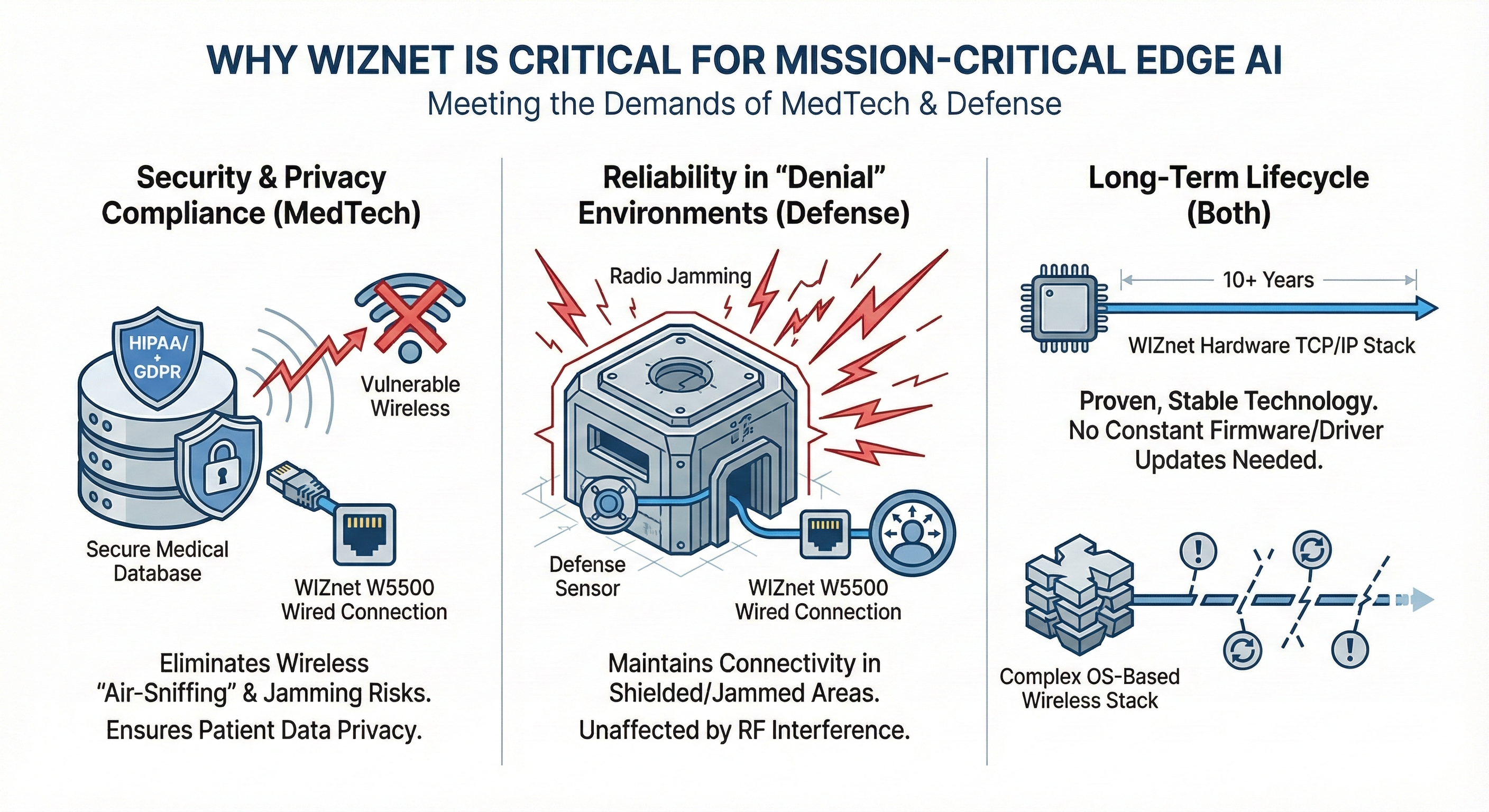
Why WIZnet is Critical for MedTech & Defense
Generative AI–generated image
This patent underscores why WIZnet connectivity is the standard for mission-critical Edge AI:
- Security & Privacy Compliance: In medical applications (like prostate cancer screening), patient data privacy is paramount. Wired connections via W5500 eliminate the attack surface of "air-sniffing" or jamming that affects wireless protocols, making compliance with medical data regulations (like HIPAA/GDPR) easier to achieve.
- Reliability in "Denial" Environments: In defense scenarios (explosive detection), the environment might be inside a shielded bunker or an area with heavy radio jamming. A WIZnet-based wired connection ensures the "electronic nose" keeps reporting data even when wireless signals are blocked or unavailable.
- Long-Term Lifecycle: Medical and defense equipment often operate for 10+ years. WIZnet’s hardware TCP/IP stack is a proven, stable technology that doesn't require constant firmware patches or driver updates to stay connected, unlike complex OS-based wireless stacks.
Quick Notes
- This article summarizes and restructures the patent content; it does not reproduce the original text verbatim.
- A granted patent does not guarantee immediate commercialization—medical and security applications require validation and regulatory approval.
- The WIZnet W5500 is explicitly identified as the core Ethernet communication component in the edge sensing device described in this patent.
Frequently Asked Questions (FAQ)
Q: What makes RealNose’s machine olfaction different from traditional e-noses?
A: Unlike traditional e-noses that analyze specific chemical molecules using mass spectrometry, RealNose uses Synesthetic Memory Objects (SMOs). This technology mimics biological smell by remembering holistic perceptual patterns rather than just identifying chemical lists, allowing for more robust recognition in varying environments.
Q: Why does the system architecture use the WIZnet W5500 Ethernet module?
A: The patent explicitly selects the WIZnet W5500 to ensure stable, deterministic wired connectivity. In critical applications like medical diagnostics and defense, wired Ethernet is preferred over Wi-Fi for its reliability, security, and the ability to offload TCP/IP processing from the main ESP32 controller.
Q: Can this system be used for medical purposes?
A: Yes. One of the primary use cases described in the patent is non-invasive prostate cancer screening via urine analysis. The multi-modal sensor fusion aims to detect disease-specific scent patterns without invasive procedures.
Q: What is the role of the ESP32 in this architecture?
A: The ESP32 acts as the edge sensor orchestrator. It manages signal generation (3.3V excitation), controls sensor array switching via MUX, handles ADC sampling, and communicates data to the server through the WIZnet W5500 interface.
Machine Olfaction과 SMO(Synesthetic Memory Object)로 구현하는 차세대 비침습 센싱 아키텍처
— RealNose Inc.의 PCT 특허 분석 (ESP32 + WIZnet W5500 Ethernet 엣지 구현 포함)
Introduction
본 특허는 **RealNose Inc.**가 출원한 국제특허(PCT) WO2025/259428A1로,
인간·동물의 후각 인지 방식을 모방한 **Machine Olfaction(기계 후각)**과
다중 센서 융합을 위한 새로운 데이터 구조인 **SMO(Synesthetic Memory Object)**를 통해
질병 진단(특히 전립선암)과 보안·방산용 위험물 탐지를 비침습 방식으로 수행하는
엔드투엔드 시스템 아키텍처를 제시합니다.
이 특허의 중요한 특징은 단순한 알고리즘 제안이 아니라,
센서 → 엣지 디바이스(ESP32) → 유선 Ethernet(W5500) → 서버/클라우드 → AI 분류로 이어지는
구현 가능한 시스템 레벨 설계를 명확히 포함한다는 점입니다.
이번에 설명할 특허는 한마디로 말하면,
사람이나 개처럼,
냄새를 맡고 → 기억하고 → 판단하는
인공지능 ‘전자 코(e-nose)’ 기술
Company & Background — RealNose Inc.는 어떤 회사인가
**RealNose Inc. (RealNose.ai)**는
인간·동물의 후각 인지 메커니즘을 기술적으로 재현하는 Machine Olfaction을 핵심 기술로 삼는 기업입니다.
회사가 공식적으로 제시하는 주요 응용 분야는 다음과 같습니다.
의료 진단: 소변·호흡 기반 비침습 암 진단(전립선암이 1차 타깃)
보안·방산: 화학·생물 무기, 폭발물, 마약, 위험물 탐지
국방·치안·로보틱스: 드론·로봇에 탑재 가능한 전자 후각 시스템
산업·제조: 바이오파마/제조 공정의 품질·오염 인라인 모니터링
이번 특허는 단일 알고리즘이 아니라,
센서 하드웨어 설계 + 엣지 처리 구조 + 데이터 구조(SMO) + AI 학습·진화 메커니즘을
하나로 묶은 플랫폼 특허 성격을 갖습니다.
Quick Background — Machine Olfaction이란 무엇인가
기존 접근의 한계
기존 기계 후각 시스템은 보통 다음 방식에 의존해 왔습니다.
GC-MS 등으로 VOC를 **“분자 목록 + 농도”**로 추출
특정 분자를 바이오마커로 매핑
하지만 특허에서 지적하듯,
연구마다 VOC 목록이 다르고
배경 냄새·환경·수집 장소에 따라 결과가 크게 흔들리며
일반화가 거의 되지 않는 문제가 존재합니다.
RealNose의 관점 전환
이 특허는 질문 자체를 바꿉니다.
❌ “이 샘플에 어떤 분자가 얼마 들어있는가?”
✅ “이 샘플은 무엇처럼 냄새 나는가?”
즉, **분석화학적 공간(chemical space)**이 아니라
**인지적 공간(perceptual space)**에서 냄새를 다루는 것이 핵심입니다.
이는 실제 **탐지견(canine olfaction)**이 작동하는 방식과 유사한 접근입니다.
SMO (Synesthetic Memory Object) — 특허의 핵심 발명
SMO의 정의
SMO는 단순한 피처 벡터가 아닙니다.
특허에 따르면 SMO는:
다중 센서(MZI, FET, 광학, 전기, 환경 센서 등)에서 나온 데이터를
여러 모델(PCA, NN, CNN, Transformer 등)로 차원 축소한 결과를 통합해
**차원 수와 구조(geometry)가 동적으로 변하는 ‘기억 객체’**로 표현합니다.
인간 기억에 대한 비유
특허는 SMO를 다음과 같이 비유합니다.
“탁자 위에 쌓인 체인 더미.
하나의 링크(핸들)를 잡아당기면 연결된 모든 기억이 따라온다.”
이 구조 덕분에,
특정 특징(핸들)이 트리거가 되면
과거 샘플, 환경 맥락, 관련 센서 정보가 함께 활성화됩니다.
Architecture & Data Flow — Mechanism-First 접근
1️⃣ 센싱 계층 — Machine Olfaction Device
BioNano E-Nose 기반
포유류 후각 수용체 단백질이 고정된 IDA 센서 어레이(8채널)
동일 샘플을
MZI (Mach–Zehnder Interferometer): 광학 기반
FET Resistometry: 전기 기반
방식으로 동시 측정
2️⃣ 엣지 처리 — ESP32의 역할 (센서 오케스트레이터)
ESP32는 단순 MCU가 아니라 센서 구동과 수집을 총괄하는 제어 노드로 동작합니다.
555 타이머 + 연산 증폭기로
3.3V DC
15Hz Square Wave
15Hz Sawtooth Wave
생성
**MOSFET(BS170)**으로 센서 구동 신호 스위칭
**MUX(74HC4051)**로 8개 센서 출력 순차 샘플링
ADC로 아날로그 신호를 디지털화
즉, ESP32는
“센서 오케스트레이터 + 데이터 수집 노드” 역할을 합니다.
3️⃣ 네트워크 계층 — WIZnet W5500의 정확한 역할
이 특허에서 W5500은 추측이 아니라 명시적으로 등장합니다.
ESP32에 SPI로 연결
센서 데이터 / 특징 데이터 / 분류 결과를
**유선 Ethernet(HR911105A 포함)**으로 서버·클라우드에 전송
W5500의 역할 요약
엣지 디바이스(ESP32)에서 생성된 데이터를
신뢰성 있는 유선 Ethernet 파이프라인으로 외부 분석 시스템에 전달
왜 W5500인가? (특허 맥락 + 설계 논리)
의료·보안 환경에서 Wi-Fi보다 예측 가능하고 안정적
TCP/IP 오프로딩으로 ESP32 연산 부담 감소
병원·연구소·국방 환경에 적합한 네트워크 선택
4️⃣ 서버/클라우드 계층
SMO 데이터베이스(SMODS)
블록체인 기반 버전 관리·감사(ledger) 구조
AI 분류(질병 위험, 무기 위험 등)
결과 활용:
의사/사용자 알림
EHR 연동
로봇·자율 시스템 제어
Why This Matters — 이 특허의 파급력
의료 진단
비침습 전립선암 조기 진단
반복 측정·모니터링에 적합한 SMO 업데이트 구조
보안·방산(듀얼유스)
화학무기·폭발물·마약 탐지
위험 환경에서 인간·동물 대신 사용 가능
로보틱스·자율 시스템
드론·로봇에 탑재 가능한 전자 후각
AI 시스템 설계 관점
“모델 중심”이 아닌 데이터 구조(SMO) 중심 학습이라는 새로운 패러다임
특히 WIZnet 관점에서는,
이 특허를 **“센서–엣지–서버를 잇는 신뢰성 있는 유선 데이터 파이프라인의 실제 산업적 사례”**로 볼 수 있습니다.
Quick Notes
본 큐레이션은 특허 원문을 직접 인용하지 않고 요약·재구성한 내용입니다.
특허는 상용 제품 완성을 의미하지 않으며, 의료·보안 분야는 규제·검증이 필수입니다.
W5500은 본 특허에서 엣지 센싱 장치의 핵심 유선 Ethernet 통신 모듈로 명확히 언급됩니다.