



libogc2
libogc2 by Extrems’ Corner modernizes the GameCube/Wii homebrew SDK, adding lwIP networking and EXI Ethernet support for WIZnet W5500 and W6100/W6300 adapters.
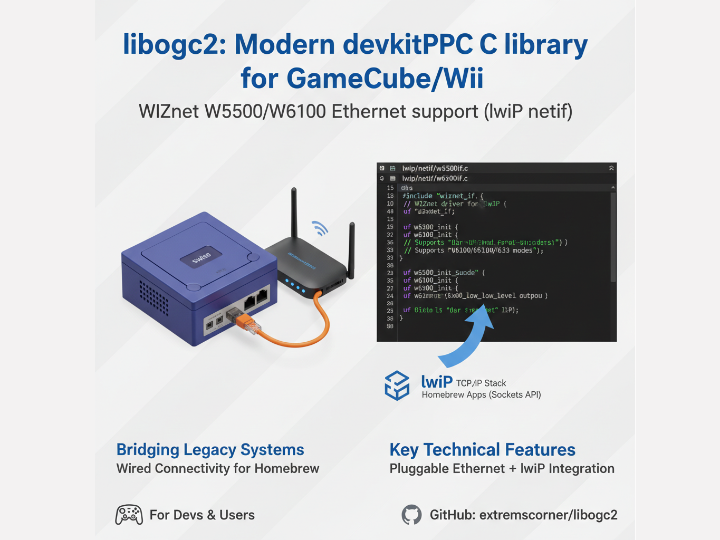
https://www.extremscorner.org/
libogc2: Modern devkitPPC C library for GameCube/Wii — with WIZnet W5500/W6100/W6300 Ethernet adapter support (lwIP netif)
Introduction
libogc2 is a drop-in evolution of the classic libogc toolchain library for Nintendo GameCube and Wii homebrew. The project positions itself as “wide-ranging fixes and additions to most subsystems of libogc,” adds hardware enablement for both new and legacy GameCube accessories, and improves interoperability with Swiss (a widely used GameCube homebrew utility). It remains largely API-compatible with libogc 2.1.0 and earlier, which keeps migration friction low. (GitHub)
What this is
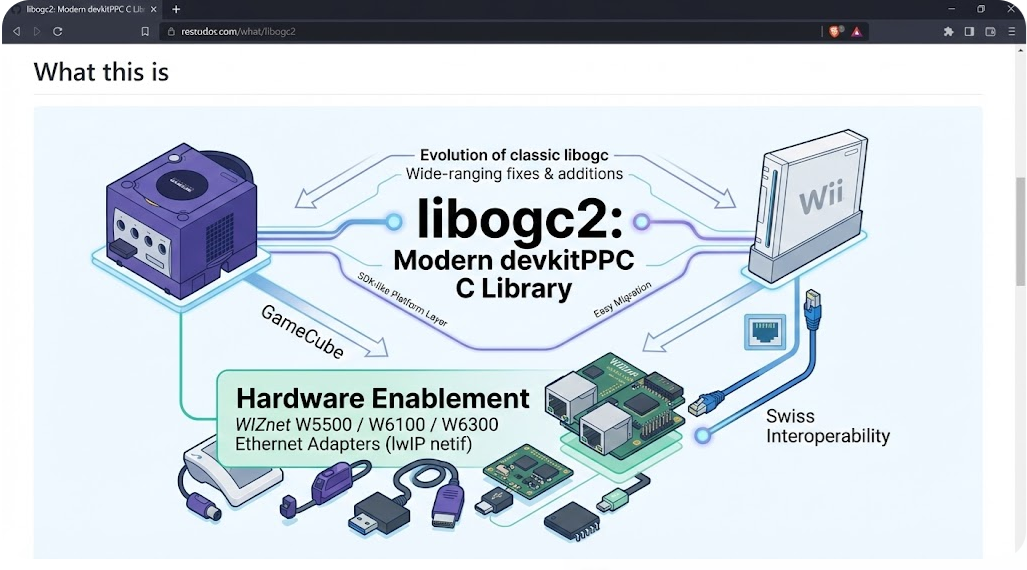
At a practical level, libogc2 is a full platform layer that homebrew apps link against—covering core system services (threads/sync, IO), device access, and optional subsystems. The repository bundles multiple subprojects (e.g., lwIP for networking, controller/input libraries, and other system components), so it behaves more like an integrated SDK than a single-purpose library. (GitHub)
For builders, the project also provides a clear “install → build → migrate” path via package installs, Makefile rules, and CI container usage (detailed below). (GitHub)
Author & Community
libogc2 is maintained by Extrems / Extrems’ Corner.org, a long-running GameCube/Wii homebrew and tooling hub. On the project’s site, Extrems’ Corner lists a sustained track record of shipping and maintaining widely used homebrew software—e.g., Swiss (2012–present), Game Boy Interface (2014–present), Not64 (2011–present), and Enhanced mGBA (2015–present)—alongside other utilities and experiments. (Extrems' Corner.org)
The same site also highlights Extrems’ role in toolchain and SDK development, including devkitRice (a devkitPPC fork), libogc-rice, and libogc2 (2021–present), plus a dedicated libogc2 pacman repository (2024–present) for distribution. (Extrems' Corner.org) This is reinforced by GitHub’s verified organization profile for Extrems’ Corner.org and the visible activity around libogc2 itself. (GitHub)
Beyond software, Extrems’ Corner frames ongoing video/audio quality testing as part of Game Boy Interface’s documentation work and notes participation in Redump preservation (2021–present)—useful context for why libogc2 emphasizes broad hardware enablement and long-term compatibility. The site also links an active Discord community, providing a practical support channel for builders and downstream projects. (Extrems' Corner.org)
How it works
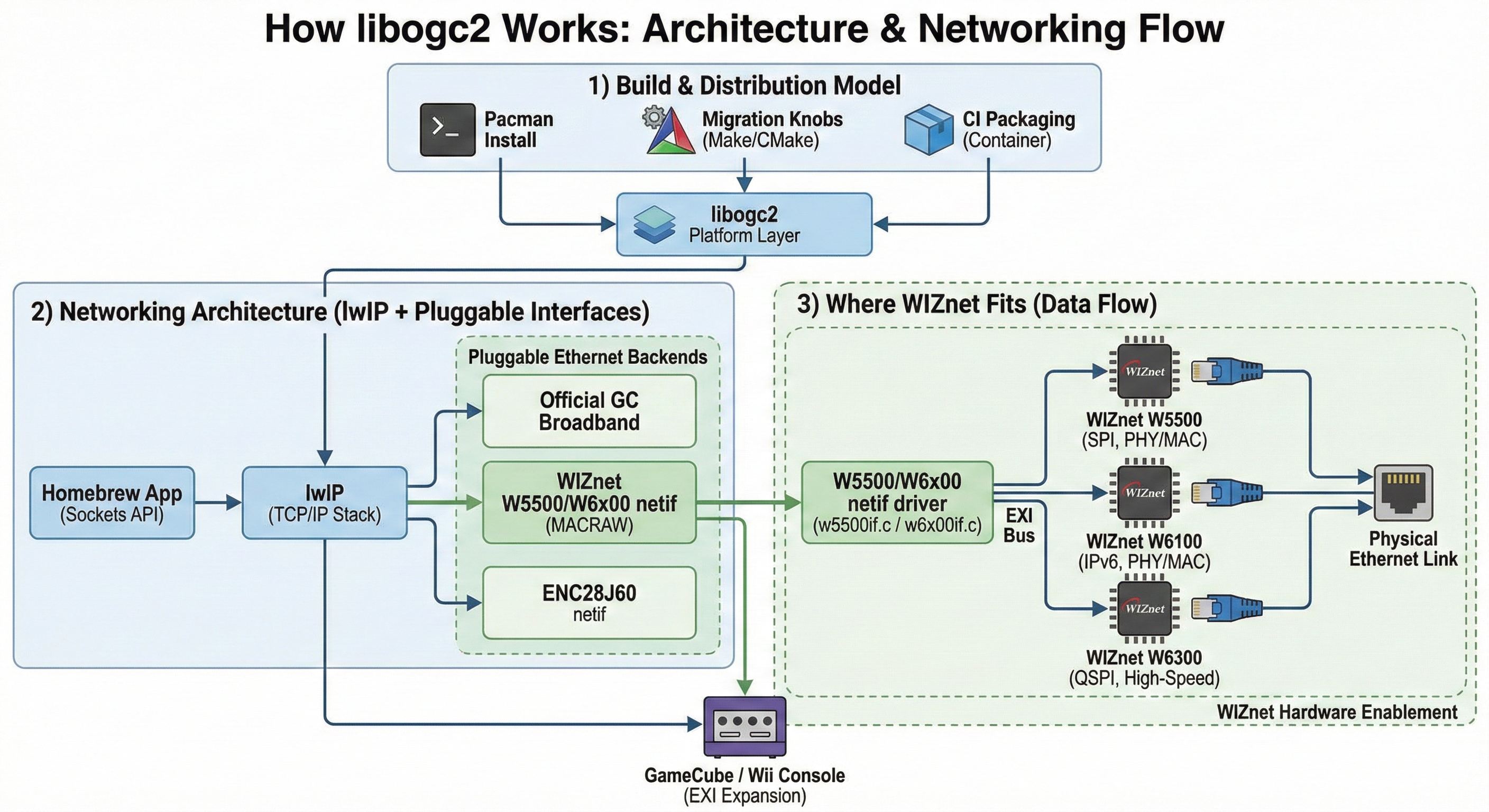
1) Build and distribution model (ready for replication)
libogc2 is designed to be installed like a platform component rather than copied into each project:
- Pacman install (devkitPro-friendly): the README explicitly documents installing
libogc2, plus separate docs and examples packages via pacman. (GitHub) - Migration knobs: it provides concrete include-rule changes for GNU Make projects and a CMake path (including a toggle variable to build against libogc or libogc2). (GitHub)
- CI packaging: it even documents swapping GitHub Actions to a dedicated container image (
ghcr.io/extremscorner/libogc2:latest), which reduces “works on my machine” problems for downstream projects. (GitHub)
One important operational note: the installation flow points to an associated pacman-packages repo. That repo explicitly states these are supplementary packages for devkitPro pacman, and that devkitPro will not provide support for issues caused by those packages (useful context for teams adopting libogc2 in a toolchain). (GitHub)
2) Networking architecture: lwIP + pluggable Ethernet interfaces
This is the part most relevant to WIZnet engineers.
From the ZIP snapshot you attached, libogc2 integrates lwIP and implements a “try the available Ethernet backend” initialization sequence that can attach to multiple hardware paths:
- Official GameCube broadband hardware first
- Then WIZnet W6x00 family adapters
- Then WIZnet W5500 adapters
- Then ENC28J60 adapters
Concretely, the lwIP layer includes:
lwip/netif/w5500if.c(W5500 netif driver)lwip/netif/w6x00if.c(W6x00 netif driver supporting W6100 and W6300 command formats)- EXI device identification that labels certain EXI device IDs as “WIZnet” (and also recognizes ENC28J60)
This means libogc2 is not only a console SDK—it’s also a compatibility layer for third-party Ethernet adapters that talk to the console over the EXI expansion bus, letting homebrew apps use a consistent IP stack and sockets API regardless of which Ethernet adapter is installed.
3) Where WIZnet fits (data flow)
When a WIZnet-based EXI Ethernet adapter is present, the data path is:
- Homebrew application calls the standard networking API (sockets-like model exposed by the SDK).
- lwIP handles IP/ARP/DHCP and packet routing.
- The W5500/W6x00 netif moves raw Ethernet frames to/from the external adapter over EXI.
- The WIZnet chip provides the physical Ethernet link (10/100 PHY/MAC) and stable wired connectivity.
Notably (from the ZIP snapshot), the W5500/W6x00 drivers are built around MACRAW-style operation to integrate with lwIP as a conventional Ethernet interface, rather than using the chip’s TCP/UDP hardware sockets as the primary stack. That keeps one software networking model (lwIP) across multiple adapter types while still benefiting from WIZnet’s robust wired PHY/MAC.
4) WIZnet insight: why W5500 and W6100/W6300 show up here
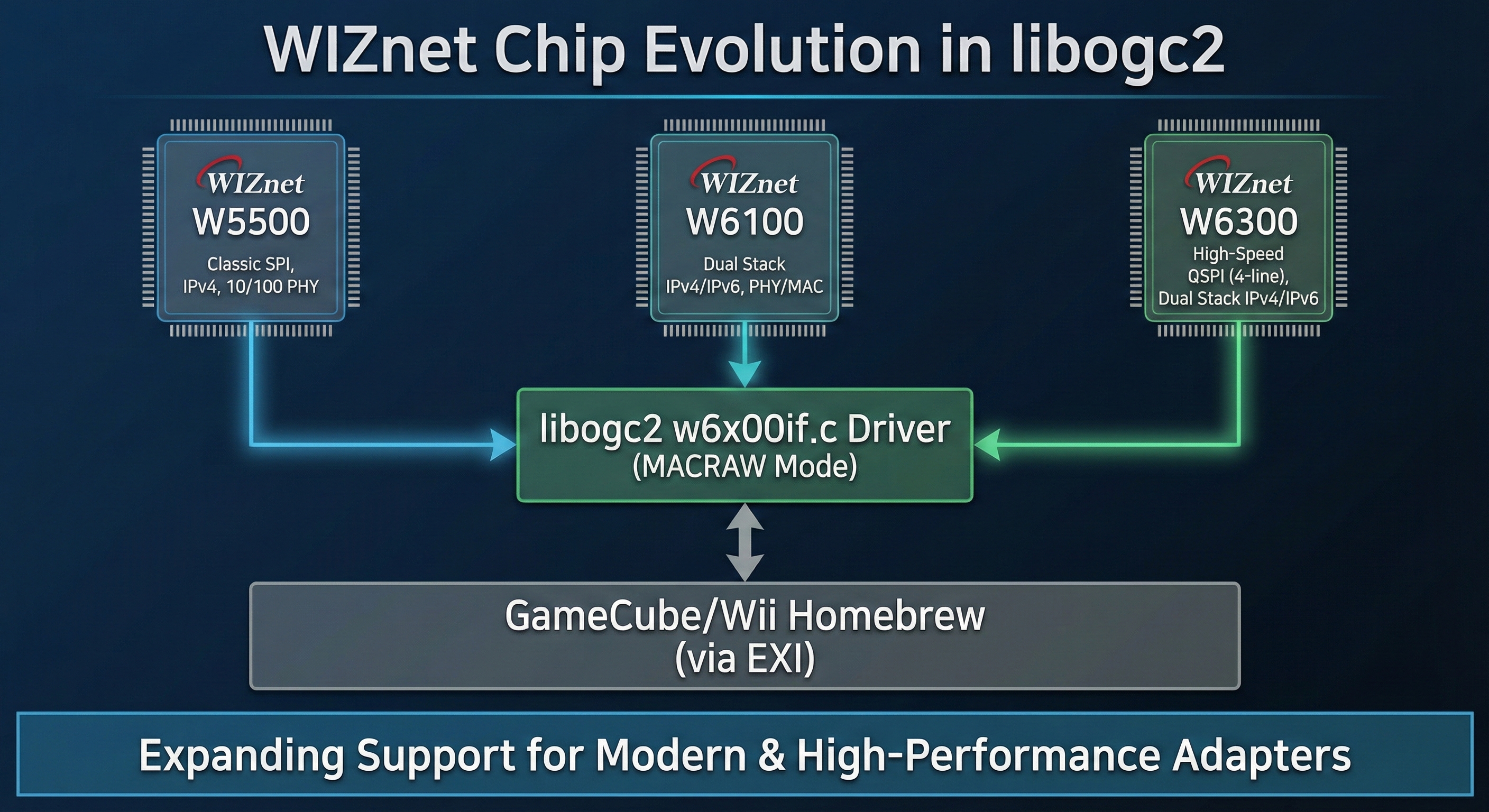
libogc2’s inclusion of both W5500 and W6x00 drivers is interesting because it maps well to how the WIZnet portfolio is used in embedded systems:
- W5500 is positioned as a hardwired Internet controller with integrated TCP/IP stack, 10/100 MAC+PHY, 8 sockets, and 32KB internal memory, commonly connected via SPI. (WIZnet)
- W6100 is WIZnet’s IPv4/IPv6 dual-stack controller (still hardwired TCP/IP), also with 8 sockets and integrated PHY/MAC. (WIZnet)
- W6300 pushes performance with a high-speed design and explicitly advertises QSPI (4 data lines) capability as part of its throughput story, alongside dual IPv4/IPv6 hardware stack. (WIZnet)
In the ZIP snapshot’s w6x00if.c, the driver defines W6100 vs W6300 command handling and includes W6300 “mode” bits associated with QSPI—evidence that libogc2 is being shaped to support not just “classic W5500 modules,” but newer WIZnet adapter designs too.
Why it matters
libogc2’s value isn’t theoretical—it’s already embedded in real deliverables:
- The README lists many downstream applications that build on it (tools, emulators, engines). It also explicitly includes projects tied to sold hardware/products such as FlippyDrive (Crowd Supply) and a commercial title like Xeno Crisis, which is a strong “external value” signal beyond hobby experiments. (GitHub)
- Adoption is helped by the project’s packaging discipline: installation instructions, migration snippets for Make/CMake, and containerized CI guidance reduce integration cost for other repos and teams. (GitHub)
- For WIZnet specifically, this is a non-obvious but valuable reference: it demonstrates how WIZnet Ethernet controllers can serve as drop-in wired networking hardware for a constrained host platform (here, a retro console via EXI), while still fitting into a standard IP stack (lwIP) and sockets programming model.
Reason: (mass-production potential) The presence of a maintained netif layer for W5500 and W6x00 suggests a repeatable pattern for future GameCube Ethernet adapter products, and libogc2 provides the software substrate to make them immediately usable by many homebrew apps. (niche market) Retro console homebrew + hardware modding is a durable niche where “new accessories” keep appearing, and networking adapters are a high-demand category.
Quick notes (caveats and reproducibility)
- Filesystem provider choice: the README discusses choosing a
libogc2-libfatprovider vslibogc2-libdvm, with an explicit note about exFAT legal concerns—useful if you’re distributing binaries or building in conservative environments. (GitHub) - Toolchain support boundary: the linked pacman-packages repo clearly states that devkitPro will not support issues introduced by these supplementary packages; teams should treat it as an alternative toolchain repo and keep rollback steps documented. (GitHub)
- WIZnet adapter behavior depends on hardware: libogc2 provides the netif/EXI recognition and driver hooks, but real-world performance and stability also depend on the specific EXI adapter design (clocking, buffering, IRQ wiring).
References
https://github.com/extremscorner/libogc2
https://github.com/extremscorner/pacman-packages
https://wiznet.io/products/ethernet-chips/w5500
https://wiznet.io/products/ethernet-chips/w6100
https://wiznet.io/products/ethernet-chips/w6300