



LamePod
lamePod combines ESP32-S3, W5500 Ethernet, TAS5805M audio, and an XVF3800 mic array in an early, privacy-focused DIY smart-speaker design.
lamePod: A Privacy-Oriented DIY Smart Speaker Design Built Around ESP32-S3 and W5500
Overview
lamePod was created in response to a gap in the open-hardware ecosystem: there are many individual audio boards, microphones, voice-assistant components, and home-automation projects, but relatively few polished DIY smart speakers that publish the complete enclosure, hardware selection, and firmware.
The project aims to combine:
- Local smart-home control
- Network music and announcements
- Far-field voice input
- User-controlled hardware and firmware
- Addressable status lighting
- A printable enclosure
- Wired Ethernet
- Clear attribution to upstream open-source projects
Its value lies not in being a finished product, but in showing how open audio hardware, local voice processing, ESPHome, and W5500 Ethernet could become a user-controlled smart-speaker platform.
About the Maker
Danielle Stone
Danielle Stone is identified as the author in the lamePod firmware. She is also a Doctoral Candidate in Epidemiology at the University of Michigan School of Public Health. Her academic background includes an M.S. in Computational Epidemiology and Systems Modeling, an M.P.H. in Hospital and Molecular Epidemiology, and undergraduate degrees in Public Health and Human Biology. Her research interests include computational, social, and infectious-disease epidemiology.
Stone’s academic work involves complex systems, modeling, data, and public-health questions. This provides useful context for lamePod’s emphasis on transparent systems, privacy, and user control, although the repository does not claim that the speaker is part of her academic research.
lamePod should therefore be described as:
Danielle Stone’s personal open-source Maker project, not an official University of Michigan research or laboratory project.
The repository also defines a clear contribution policy. Generative AI may be used for proofreading or conversational problem solving, but AI-generated project code is not accepted.
What Is lamePod?
lamePod is an early-stage project for building a privacy-focused DIY smart speaker with open hardware, open firmware, and a printable enclosure.
It is inspired by the functions and appearance of commercial smart speakers such as the Apple HomePod, but it is intended to operate through community-developed components and local smart-home software rather than a fully closed vendor ecosystem.
The planned proof-of-concept combines:
| Function | Planned component |
|---|---|
| Main processing | ESP32-S3 |
| Audio output | Sonocotta Louder ESP32 with TAS5805M |
| Wired network | WIZnet W5500 Ethernet add-on |
| Voice input | Seeed Studio ReSpeaker XVF3800 |
| Speaker | Dayton Audio RS100-4 full-range driver |
| Visual feedback | Addressable RGB lighting |
| Smart-home software | ESPHome and Home Assistant |
| Network playback | Sendspin and HTTP audio |
| Mechanical design | Three-part 3D-printed enclosure |
| Main power | 24V external supply |
The intended device would support music playback, spoken announcements, voice input, Home Assistant control, visual feedback, and firmware maintenance over a local network.
In practical terms:
lamePod is an attempt to turn an open ESP32 audio board, a far-field microphone array, and W5500 Ethernet into a locally controlled smart speaker.
How lamePod Is Intended to Work
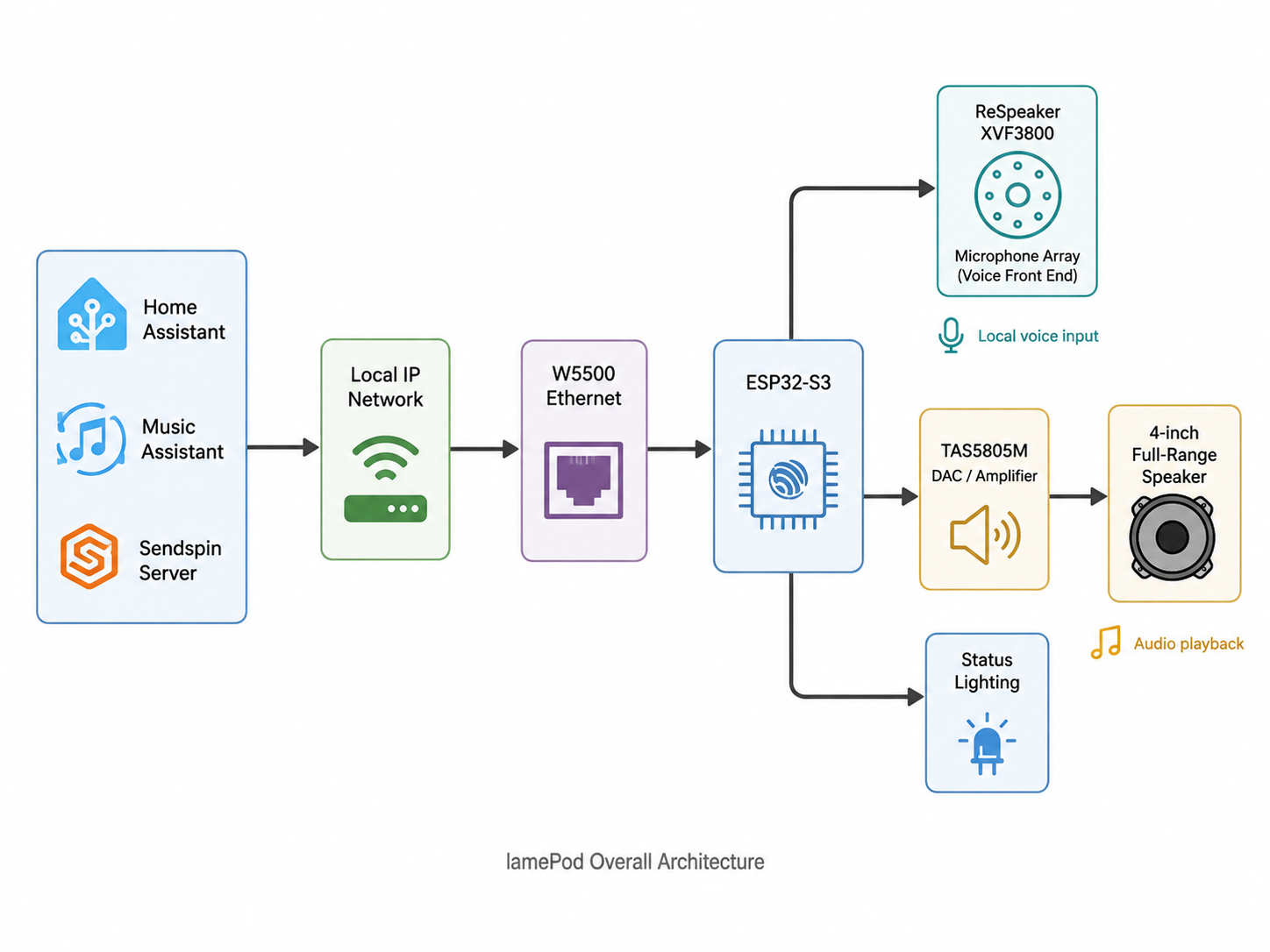
Home Assistant / Music Assistant
               │
               │ Local Network
               ▼
          W5500 Ethernet
               │
               ▼
            ESP32-S3
     ┌─────────┼──────────┐
     ▼         ▼          ▼
XVF3800     TAS5805M    Status LEDs
Microphones  DAC / Amp
     │         │
 Voice Input   ▼
          Full-Range Speaker
The ESP32-S3 is intended to coordinate networking, media playback, microphone input, smart-home communication, and status feedback.
The TAS5805M provides the amplified speaker output and supports volume, mixing, equalization, and fault monitoring. The upstream Sonocotta Louder ESP32 hardware combines the ESP32-S3 and TAS5805M in an open audio-development platform that also supports an optional W5500 Ethernet module. Github
The ReSpeaker XVF3800 provides a circular four-microphone array with acoustic echo cancellation, beamforming, direction-of-arrival detection, voice-activity detection, noise suppression, and processed I²S audio for an embedded host. It also includes 12 addressable RGB LEDs and a physical microphone-mute control. Seed Studio
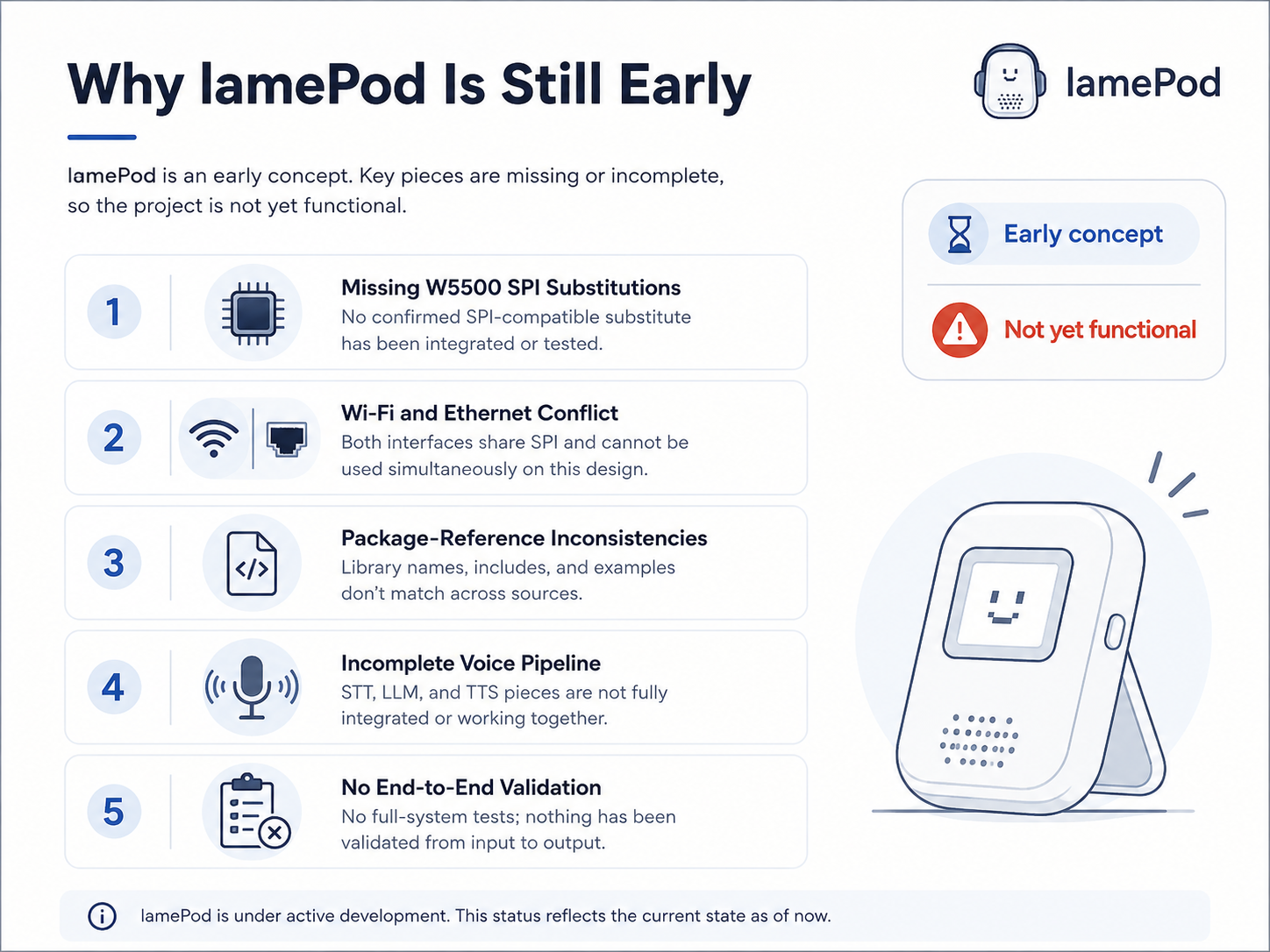
The public lamePod repository defines the hardware direction, but it does not yet demonstrate a complete wake-word, voice-assistant, playback, and echo-cancellation workflow.
Role of the WIZnet W5500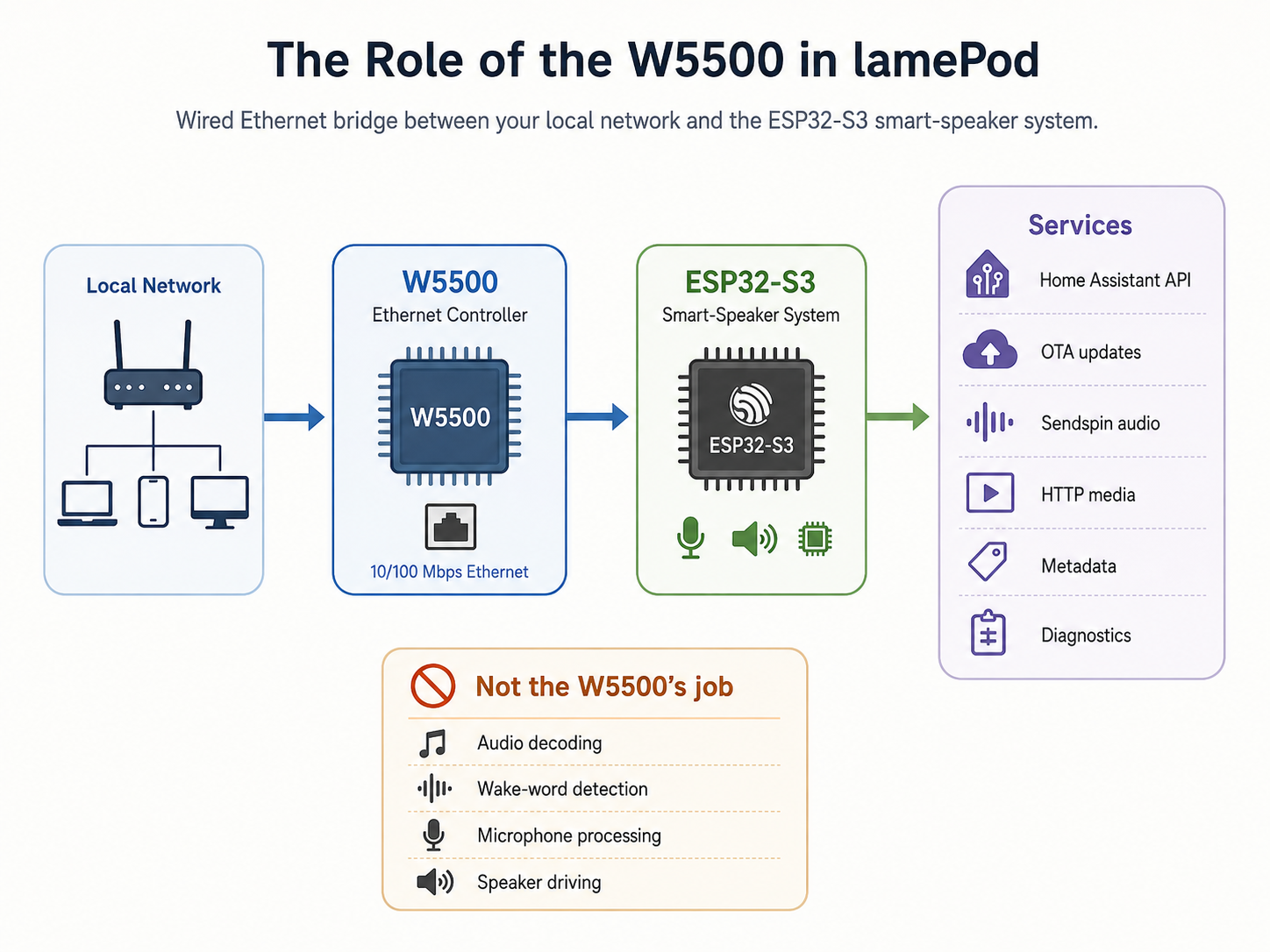
The source explicitly selects the W5500 as the project’s Ethernet interface.
ethernet:
  type: W5500
The W5500 connects to the ESP32-S3 through SPI and is intended to provide lamePod’s wired connection to the local network.
Once the firmware is corrected and validated, this Ethernet path could carry:
- Sendspin synchronized audio
- HTTP music and announcements
- Home Assistant commands and device states
- ESPHome API traffic
- Track metadata
- Device discovery
- OTA firmware updates
- Diagnostics and logging
This makes Ethernet more than a setup or maintenance port. It is intended to serve as the shared transport for continuous media, smart-home control, and device management.
The W5500 does not decode audio, perform microphone beamforming, run wake-word detection, or drive the speaker. Those functions remain with the ESP32-S3, XVF3800, TAS5805M, and ESPHome audio pipeline.
The clearest WIZnet message is:
W5500 is intended to provide the wired network path shared by lamePod’s audio, smart-home control, and maintenance services.
Current Status and Limitations
The repository contains meaningful early design work, but it is not yet a reproducible finished device.
What Is Public
- Hardware selection
- W5500 ESPHome configuration
- Audio-output configuration
- Microphone and I²S planning
- Sendspin and HTTP media packages
- TAS5805M control and fault monitoring
- Status-lighting code
- Three preliminary enclosure files
- Apache 2.0 licensing
What Is Still Missing
- A successful complete firmware build
- A working physical prototype
- A final wiring diagram
- A complete bill of materials
- A finished enclosure and assembly guide
- A demonstrated voice-assistant pipeline
- Ethernet audio-streaming results
- Acoustic and thermal measurements
- Long-duration operation
- Privacy and security validation
Three source-level limitations are especially important.
Incomplete Ethernet Pin Configuration
The Ethernet package expects SPI clock, MOSI, and MISO substitutions, but those substitutions are not defined in the reviewed main.yaml. The upstream Sonocotta documentation supplies likely board values, but they still need to be incorporated and tested in lamePod itself.
Wi-Fi and Ethernet Conflict
The draft configuration declares both Wi-Fi and W5500 Ethernet. Current ESPHome documentation states that its Wi-Fi and Ethernet components cannot be used simultaneously in the same configuration. lamePod will therefore need separate network variants or a revised configuration strategy.
Inconsistent Package References
Several package names referenced by main.yaml do not match the filenames in the supplied archive. The configuration must be cleaned up before it can serve as a reproducible release.
Privacy should also be treated as a project goal rather than a verified property. The repository does not yet publish a threat model, network-isolation guide, outbound-traffic analysis, API-encryption configuration, or local-only acceptance test.
Why This Project Matters to WIZnet
A Wired Smart-Speaker Application
Most consumer smart speakers rely on Wi-Fi. A fixed W5500-based speaker could be relevant where wired infrastructure is preferred or wireless quality is inconsistent.
Potential applications include:
- Home Assistant voice endpoints
- Wired multi-room speakers
- Offices and meeting rooms
- Schools and laboratories
- Hotels and managed residences
- Local announcement systems
- Privacy-oriented home automation
lamePod has not yet proved that Ethernet improves its streaming performance, but it provides a practical platform for testing that question.
One Interface for Several Services
The planned W5500 interface would carry both continuous and administrative traffic:
Music and Announcements
Home Assistant Control
Metadata and Status
OTA and Diagnostics
            │
            ▼
       W5500 Ethernet
This is more strategically valuable than using Ethernet only for configuration.
A Missing W5500–ESPHome Reference
Most of the required building blocks already exist:
- W5500 support in ESPHome
- Sonocotta network-audio hardware
- TAS5805M audio control
- Sendspin synchronized playback
- ReSpeaker voice processing
- Home Assistant integration
What is missing is one polished, tested reference that combines them.
A useful WIZnet-supported follow-up could provide:
- Correct W5500 pin configuration
- A validated Ethernet-only firmware
- Fixed dependency versions
- Home Assistant onboarding
- Sendspin playback testing
- Simultaneous microphone and speaker testing
- Network latency and dropout measurements
- OTA and recovery instructions
- Security guidance
Future PoE Potential
The current concept uses separate power and Ethernet connections.
A later design could investigate PoE as a one-cable installation method, provided that the power stage is designed for the amplifier’s startup current, peak output, conversion efficiency, and thermal requirements.
PoE is a possible extension, not a current lamePod feature.
Related WIZnet Maker Projects
Satellite1 PoE SHOE
Satellite1 PoE SHOE adds W5500 Ethernet and a PoE-oriented power path to an ESP32-S3 Home Assistant voice-assistant platform. Its published development architecture includes voice data, sensors, ESPHome, Home Assistant, and wired networking. (WIZnet Makers)
Difference from lamePod
| Satellite1 PoE SHOE | lamePod |
|---|---|
| Voice-satellite and multisensor focus | Voice plus higher-power music playback |
| PoE-oriented installation | Separate 24V supply and Ethernet |
| Established voice-assistant hardware | Early personal integration project |
| Voice endpoint first | Smart-speaker and network-audio concept |
| Active Ethernet feature development | Incomplete Ethernet configuration |
Louder ESP32 Plus
Louder ESP32 Plus belongs to the Sonocotta hardware ecosystem used as lamePod’s foundation. It combines ESP32 audio processing, TAS58xx amplification, PSRAM, and optional W5500 connectivity. (WIZnet Makers)
Difference from lamePod
- Louder ESP32 is a reusable audio-development board.
- lamePod attempts to turn the board into a complete smart speaker.
- lamePod adds a far-field microphone, enclosure, status interaction, and privacy-oriented project identity.
- Louder ESP32 supports multiple firmware ecosystems beyond lamePod’s ESPHome configuration.
Louder ESPHome Sendspin
Louder ESPHome Sendspin combines a Sonocotta ESP32-S3 audio board, W5500, ESPHome, Sendspin, I²S audio, TAS5805M playback, and media metadata. It is the closest existing reference to lamePod’s planned network-audio path. (WIZnet Makers)
Difference from lamePod
- The Sendspin project focuses on network playback.
- lamePod adds a far-field microphone and voice-assistant objective.
- lamePod proposes a custom consumer-style enclosure.
- lamePod’s public configuration is currently less complete and less validated.
Comparison at a Glance
| Project | Primary function | WIZnet role | Difference from lamePod |
|---|---|---|---|
| Satellite1 PoE SHOE | Home Assistant voice satellite | W5500 Ethernet and PoE path | Voice-first installation platform |
| Louder ESP32 Plus | Open ESP32 audio hardware | Optional W5500 interface | Hardware platform rather than complete speaker |
| Louder ESPHome Sendspin | Synchronized network audio | W5500 audio and control transport | Playback-focused and more developed |
| lamePod | Privacy-oriented DIY smart speaker | Planned wired audio, control, and maintenance interface | Voice, music, enclosure, and FOSS philosophy combined |
Potential Application Directions
If completed and validated, lamePod could support several application categories.
Local Voice Assistants
- Home Assistant voice endpoints
- Room-level automation
- Local timers and announcements
- Privacy-conscious voice control
- Replaceable voice hardware
Multi-Room Audio
- Sendspin synchronized playback
- Whole-home announcements
- Wired zone speakers
- Classroom and office audio
- Small commercial background-music systems
Open Smart-Home Hardware
- Repairable smart speakers
- User-selectable microphones and amplifiers
- Hardware independent of a single cloud vendor
- Community-developed enclosures
- Long-term firmware maintainability
Education and Prototyping
- ESPHome audio development
- I²S input and output
- W5500 networking
- Acoustic echo cancellation
- Network-audio buffering
- Local voice-assistant design
- 3D-printed acoustic enclosures
These are potential applications, not current validated deployments.
Connecting with the Maker
A focused interview with Danielle Stone could clarify the project’s next stage:
- Has the first physical prototype been assembled?
- Does the current ESPHome configuration compile?
- Will Ethernet and Wi-Fi be released as separate firmware variants?
- Which final LED arrangement will be used?
- Will the first design remain a single full-range speaker?
- Which wake-word and Home Assistant voice pipeline is planned?
- How will physical microphone mute be verified?
- Will voice processing remain local?
- Will Ethernet-versus-Wi-Fi streaming measurements be published?
- Is a PoE version being considered?
Because lamePod builds directly on Sonocotta hardware, a joint discussion with Stone and Sonocotta could also help distinguish upstream board capabilities from lamePod-specific design work.
Conclusion
lamePod is an early attempt to build an open, privacy-focused smart speaker using:
- ESP32-S3
- TAS5805M audio hardware
- ReSpeaker XVF3800 microphones
- ESPHome and Home Assistant
- Sendspin network audio
- WIZnet W5500 Ethernet
- A printable enclosure
Its defining idea is the use of a single wired network interface for both media and smart-home communication.
The project is not yet a finished WIZnet design win. Its firmware contains unresolved configuration issues, and no complete prototype or end-to-end validation has been published.
The most accurate description is:
lamePod is a promising open smart-speaker architecture that places W5500 at the center of its wired audio and control path, but it still requires firmware repair, physical integration, and practical validation.
Its strongest value to WIZnet is the opportunity to develop a verified reference for W5500, ESPHome, Sendspin, local voice processing, and open smart-home audio.
FAQ
Q. Is lamePod currently functional?
A. No. The repository explicitly describes it as an early, non-functional project.
Q. Is W5500 actually included in the design?
A. Yes. The ESPHome Ethernet package explicitly selects W5500 over SPI.
Q. What would W5500 carry?
A. The intended traffic includes Sendspin audio, Home Assistant control, ESPHome API data, announcements, OTA updates, and diagnostics.
Q. Can Ethernet and Wi-Fi operate together in the current firmware?
A. Not through the standard ESPHome configuration used here. Separate or revised firmware variants are required.
Q. Is lamePod an official University of Michigan project?
A. No. Danielle Stone is a University of Michigan epidemiology researcher, but lamePod is presented as her personal open-source Maker project.
Source Snapshot
| Item | Reviewed information |
|---|---|
| Original repository | danni-storm/lamePod |
| Reviewed branch | main |
| Reviewed revision | e5476110add4573c61e7cda16310fa24c78d33fd |
| Latest reviewed commit | add lighting effect code — May 17, 2026 |
| Review date | August 3, 2026 |
| Project author | Danielle Stone, M.S., M.P.H. |
| Author location | United States |
| Academic affiliation | University of Michigan School of Public Health |
| Academic role | Doctoral Candidate in Epidemiology |
| Project operation | Personal open-source Maker project |
| Project type | Open-source DIY smart-speaker concept |
| Main controller | ESP32-S3 |
| WIZnet product | W5500 |
| Ethernet hardware | Sonocotta-compatible W5500 Ethernet add-on |
| Audio board | Sonocotta Louder ESP32-S3 |
| DAC and amplifier | TAS5805M |
| Microphone array | Seeed Studio ReSpeaker XVF3800 |
| Planned speaker | Dayton Audio RS100-4, 4-inch full-range driver |
| Main framework | ESPHome with ESP-IDF |
| Network-audio software | Sendspin and HTTP media sources |
| Repository license | Apache License 2.0 |
| Current maturity | Early concept, explicitly non-functional and untested |
The repository describes lamePod as an attempt to create a polished, open alternative to commercial smart speakers using ESPHome, FOSS software, open hardware, and a printable chassis. The same README explicitly warns that the project remains in its infancy and is not functional. It must therefore be presented as an early architecture and development repository rather than a completed speaker or validated construction guide.
The reviewed source archive contains ESPHome configuration packages, three preliminary STL enclosure parts, a hardware overview, and an Apache 2.0 license. The commit introducing the initial ESPHome implementation described it as untested and published for reference.
Source and license note: This article independently summarizes and analyzes the repository. The repository is published under Apache License 2.0, which permits reuse and modification under its stated conditions, including preservation of applicable notices. The license does not grant unrestricted trademark rights, and externally referenced hardware, audio assets, and upstream software may carry separate licenses.