



Haven: A W5500 Art-Net Lighting Network for a 100-Foot Interactive Sculpture
Flaming Lotus Girls’ Haven uses distributed W5500-EVB-Pico lighting nodes and Embedded Rust to deliver Art-Net lighting across a 100-foot interactive sculpture
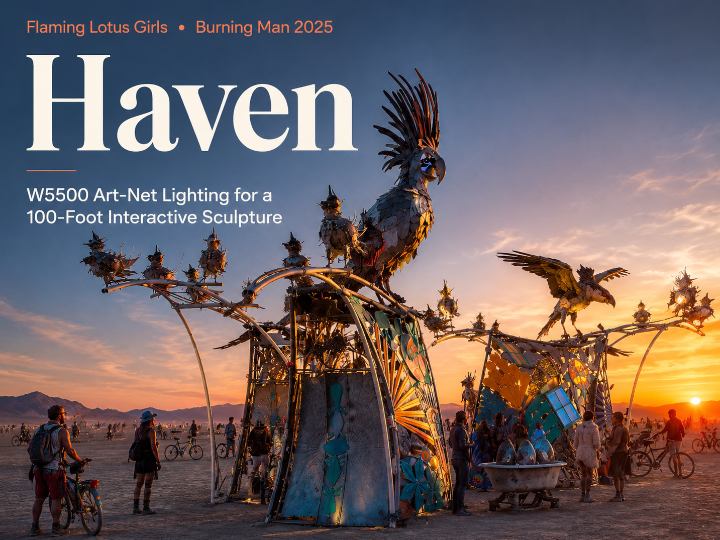
Thumbnail Image: AI-Generated Image
Overview
Haven is a large interactive fire sculpture created by the San Francisco-based art collective Flaming Lotus Girls.
At the center of the installation is a giant nest containing several eggs, surrounded by bird sculptures of different sizes and forms. The birds combine flame, movement, lighting, and audience interaction, while the nest includes non-flame lighting, seating, and an immersive soundscape.
According to the official project page, Haven measures approximately 100 feet in diameter, not 100 feet in height. The complete installation was presented at Burning Man in Black Rock City in 2025. Maker Faire Bay Area and Burning Man Decompression hosted a partial configuration consisting of the Cockatoo and one section of the nest.
The public GitHub repository contains software supporting Haven’s lighting, audience interaction, scene control, and selected flame-related subsystems. The component most directly connected to WIZnet is the led_node firmware.
Each LED node receives Art-Net lighting data over wired Ethernet and drives addressable LEDs installed throughout Haven’s birds, nest, eggs, and interior spaces. This makes the repository more than a W5500 or LED demonstration: it contains a distributed network-lighting implementation developed for a physical, large-scale public artwork.
The W5500 does not directly operate Haven’s flames or mechanical movement. Its verified role is within the distributed Art-Net LED lighting path.
About the Maker
Flaming Lotus Girls
Flaming Lotus Girls, or FLG, is a women-led, volunteer-based art collective based in San Francisco.
According to its official profile, the group began in 2000 with six women and two men. More than 200 people have since participated in its projects. Although women make up the majority of its members, the collective welcomes participants of all genders.
FLG develops large-scale interactive metal and fire artworks through regular meetings, collaborative design, technical workshops, and project-based teams. New participants do not need previous metalworking or fire-art experience. The organization provides a hands-on environment in which members can learn fabrication, electronics, project management, and leadership.
Its sculptures combine materials such as steel, copper, aluminum, glass, resin, and wood with flame, movement, lighting, sound, and physical interaction. Audience members are often invited to activate part of the installation through buttons, mechanical controls, or other interfaces.
Haven was introduced by the Burning Man Journal as Flaming Lotus Girls’ 19th Burning Man Honoraria installation. The article describes the work as a nest that welcomes visitors inside and allows them to participate in the fire effects of the surrounding birds.
Collaborative Development
Haven is not the work of a single artist or embedded developer. It is a collaborative system created by teams responsible for metal fabrication, flame effects, lighting, interaction, audio, software, and installation.
The BirdBath documentation, for example, states that its valve technology is based on LightCurve, developed by Sam Cooler and Sequoia Alexander. It also credits Carolyn Wales and Brian Bulkowski with the control software, pattern system, and Web UI.
This collaborative structure is important when describing Haven. It is not an isolated prototype produced by one developer, but a field-deployed system created by an experienced art collective with multiple technical disciplines.
Flaming Lotus Girls also operates open meetings and workshops for new participants and accepts inquiries concerning installations and event bookings. Its published experience ranges from small gatherings to major public events and from short performances to longer-term installations.

-Facebook-

-Instagram-

-X(Twitter)-
What Is Haven?
Haven is built around the story of enormous birds constructing a nest from industrial material and discarded objects left behind by humans.
The nest incorporates steel tube, sheet metal, chain-link fencing, windows, and reclaimed materials. Large birds are constructed from welded steel, while smaller birds use laser-cut wood. Selected birds produce flame or movement, and lighting elements respond throughout the sculpture. The eggs at the center of the nest form part of the installation’s central visual sequence through movement, light, and colored flame effects.
The official exhibition history includes:
| Event | Confirmed exhibition scope |
|---|---|
| Burning Man, Black Rock City — 2025 | Full 100-foot-diameter Haven installation |
| Maker Faire Bay Area — 2025 | Cockatoo and one section of the nest |
| Burning Man Decompression, Oakland — 2025 | Cockatoo and one section of the nest |
| Lawrence Hall of Science Spring Break — 2026 | Haven-related engineering and interactive-art exhibition |
| unSCruz — 2026 | Scheduled participant-interactive Haven flame show |
The Lawrence Hall of Science presented Haven as an opportunity to explore the engineering behind metal, fuel systems, sensors, and public art. This demonstrates how the project has been used not only as a festival installation, but also as an educational experience connecting art and engineering.
Project at a Glance
| Item | Publicly documented information |
|---|---|
| Project | Haven |
| Maker | Flaming Lotus Girls |
| Location | San Francisco Bay Area, California |
| Content type | UCC / Interactive Fire and Light Installation |
| Original installation | Burning Man 2025 |
| Overall size | Approximately 100 feet in diameter |
| WIZnet hardware | W5500-EVB-Pico family / W5500 |
| LED-node MCU | RP2040 |
| LED-node language | Embedded Rust |
| Lighting protocol | Art-Net over UDP |
| Network interface | Wired Ethernet |
| LED generation | RP2040 PIO + DMA |
| Repository license | MIT |
| LED-node package license | MIT OR Apache-2.0 |
| Public status | A field-deployed installation supported by an actively maintained repository |
The root repository is licensed under MIT, while the led_node Rust package declares MIT OR Apache-2.0.
Core Components
Hardware
| Component | Role |
|---|---|
| W5500-EVB-Pico family | Distributed LED node combining RP2040 and W5500 |
| W5500 | Wired Ethernet MAC, PHY, and raw-frame interface |
| RP2040 | Network application, Art-Net mapping, and LED control |
| Ethernet switch or direct Ethernet connection | Connects the Art-Net source to distributed nodes |
| Addressable LED strips and fixtures | Illuminate Haven’s birds, nest, eggs, and interior spaces |
| Show-control host | Transmits Art-Net scenes and DMX universes |
| UART debug interface | Provides local diagnostics and network-status output |
The W5500 signal mapping in the firmware matches the W5500-EVB-Pico internal connection: GPIO 16 through GPIO 21 are used for MISO, chip select, clock, MOSI, reset, and interrupt. A repository commit also explicitly refers to changes made for programming w5500-evb-picos.
Software
| Component | Role |
|---|---|
| Rust 2021 | LED-node firmware |
| Embassy Executor | Asynchronous task execution |
embassy-rp | RP2040 hardware abstraction |
embassy-net | IPv4 and UDP software networking |
embassy-net-wiznet | W5500 MACRAW Ethernet driver |
tiny-artnet | Art-Net packet parsing |
smart-leds | Pixel-data representation |
| RP2040 PIO + DMA | Timing-sensitive addressable LED output |
The led_node/Cargo.toml file explicitly includes RP2040 support, the Embassy networking stack, the WIZnet driver, and the Art-Net parser.
System Architecture
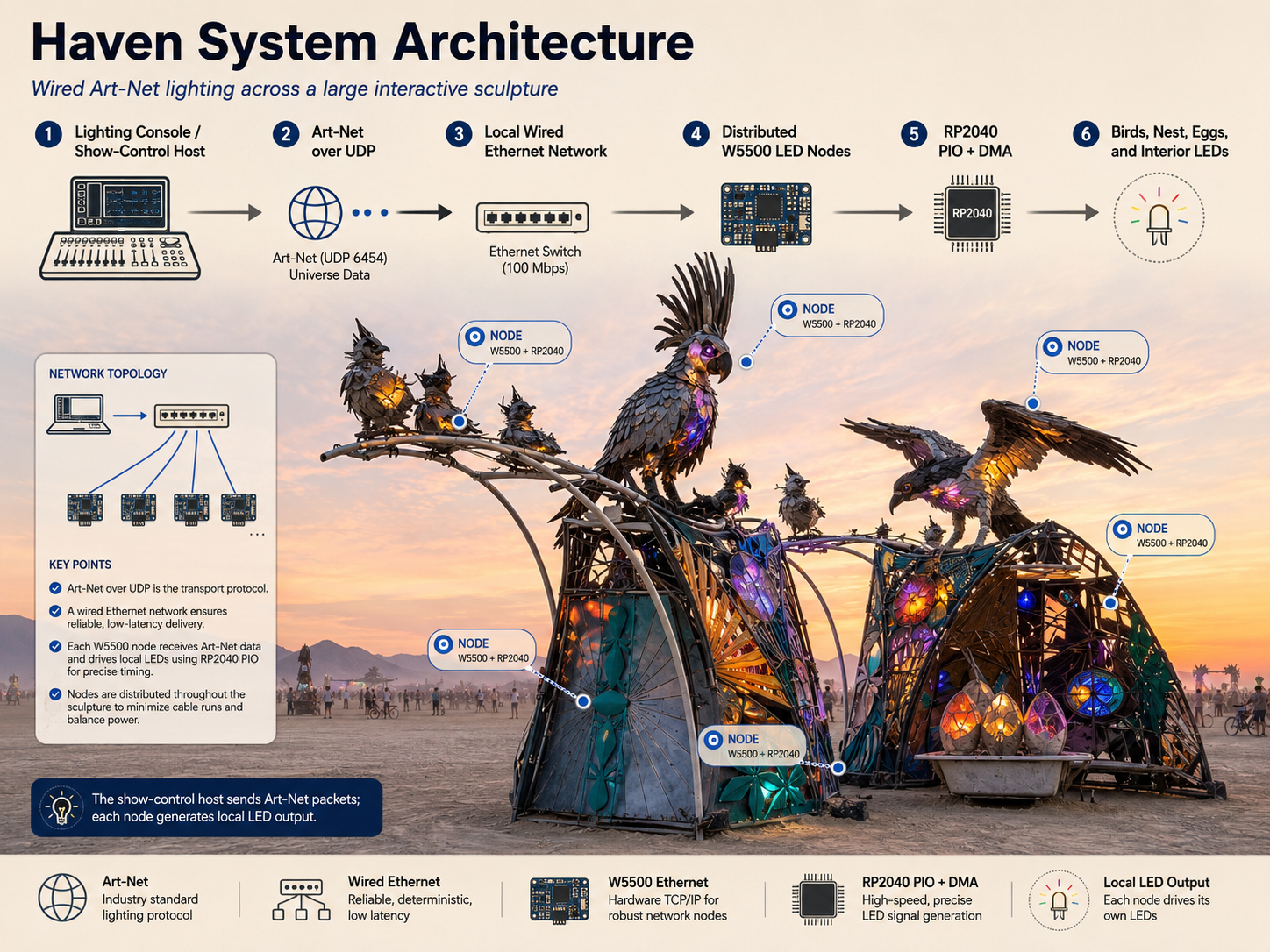
Wired Art-Net Lighting Path
Lighting Console / Show-Control Host
                 │
                 │ Art-Net over UDP
                 │ Wired Ethernet
                 ▼
        Local Ethernet Network
                 │
       ┌─────────┼──────────┐
       ▼         ▼          ▼
  W5500 Node  W5500 Node  W5500 Node ...
     RP2040      RP2040       RP2040
       │           │            │
   PIO + DMA   PIO + DMA    PIO + DMA
       │           │            │
 Sculpture LEDs  Sculpture LEDs  Sculpture LEDs
The central show-control system does not generate electrical LED waveforms for the entire installation directly. Instead, it transmits Art-Net packets across the local Ethernet network.
Each W5500-equipped node interprets the Art-Net universes assigned to its sculpture element and uses its RP2040 to generate the physical LED output.
Other Haven Subsystems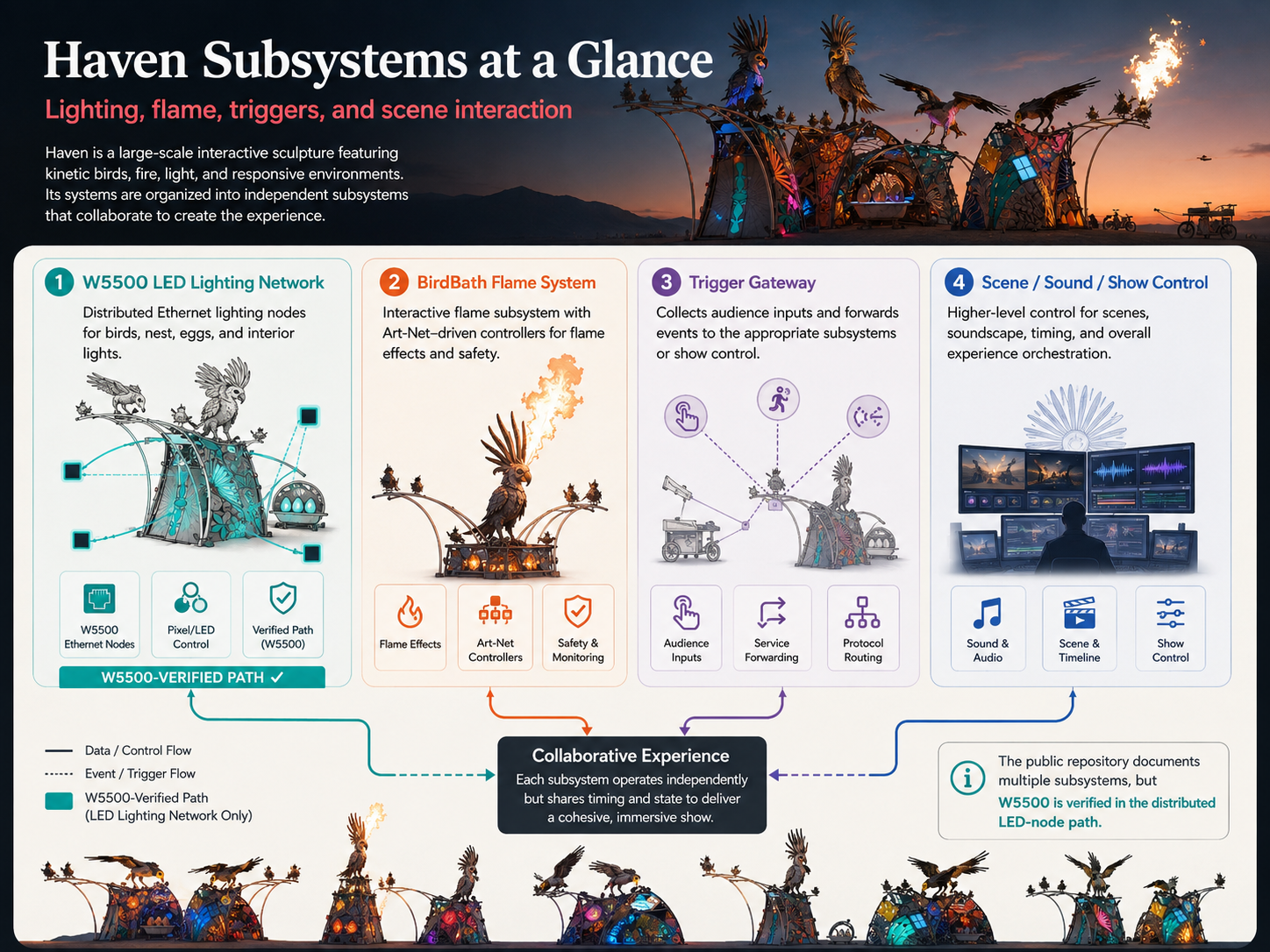
AI-Generated Image
The repository also contains systems beyond the wired LED network.
BirdBath is an interactive flame subsystem controlling 36 valves. Its Raspberry Pi runs a Web UI, REST API, and pattern loop, then sends Art-Net frames to dedicated hardware controllers. The BirdBath documentation explains that the Raspberry Pi is configured as a Wi-Fi access point so its Art-Net controller boards can connect without an external router. This path is separate from the W5500 LED-node implementation.
The Trigger Gateway distributes audience inputs to services such as flame, scene, and sound controllers. It supports service registration, persistent TCP connections, event caching, and forwarding control. Because Haven can operate without internet access and device clocks may not be synchronized, the gateway uses event identifiers rather than timestamps as the primary cache key.
The public repository does not contain one definitive field-deployment diagram covering every Haven subsystem. The structure described here combines the independently documented software and network paths into a curator’s system-level view.
Distributed Lighting Nodes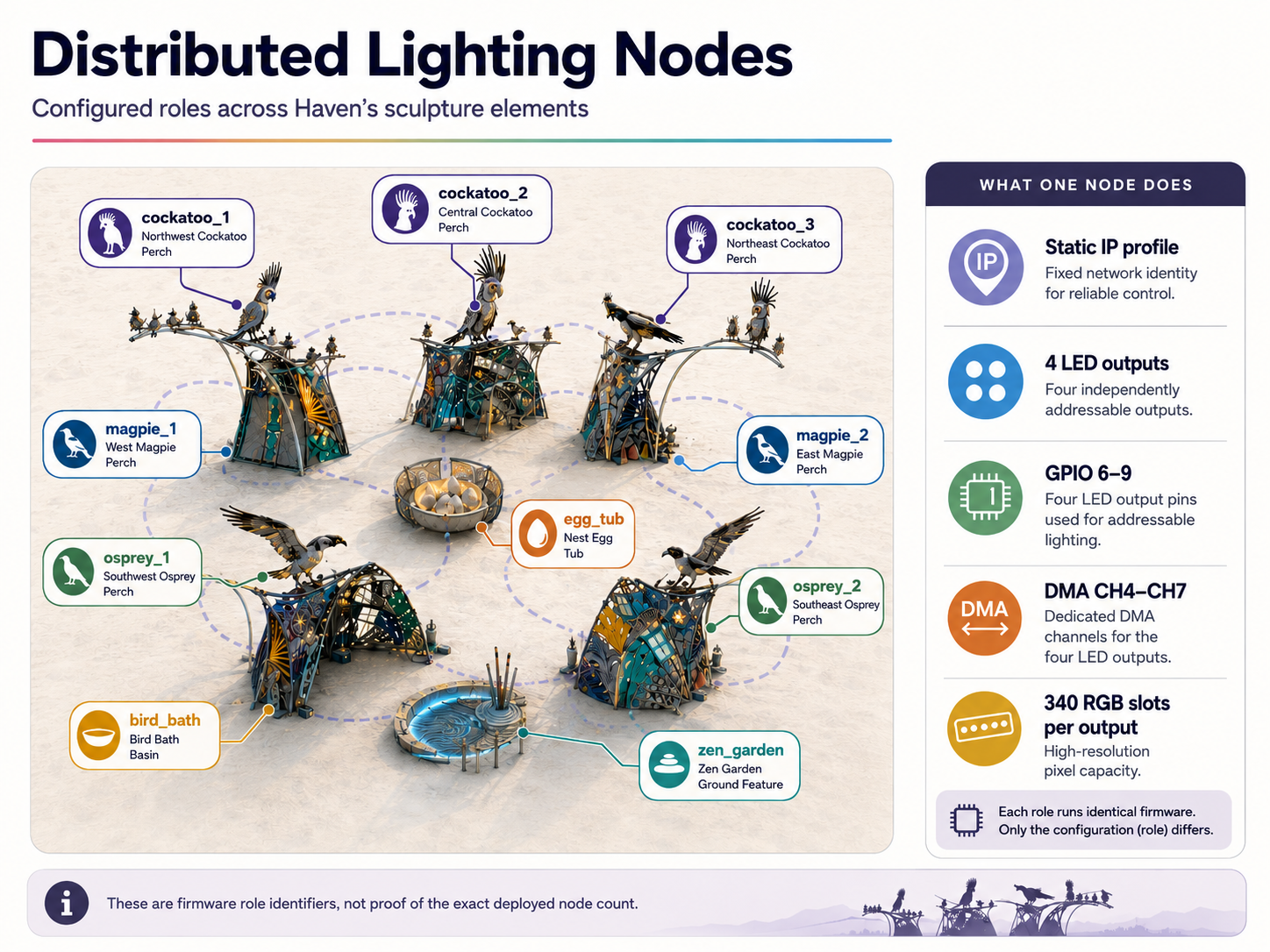
AI-Generated Image
Sculpture-Specific Controller Roles
The current main.rs file defines the following controller roles:
cockatoo_1
cockatoo_2
cockatoo_3
magpie_1
magpie_2
osprey_1
osprey_2
egg_tub
zen_garden
bird_bath
Each role is associated with a static IPv4 address. The current source maps the roles to addresses between 192.168.13.20 and 192.168.13.29.
Comments also retain a link-local profile for Haven at Burning Man 2025 and a 192.168.13.x profile for Haven at unSCruz 2026.
These ten identifiers are firmware configuration roles. They do not prove that exactly ten physical W5500 boards were operated simultaneously at every exhibition. Confirming the deployed node count would require an installation BOM or field network record.
Four Addressable LED Outputs
Each node creates four independent LED outputs using RP2040 PIO state machines and DMA channels.
| Output | RP2040 pin | DMA channel |
|---|---|---|
| Strip 0 | GPIO 6 | DMA CH4 |
| Strip 1 | GPIO 7 | DMA CH5 |
| Strip 2 | GPIO 8 | DMA CH6 |
| Strip 3 | GPIO 9 | DMA CH7 |
The current source defines PIXEL_COUNT as 340 for each output. The software is therefore structured around up to 1,360 RGB buffer slots per node:
340 RGB slots × 4 outputs
= 1,360 RGB buffer slots
This is a software buffer capacity. It does not establish that every output carried 340 physical LEDs or that every installed node used an identical LED configuration.
Lighting Data Flow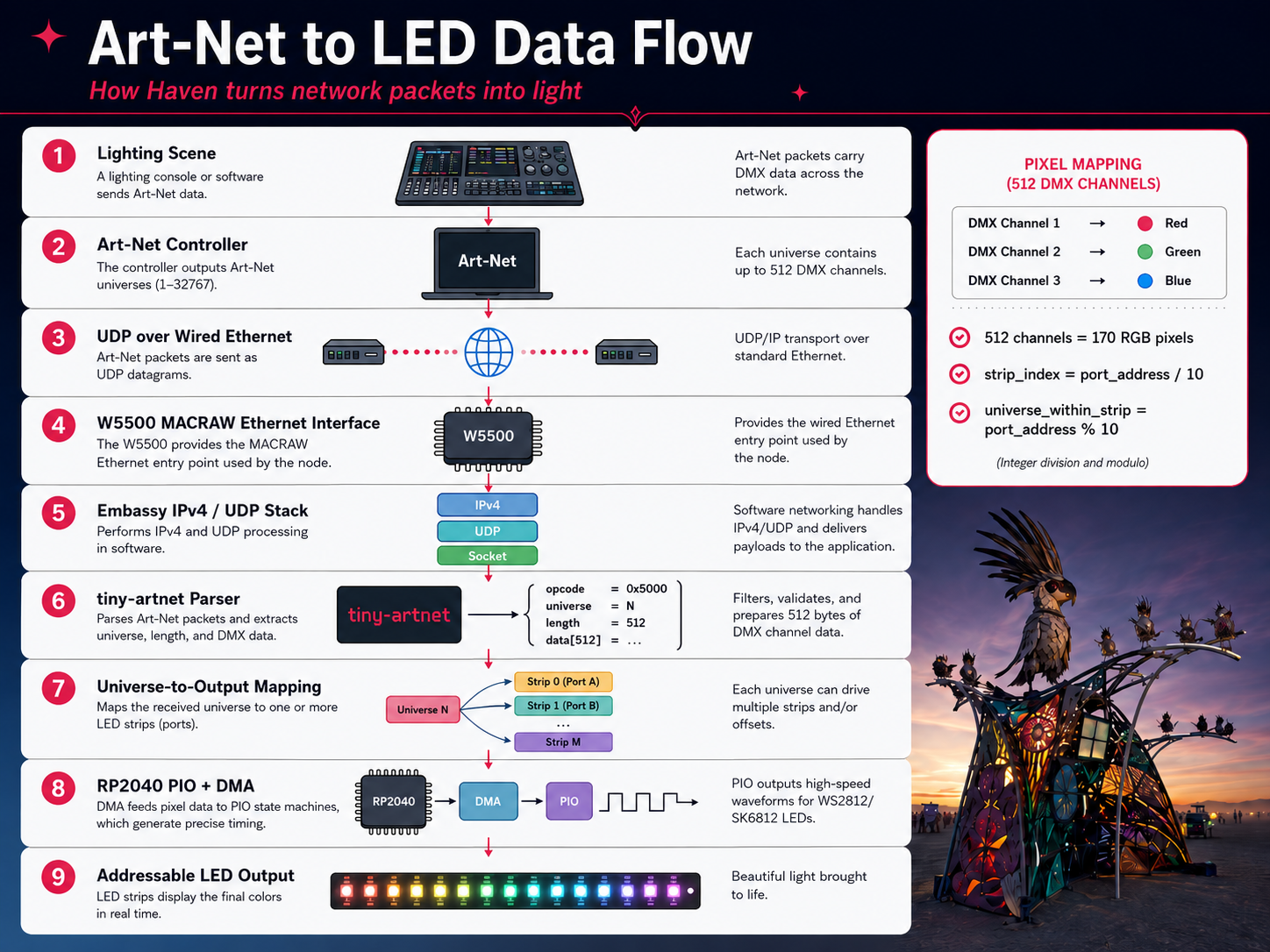
AI-Generated Image
Lighting Scene
      │
      ▼
Art-Net Controller
      │
      ▼
UDP over Wired Ethernet
      │
      ▼
W5500 Ethernet Interface
      │
      ▼
Embassy IPv4 / UDP Stack
      │
      ▼
tiny-artnet Parser
      │
      ▼
Universe-to-Output Mapping
      │
      ▼
RP2040 PIO + DMA
      │
      ▼
Addressable LED Output
Art-Net Reception
The artnet.rs module creates an Embassy UdpSocket and binds it to the standard Art-Net port.
Incoming packets are parsed through tiny_artnet::from_slice(). For an ArtDMX packet, the firmware combines the net, sub_net, and universe fields to calculate the Art-Net Port-Address.
DMX-to-Pixel Mapping
ArtDMX data is processed in groups of three bytes:
DMX Channel 1 → Red
DMX Channel 2 → Green
DMX Channel 3 → Blue
A single DMX universe contains 512 channels and can therefore carry 170 complete RGB pixels.
The firmware uses the Port-Address to select one of the four LED outputs and an offset within that output:
strip_index = port_address / 10
universe_within_strip = port_address % 10
Parsed RGB values are written into one of four pixel buffers before being transferred to the selected PIO-based LED output.
Art-Net Discovery
The firmware processes ArtPoll packets in addition to ArtDMX.
When a controller sends a discovery request, a Haven node generates a PollReply containing its IP address, MAC address, and Art-Net port information. This supports discovery and identification of lighting nodes by compatible show-control software.
Role of the WIZnet W5500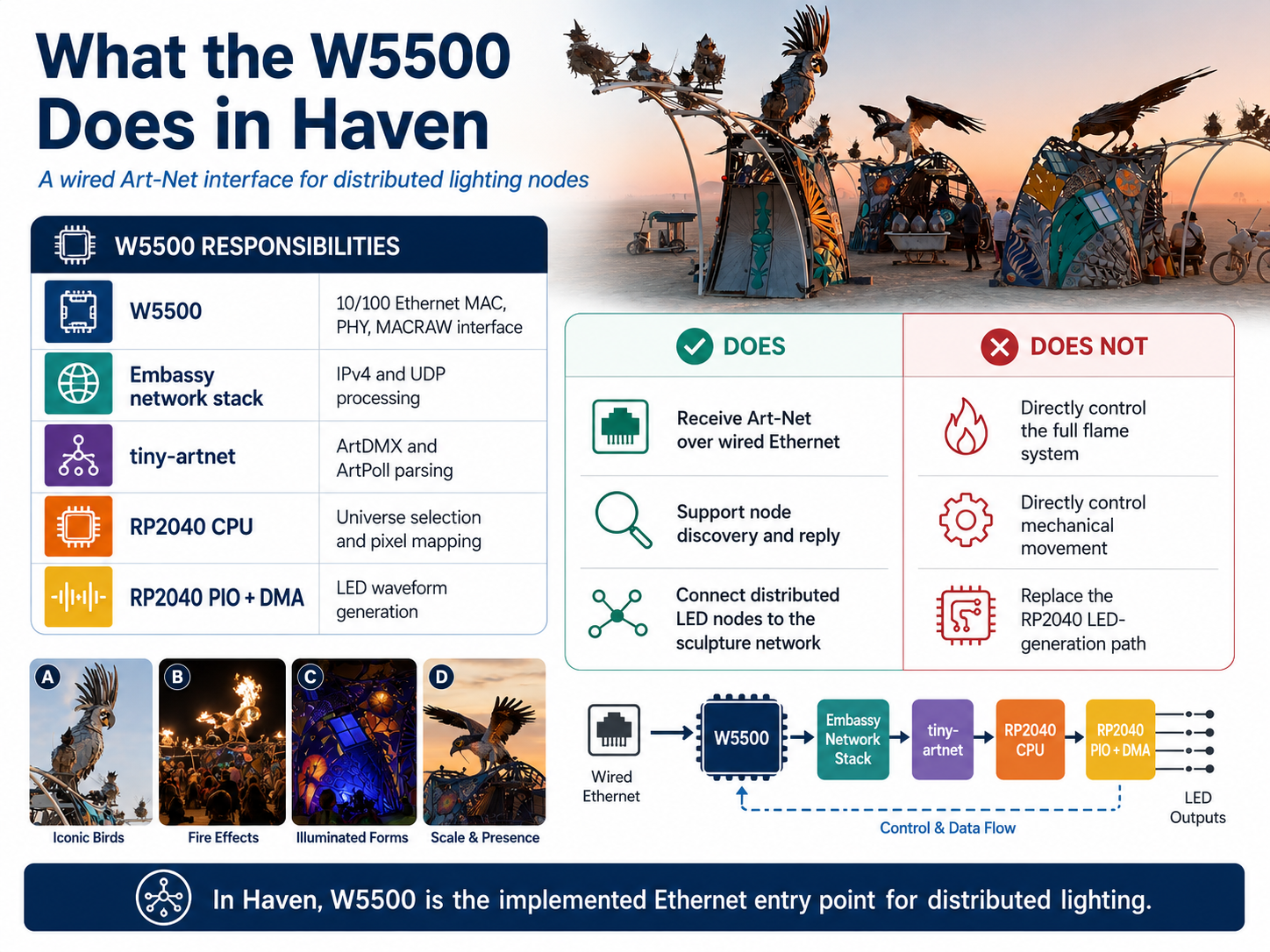
AI-Generated Image
A Directly Implemented Ethernet Interface
The Haven repository does not merely mention the W5500 as an optional component.
The main.rs source directly initializes:
- RP2040 SPI0
- A 50MHz SPI clock
- W5500 chip select
- W5500 interrupt
- W5500 reset
- A W5500 background runner
- The Embassy network stack
W5500-EVB-Pico combines the RP2040 and W5500 on a compact Ethernet development board. Haven uses this board architecture as a distributed lighting node that can be installed close to a bird, nest element, or interior lighting feature.
Division of Responsibilities
| Component | Role in Haven |
|---|---|
| W5500 | 10/100 Ethernet MAC, PHY, and raw-frame interface |
| Embassy network stack | IPv4 and UDP socket processing |
tiny-artnet | ArtDMX and ArtPoll parsing |
| RP2040 CPU | Universe selection and pixel mapping |
| RP2040 PIO + DMA | Timing-sensitive LED waveform generation |
The firmware uses embassy-net-wiznet, which operates the W5500 through its MACRAW interface. IPv4 and UDP are handled by embassy-net, an embedded software network stack based on smoltcp.
The key value of the W5500 in Haven is therefore its use as a reliable wired Ethernet interface connecting distributed sculpture nodes to a Rust-based asynchronous network application and RP2040-driven lighting outputs.
Why the W5500 Is a Core Component
W5500 usage is confirmed through several independent elements in the repository:
| Evidence | Confirmed implementation |
|---|---|
led_node/Cargo.toml | Includes embassy-net-wiznet |
led_node/src/main.rs | Uses the W5500 driver type |
| SPI configuration | Configures 50MHz SPI and W5500-specific pins |
| Device creation | Calls embassy_net_wiznet::new() |
| Background runner | Runs a dedicated W5500 Ethernet task |
| Network stack | Passes the W5500 device into Embassy networking |
| Art-Net path | Receives Art-Net through the resulting stack |
| Commit history | Explicitly mentions W5500-EVB-Pico programming |
| Pin mapping | Matches the official W5500-EVB-Pico configuration |
The W5500 is not simply included in a component list. It forms the physical wired path through which Art-Net data enters each distributed lighting node.
Public Activities and External Indicators
Burning Man Honoraria
Haven was selected for the 2025 Black Rock City Honoraria Program.
Honoraria is not a product award, certification, or conventional competition prize. It is a Burning Man Project grant program that provides partial funding for participatory sculptures created for Black Rock City. In 2025, Burning Man reviewed hundreds of proposals and announced funding for 76 projects.
Haven was introduced as Flaming Lotus Girls’ 19th Honoraria installation.
Crowdfunding
A public campaign tracker records the following results for Haven’s Kickstarter campaign:
| Item | Result |
|---|---|
| Funding goal | $30,000 |
| Final funding | $31,241 |
| Achievement | 104% |
| Backers | 217 |
| Campaign period | June 3–July 10, 2025 |
These figures indicate that Haven secured meaningful community participation and external financial support during production. They do not measure the performance or reliability of its W5500 lighting network.
Activities After Burning Man
The 2026 Lawrence Hall of Science Spring Break program presented Haven as an opportunity to explore the relationship between metalwork, fuel systems, sensors, engineering, and public art.
The official unSCruz schedule also included a participant-interactive flame show associated with Haven.
These records show that Haven continued to support community events and educational programming after its Burning Man 2025 installation. They do not establish that the complete 100-foot structure was reassembled in the same configuration at every later event.
Related WIZnet Maker Projects
1. 4-Universe Art-Net LED Controller with W5500-EVB-Pico
This Maker project also combines an RP2040-based W5500-EVB-Pico with four addressable LED outputs.
| 4-Universe Controller | Haven |
|---|---|
| General-purpose Art-Net controller | Site-specific distributed sculpture node |
| User-configurable universes and outputs | Firmware roles named for individual sculpture elements |
| Controller-construction focus | Field-deployed Burning Man installation |
| Arduino-oriented implementation | Rust and Embassy async implementation |
The hardware concept is similar, but Haven demonstrates how such a controller can be integrated into a modular public artwork.
2. ArtGateOne-DMX
ArtGateOne-DMX uses an Arduino Uno and a W5100 or W5500 Ethernet Shield to convert Art-Net data into one physical DMX512 output.
| ArtGateOne-DMX | Haven |
|---|---|
| Arduino Uno | RP2040 |
| W5100/W5500 Shield | W5500-EVB-Pico family |
| Art-Net to DMX512 | Art-Net to addressable LEDs |
| MAX485 output | RP2040 PIO and DMA output |
| General-purpose gateway | Installation-specific distributed node |
Haven drives addressable LEDs directly rather than translating Art-Net into an RS-485 DMX512 signal.
3. ArtNet to ESP-NOW DMX512
This project uses an ESP32 and W5500 master to receive wired Art-Net and relay it over ESP-NOW to wireless slaves, which then generate RS-485 DMX512.
| ArtNet to ESP-NOW | Haven |
|---|---|
| One W5500 master relays to wireless slaves | Multiple W5500 nodes connect directly to wired Ethernet |
| Wireless ESP-NOW distribution | Wired distribution to sculpture elements |
| Final output is DMX512 | Final output is addressable LED data |
| Central bridge architecture | Distributed node architecture |
Comparison at a Glance
| Project | MCU and network | Final output | Main difference from Haven |
|---|---|---|---|
| 4-Universe Art-Net Controller | RP2040 + W5500-EVB-Pico | Four addressable LED outputs | General-purpose controller rather than sculpture-specific firmware |
| ArtGateOne-DMX | Arduino + W5100/W5500 | One DMX512 output | DMX gateway instead of direct pixel output |
| ArtNet to ESP-NOW | ESP32 + W5500 + ESP-NOW | Wireless DMX512 | Central wireless bridge rather than multiple wired nodes |
| Haven | RP2040 + W5500-EVB-Pico | Four PIO/DMA LED outputs per configured node | Field-deployed distributed lighting for a large interactive artwork |
Why This Project Matters
A Field-Deployed W5500 Application in Public Art
Haven demonstrates that the W5500 can support more than industrial controllers, data loggers, and conventional IoT endpoints.
Its verified role is not control of the entire fire sculpture. The W5500 connects distributed LED nodes installed throughout a major public artwork to a local Art-Net network.
The combination of repository evidence and external exhibition records distinguishes Haven from a desk prototype or proof-of-concept lighting controller.
An Embedded Rust Reference
Many W5500 lighting projects are developed using Arduino C++ and Ethernet libraries.
Haven combines:
- Embedded Rust
- Embassy asynchronous execution
- A smoltcp-based network stack
- W5500 MACRAW Ethernet
- Art-Net parsing
- RP2040 PIO and DMA
This makes it a notable example of W5500-EVB-Pico being used within the Embedded Rust ecosystem for a real installation.
Modular Physical Systems
Assigning a controller role and IP address to each sculpture element provides a useful reference for operating devices distributed across a large physical environment.
Potential operational advantages include:
- Per-sculpture firmware configuration
- Network profiles for different venues
- Reduced installations using selected sculpture elements
- Independent testing and replacement of individual nodes
- Modular transportation and reassembly
These are architectural interpretations based on the role mapping and the documented partial exhibitions. They are not claims that every commissioning procedure is fully documented in the repository.
Potential Application Directions
The architecture used in Haven may be relevant to several related fields.
Experiential and Event Technology
- Festival lighting
- Stage and performance systems
- Immersive exhibitions
- Theme parks and pop-up experiences
- Museum installations
- Parade floats and public art
- Architectural illumination
Placing compact Ethernet nodes near individual physical elements can simplify the control of lighting distributed across a wide area.
Distributed Show Control
Separating lighting, flame, audience input, and scene services into distinct subsystems may reduce the need to replace an entire control system when one function changes.
This approach can inform modular show-control platforms for events, installations, and entertainment environments.
Education and Maker Programs
Haven can be used to explain several engineering topics within one project:
- Ethernet networking
- Art-Net and DMX universes
- Embedded Rust
- RP2040 PIO and DMA
- Sensors and physical interaction
- Distributed-node commissioning
Its Lawrence Hall of Science exhibition demonstrates its value as an educational bridge between art, fabrication, electronics, and networking.
Future Wiring Research
A large installation with widely distributed low-power sensors or trigger nodes may provide a useful context for studying simplified power-and-data wiring.
No Single Pair Ethernet or power-over-data implementation is confirmed in the current Haven repository. Such technologies should be treated only as possible future research topics, not as existing Haven features.
Open Source and Limitations
Publicly Available Material
The repository includes:
- Rust-based W5500 LED-node firmware
- Art-Net parsing and LED-output code
- BirdBath controller software and Web UI
- Trigger Gateway and scene-related services
- Python and Embedded Rust source code
- KiCad, PCB, and manufacturing files for selected fire-button subsystems
- An MIT root license
The repository supports a real installation, but it is not organized as a single step-by-step tutorial for reproducing the complete Haven artwork.
Information Not Confirmed by the Public Sources
The reviewed materials do not establish:
- The exact number of W5500 nodes operated at Burning Man
- The total number of installed LEDs
- The physical pixel count for each node
- The final Ethernet switch and cable BOM
- The complete power-distribution diagram
- The exact Art-Net source hardware and software
- Field packet-loss, latency, or uptime measurements
- Dust, heat, or rain qualification results
- Network redundancy or failover behavior
- A frozen firmware release matching the Burning Man 2025 deployment
- Whether W5500 hardware was also used in the flame, movement, or sound subsystems
The ten controller roles should not be presented as proof of exactly ten deployed boards. Likewise, the 1,360-slot software buffer should not be presented as the installed LED count for each node.
Scope of the Fire-System Material
The repository includes software and hardware related to flame interaction and valve control. This does not establish safety certification, operational approval, or reproducibility in another venue.
This curation focuses on the W5500 lighting network and software architecture. Gas and flame systems require separate professional engineering, inspection, and site-specific safety procedures.
Connecting with the Maker
Flaming Lotus Girls welcomes new participants and operates public channels for installation and event-booking inquiries. The GitHub repository is also maintained under an organization account, making its contribution and issue history publicly visible.
A technical interview could explore:
- The developers and operators responsible for the LED subsystem
- The number of W5500 nodes used at Burning Man 2025
- Why W5500-EVB-Pico was selected
- Why Rust and Embassy were chosen
- Advantages and limitations of the MACRAW architecture
- Field frame rate, packet loss, and recovery behavior
- Node enclosures, power injection, and Ethernet cabling
- IP and Art-Net universe provisioning
- Comparisons with WIZnet hardware-socket implementations
- Modular commissioning for later exhibitions
Because Flaming Lotus Girls identifies technical education and the development of new makers as organizational goals, an interview involving both artists and embedded developers would be more appropriate than a conventional product-promotion approach.
Conclusion
Haven is a 100-foot-diameter interactive installation combining a giant nest, large birds, eggs, lighting, movement, sound, and audience-controlled flame effects.
The WIZnet-related led_node subsystem uses RP2040 and W5500-EVB-Pico-class hardware to receive wired Art-Net packets. Embassy processes ArtDMX and ArtPoll data, while RP2040 PIO and DMA generate four addressable LED outputs.
The significance of Haven is not simply that the W5500 appears in its component list. The device forms the implemented Ethernet interface connecting lighting nodes distributed across the installation’s birds, nest, eggs, and interior spaces.
With its verified Burning Man installation, later public exhibitions, educational programming, crowdfunding support, and open repository, Haven is a rare field-deployed example of W5500-EVB-Pico and Embedded Rust being used for distributed Art-Net lighting in a large public artwork.
FAQ
Q. What is Haven?
A. Haven is a 100-foot-diameter interactive fire sculpture created by Flaming Lotus Girls. It combines a giant nest and bird sculptures with flame, movement, lighting, sound, and audience participation.
Q. Is the WIZnet W5500 actually used in the project?
A. Yes. The led_node firmware initializes W5500 SPI, interrupt, and reset signals and connects the resulting device to the Embassy network stack. Repository history also directly refers to W5500-EVB-Pico programming.
Q. Does the W5500 control Haven’s flame effects?
A. The verified W5500 implementation is the wired Art-Net interface for distributed LED nodes. BirdBath flame control and other interactive services are implemented as separate subsystems.
Q. How many LED outputs does one node support?
A. The current firmware defines four PIO-and-DMA LED outputs and 340 RGB buffer slots per output. This describes software capacity, not the confirmed number of physical LEDs installed on every node.
Q. How is Art-Net processed?
A. The W5500 provides the wired Ethernet interface in MACRAW mode. IPv4 and UDP are handled by embassy-net, while tiny-artnet parses ArtDMX and ArtPoll packets.
Q. Do the ten controller names prove that ten W5500 boards were installed?
A. No. They are firmware roles and IP mappings. Confirming the physical node count would require a field BOM or installation network record.
Q. Can the complete Haven installation be reproduced from the repository?
A. The repository publishes substantial LED, BirdBath, trigger, and selected PCB materials. It does not provide a single complete guide covering the full structure, final BOM, power distribution, cabling, enclosures, and venue-specific safety procedures.
Source Snapshot
| Item | Reviewed information |
|---|---|
| Original repository | FlamingLotusGirls/haven |
| Reviewed branch | main |
| Reviewed revision | 6549b0fbb5f2b8307206441de8054930bc0ca7a9 |
| Review date | July 20, 2026 |
| Primary WIZnet source | led_node/src/main.rs |
| Art-Net source | led_node/src/artnet.rs |
| Package definition | led_node/Cargo.toml |
| Additional subsystem sources | BirdBath/README.md, Triggers/TRIGGER_DISPATCH.md |
| WIZnet hardware | W5500-EVB-Pico family / W5500 |
| Host MCU | RP2040 |
| Main language | Rust |
| Lighting protocol | Art-Net over UDP |
| Root license | MIT |
| LED-node package license | MIT OR Apache-2.0 |
The repository’s root README contains only a brief description identifying it as code supporting the Haven project. Understanding the complete system requires reviewing the individual led_node, BirdBath, and Triggers subsystems alongside the root repository.
The reviewed main revision contains network profiles for Burning Man 2025 as well as later configuration work and BirdBath updates. The current branch should therefore be treated as an actively maintained working repository, not as a frozen copy of the exact firmware deployed at Burning Man 2025.