



HaphazardBridge
HaphazardBridge uses ESP32-S3 and W5500 to link Ethernet-only SDRs to ATAK over Wi-Fi, adding NAT, gRPC, CoT relays, and two field modes.
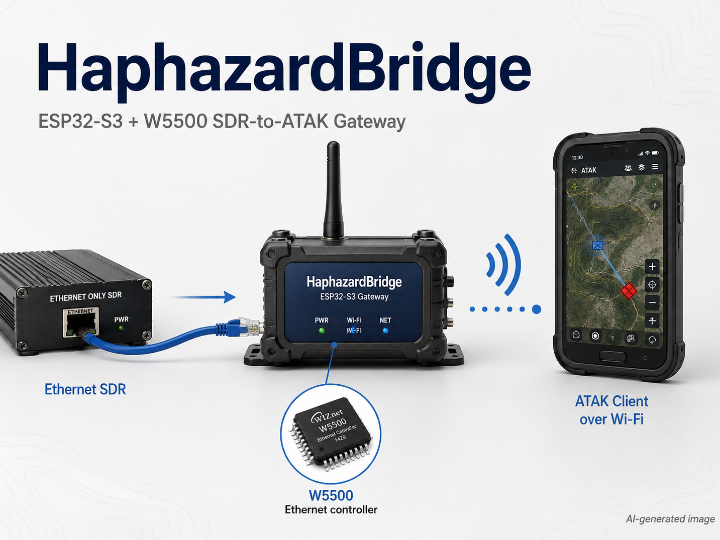
HaphazardBridge: A W5500 Gateway Connecting Ethernet SDRs to ATAK over Wi-Fi
Overview
HaphazardBridge was created to solve a clear network mismatch.
Some software-defined radios and sensor appliances communicate only through wired Ethernet, while ATAK normally runs on an Android device connected over Wi-Fi. HaphazardBridge places an ESP32-S3 and W5500 between those two environments.
Ethernet-Only SDR
        │
        │ Wired Ethernet
        ▼
WIZnet W5500
        │
        │ SPI
        ▼
ESP32-S3 Gateway
        │
        │ Wi-Fi
        ▼
ATAK Device
The project does more than convert one physical network interface into another. It also routes traffic between separate networks and forwards the services required by the SDR and ATAK plugin.
Its core functions include:
- Ethernet-to-Wi-Fi routing
- Wi-Fi-to-Ethernet access in standalone mode
- gRPC forwarding
- Cursor on Target TCP and UDP relays
- SDR web-interface access
- Local configuration
- OTA firmware updates
- Mobility and Dismounted operating modes
The project’s value lies in connecting an existing wired appliance to mobile Wi-Fi clients without modifying the SDR itself.
About Brad and Haphazard Labs
Brad develops the project publicly under the HaphazardLabs GitHub account and the Haphazard Labs name.
The public profile lists Northern Virginia, USA, and describes a focus on open-source tools for military, intelligence-community, and law-enforcement use cases, particularly TAK, SDR, communications, and edge computing for austere or infrastructure-limited environments.
This identifies the intended technical audience, but it does not establish that Brad or Haphazard Labs is a government organization, military unit, intelligence agency, law-enforcement agency, or verified government contractor.
The most accurate description is:
Haphazard Labs is a Northern Virginia-based open-source field-technology project operated publicly by Brad.
A Broader TAK Project Family
HaphazardBridge is one part of a broader collection of local-network and TAK-oriented projects.
| Project | Main hardware | Primary role |
|---|---|---|
| HaphazardBridge | ESP32-S3 with W5500 | Ethernet SDR to Wi-Fi gateway |
| HaphazardNet | Raspberry Pi Zero 2 W | Battery-oriented TAK and SDR field kit |
| HaphazardTAKyPi | Raspberry Pi 5 | Higher-power local CoT relay |
HaphazardTAKyPi explicitly describes these repositories as part of the Haphazard Labs TAK family and distinguishes HaphazardBridge as a gateway rather than a TAK Server.
HaphazardNet packages a local access point, Ethernet-side SDR connection, lightweight CoT server, battery monitoring, and selectable modes into a Raspberry Pi-based field kit.
Together, the repositories show a consistent focus on:
- Local operation without mandatory cloud access
- Ethernet-connected sensors and SDRs
- Mobile Wi-Fi clients
- Portable field hardware
- TAK and CoT interoperability
- Infrastructure-light networking
What Is HaphazardBridge?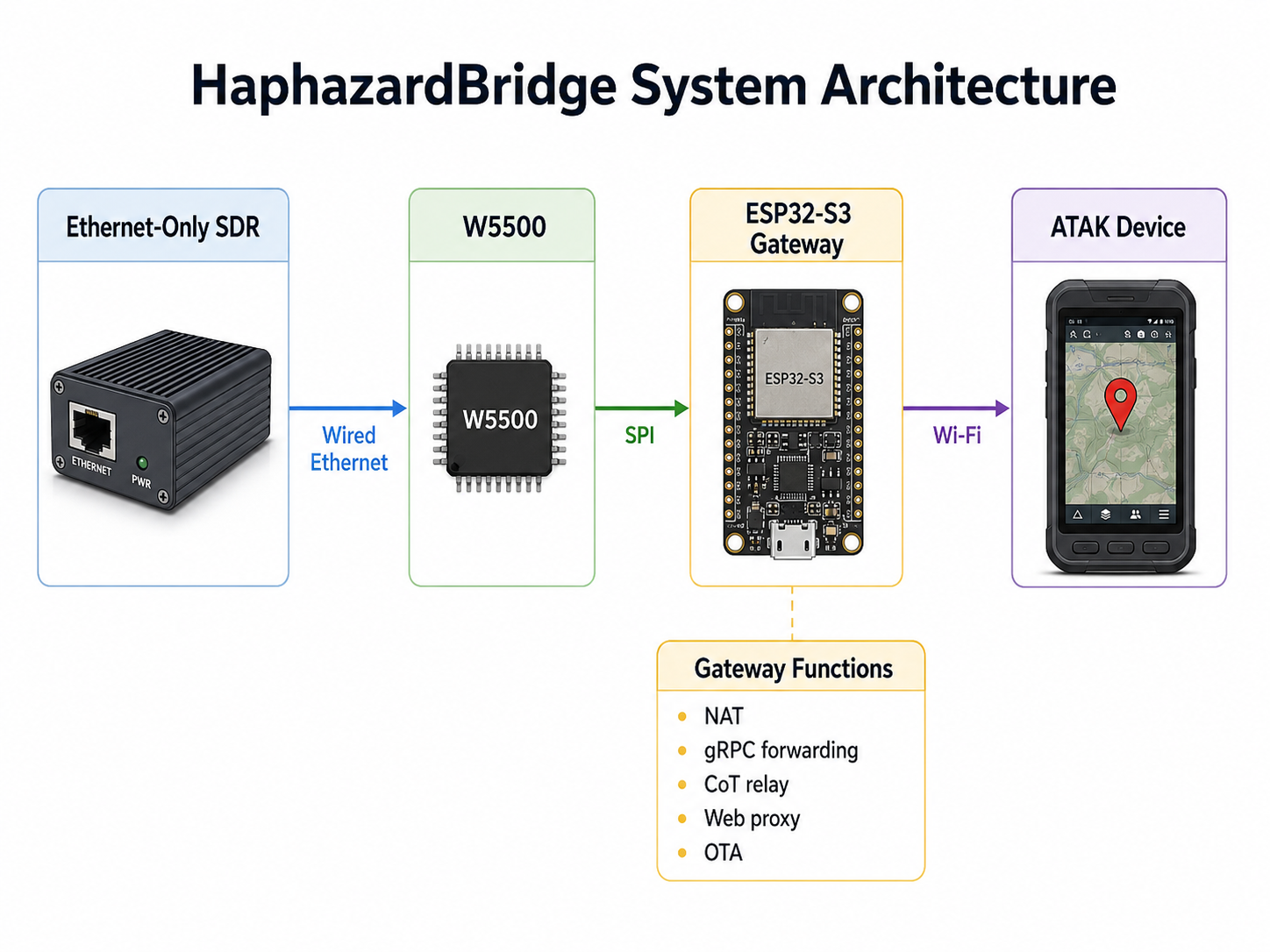
HaphazardBridge is an embedded network gateway that allows a wired SDR to exchange data with ATAK clients over Wi-Fi.
It does not replace the SDR, decode radio signals, or operate a complete TAK Server. Instead, it creates the network path between existing endpoints.
SDR Services
gRPC · CoT · Web UI · Other IP Traffic
                      │
                      ▼
                W5500 Ethernet
                      │
                      ▼
                 ESP32-S3
          NAT · Relay · Proxy · Wi-Fi
                      │
                      ▼
                 ATAK Client
ATAK is the Android client within the U.S. government-owned Team Awareness Kit ecosystem. TAK Server is a separate platform that brokers, secures, stores, and distributes data between TAK clients and networks. HaphazardBridge is a smaller local gateway and does not provide those server functions.
How HaphazardBridge Works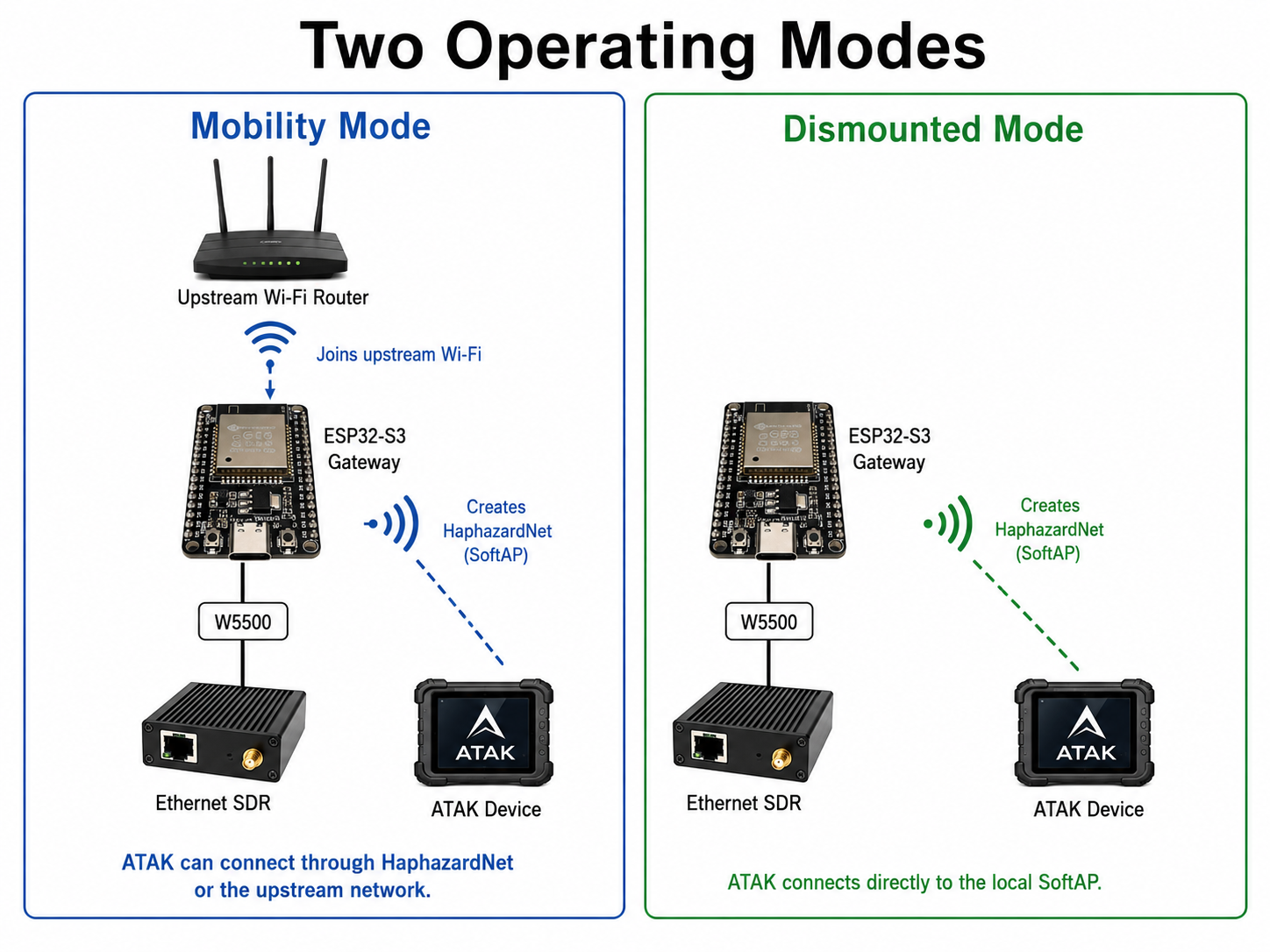
Mobility Mode
Mobility Mode is intended for environments that already have a vehicle or infrastructure Wi-Fi network.
The ESP32-S3:
- Joins the upstream access point as a station
- Broadcasts its own local HaphazardNet access point
- Connects to the SDR through W5500 Ethernet
Vehicle / Infrastructure Wi-Fi
                │
       ┌────────┴─────────┐
       │                  │
   ATAK Device      ESP32-S3 STA
                          │
                          ├── HaphazardNet AP
                          │          │
                          │      ATAK Device
                          │
                          ▼
                     W5500 Ethernet
                          │
                          ▼
                         SDR
ATAK can reach the bridge through either the upstream network or HaphazardNet.
Dismounted Mode
Dismounted Mode requires no upstream access point.
The ESP32-S3 creates HaphazardNet as a standalone local network, and ATAK connects directly to it.
ATAK Device
      │
      │ HaphazardNet Wi-Fi
      ▼
ESP32-S3 SoftAP
      │
      │ NAT and Relays
      ▼
W5500 Ethernet
      │
      ▼
     SDR
The firmware routes SDR traffic toward Wi-Fi and also allows HaphazardNet clients to access the Ethernet-side SDR.
Main Network Services
| Service | Role |
|---|---|
| NAT | Routes traffic between the SDR Ethernet subnet and Wi-Fi clients |
| gRPC forward | Connects the ATAK SDR plugin to the SDR’s gRPC service |
| CoT TCP relay | Relays Cursor on Target traffic to a configured destination |
| CoT UDP relay | Rebroadcasts SDR CoT packets to HaphazardNet clients |
| Web proxy | Makes the SDR management interface reachable over Wi-Fi |
| OTA | Updates bridge firmware without reconnecting USB |
The source implements the gRPC, CoT, and web paths as network relays. It does not interpret or modify the application messages themselves.
Role of the WIZnet W5500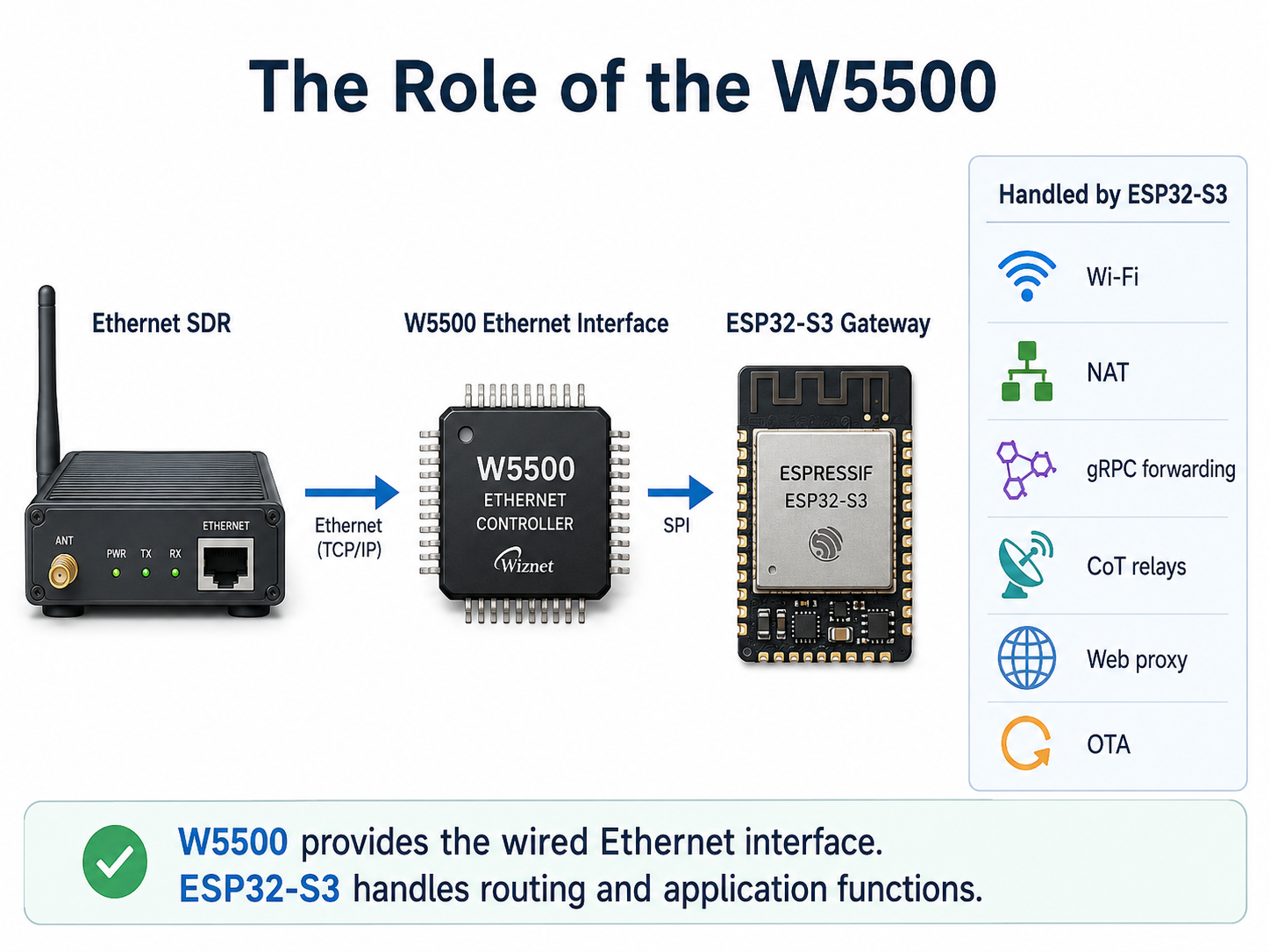
The W5500 is the wired network boundary of HaphazardBridge.
All traffic between the SDR and ESP32-S3 passes through the W5500.
SDR
 │
 │ 10/100 Ethernet
 ▼
W5500
 │
 │ SPI
 ▼
ESP32-S3
 │
 ├── Wi-Fi AP / STA
 ├── NAT
 ├── gRPC Forwarding
 ├── CoT Relays
 ├── Web Proxy
 └── Configuration and OTA
The Waveshare ESP32-S3-ETH combines an ESP32-S3R8, 8 MB PSRAM, 16 MB flash, 2.4 GHz Wi-Fi, and an onboard W5500 providing 10/100 Mbps Ethernet through SPI.
Division of Responsibilities
| Function | Main component |
|---|---|
| Wired Ethernet connection | W5500 |
| Wi-Fi AP and station | ESP32-S3 |
| IP routing and NAT | ESP32-S3 network stack |
| gRPC forwarding | HaphazardBridge firmware |
| CoT relaying | HaphazardBridge firmware |
| SDR web proxy | HaphazardBridge firmware |
| Configuration and OTA | ESP32-S3 firmware |
The source initializes the onboard W5500 through the Arduino-ESP32 Ethernet interface and performs routing and relaying through the ESP32 network stack.
The clearest technical description is:
W5500 connects the Ethernet-only SDR to the ESP32-S3, while the ESP32-S3 handles Wi-Fi, NAT, and application-level traffic forwarding.
The W5500 does not itself implement ATAK, gRPC, Cursor on Target, or the project’s routing policy.
Why This Project Matters to WIZnet
A Core W5500 Application, Not an Optional Port
HaphazardBridge could not perform its intended role without a wired interface to the SDR.
W5500 is therefore central to the architecture rather than an optional setup or monitoring port.
Existing Ethernet Appliance
            │
            ▼
       W5500 Interface
            │
            ▼
   ESP32-S3 Edge Gateway
            │
            ▼
      Wi-Fi Clients
More Than Basic Telemetry
Many embedded Ethernet projects send sensor values to a server or host a simple web page.
HaphazardBridge combines:
- Wired and wireless networks
- Separate IP subnets
- NAT
- TCP forwarding
- UDP rebroadcast
- Multiple application services
- Offline operation
- Local configuration and updates
This makes it a useful example of W5500 in an embedded edge gateway.
Reusing Existing Wired Equipment
The same architectural pattern can extend beyond ATAK and SDR.
Potential applications include:
- Research instruments
- Industrial inspection equipment
- Environmental sensors
- Wired cameras
- Robot payloads
- Temporary event systems
- Mobile laboratories
- Emergency-response equipment
The broader WIZnet value is:
W5500 can preserve a dependable wired interface for existing equipment while an ESP32-S3 adds Wi-Fi access and application-specific gateway functions.
Infrastructure-Light Networking
Dismounted Mode creates a local network without requiring internet access, cloud services, or an upstream router.
That design pattern may be valuable in:
- Remote research
- Disaster response
- Infrastructure outages
- Temporary inspection sites
- Portable demonstrations
- Pop-up local networks
Official TAK materials describe applications across military, law enforcement, emergency response, disaster relief, commercial work, and recreation. They also state that organizations must follow the authorization and distribution rules applicable to their TAK product and environment.
Current Status and Limitations
The source contains the main functions described by the documentation, and the maintainer identifies v1.5 and v1.6 as operational releases.
However, the reviewed repository does not publish:
- Independent hardware testing
- Performance benchmarks
- Packet-loss or latency results
- Long-duration stability logs
- A downloadable firmware release
- Third-party field reports
- A formal security assessment
The safest status statement is:
The source implements the documented gateway functions, and the maintainer reports that v1.6 works on the target hardware, but independent performance and field validation have not been published.
Security
The current source includes shared default credentials and broad NAT access to the Ethernet-side SDR. Stronger credential management, authenticated configuration, restricted forwarding rules, and secure OTA are still needed.
The roadmap places WPA3, MAC allowlisting, separate credentials, and stronger OTA authentication in a future security milestone.
License
The README contains an informal reuse statement, but the reviewed archive does not include a standard project license file.
Reuse and redistribution terms should be clarified with Brad before modified firmware is republished.
Related WIZnet Maker Projects
| Project | Similarity | Difference from HaphazardBridge |
|---|---|---|
| YB-ESP32-S3-ETH | Combines ESP32-S3, W5500, Ethernet, and Wi-Fi | A hardware platform rather than an application gateway |
| newRouter | Implements ESP32-S3 routing, NAT, Wi-Fi, and W5500 Ethernet | A general router with dual W5500 and 4G |
| EthWiFiManager | Coordinates W5500 Ethernet and ESP32 Wi-Fi | Provides failover rather than routing traffic between both networks |
YB-ESP32-S3-ETH demonstrates the general hardware combination of ESP32-S3, W5500, Ethernet, and Wi-Fi. HaphazardBridge applies that combination to a specific SDR gateway.
newRouter is similar at the network-software level because it implements routing, NAT, Wi-Fi, and multiple W5500 interfaces. HaphazardBridge is smaller and focused on one wired appliance and ATAK traffic.
EthWiFiManager manages Ethernet-first connectivity with Wi-Fi fallback. HaphazardBridge differs because wired Ethernet and Wi-Fi are both required in the normal end-to-end data path.
Connecting with the Maker
A focused interview with Brad could clarify the project’s maturity and future direction:
- Which SDR platform was used during development?
- How long has v1.6 operated continuously?
- Can build logs or firmware releases be published?
- What throughput, latency, and packet-loss results were observed?
- How does the bridge recover when Ethernet or Wi-Fi is lost?
- When will default credentials be replaced?
- Is a port-level firewall planned?
- Will a standard open-source license be added?
- How was AI-assisted code reviewed and tested?
- Is there interest in a secure W5500 or PoE gateway reference design?
These answers would help distinguish a promising working prototype from a production-ready field appliance.
Conclusion
HaphazardBridge uses ESP32-S3 and W5500 to connect an Ethernet-only SDR to ATAK clients over Wi-Fi.
W5500 provides the wired Ethernet interface, while ESP32-S3 handles:
- Wi-Fi AP and station operation
- Ethernet–Wi-Fi routing
- gRPC forwarding
- Cursor on Target relaying
- SDR web access
- Configuration
- OTA updates
- Mobility and Dismounted modes
Its strongest technical idea is the use of W5500 as the wired boundary of a compact dual-network edge gateway.
The project is also part of a wider Haphazard Labs family focused on local TAK, SDR, communications, and edge-computing tools for infrastructure-limited environments.
Important work remains around independent validation, credentials, network restrictions, secure updates, and licensing.
The most accurate description is:
HaphazardBridge is a technically focused W5500 gateway that connects Ethernet SDR traffic to local ATAK Wi-Fi clients. It is a strong UCC and reference-design candidate, but it still requires independent testing and security hardening before being treated as a production field appliance.
FAQ
Q. What is HaphazardBridge?
A. It is an ESP32-S3 and W5500 gateway that connects an Ethernet-only SDR to ATAK clients over Wi-Fi.
Q. Who develops it?
A. Brad develops it publicly under HaphazardLabs and the Haphazard Labs name in Northern Virginia, USA.
Q. What is the role of the W5500?
A. It provides the Ethernet interface between the SDR and ESP32-S3. The ESP32-S3 performs Wi-Fi networking, routing, and application relays.
Q. What are Mobility and Dismounted modes?
A. Mobility Mode joins an upstream Wi-Fi network while also providing a local access point. Dismounted Mode creates a standalone local network.
Q. Is HaphazardBridge an official TAK or government product?
A. No. It is an independent third-party project designed to interoperate with ATAK-related workflows.
Q. Is it independently validated and security hardened?
A. Not yet. The maintainer describes the source as operational, but independent benchmarks and a complete security review have not been published.
Source Snapshot
| Item | Reviewed information |
|---|---|
| Original repository | HaphazardLabs/HaphazardBridge |
| Reviewed branch | master |
| Reviewed revision | 9d6466b84d3d49721cbfebc7f667b2e437161ba3 |
| Review date | August 3, 2026 |
| Developer | Brad |
| Project identity | HaphazardLabs / Haphazard Labs |
| Public location | Northern Virginia, USA |
| Current documented version | v1.6 |
| Main controller | ESP32-S3 |
| WIZnet product | W5500 |
| Hardware platform | Waveshare ESP32-S3-ETH |
| Project status | Maintainer-described as operational; independently unverified |
| License status | Informal reuse statement; no standard root license file |
| Development provenance | Claude Sonnet 4.6 is credited as a commit co-author |
The repository documents two operating modes, Ethernet–Wi-Fi NAT, gRPC forwarding, Cursor on Target relays, an SDR web proxy, local configuration, and OTA updates.
The initial and latest reviewed commits openly credit Claude Sonnet 4.6 as a co-author. That disclosure is useful, but reproducible builds and physical testing remain necessary regardless of how the source was produced.
Independence note: HaphazardBridge is an independent third-party project. It is not presented as an official product of TAK.gov, the U.S. government, WIZnet, Waveshare, or any military, intelligence, or law-enforcement organization.