



EGOS SDK for ESP32 — Escape Room Hardware Modules with Ethernet-First W5500 Connectivity
EGOS powers escape-room puzzle hardware, and this SDK connects ESP32 modules to it with optional W5500 Ethernet for more reliable field deployment.
Thumbnail Image: EGOS Games Facebook
📌 Overview
Source: https://egos.games/
EGOS, short for Enhanced Gaming Operating System, is EGOS Games’ platform for escape room hardware modules. On its official site, EGOS is presented as an “Escape Room Hardware Modules” lineup and a broader “EGOS Modular Hardware Ecosystem.” In practice, this means EGOS is not a single game title, but a system for connecting and operating the physical puzzle devices used inside escape rooms. (Egos Games)
That is where egos-sdk-esp32 fits in. This repository is an ESP32 SDK for building EGOS-compatible puzzle modules such as button panels, keypad boxes, sensor nodes, RFID readers, LED feedback units, and motor or relay controllers. Instead of writing network handling and controller integration from scratch for every device, developers can use one reusable ESP-IDF component and focus on the actual game hardware logic.
📌 Features
Modular hardware for escape-room puzzles
EGOS is built around separate hardware modules rather than one large all-in-one board. A puzzle can be split into multiple devices, such as input panels, sensor nodes, lighting modules, and actuator controllers, each with its own role.
Controller + Studio + module workflow
The overall system appears to be structured around a central controller, a Studio interface for configuration and game logic, and distributed hardware modules installed around the room. This makes it suitable for puzzle setups where devices are physically spread across multiple props and locations.
Reusable ESP32 integration layeregos-sdk-esp32 handles the common parts of module development: connectivity, device registration, event publishing, command handling, credential management, and reconnection logic. That reduces repeated engineering work across multiple puzzle devices.
Designed for real puzzle interactions
This is not just sensor logging. EGOS modules are meant to react to player actions and drive game responses. Buttons, keypads, RFID readers, and sensors act as inputs; LEDs, LCDs, lighting, audio, relays, and motors act as outputs.
Optional wired Ethernet with W5500
For fixed-installation puzzle hardware, the SDK can optionally use a W5500-based Ethernet path instead of relying only on wireless connectivity.
📌 System Architecture
AI-generated image
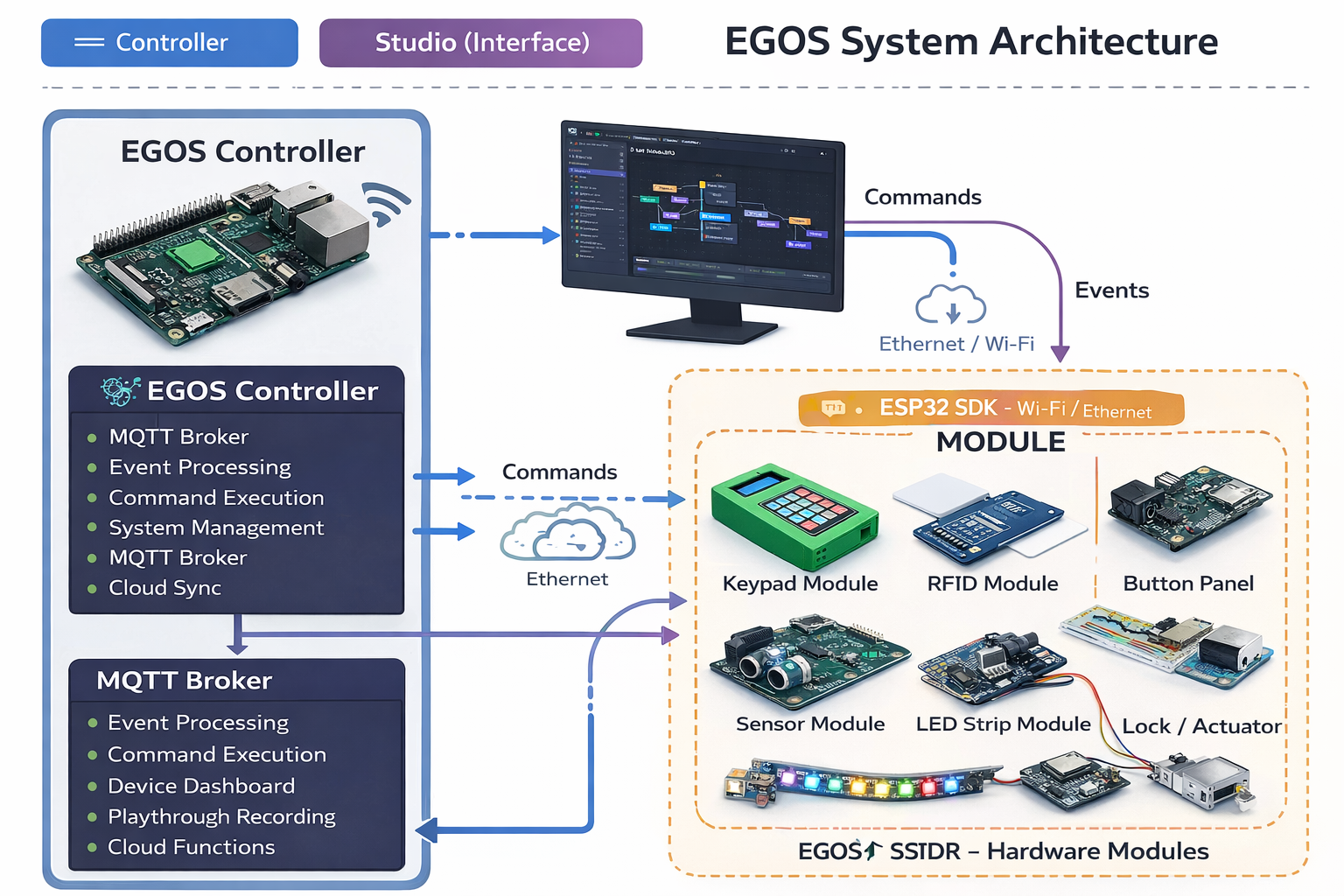
The EGOS structure is best understood as a controller, Studio, and hardware module system.
At the center is the controller, which acts as the runtime brain of the installation. Based on the public materials you shared, it is tied to a Raspberry Pi-based controller environment and is responsible for coordinating device events, command execution, and overall game flow.
Around that controller are the hardware modules. These modules are the actual puzzle devices placed inside the room: button units, keypad enclosures, RFID-based object readers, sensor boards, lighting modules, display units, and actuator controllers. Each module exposes its own devices to the EGOS system and reacts to commands from the controller.
On top of that sits Studio, which appears to be the operational layer used to configure devices, define logic flows, monitor status, and manage game behavior. In other words, the system is not only about hardware connectivity; it also includes a software layer for building and operating puzzle logic.
This architecture matches escape-room usage very naturally: player actions happen at distributed props, the controller evaluates what those actions mean, and the rest of the room reacts accordingly.
📌 Role and Application of the WIZnet's Chip
WIZnet chip used: W5500
In this project, the W5500 is used as an optional wired Ethernet interface for ESP32-based EGOS modules.
What makes this more interesting than a simple Ethernet add-on is the SDK’s connection strategy. The implementation is clearly structured as follows:
- Ethernet is tried first
- If that fails, the module falls back to Wi-Fi
- If timeouts repeat, the SDK performs network switching
That behavior is especially meaningful for escape-room hardware. These devices are usually installed in fixed positions and are expected to respond the same way every time. If a keypad, RFID reader, or control box loses communication or behaves unpredictably due to wireless instability, it can directly affect the player experience. In that context, W5500 is not just an extra feature; it is a practical wired connectivity option for puzzle devices that need stable field operation.
📌 Market & Application Value
The most direct application of this system is escape room production and operation.
Typical uses would include:
- keypad-based code puzzles
- button-sequence puzzles
- RFID or object-recognition puzzles
- hidden trigger or sensor-based puzzles
- LED/LCD-based feedback devices
- lighting and audio effect modules
- relay or motor-controlled props, locks, and doors
This makes EGOS more than a hobby electronics project. It is closer to a structured hardware platform for puzzle installations where multiple devices must work together reliably and consistently during live gameplay.
It may also be relevant for adjacent installations such as themed attractions or interactive puzzle exhibits, but its clearest and most explicitly stated fit is escape-room hardware. (Egos Games)
📌 External Indicators
The official EGOS site explicitly frames the platform around escape room hardware modules, which gives the project a clear application context rather than leaving it as a generic embedded-system SDK. (Egos Games)
The Facebook screenshots you shared add useful context as well. They show:
- prototype hardware boards and module evolution
- keypad and large-button enclosures
- EGOS Studio interface previews
- logic-flow and DMX-related screens
- controller and cloud update posts
Taken together, those materials suggest that EGOS is being developed as a complete operating stack for puzzle hardware, not just as a single dev board or proof-of-concept firmware.
EGOS-games Facebook: https://www.facebook.com/people/EGOS-Games/61575627608073/
EGOS-games Site: https://egos.games/
Hardware: https://egos.games/modules/digital-inputs
📌 Summary
EGOS is an escape-room hardware operating platform developed by EGOS Games. It connects and operates the physical puzzle devices used in gameplay, including buttons, keypads, RFID readers, sensors, displays, lighting, audio, and actuators. The official site positions it as an escape-room hardware ecosystem, and the materials you shared show both the hardware side and the controller/studio side of that system. (Egos Games)
egos-sdk-esp32 is the ESP32-side SDK for building those puzzle modules. Its support for W5500 is especially notable because the network behavior is clearly designed for installation-grade reliability:
- Ethernet is tried first
- If that fails, the module falls back to Wi-Fi
- If timeouts repeat, the SDK performs network switching
That makes this project a strong example of W5500 being used in a real, application-specific device platform rather than in a standalone networking demo.
📌 FAQ
Q1. What is EGOS?
EGOS is an escape-room hardware operating platform. It is used to connect and control puzzle devices inside a room rather than to represent a single game title. (Egos Games)
Q2. What does EGOS Games build?
Based on the official site and the materials you shared, EGOS Games is building a system for escape-room puzzle hardware, including controllers, modules, and a Studio-style operational interface. (Egos Games)
Q3. What is egos-sdk-esp32?
It is the ESP32 SDK used to build EGOS-compatible hardware modules such as button units, keypad devices, sensor nodes, RFID readers, and actuator controllers.
Q4. What kinds of puzzle devices fit this SDK?
Button panels, keypad boxes, RFID readers, sensor modules, LED feedback devices, relay boards, motor-driven props, and similar escape-room hardware are natural fits.
Q5. What does the W5500 do here?
It provides an optional wired Ethernet path for ESP32-based modules. The SDK is designed to try Ethernet first, then fall back to Wi-Fi, and switch networks if repeated timeouts occur.
Q6. Why is that useful in escape-room hardware?
Because these devices are fixed-installation puzzle components. Stable and predictable communication matters when a device is expected to react correctly every time a player interacts with it.
📌 Overview
Source: https://egos.games/
EGOS는 EGOS Games가 개발하는 Enhanced Gaming Operating System으로, 방탈출 게임 안에 들어가는 전자 퍼즐 장치들을 하나의 시스템으로 연결하고 운영하기 위한 플랫폼입니다.
이 시스템 안에서는 버튼, 키패드, RFID, QR/바코드, 각종 센서 같은 입력 장치와 LED, LCD, DMX 조명, 오디오, 모터, 릴레이 같은 출력 장치가 중앙 controller와 연결되어 함께 동작합니다.
즉, EGOS는 특정 게임 제목이 아니라, 방탈출 게임에서 퍼즐 장치의 입력과 반응을 제어하는 운영 시스템에 가깝습니다. 플레이어가 버튼을 누르거나 코드를 입력하고, RFID를 태그하거나 특정 오브젝트를 움직이면, 시스템이 이를 읽고 다음 반응을 실행하는 구조입니다.
이번에 소개하는 egos-sdk-esp32는 그 EGOS 시스템 안에서 ESP32 기반 퍼즐 장치 모듈을 만들기 위한 SDK입니다.
ESP32로 버튼 박스, 키패드 장치, 센서 노드, LED 반응 장치, RFID 리더, 모터 제어 장치 등을 만들고 EGOS controller에 module로 연결할 수 있도록 공통 기능을 제공하는 저장소입니다.
📌 Features
방탈출 퍼즐 장치용 모듈 구조
EGOS는 하나의 큰 장비가 아니라, 여러 퍼즐 장치를 각각 module로 분리해 연결하는 구조를 가집니다. 버튼 패널, RFID 리더, 조명 장치, 키패드 박스, 센서 모듈, 액추에이터 장치 등을 역할별로 나눠 붙일 수 있습니다.
Controller + Studio + Module 구조
현장에는 Raspberry Pi 기반 controller가 중심이 되고, Studio에서 게임 로직과 장치 상태를 관리하며, 각 퍼즐 장치는 개별 module로 연결되는 형태입니다.
재사용형 ESP32 SDKegos-sdk-esp32는 Wi-Fi, MQTT, 디바이스 등록, 이벤트 publish, output command 처리, reconnect logic, credentials 관리 같은 기능을 공통화해 둡니다. 덕분에 개발자는 장치의 실제 하드웨어 동작에 더 집중할 수 있습니다.
입력과 출력이 함께 묶이는 구조
버튼, 키패드, RFID, 센서가 입력을 담당하고, LED, LCD, 조명, 오디오, 모터가 반응을 담당합니다. 즉, 단순 상태 측정 시스템이 아니라 실제 퍼즐 인터랙션을 만드는 구조입니다.
유선 Ethernet 선택 가능
ESP32 module 쪽에서는 W5500을 통해 wired Ethernet을 선택적으로 사용할 수 있습니다. 이 점이 설치형 퍼즐 장치에서 중요한 의미를 가집니다.
📌 System Architecture
AI-generated image
EGOS의 핵심은 controller, studio, hardware module이 나뉘는 구조입니다.
중앙의 controller는 게임 진행 중 발생하는 장치 이벤트, 변수 변화, command 실행, 오디오 처리, 상태 기록 등을 관리하는 brain 역할을 합니다.
Studio는 logic flow, device dashboard, game configuration을 다루는 운영 UI에 가깝고, 개별 hardware module은 실제 현장에 설치되는 버튼, 센서, 조명, 액추에이터 장치들입니다.
egos-sdk-esp32는 이 module 계층에 해당합니다.
즉, ESP32 장치가 EGOS controller에 붙어서 자신을 module로 등록하고, 자신이 가진 button, sensor, led, motor 같은 device를 노출하며, input event를 publish하고 output command를 받아 동작하는 구조입니다.
이 구조는 방탈출 게임에서 특히 자연스럽습니다.
퍼즐 장치가 방 안 곳곳에 분산 설치되고, 중앙 controller가 전체 진행을 관리하며, 운영자는 Studio에서 게임 흐름과 장치 상태를 보는 방식이기 때문입니다.
📌 Role and Application of the WIZnet's Chip
사용 칩 모델명: W5500
이 프로젝트에서 W5500은 ESP32 기반 EGOS module에 유선 Ethernet 경로를 추가하는 칩으로 사용됩니다.
중요한 점은 단순히 Ethernet 지원 여부가 아니라, SDK 안에 명확한 연결 전략이 들어 있다는 점입니다.
- Ethernet을 먼저 시도
- 실패하면 Wi-Fi로 fallback
- timeout이 반복되면 network switching 수행
이 구조 덕분에 방 안에 고정 설치된 keypad box, sensor module, lock controller 같은 장치가 무선 연결 하나에만 의존하지 않고 동작할 수 있습니다.
특히 방탈출 퍼즐 장치는 “한 번 설치하고 나면 항상 같은 방식으로 안정적으로 반응해야 하는 장치”인 경우가 많습니다. 버튼 입력이 들어갔는데 네트워크 상태 때문에 반응이 늦거나, 장치 연결이 불안정하면 게임 경험이 바로 흔들릴 수 있습니다.
그런 점에서 W5500은 이 프로젝트에서 단순 부가 기능이 아니라, 설치형 퍼즐 장치를 위한 wired communication option으로 쓰인다고 볼 수 있습니다.
📌 Market & Application Value
이 시스템의 가장 직접적인 적용처는 방탈출 게임 제작자와 운영자, 그리고 퍼즐 장치 인테그레이션을 맡는 팀입니다.
실제 적용 장치를 떠올려 보면 다음과 같습니다.
- 비밀번호 입력용 키패드 퍼즐
- RFID 태그를 이용한 오브젝트 인식 퍼즐
- 버튼 순서 입력 퍼즐
- 숨겨진 센서 트리거 장치
- 정답 시 반응하는 LED / LCD 장치
- 조명과 사운드를 연동하는 연출 장치
- 문이나 오브젝트를 움직이는 모터 / 릴레이 제어 장치
즉, EGOS는 일반 소비자용 스마트홈 플랫폼이라기보다, 현장에 설치되는 게임용 퍼즐 하드웨어를 체계적으로 운영하기 위한 구조에 더 가깝습니다.
📌 External Indicators
공식 사이트는 EGOS를 Escape Room Hardware Modules와 EGOS Modular Hardware Ecosystem으로 소개하고 있습니다.
공개된 자료에서는 hardware prototype, keypad and big-button module, Studio screen, DMX 관련 화면, controller/cloud update 등이 함께 확인됩니다.
또한 GitHub에는 ESP32뿐 아니라 Node.js, Python, Arduino용 SDK도 함께 공개되어 있어, 단일 보드 예제라기보다 플랫폼 전체를 여러 hardware/software stack으로 확장하려는 방향을 보여줍니다.
EGOS-games Facebook: https://www.facebook.com/people/EGOS-Games/61575627608073/
EGOS-games Site: https://egos.games/
Hardware: https://egos.games/modules/digital-inputs
📌 WIZnet Strategic Value
이 사례는 W5500이 단순 Ethernet 예제용 부품이 아니라, 실제 설치형 퍼즐 장치에서 안정적인 유선 네트워크 경로를 제공하는 용도로도 사용될 수 있음을 보여줍니다.
특히 EGOS처럼 방탈출 게임 장치를 module 단위로 운영하는 시스템에서는, 장치가 항상 일정한 방식으로 controller와 연결되는 것이 중요합니다.
그런 점에서 W5500은 ESP32 기반 퍼즐 장치에 보다 예측 가능하고 안정적인 wired path를 제공하는 현실적인 선택지로 보입니다.
📌 Summary
EGOS는 방탈출 게임 안의 퍼즐 장치들을 연결하고 운영하는 Enhanced Gaming Operating System입니다.
버튼, 키패드, RFID, 센서 같은 입력 장치와 LED, LCD, DMX, 오디오, 모터 같은 출력 장치를 controller와 Studio 구조 안에서 함께 다루는 시스템이라고 볼 수 있습니다.
egos-sdk-esp32는 그 EGOS module을 ESP32로 구현하기 위한 SDK이며, W5500은 여기에 유선 Ethernet을 선택적으로 추가하는 부품으로 사용됩니다.
특히 이 프로젝트의 연결 전략은 아주 명확합니다.
- Ethernet을 먼저 시도
- 실패하면 Wi-Fi로 fallback
- timeout이 반복되면 network switching 수행
이 점이 설치형 게임 장치에서 W5500의 역할을 가장 잘 보여주는 부분입니다.
📌 FAQ
Q1. EGOS는 무엇인가요?
EGOS는 방탈출 게임 안에서 퍼즐 장치들을 연결하고 제어하는 운영 시스템입니다.
Q2. EGOS Games는 무엇을 만드는 곳인가요?
방탈출 게임용 전자 퍼즐 장치와 그것을 운영하는 시스템을 개발하는 팀으로 이해할 수 있습니다.
Q3. egos-sdk-esp32는 무엇인가요?
ESP32 기반 장치를 EGOS module로 만들기 위한 SDK입니다.
Q4. 이 SDK로 어떤 장치를 만들 수 있나요?
버튼 패널, 키패드 박스, RFID 리더, 센서 모듈, LED 반응 장치, 모터/릴레이 제어 장치 등을 구현할 수 있습니다.
Q5. W5500은 여기서 어떤 역할을 하나요?
ESP32 module에 wired Ethernet 경로를 추가합니다. SDK는 Ethernet을 먼저 시도하고, 실패하면 Wi-Fi로 fallback하며, timeout이 반복되면 network switching을 수행합니다.
Q6. 왜 이런 구조가 필요한가요?
방탈출 퍼즐 장치는 현장에 고정 설치되고, 입력과 반응이 안정적으로 반복되어야 하기 때문입니다.