



Desenvolvimento de um Sistema de Conversão entre os Protocolos DNP3 e Modbus (TCC)
A low-cost bidirectional DNP3↔Modbus TCP gateway built with two ESP32s and WIZnet W5500 Ethernet, with measured latency and real-world pitfalls.

Low-cost DNP3 ↔ Modbus TCP Gateway on ESP32 + WIZnet W5500 (UFSC Undergraduate Thesis)
Introduction
This work is an undergraduate thesis (TCC) from UFSC that tackles a common real-world automation problem: bridging two widely used industrial protocols—DNP3 and Modbus TCP—when systems can’t “speak” the same language. The author implements a bidirectional protocol converter using two ESP32-WROOM-32 modules, each paired with a WIZnet W5500 Ethernet controller, and links the ESP32 pair via UART to separate and simplify the translation pipeline.
Overview
- Goal: Convert traffic both ways between Modbus TCP and DNP3 TCP in a transparent gateway-style setup.
- Hardware: Two ESP32 boards + UART interconnect + one W5500 per ESP32 for wired Ethernet.
- Validation: A small LAN testbed is used to send commands through the gateway, capture logs, and measure latency at each hop.
Quick background: What is DNP3?
DNP3 (Distributed Network Protocol 3) is widely used in utility/SCADA environments (power, water, etc.), typically in a master/outstation model for remote monitoring and control. It is also known as IEEE Std 1815 and has standardized extensions like Secure Authentication discussed in industry documentation.
Why this matters here: Modbus is common in industrial equipment and PLC-centric environments, while DNP3 is common in utility SCADA. That split creates a recurring need for protocol gateways—exactly what this thesis prototypes.
Related VAR (DNP3 VAR Product)
- VAR1 : https://maker.wiznet.io/matthew/resellers/pmi-dc-battery-charger/
- VAR2: https://maker.wiznet.io/matthew/resellers/industrial-shields-arduino-plc-for-automation-monitoring-and-control/
Author & context
- Author: Pedro Henrique Nogacz
- Advisor: Prof. Ciro André Pitz
- The UFSC repository metadata and abstract clearly state the objective and the chosen architecture (ESP32 pair, UART link, W5500 Ethernet).
- Publish: 2025. 7
Architecture & data flow
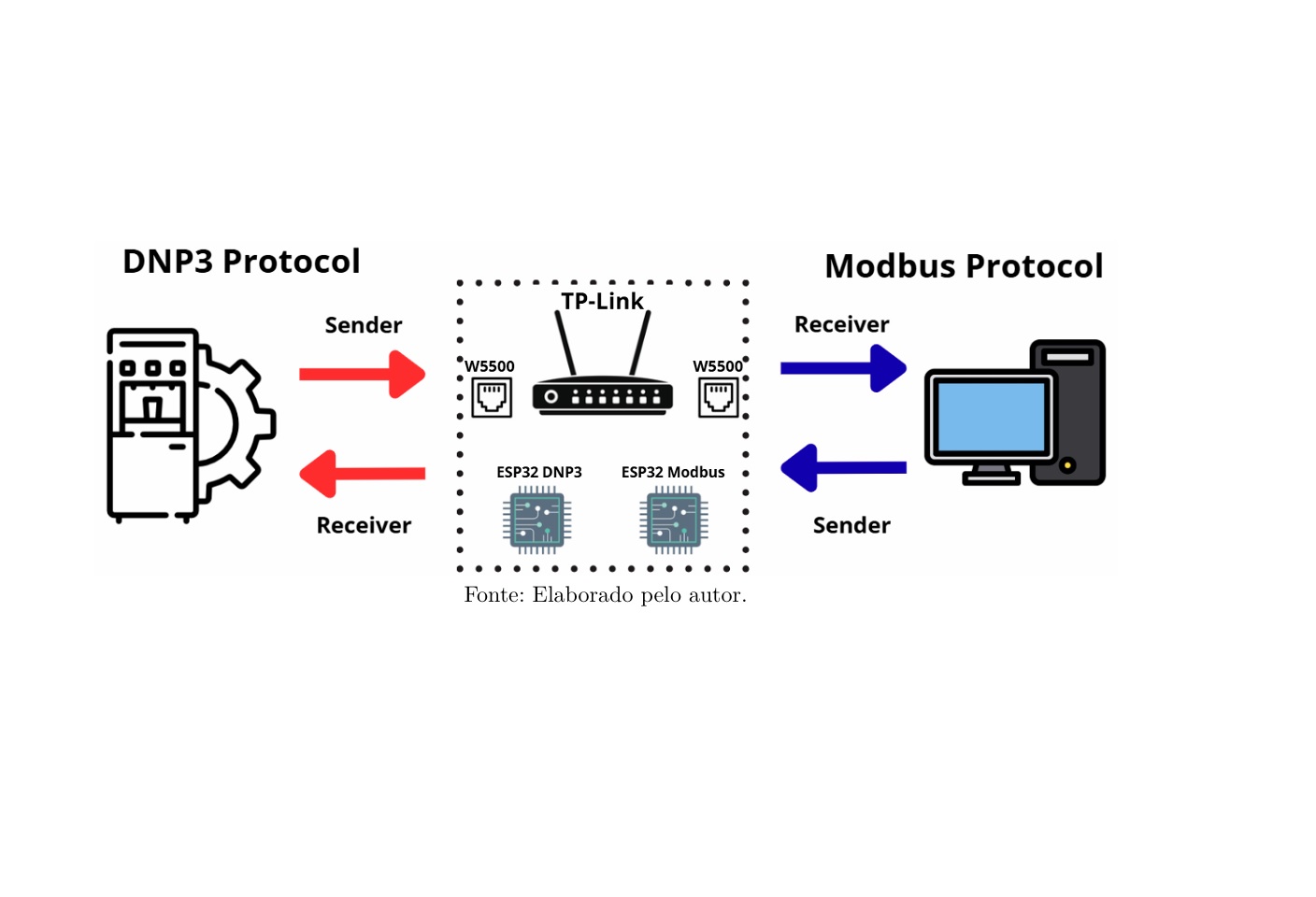
At a high level, the gateway is designed as a two-stage pipeline:
- ESP32 #1 receives Protocol A over Ethernet → parses and maps data → sends an internal representation over UART
- ESP32 #2 receives that internal representation → rebuilds Protocol B → outputs Protocol B over Ethernet
The thesis specifies the UART interconnect (115200 baud) and uses a LAN test setup to isolate and measure each stage.
What W5500 does in this design
In this project, W5500 is the wired Ethernet interface that makes the ESP32 boards reliable LAN endpoints for TCP/IP traffic. The thesis explicitly notes W5500 characteristics such as SPI Ethernet integration, 8 simultaneous connections, and 32 KB internal buffer, and it uses one W5500 per ESP32 to implement the gateway’s network-facing endpoints.
Results: latency & behavior
The thesis measures latency per segment (Table 8), reporting millisecond-level averages such as:
- Modbus ESP32 → DNP3 ESP32: 4.38 ms (avg)
- DNP3 ESP32 → PC: 3.24 ms (avg)
- DNP3 ESP32 → Modbus ESP32: 5.52 ms (avg)
- Modbus ESP32 → PC: 3.58 ms (avg)
It also explains why DNP3→Modbus tends to be slower—additional processing plus the UART handoff.
Commercial gateways vs. the prototype
The thesis compares against commercial devices (e.g., Moxa/Siemens examples) and frames the ESP32+W5500 build as a low-cost, high-flexibility reference rather than a drop-in replacement for certified industrial gear. A comparison table highlights prototype advantages such as low estimated cost and open code, contrasted with higher-cost commercial gateways that offer industrial robustness and vendor tooling.
Limitations & lessons learned
This is one of the strongest parts of the write-up: it documents practical failure modes and integration issues, including:
Packet loss / backlog under aggressive update timing and load
W5500 initialization issues after power cycling, with discussion of SPI timing/reset handling and suggested recovery strategies
Watchdog-related resets under certain conditions
Future work
Proposed next steps include:
- Dynamic configuration (IP/port) via UI or config system
- FreeRTOS task separation, UART flow-control improvements, buffering upgrades
- More robust W5500 fault detection and recovery/logging
Why this content matters
- For automation learners/researchers: a reproducible example of how a real gateway is structured, tested, and benchmarked.
- For legacy integration: shows a practical path to connect Modbus-only equipment to DNP3-centric SCADA ecosystems.
- For WIZnet makers: a concrete reference of W5500 used as the network backbone of an industrial protocol gateway, including measured latency and documented edge cases (like power-cycle initialization pitfalls).
ESP32 + W5500 기반 DNP3 ↔ Modbus TCP 양방향 프로토콜 컨버터 (UFSC TCC)
Introduction
본 컨텐츠는 UFSC(Universidade Federal de Santa Catarina)에서 공개된 학부 졸업작품(TCC) **「DNP3와 Modbus 프로토콜 간 변환 시스템 개발」**로, 산업·에너지 자동화 환경에서 빈번히 발생하는 서로 다른 산업용 프로토콜(DNP3 ↔ Modbus TCP) 간 통합 문제를 저비용 임베디드 하드웨어로 해결하는 레퍼런스입니다.
TCC는 브라질 대학에서 쓰는 약어로, Trabalho de Conclusão de Curso(코스/학위 졸업(종합)과제, Final Course Project/Final Paper)라는 뜻이에요. 대부분 학부 과정에서 졸업 요건으로 제출하는 논문/모노그래프/프로젝트 보고서를 말합니다.
핵심은 간단합니다:
ESP32 2대를 UART로 연결해 변환 파이프라인을 분리하고,
각 ESP32를 WIZnet W5500 Ethernet으로 유선 LAN에 붙여,
Modbus TCP ↔ DNP3 TCP 변환을 “양방향”으로 구현합니다.
Overview
목표: Modbus TCP 기반 장비와 DNP3 TCP 기반 장비를 “투명하게” 연결하는 양방향 게이트웨이/컨버터
구현: ESP32-WROOM-32 2대 + UART interconnect + 각 1개씩 W5500 Ethernet 모듈
테스트 환경: 로컬 Ethernet 네트워크에서 송신/수신 클라이언트를 구성해 실제 변환 흐름과 지연을 검증
결론(논문 요약): 변환이 양방향으로 정상 동작하며, ms 단위 지연이 비핵심(저위험) 산업용 적용에 적합하다는 결과
Quick background: What is DNP3?
이 논문의 주제(“DNP3 ↔ Modbus”)를 이해하려면, DNP3가 어떤 분야에서 쓰이는지 짧게 짚는 게 좋습니다.
**DNP3(Distributed Network Protocol 3)**는 전력·수도 같은 **유틸리티 SCADA(원격감시제어)**에서 널리 쓰이는 통신 프로토콜로 소개됩니다.
산업계에서 DNP3는 IEEE Std 1815로도 알려져 있으며, 유틸리티 환경에서 원격 데이터 교환을 염두에 두고 설계된 표준으로 설명됩니다.
또한 DNP3는 “Secure Authentication(DNP3-SA)”처럼 응용 계층 수준의 인증 메커니즘이 문서화/논의되는 프로토콜로도 자주 언급됩니다.
반면 Modbus는 공장 자동화/프로세스 제어에서도 광범위하게 쓰이는 단순하고 보편적인 프로토콜로 요약되는 경우가 많고, 이 때문에 현장에서는 “Modbus 장비 ↔ DNP3 SCADA”를 연결하는 게이트웨이 수요가 생깁니다.
DNP3는 주로 유틸리티(전력·수도 등) SCADA에서 많이 쓰입니다. 특히 북미 전력 유틸리티에서 채택이 매우 높다는 자료가 있고, 한 설문 요약에서는 북미 전력 유틸리티의 94%가 SCADA에 DNP3를 사용한다고 보고합니다. 또한 NIST 문서도 DNP3가 북미 전력에서 광범위하게 쓰이고, water/wastewater·oil&gas 등으로도 사용된다고 정리합니다.
“DNP3 시장 규모”는 보통 프로토콜 자체보다는 DNP3 게이트웨이/SCADA 장비 시장의 일부로 잡히며, 일부 민간 리서치는 DNP3 게이트웨이 시장을 별도로 추정치로 제시하지만(예: 2024년 약 $1.18B), 이는 공식 통계가 아닌 참고용으로 다루는 게 안전합니다.
Related VAR (DNP3 VAR Product)
- VAR1 : https://maker.wiznet.io/matthew/resellers/pmi-dc-battery-charger/
- VAR2: https://maker.wiznet.io/matthew/resellers/industrial-shields-arduino-plc-for-automation-monitoring-and-control/
Author & Context
저자: Pedro Henrique Nogacz
지도교수: Prof. Ciro André Pitz
UFSC Campus Blumenau, Engenharia de Controle e Automação TCC로 등록되어 있으며, 리포지터리 페이지의 초록에서 프로젝트 목적/구성(ESP32 2대 + UART + W5500 Ethernet)이 명확히 요약됩니다.
Architecture & Data Flow
이 시스템의 데이터 흐름은 “프로토콜 A를 받은 ESP32가 해석 → UART로 전달 → 다른 ESP32가 프로토콜 B로 재구성”이라는 모듈러 파이프라인입니다.
두 ESP32는 UART 115200 baud로 연결되며, 한쪽은 Modbus→DNP3, 다른 한쪽은 DNP3→Modbus 역할을 맡습니다.
테스트 구성은 “송신 클라이언트 ↔ 변환기(ESP32 2대) ↔ 수신 클라이언트”로 분리되어, 변환 과정에서의 지연/병목을 로그로 추적합니다.
W5500은 여기서 무엇을 하나?
이 작품에서 W5500은 단순 부품이 아니라, 유선 TCP/IP 통신을 안정적으로 제공하는 핵심 인터페이스입니다.
논문은 W5500을 다음처럼 설명합니다:
W5500은 SPI 인터페이스를 갖는 Ethernet 컨트롤러로, 임베디드 장치의 TCP/IP 연결에 적합
최대 8개 동시 연결과 32kB 내부 버퍼를 지원
본 프로젝트에서는 각 ESP32에 W5500을 1개씩 연결해 로컬 Ethernet에서 안정적인 통신을 수행
또한 테스트 네트워크는 스위치로 동작하는 TP-Link 장비에 모두 물려 고정 IP 기반 로컬망에서 진단과 재현성을 높였다고 설명합니다.
Results: 성능/지연/안정성
변환 지연은 각 단계별로 ms 단위로 계측되어 표로 정리됩니다(“Tabela 8”).
예시(평균):
Modbus ESP32 → DNP3 ESP32: 4.38 ms
DNP3 ESP32 → PC: 3.24 ms
DNP3 ESP32 → Modbus ESP32: 5.52 ms
Modbus ESP32 → PC: 3.58 ms
저자는 DNP3→Modbus 변환이 더 느린 이유를 “추가 처리 + UART 데이터 교환” 때문이라고 설명하며, 표준편차가 0.2ms 이하로 낮아 시간적 안정성이 있음을 강조합니다.
상용 게이트웨이와의 비교: “왜 굳이 ESP32로?”
논문은 상용 게이트웨이(예: Moxa MGate 5109, Siemens TIM/SINAUT)를 예로 들며, 프로토타입의 포지션을 분명히 합니다.
상용 장비는 견고성과 산업 인증/지원이 강점이지만, 가격대가 높고 구성/도구 종속이 큼
비교표(“Tabela 9”)에서는 프로토타입의 강점을
저비용(추정 R$240)
코드 오픈(“Sim”)
유연성(Alta)
로 정리합니다.
즉, 이 컨텐츠는 “바로 공장 핵심 공정에 투입”이라기보다, 교육/테스트/연구/레거시 통합 같은 영역에서 “빠르게 만들고 바꿔 쓰는” 게이트웨이 레퍼런스를 제공합니다.
Limitations & Lessons Learned
현장 적용 관점에서 가장 가치 있는 부분은 “실제로 부딪힌 문제”를 구체적으로 적은 대목입니다.
고부하/짧은 주기(0.5s)에서는 패킷 손실·메시지 누적이 관측되고, UART 구간이 병목이 될 수 있다고 설명합니다.
전원 사이클에 따라 W5500이 초기화 실패를 일으켜 TCP 통신이 막힐 수 있으며, 원인 후보로 SPI 초기화 타이밍/리셋 펄스를 지목하고 “상태 확인 + 재초기화 루틴”을 제안합니다.
결론 파트에서는 UART 취약성과 더불어 watchdog(INT_WDT) 연관 재시작, W5500 초기화 실패 등을 명시적으로 언급합니다.
Future Work
개선 방향도 “바로 다음 버전에서 할 일” 수준으로 구체적입니다.
IP/포트의 동적 설정(웹 설정/UI 등)
FreeRTOS로 태스크 분리, UART 흐름 제어, 버퍼(링 버퍼 등) 최적화
W5500 장애 감지, 지속 로그, watchdog 세분화
Where this content has impact
산업·에너지 자동화에서 “DNP3 ↔ Modbus 통합”을 저비용으로 검증하려는 팀
교육/연구/실험실에서 DNP3/Modbus/TCP 게이트웨이 개념을 재현하려는 커리큘럼
WIZnet Maker 관점에서는, W5500이 “단순 네트워크 모듈”이 아니라 프로토콜 게이트웨이 설계의 핵심 인터페이스로 쓰이며, 성능 측정·상용 비교·실패 모드(전원 사이클 초기화 실패)까지 포함해 학습할 수 있는 좋은 사례입니다.
원문 링크
UFSC 리포지터리(메타/초록): https://repositorio.ufsc.br/handle/123456789/266826
PDF: https://repositorio.ufsc.br/bitstream/handle/123456789/266826/Pedro_Nogacz___TCC.pdf?sequence=1&isAllowed=y