



A high-performance, portable, field-deployable gas analyzer
This project demonstrates how WIZ750SR and PoE can transform high-fidelity serial laboratory sensors into an open, field-deployable, single-cable scientific mea
Portable Gas Sensor Module: A Field-Deployable O₂, CO, and CO₂ Analyzer Networked with WIZ750SR and PoE
Summary
Developed by UL Research Institutes’ Fire Safety Research Institute, this open-hardware gas analyzer uses three WIZ750SR serial-to-Ethernet modules to network high-fidelity O₂, CO, and CO₂ sensors through a single external PoE cable.
Overview
Large-scale fire experiments may require gas-concentration measurements at several locations inside or around a structure. Conventional high-accuracy paramagnetic and NDIR analyzers are often rack-mounted, requiring long sampling tubes between each measurement point and a centralized analyzer rack.
That arrangement introduces several practical challenges:
- Long gas-sampling lines
- Delayed response caused by tubing volume
- Separate cables for power and data
- Limited portability
- Dependence on centralized data-acquisition hardware
- Dependence on proprietary logging and visualization software
The Portable Gas Sensor Module was designed to reduce those requirements by placing the analyzer closer to the sampling location.
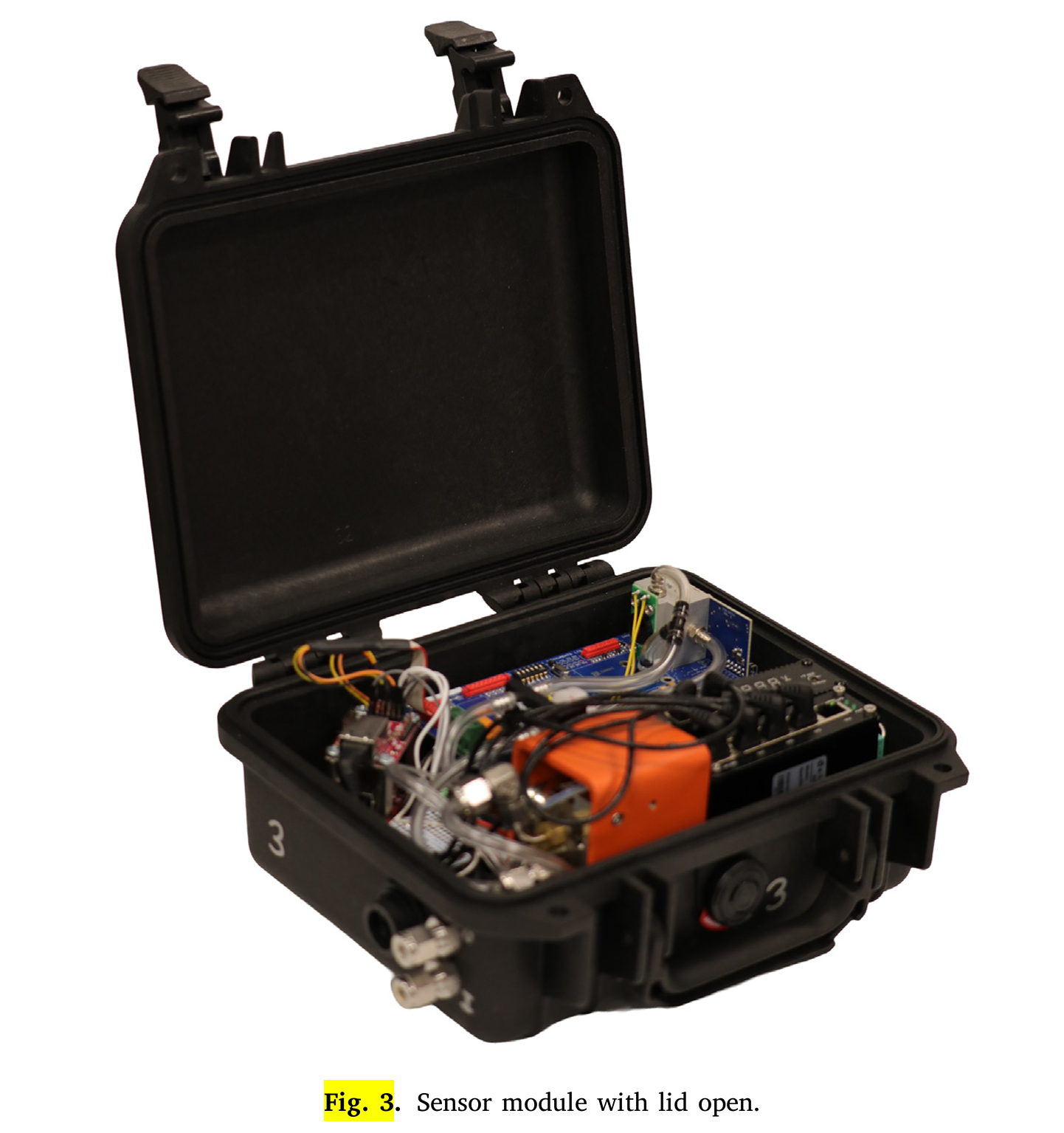
It integrates:
- A paramagnetic O₂ sensor
- An NDIR CO sensor
- An NDIR CO₂ sensor
- Three WIZnet serial-to-Ethernet servers
- A four-port Ethernet switch
- A PoE splitter
- 24V, 5V, and 3.3V power distribution
- Gas fittings and serial plumbing
- A Python dashboard and CSV logger
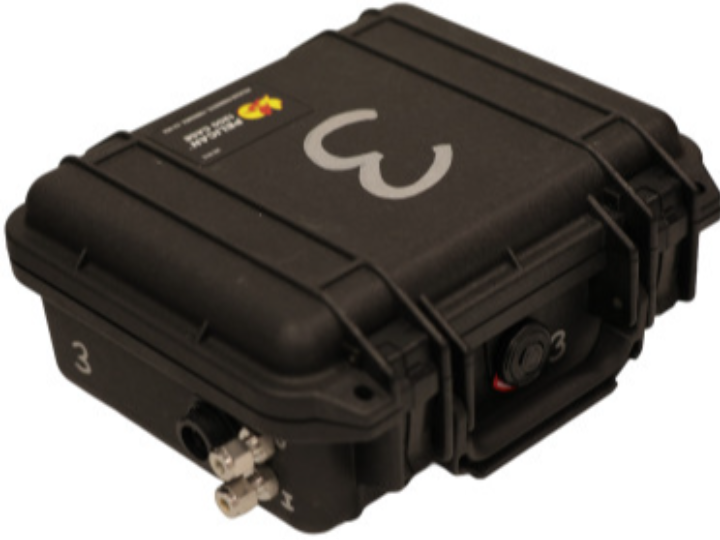
- A portable carrying case
The external field connection is reduced to one Ethernet cable carrying both network data and PoE power.
The GitHub repository explains that the module was initially developed to support a portable, modular phi meter for measuring global equivalence ratio in large-scale fire experiments. It was also intended to support other experiments conducted by FSRI and similar institutions.
About the Authors
Mark B. McKinnon
Mark B. McKinnon led the project’s conceptualization, project administration, investigation, and original manuscript preparation. The paper describes him as a Fire Safety Research Institute research engineer with an M.S. in Fire Protection Engineering and a Ph.D. in Mechanical Engineering from the University of Maryland. His work includes experimental apparatus development, material flammability, fire modeling, lithium-ion battery energy-storage fires, and large-scale fire experiments.
FSRI’s current staff profile identifies McKinnon as a Principal Research Engineer. His background includes developing and instrumenting a bench-scale gasification apparatus, characterizing materials for pyrolysis models, managing laboratory operations, and designing experimental systems. (FSRI)
This context is important: the analyzer was not developed as a generic IoT demonstration. It was created by a fire-science researcher experienced in instrumentation, combustion experiments, and laboratory apparatus design.
Ian Brady
Ian Brady contributed to investigation, validation, and manuscript review and editing.
Brady entered the project through the FSRI Fellowship Program while studying Fire Protection Engineering at the University of Maryland. His research expanded the sensor module into a portable, modular, multi-point phi meter for analyzing combustion conditions and toxic smoke in compartment fires. After completing the fellowship, he was hired by FSRI as a research engineer. (FSRI)
His project was supervised through a collaboration involving University of Maryland faculty, FSRI researchers, and laboratory personnel. This illustrates how the instrument developed through a structured university–research-institute program rather than as an isolated student prototype. (FSRI)
About UL Research Institutes and FSRI
UL Research Institutes
UL Research Institutes, or ULRI, is an independent safety-science organization with global reach. It emphasizes rigorous and objective research, collaboration, transparency, and broad public access to the knowledge it creates. (UL Research Institutes)
ULRI is part of the broader UL enterprise that evolved from Underwriters Laboratories. The publication of this instrument by a ULRI research institute does not mean that the analyzer is a UL-listed, certified, or commercially qualified safety product. It is an open research instrument described in a HardwareX article.
Fire Safety Research Institute
The Fire Safety Research Institute, or FSRI, is part of UL Research Institutes and is based in Columbia, Maryland. Its research addresses unresolved fire-safety risks through full-scale testing, field testing, modeling, experimental measurement, and education. Its work has historically covered fire dynamics and firefighter tactics in residential, commercial, and industrial structures, while expanding into emerging hazards, firefighter health, fire investigation, and public-safety education. (FSRI)
FSRI also publishes research reports, journal articles, data portals, videos, training courses, and educational materials so that findings can be used by firefighters, researchers, engineers, investigators, and policymakers. (UL Research Institutes)
University of Maryland Fellowship Program
FSRI’s Fellowship Program supports graduate research assistants enrolled in the University of Maryland Department of Fire Protection Engineering.
Research projects are developed jointly by FSRI and the university. Fellows conduct much of their work at FSRI’s Columbia facility under both a University of Maryland faculty advisor and an FSRI supervisor. (FSRI)
The gas analyzer demonstrates the practical value of this model:
University of Maryland
Academic supervision and graduate research
                 │
                 ▼
FSRI Fellowship Program
Full-scale facilities and experimental needs
                 │
                 ▼
Open Research Instrument
Hardware + software + validation + publication
For WIZnet, this organizational structure is relevant because it provides a route beyond individual university laboratories. A successful connectivity component can be adopted through a combined university, research-institute, and full-scale experimental program.
What Is the Portable Gas Sensor Module?
The module combines three high-fidelity gas-sensing technologies in one case.
| Measurement | Sensor technology | Paper-described characteristic |
|---|---|---|
| O₂ | Hummingbird Premus Delta paramagnetic sensor | Digital output, wide-range and stable oxygen measurement |
| CO | Edinburgh Instruments Gascard NG NDIR sensor | Calibrated for 0–10 vol.% CO |
| CO₂ | Edinburgh Instruments Gascard NG NDIR sensor | Calibrated for 0–10 vol.% CO₂ |
Paramagnetic oxygen sensing offers greater stability and a wider useful range than many compact electrochemical oxygen sensors, but it normally appears in larger analyzer systems and is sensitive to vibration.
The CO and CO₂ channels use non-dispersive infrared sensing, selected for high-fidelity measurement over concentration ranges relevant to combustion research.
This instrument is not a personal gas alarm or a certified confined-space monitor. It is a research analyzer intended to quantify gas composition in controlled fire and combustion experiments.
Project at a Glance
| Item | Publicly documented information |
|---|---|
| Hardware name | Portable gas sensor module |
| Primary field | Fire science and combustion research |
| Measured gases | O₂, CO, and CO₂ |
| Sensor interfaces | RS-232 ×2 and TTL UART ×1 |
| WIZnet interface | WIZ750SR-family serial-to-Ethernet servers ×3 |
| Network mode | Static IPv4, TCP server |
| Listening port | TCP 5000 |
| Internal network | Four-port Ethernet switch |
| External connection | One Ethernet cable carrying PoE and data |
| Visualization | Python Dash browser dashboard |
| Data logging | CSV at 2Hz |
| Power architecture | PoE splitter with 24V, 5V, and 3.3V rails |
| Startup power | Approximately 20W |
| Steady-state power | Approximately 14W |
| Sample flow | Approximately 200mL/min |
| Paper-listed module cost | USD 4,924.88 |
| Hardware license | CERN-OHL-P-2.0 |
| Article license | CC BY 4.0 |
The system diagram on page 2 shows the primary data path from gas sensors to serial servers, Ethernet switch, and computer. The exploded drawing on page 4 shows how the sensors, serial servers, PoE equipment, power boards, and enclosure are physically integrated.
System Architecture
Data and Power Path
Computer or Laboratory Network
              │
              │ Ethernet data
              ▼
        PoE++ Injector
              │
              │ One Cat 6A cable
              │ Power + Ethernet
              ▼
      Module Bulkhead Port
              │
              ▼
          PoE Splitter
       ┌──────┴───────────────┐
       │                      │
       │ Ethernet data        │ 24VDC
       ▼                      ▼
 Four-Port Ethernet      Power Distribution
        Switch           ├─ 24V → CO sensor
         │               ├─ 24V → CO₂ sensor
         │               ├─ 5V  → O₂ sensor
         │               └─ 3.3V → Serial servers
    ┌────┼──────────┐
    ▼    ▼          ▼
 WIZ750SR WIZ750SR WIZ750SR
  RS-232   RS-232      TTL
    │        │          │
   CO       CO₂         O₂
The “single-cable” claim refers to the external connection between the field module and the host-side PoE infrastructure. Inside the enclosure, a PoE splitter separates 24VDC power from Ethernet data, while the Ethernet switch and local wiring distribute data and power to the individual components.
The WIZ750SR modules do not receive PoE directly. They are powered from the internal 3.3V rail created by the module’s power-distribution circuit.
Gas-Sampling Path
External Pump, Filter, and Dryer
               │
               │ Conditioned sample gas
               ▼
       Paramagnetic O₂ Sensor
               │
               ▼
          NDIR CO Sensor
               │
               ▼
         NDIR CO₂ Sensor
               │
               ▼
       Ventilation or Exhaust
The pump was deliberately kept outside the analyzer enclosure because vibration can affect the paramagnetic oxygen sensor. A separate sampling module filters, dries, and pumps the gas at approximately 200mL/min.
The sensors are connected in series to reduce tubing volume and simplify installation. The sequence also explains the small difference in measured response time among the three gas channels.
Role of the WIZnet WIZ750SR
Three Serial Sensors, Three Network Endpoints
The detailed communications documentation supports the following configuration:
| Sensor | Serial interface | Serial configuration | Network role |
|---|---|---|---|
| CO NDIR | RS-232 | 57,600 baud, 8-N-1 | Static-IP TCP server |
| CO₂ NDIR | RS-232 | 57,600 baud, 8-N-1 | Static-IP TCP server |
| O₂ paramagnetic | TTL UART | 19,200 baud, 8-N-1 | Static-IP TCP server |
The paper refers to the devices as WIZnet serial servers and cites the WIZ750SR user manual, Configuration Tool, virtual serial-port software, and web-configuration guide.
WIZ750SR is a compact serial-to-Ethernet module based on WIZnet’s W7500P Ethernet MCU. The family is available with TTL, RS-232, and RS-422/485 serial interfaces, supports 10/100Mbps Ethernet, and provides configurable TCP/IP and serial settings. (docs.wiznet.io)
The paper’s bill of materials does not print the complete product suffixes. Based on the documented interface count, the implementation corresponds to two WIZ750SR-RS232 channels and one WIZ750SR-TTL channel.
Network Configuration
Each serial server was configured as an independent network endpoint.
| Setting | Documented configuration |
|---|---|
| IPv4 assignment | Static |
| Host computer IP | 192.168.11.3 |
| Gateway | 192.168.11.1 |
| Subnet mask | 255.255.255.0 |
| Operating mode | TCP server |
| Local port | 5000 |
| Device identity | Unique static IP and MAC address |
| COM-port mapping | Final IP octet matched the virtual COM number |
| Example | 192.168.11.11:5000 mapped to COM11 |
The researchers used WIZnet Configuration Tool to define the serial and network settings. WIZVSP then mapped each TCP endpoint to a Windows virtual COM port, allowing the existing serial-oriented acquisition software to access the remote sensors. Strict baud-rate emulation and raw-data transmission were enabled.
Why a Finished Serial-to-Ethernet Module Matters
The research team did not need to develop:
- A custom Ethernet PCB
- A separate MCU firmware project
- A TCP server implementation
- A serial-packet bridge
- A network configuration interface
- A virtual serial-port driver
Instead, each sensor’s existing digital serial output was connected to a WIZ750SR and exposed as a TCP server.
That allowed the researchers to focus on:
- Sensor selection
- Gas plumbing
- Calibration
- Pressure and temperature compensation
- Mechanical integration
- Power conversion
- Field deployment
- Data visualization
- Measurement validation
The official WIZ750SR product includes its own serial-to-Ethernet firmware and supports configuration tools, WIZVSP, TCP server/client modes, UDP, and firmware source access. (docs.wiznet.io)
The WIZ750SR source includes WIZnet socket APIs and implements TCP client, TCP server, mixed, and UDP operating modes.
PoE and Single-Cable Deployment
The researchers used an IEEE 802.3bt Type 4 PoE++ injector and a compatible splitter.
The module draws:
- Approximately 20W during startup
- Approximately 14W during steady operation
The paper notes that lower-power PoE standards would probably be sufficient, but only the Type 4 arrangement was tested. IEEE 802.3at and Type 3 compatibility should therefore be treated as a likely possibility, not a validated result.
The value of PoE is not limited to eliminating a wall adapter. It also allows the analyzer to be installed closer to the sampling point.
Shorter gas lines can reduce:
- Sampling delay
- Tubing volume
- Condensation risk
- Installation complexity
- The number of cables routed through a test structure
For multi-point experiments, several modules can be connected through external network switching and PoE infrastructure. The paper describes this scaling direction but does not publish a maximum node count, synchronization benchmark, or aggregate network-load test.
Data Acquisition and Visualization
The Collect_Gas_Data.py application reads all three sensor channels and creates both a browser dashboard and a CSV log.
Three Virtual COM Ports
            │
            ▼
      Python + pyserial
            │
       ┌────┼────────────┐
       ▼    ▼            ▼
 Numeric   Plotly     raw_data_log.csv
 Values    Chart
The dashboard displays:
- Instantaneous O₂ concentration
- Instantaneous CO concentration
- Instantaneous CO₂ concentration
- A live time-series chart
- Acquisition runtime
Both visualization and CSV logging update at 2Hz. The documented software environment includes Python 3.12+, Dash 3.2+, pyserial 3.5+, and Plotly 5.24+.
The paper describes Python as operating-system agnostic, but the published virtual-COM configuration was tested only on Windows 11. The complete workflow should therefore not yet be described as validated on every desktop operating system.
A future direct-TCP Python client could remove the virtual-COM dependency and make Linux and macOS deployment more straightforward. That is a logical extension of the architecture, not a feature of the current published implementation.
Open Hardware and Reproducibility
The open archive includes:
Sensor_Module_Assembly.stpMounting_Plate.stpPlumbing_Diagram.pdfElectrical_Diagram.pdfComms_Diagram.pdf- Python data-acquisition scripts
- Visualization code
- Component manuals
- Configuration guides
- A detailed bill of materials
- Manuscript figures
The GitHub repository is organized into:
01_Design02_Controls03_Documentation
It separates editable geometry and schematics from control software and setup documentation.
The current Zenodo v1.2 release adds a Python requirements.txt file and includes the figures from the HardwareX manuscript. Zenodo identifies Mark McKinnon as project leader and Ian Brady as researcher. (Zenodo)
Cost Structure
The paper lists a total module hardware cost of USD 4,924.88.
The three gas sensors account for approximately USD 4,192, or about 85.1% of the paper-listed total. The two RS-232 serial servers and one TTL serial server together cost USD 85.16, or about 1.7% of the total. These percentages are calculated from Table 2.
The meaning of “low cost” is therefore relative.
This is not an inexpensive consumer gas detector. It is a high-fidelity measurement system in which the sensors dominate the cost, while a comparatively small networking investment converts them into remotely accessible instruments without a proprietary DAQ platform.
The paper-listed cost may not include the complete external sampling system, calibration gases, PoE injector, host computer, or all supporting laboratory infrastructure.
Validation and Characterization
Calibration
The NDIR sensors were calibrated using:
- Ultra-high-purity N₂ for zero
- A nominal mixture of 5 vol.% CO, 10 vol.% CO₂, and balance N₂ for span
The oxygen sensor was calibrated using:
- Ultra-high-purity N₂ for zero
- Synthetic air or high-purity O₂ for span
Because the gas-sensor responses depend on temperature, pressure, and flow, calibration conditions should match experimental conditions as closely as possible. The paper also describes pressure and temperature compensation for the NDIR and paramagnetic sensors.
The authors recommend:
- Approximately 30 minutes of warm-up
- Full calibration before each test series
- A daily bump test using known gas concentrations
- A controlled flow near 200mL/min
Response Time
The observed T90 response times were:
| Gas | T90 response time |
|---|---|
| O₂ | 2.7s |
| CO | 2.9s |
| CO₂ | 3.1s |
The sequence is consistent with the serial gas path. The sample reaches the O₂ sensor first, followed by the CO sensor and then the CO₂ sensor.
The authors also note that downstream analysis may need to shift the channels in time to compensate for transport delay and sensor-response differences.
Repeatability and Steady-State Error
| Gas | Nominal concentration | Repeatability standard deviation | Steady-state error |
|---|---|---|---|
| O₂ | 20.95 vol.% | 0.03 vol.% | -1.09 vol.% |
| CO | 5.16 vol.% | 0.01 vol.% | +0.15 vol.% |
| CO₂ | 10.01 vol.% | 0.02 vol.% | +0.41 vol.% |
The paper reports less than 0.2% deviation between replicate cycles under the tested conditions.
The manuscript also summarizes the measurements as being within 5% of the known gas concentrations. However, the rounded O₂ values in Table 6 imply a relative error slightly above 5%. Presenting the individual table values is therefore more precise than repeating a single blanket accuracy figure.
These are author-reported results under the documented calibration, flow, pressure, and temperature conditions. They are not an independent third-party certification of the analyzer.
Environmental and Safety Boundaries
The paper derives the following practical sample-gas limits from the installed components:
| Condition | Practical operating boundary |
|---|---|
| Gas temperature | No more than approximately 45°C |
| Humidity | Non-condensing |
| Particle filtration | At least 3µm |
| Gauge pressure | Approximately 0.15bar or less |
| O₂-sensor flow | No more than approximately 200mL/min |
The system may be exposed to hazardous gases, reduced oxygen, carbon monoxide, soot, hot combustion products, compressed calibration gas, moisture, and energized electrical hardware.
The paper instructs users to:
- Direct exhaust to ventilation when not operating outdoors
- Secure compressed-gas cylinders
- Inspect regulators and valves
- Use appropriate PPE
- Inspect electrical and grounding connections before energizing
- Perform electrical inspection only while de-energized
- Keep the case lid closed while powered
- Prevent condensed moisture from reaching electrical components
The use of a rugged carrying case does not establish an ingress-protection rating for the completed analyzer. The case was modified with gas and Ethernet bulkhead openings, and no assembled-system IP rating or fire-scene environmental certification is reported.
Why This Architecture Matters
Networking Scientific Instruments Without a Custom DAQ
Each gas sensor already produces calibrated digital serial data.
Rather than routing the signals into a custom analog DAQ or developing a bespoke embedded controller, the researchers converted each serial channel into an independent TCP endpoint.
This architecture can apply to many scientific and industrial instruments:
- Gas analyzers
- Flow meters
- Laboratory balances
- Spectrometers
- Environmental chambers
- Calibration equipment
- Furnaces
- Legacy serial instruments
- Industrial sensor modules
The WIZ750SR does not interpret gas concentration or perform calibration. It transparently moves the existing digital sensor data onto Ethernet.
Small Networking Cost Around High-Value Sensors
The WIZnet communication hardware represents only about 1.7% of the listed module cost, while the sensors represent about 85.1%.
That small connectivity investment provides:
- Long-distance wired communication
- Stable device identity
- Independent access to each sensor
- Compatibility with serial-oriented software
- Multi-module scalability
- Reduced dependence on proprietary DAQ hardware
- Single-cable deployment when combined with PoE
A Scientific-Instrumentation Use Case for WIZ750SR
WIZ750SR is often positioned for industrial serial-device retrofit. This project demonstrates a second market: network-enabling high-value scientific instruments.
Relevant fields may include:
- Fire and combustion research
- Lithium-ion battery fire testing
- Smoke-toxicity studies
- Industrial-emissions research
- Environmental monitoring
- Indoor-air research
- Multi-point process measurement
- University laboratory modernization
- Portable field-test systems
These are potential application areas derived from the architecture. The published analyzer is not certified or documented as deployed across all of them.
Potential Follow-Up Directions
Direct TCP Acquisition
The current workflow maps the three WIZ750SR endpoints to virtual COM ports before Python reads them.
A direct TCP implementation could provide:
- Native Linux and macOS support
- Elimination of virtual-COM software
- Automatic endpoint discovery
- Connection health monitoring
- Automatic reconnection
- Centralized management of several analyzer modules
- Network-based timestamping
This would preserve the existing WIZ750SR TCP-server configuration while simplifying the host-side architecture.
Integrated Multi-Channel Gateway
The current module uses three independent WIZ750SR boards and an Ethernet switch.
A future integrated instrument gateway could combine:
- Two RS-232 channels
- One TTL or RS-485 channel
- PoE input
- Per-channel isolation
- Managed power rails
- Local timestamping
- Data buffering
- Direct CSV, MQTT, or database output
This is a product-development possibility derived from the paper’s architecture, not part of the current design.
Single Pair Ethernet
WIZnet’s WIZ750SR-T1L combines the W7500 with an external 10BASE-T1L PHY and supports serial-to-Ethernet communication over one wire pair for distances up to 1.2km. (docs.wiznet.io)
That product could be relevant when research instruments must be distributed over long distances with lighter cabling.
However, the present gas analyzer uses conventional 10/100BASE-T Ethernet and consumes approximately 14W in steady operation. A future T1L version would require a separate power analysis. The current instrument should not be described as directly portable to SPE or PoDL without additional hardware engineering.
Related WIZnet Maker Projects
1. Remote Serial Device Control with WIZ750SR
This Maker Site project presents WIZ750SR as a transparent bridge between RS-232 or RS-485 equipment and TCP/IP systems used for remote control and SCADA integration. (WIZnet Makers)
Common ground
- Serial-to-Ethernet conversion
- WIZ750SR configuration tools
- Remote access to legacy serial devices
- Static or managed IP configuration
Key difference
Remote Serial Device Control is a general industrial retrofit example. The Portable Gas Sensor Module incorporates three commercial-grade sensing channels, gas plumbing, PoE power, mechanical integration, calibration, and measurement validation in a complete scientific instrument.
2. Yaugi 4: GPIB Ethernet PoE Adapter
Yaugi 4 uses W5500 and PoE to connect legacy GPIB laboratory equipment to modern Ethernet-based control systems. (WIZnet Makers)
Common ground
- Modernization of scientific instruments
- Network access to a legacy interface
- Single-cable PoE deployment
- Open-source laboratory hardware
Key difference
Yaugi 4 is an external adapter for existing GPIB instruments. The gas analyzer integrates the sensors, serial converters, power system, fluid path, enclosure, and validation process into one instrument.
3. EtherSense
EtherSense uses an STM32F103 and W5500 to acquire and stream sensor data over UDP in a FreeRTOS-based embedded system. (WIZnet Makers)
Common ground
- Wired Ethernet sensor data
- Distributed measurement
- Fixed network infrastructure
- Real-time host acquisition
Key difference
EtherSense requires custom MCU firmware for acquisition and W5500 networking. The gas module uses OEM sensors with existing serial protocols and finished WIZ750SR converters, allowing the researchers to avoid developing a custom network firmware stack.
Comparison at a Glance
| Project | Instrument interface | WIZnet role | Main distinction |
|---|---|---|---|
| Remote Serial Device Control | RS-232 / RS-485 | WIZ750SR transparent S2E | General SCADA and industrial retrofit |
| Yaugi 4 | GPIB | W5500 Ethernet and PoE adapter | External adapter for legacy instruments |
| EtherSense | MCU sensor interface | W5500 UDP networking | Custom embedded sensor node |
| Portable Gas Sensor Module | RS-232 ×2 + TTL ×1 | Three WIZ750SR TCP servers | Complete scientific instrument with sensors, plumbing, power, and validation |
Open-Source Scope and Limitations
Confirmed by the Public Sources
- Paramagnetic O₂ measurement
- NDIR CO and CO₂ measurement
- Three WIZnet serial-to-Ethernet servers
- Static-IP TCP-server configuration
- TCP port 5000
- One external PoE/Ethernet cable
- Python visualization and CSV logging
- CAD, wiring, plumbing, and communication diagrams
- Detailed bill of materials
- Calibration procedures
- Response-time characterization
- Repeatability measurements
- Open hardware and software archive
Not Established by the Public Sources
- Certified life-safety gas-monitoring use
- UL product listing or certification
- Independent third-party replication
- Exact WIZ750SR suffixes in the bill of materials
- Exact WIZ750SR firmware version
- Maximum multi-module network size
- Network latency or packet-loss performance
- Cross-module time synchronization
- Lower PoE-class compatibility
- Completed-enclosure IP rating
- Long-duration fire-scene qualification
- Cross-platform validation of the virtual-COM workflow
- Encrypted transport or authenticated host access
The paper configures each channel as a TCP server on port 5000 but does not describe an encrypted transport, network segmentation policy, or connection-password setting.
WIZ750SR supports features such as configuration passwords, TCP keep-alive, and several operating modes, but the article does not state which optional protections were enabled. The intended deployment assumption should therefore be a trusted laboratory network or an isolated field network. (docs.wiznet.io)
Connecting with the Researchers
Mark McKinnon is the corresponding author and currently serves as a Principal Research Engineer at FSRI. Ian Brady’s work progressed from an FSRI–University of Maryland fellowship into a full-time research-engineering role. (FSRI)
A technical interview could explore:
- The exact WIZ750SR product variants
- The firmware revision used in the published instrument
- The number of completed analyzer modules
- Use in full-scale compartment-fire experiments
- Integration with Ian Brady’s complete phi meter
- Direct TCP acquisition versus virtual COM ports
- Long-term connection and reconnection behavior
- PoE cable length and field topology
- Time alignment among multiple analyzers
- Calibration management for distributed modules
- Replication by other university laboratories
- Interest in a WIZnet-supported scientific-instrumentation reference design
- Possible evaluation of WIZ750SR-T1L for long-distance sensing
FSRI emphasizes open, accessible safety science and collaboration with universities, fire departments, public agencies, and research organizations. A researcher interview combined with a technical architecture article would therefore be more appropriate than a conventional product advertisement. (UL Research Institutes)
Conclusion
The Portable Gas Sensor Module combines a paramagnetic O₂ sensor, NDIR CO and CO₂ sensors, three WIZnet serial-to-Ethernet servers, an Ethernet switch, PoE power distribution, open-source acquisition software, and a portable enclosure.
Each gas sensor retains its native digital serial interface. Two WIZ750SR channels bridge the RS-232 NDIR sensors, while one channel bridges the TTL oxygen sensor. Each module operates as an independent static-IP TCP server on port 5000.
The three network channels are aggregated through an internal Ethernet switch. An external PoE cable supplies both communications and system power, allowing the analyzer to be deployed closer to the gas-sampling point.
The published characterization reports T90 response times of 2.7 to 3.1 seconds and high repeatability under the documented calibration and flow conditions. CAD, wiring, plumbing, bill-of-materials, and Python resources are available for replication.
The most important WIZnet story is not simply that Ethernet was added to a gas analyzer.
It is that finished WIZ750SR modules allowed fire-safety researchers to transform three high-value serial sensors into a portable and scalable network instrument without designing a custom Ethernet board, TCP/IP firmware, or proprietary DAQ system.
This project demonstrates how WIZ750SR and PoE can transform high-fidelity serial laboratory sensors into an open, field-deployable, single-cable scientific measurement system.
FAQ
Q. Is this a portable personal gas detector?
A. No. It is a research instrument for quantitative O₂, CO, and CO₂ measurement in fire and combustion experiments. It is not presented as a certified personal alarm or life-safety gas monitor.
Q. Which WIZnet product is used?
A. The paper cites the WIZ750SR family. The detailed design uses two RS-232 serial servers and one TTL serial server, although the complete product suffixes are not printed in the bill of materials.
Q. Why are three WIZ750SR modules required?
A. Each sensor has an independent serial channel and configuration. Every WIZ750SR converts one sensor into a separate static-IP TCP server.
Q. Does one Ethernet cable really carry all sensor data and power?
A. Externally, yes. The PoE cable enters the case through one bulkhead. Inside the module, a splitter separates power from Ethernet data, a switch distributes the three network channels, and voltage converters power the sensors and serial servers.
Q. How was the measurement performance tested?
A. The researchers used known calibration gases and room air to measure calibration behavior, T90 response, steady-state error, and repeatability. Reported T90 values were 2.7s for O₂, 2.9s for CO, and 3.1s for CO₂.
Q. Can the instrument be reproduced from the public files?
A. The archive includes CAD, a bill of materials, power and communication diagrams, plumbing diagrams, Python scripts, and configuration documentation. A complete system also requires an external pump, filters, dryer, flow controller, calibration gases, PoE injector, and appropriate laboratory safety procedures.
Q. Can several modules be operated at the same time?
A. The paper describes connecting multiple modules through external Ethernet switching. It does not publish a maximum node count, aggregate network benchmark, or cross-module synchronization result.
Image Credits
Figures used in this article were reproduced, cropped, or adapted from Mark B. McKinnon and Ian Brady, “A high-performance, portable, field-deployable gas analyzer,” HardwareX 26 (2026), e00792, DOI: 10.1016/j.ohx.2026.e00792. © 2026 The Authors. The article is licensed under Creative Commons Attribution 4.0 International. Individual captions identify the original figure number and any changes made. Reuse in this curation does not imply endorsement by the authors, the Fire Safety Research Institute, UL Research Institutes, HardwareX, or Elsevier.
Source Snapshot
| Item | Reviewed information |
|---|---|
| Article | A high-performance, portable, field-deployable gas analyzer |
| Authors | Mark B. McKinnon and Ian Brady |
| Affiliation | UL Research Institutes, Fire Safety Research Institute |
| Journal | HardwareX, Volume 26, e00792 |
| Article type | Open-hardware research article |
| Article DOI | 10.1016/j.ohx.2026.e00792 |
| Received | January 7, 2026 |
| Revised | May 8, 2026 |
| Accepted | May 9, 2026 |
| Available online | May 20, 2026 |
| Current design archive | Portable Gas Sensor Module v1.2 |
| Current Zenodo DOI | 10.5281/zenodo.19207355 |
| GitHub repository | mckinnonm/gas_sensor_module |
| Review date | July 27, 2026 |
| WIZnet product | WIZ750SR family |
| WIZnet MCU | W7500P |
| Article license | CC BY 4.0 |
| Hardware-design license | CERN-OHL-P-2.0 |
| Paper-listed hardware cost | USD 4,924.88 |
The paper presents a compact instrument for high-fidelity measurement of oxygen, carbon monoxide, and carbon dioxide during field and large-scale fire experiments. It combines three gas sensors, serial-to-Ethernet communication, PoE power distribution, open-source data acquisition, and a portable enclosure.
The article was published as open access under CC BY 4.0, while its hardware-design files are released under the permissive CERN Open Hardware Licence Version 2.
Source Consistency Notes
The paper’s specifications table lists the source archive as Zenodo record 18168325. However, reference [4], the GitHub README, and the current v1.2 Zenodo release use 19207355. The latter is the current archive and includes revisions made in response to HardwareX reviewer comments. (Zenodo)
One paragraph on page 3 also reverses the sensor-interface assignments, stating that the oxygen sensor uses an RS-232 server and the NDIR sensors use TTL servers. The bill of materials, stacked-module description, communications section, and wiring diagrams consistently show the opposite configuration: two RS-232 servers for the CO and CO₂ NDIR sensors and one TTL server for the O₂ sensor. This curation follows the more detailed and internally consistent wiring documentation.