


Orcad-Allegro-2-Layers-STM32-Ethernet-MiniPLC-Board
Orcad-Allegro-2-Layers-STM32-Ethernet-MiniPLC-Board
WIZnet - W5500
x 1

프로젝트 정체성
이 GitHub 레포는 OrCAD/Allegro 설계 산출물 중심의 MiniPLC 보드 프로젝트입니다. 보드 목표는 “현장 I/O 제어 + 통신 + 로깅”을 한 장에 통합하는 것입니다.
핵심 하드웨어 구성
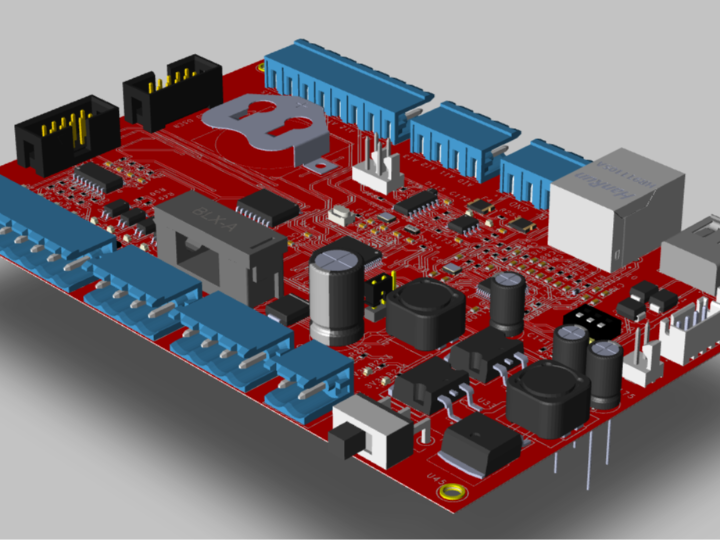
MCU로 **STM32F411RET6(100MHz, 512KB Flash, 128KB RAM)**가 명시되어 있습니다. 산업용 MiniPLC에서 자주 쓰는 블록들이 함께 구성됩니다.

이미지 출처 : https://github.com/maixuancanh2003/Orcad-Allegro-2-Layers-STM32-Ethernet-MiniPLC-Board
산업용 I/O 블록
레포 설명 기준으로 **절연(옵토커플러) 기반 디지털 I/O(12V 레벨)**를 포함합니다. 산업 환경에서 노이즈/그라운드 루프/서지에 대응하기 위한 전형적인 접근입니다.
아날로그/출력 기능
0–10V 아날로그 입력, 그리고 PWM/DAC 출력이 기능 목록에 포함되어 있습니다. 이는 센서(압력/유량/레벨) 및 액추에이터(밸브/드라이브)와의 연동에 필요한 MiniPLC 기본 스펙에 가깝습니다.
필드 통신(RS485)
RS485 통신이 포함되어 있고, README에서는 Modbus RTU/TCP 같은 산업용 프로토콜 확장을 염두에 둔 방향을 언급합니다. RS485는 현장 장비(인버터/센서/리모트 I/O) 연동에서 여전히 표준급으로 널리 쓰입니다.
시간 유지/로깅
**RTC(DS3231 배터리 백업)**와 SD 카드 데이터 로깅을 포함합니다. MiniPLC에서 “네트워크 장애 시에도 데이터 유실 최소화”를 위해 로컬 저장소를 두는 패턴과 맞닿아 있습니다.
W5500이 하는 일
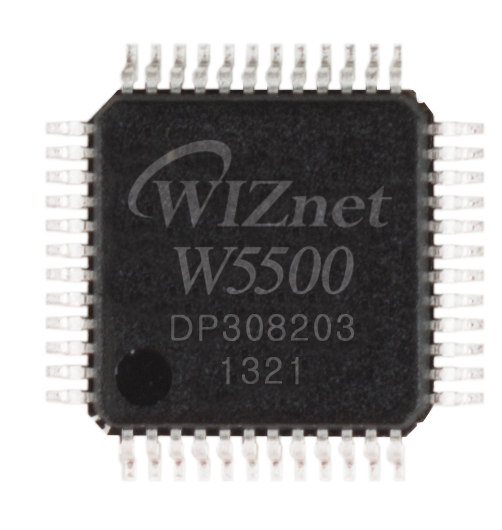
W5500은 **하드웨어 TCP/IP 스택(“Hardwired TCP/IP”)**을 내장한 SPI Ethernet 컨트롤러입니다. MiniPLC에서 MCU가 해야 할 일이 많을 때(스캔/통신/로깅) 네트워크 처리를 칩에 맡겨 MCU 부하를 줄이는 구조에 적합합니다.
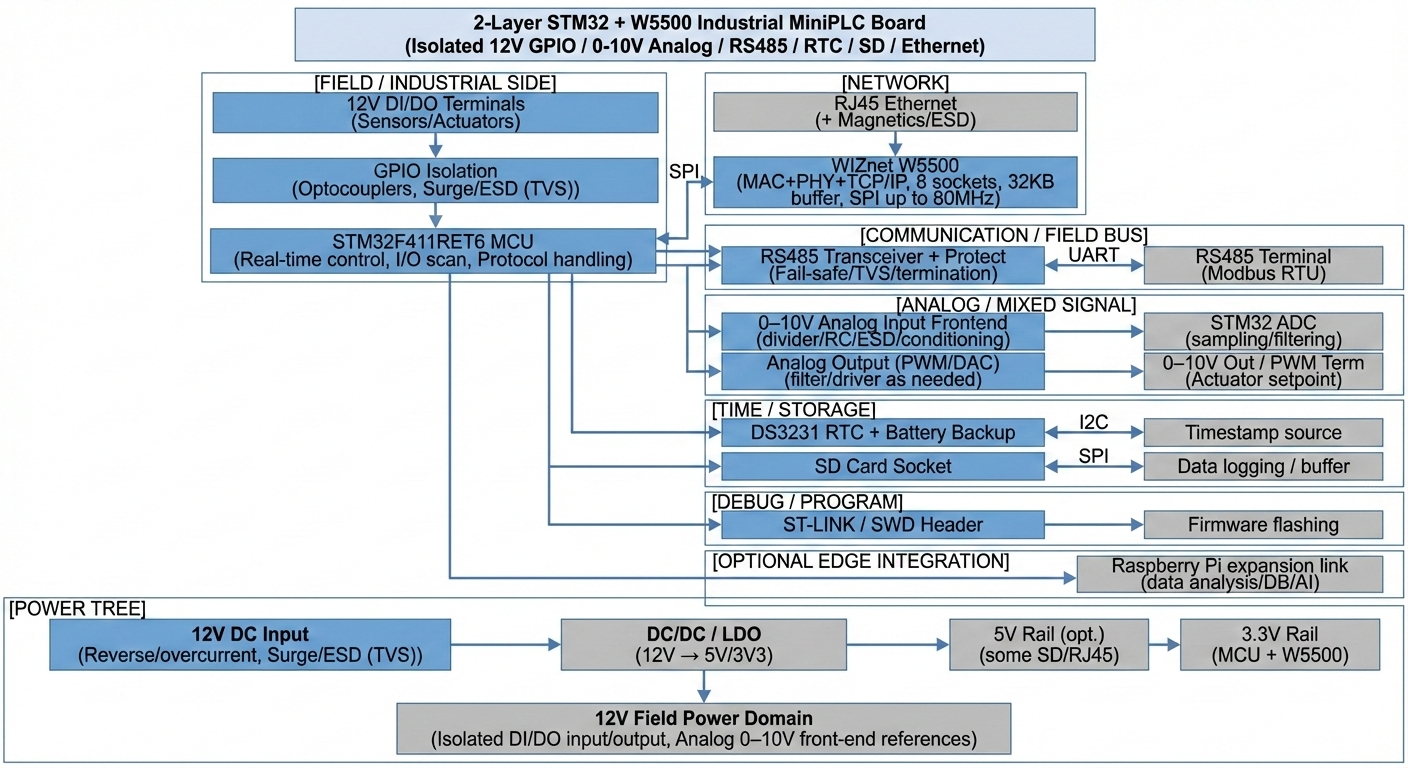
이미지 출처 : AI 생성
권장 아키텍처
I/O 스캔 태스크는 1–10ms 주기로 DI/DO 갱신과 아날로그 샘플링/필터링을 담당합니다.
RS485 태스크는 Modbus RTU 폴링, 타임아웃/재시도 정책, 결과를 “레지스터 맵(상태 테이블)”로 반영하는 역할이 적합합니다.
Ethernet 태스크는 W5500 소켓을 사용해 Modbus TCP 또는 MQTT 송수신을 담당합니다. MCU는 SPI로 W5500 버퍼/레지스터를 제어하고, TCP/IP 처리는 W5500이 수행하는 구조가 일반적입니다.
로깅 태스크는 SD 카드에 주기 저장하고, 네트워크 장애 시 로컬에 누적 후 복구 시 업로드하는 패턴으로 확장할 수 있습니다.
MiniPLC 시장 규모와 전망
MiniPLC는 리서치에서 Micro/Nano PLC 또는 Compact PLC로 잡히는 경우가 많습니다. Mordor Intelligence는 **Micro & Nano PLC 시장이 2025년 64.4억 달러 → 2030년 82.8억 달러(CAGR 5.14%)**로 성장한다고 추정합니다.
다른 기관들은 더 공격적인 장기 전망을 제시하기도 합니다(정의/범위 차이로 수치 편차 존재). 예를 들어 Future Market Insights는 2025년 100.48억 달러 → 2035년 182.67억 달러(CAGR 6.2%) 같은 전망을 제시합니다.
전반적인 성장 동인은 중소 제조 자동화 확대, 설비 단 IIoT 연결 요구(데이터 수집/모니터링/예지보전), 공간·비용 제약 속 소형 통합 컨트롤러 수요 증가로 요약됩니다. 이 레포의 “I/O+로깅+RS485+Ethernet” 통합 방향은 이러한 수요와 잘 맞습니다.
FAQ (WIZnet 중심)
Q1. 왜 이 프로젝트에서 W5500이 유리한가요?
W5500은 TCP/IP를 하드웨어로 처리하는 구조라, MCU가 네트워크 패킷 처리에 쓰는 부담을 줄이기 좋습니다. 8 소켓과 내부 버퍼를 통해 다중 연결/버퍼링에서 구현 난이도를 낮출 수 있습니다. MiniPLC처럼 I/O 스캔과 필드버스를 동시에 굴리는 시스템에서 안정적인 통신 구조를 잡는 데 유리합니다.
Q2. STM32와 W5500은 어떻게 연결하나요?
레포에 W5500이 SPI Ethernet Controller로 명시되어 있습니다. 따라서 STM32는 SPI로 W5500의 레지스터/버퍼를 제어하고, 소켓 기반으로 송수신을 수행하는 구조가 일반적입니다. 이때 TCP/IP 처리 자체는 W5500 내부에서 수행되므로, MCU는 애플리케이션 프로토콜과 로직에 더 집중하는 설계가 가능합니다.
Q3. 이 MiniPLC에서 W5500의 정확한 역할은 무엇인가요?
역할은 “현장 제어 데이터의 Ethernet 게이트”입니다. DI/DO 상태, 아날로그 값, RS485(Modbus RTU)로 읽은 장비 데이터를 상태 테이블로 모아두고, W5500 소켓을 통해 상위 시스템에 전달합니다(Modbus TCP, MQTT 등). 즉 제어·로깅·필드버스는 MCU가, TCP/IP 통신은 W5500이 중심이 되는 분업 구조입니다.
Q4. 초보자도 따라 할 수 있나요?
가능하지만 “회로/PCB 중심 레포”라는 점을 알아야 합니다. OrCAD/Allegro 설계 자료를 이해할 수 있어야 하며, 펌웨어는 README에 방향이 있으나 완성된 예제 코드 형태는 아닙니다. 초보자는 W5500의 기본 소켓 통신(예: TCP echo)부터 검증하고, 이후 RS485 폴링과 로깅을 붙여가는 방식이 실패 확률이 낮습니다.
Q5. Industrial IoT/MiniPLC 요구사항에 W5500이 주는 실무 이점은?
Industrial IoT는 장시간 가동, 재접속, 다중 연결, 장애 복구가 핵심입니다. W5500은 8개 소켓과 내부 버퍼로 네트워크 연결을 구조적으로 단순화하는 데 도움을 줍니다. SPI 기반이라 보드 설계도 상대적으로 단순해지고, MCU 리소스를 제어/로깅/필드버스에 더 배분할 수 있어 전체 시스템 안정성 목표에 맞추기 쉽습니다.
Project Identity
This GitHub repository is a MiniPLC board project focused on OrCAD/Allegro design deliverables. The goal of the board is to integrate “field I/O control + communications + logging” into a single board.
Core Hardware Configuration
The MCU is specified as STM32F411RET6 (100 MHz, 512 KB Flash, 128 KB RAM). It is paired with building blocks commonly found in industrial MiniPLC designs.
Image source: https://github.com/maixuancanh2003/Orcad-Allegro-2-Layers-STM32-Ethernet-MiniPLC-Board
Industrial I/O Block
According to the repository description, it includes isolated (optocoupler-based) digital I/O (12 V level). This is a typical approach for handling noise, ground loops, and surges in industrial environments.
Analog / Output Capabilities
The feature list includes 0–10 V analog inputs and PWM/DAC outputs. This is close to a baseline MiniPLC specification needed to interface with sensors (pressure/flow/level) and actuators (valves/drives).
Field Communication (RS485)
RS485 communication is included, and the README mentions a direction that considers extending to industrial protocols such as Modbus RTU/TCP. RS485 is still widely used as a de facto standard for connecting field devices (inverters, sensors, remote I/O).
Timekeeping / Logging
It includes an RTC (DS3231 with battery backup) and SD card data logging. This aligns with the common MiniPLC pattern of maintaining local storage to minimize data loss during network outages.
What W5500 Does
W5500 is an SPI Ethernet controller with an integrated hardware TCP/IP stack (“Hardwired TCP/IP”). In a MiniPLC where the MCU has a lot to handle (scan, communications, logging), offloading network processing to the chip is a good fit to reduce the MCU workload.
Image source: AI-generated
Recommended Architecture
The I/O scan task runs every 1–10 ms to update DI/DO and handle analog sampling/filtering.
The RS485 task is suited for Modbus RTU polling, timeout/retry policies, and reflecting results into a “register map (status table).”
The Ethernet task uses W5500 sockets to handle Modbus TCP or MQTT TX/RX. The MCU controls W5500 buffers/registers over SPI, while TCP/IP processing is typically performed inside the W5500.
The logging task periodically writes to the SD card. It can be extended with a pattern where data accumulates locally during network outages and uploads after recovery.
MiniPLC Market Size and Outlook
MiniPLCs are often categorized in research as Micro/Nano PLCs or Compact PLCs. Mordor Intelligence estimates that the Micro & Nano PLC market will grow from USD 6.44B in 2025 to USD 8.28B in 2030 (CAGR 5.14%).
Other organizations sometimes present more aggressive long-term outlooks (figures vary due to differences in definition and scope). For example, Future Market Insights projects a market growth from USD 10.048B in 2025 to USD 18.267B in 2035 (CAGR 6.2%).
Overall growth drivers can be summarized as: expanding automation among small and mid-sized manufacturers, increasing IIoT connectivity demands at the equipment level (data collection/monitoring/predictive maintenance), and rising demand for compact integrated controllers under space and cost constraints. The repository’s integration direction—“I/O + logging + RS485 + Ethernet”—aligns well with these trends.
FAQ (WIZnet-focused)
Q1. Why is W5500 advantageous in this project?
Because W5500 processes TCP/IP in hardware, it helps reduce the MCU’s packet-processing burden. With 8 sockets and internal buffers, it can lower implementation complexity for multi-connection handling and buffering. In systems like a MiniPLC that run I/O scanning and fieldbus communications concurrently, it is beneficial for building a stable communication architecture.
Q2. How are STM32 and W5500 connected?
The repository specifies W5500 as an SPI Ethernet controller. A common architecture is for the STM32 to control W5500 registers/buffers via SPI and perform socket-based TX/RX. Since TCP/IP processing itself is handled inside the W5500, the MCU can focus more on application protocols and control logic.
Q3. What is W5500’s exact role in this MiniPLC?
Its role is the “Ethernet gateway” for field control data. DI/DO states, analog values, and device data read over RS485 (Modbus RTU) are collected into a status table and delivered to upper-layer systems through W5500 sockets (e.g., Modbus TCP, MQTT). In short: control/logging/fieldbus are MCU-centric, while TCP/IP communication is W5500-centric.
Q4. Can beginners follow this project?
Yes, but you should be aware that it is a “schematic/PCB-focused repository.” You need to understand OrCAD/Allegro design artifacts, and while the README provides direction for firmware, it is not a polished, ready-to-run example-code repository. For beginners, it is safer to validate basic W5500 socket communication first (e.g., TCP echo), then incrementally add RS485 polling and logging.
Q5. What practical benefits does W5500 provide for Industrial IoT/MiniPLC requirements?
Industrial IoT emphasizes long uptime, reconnection behavior, multi-connection handling, and fault recovery. W5500’s 8 sockets and internal buffers help structurally simplify network connection handling. Its SPI interface also keeps board design relatively simple, and it allows more MCU resources to be allocated to control/logging/fieldbus, making it easier to meet overall system stability goals.


