



How to Teach FPGA Ethernet Architecture with WIZnet W5500 on an FPGA Platform?
This article explains an education-oriented FPGA Ethernet architecture based on WIZnet W5500 and Verilog.
1. Title
How to Teach FPGA Ethernet Architecture with WIZnet W5500 on an FPGA Platform?
2. Summary
This article explains an education-oriented FPGA Ethernet architecture based on WIZnet W5500 and Verilog. The referenced CSDN blog describes a W5500 TCP/IP stack FPGA source project for implementing high-performance network communication on an FPGA platform. In this architecture, the FPGA design handles hardware-side logic, data movement, configuration control, and application-specific processing, while the W5500 provides the Ethernet interface, hardwired TCP/IP stack, 10/100 Ethernet MAC/PHY, socket engine, and internal packet buffers. The article is useful for teaching how hardware logic, network configuration, TCP/UDP transport, and embedded Ethernet components fit together in a complete communication system.
3. What the Project Does
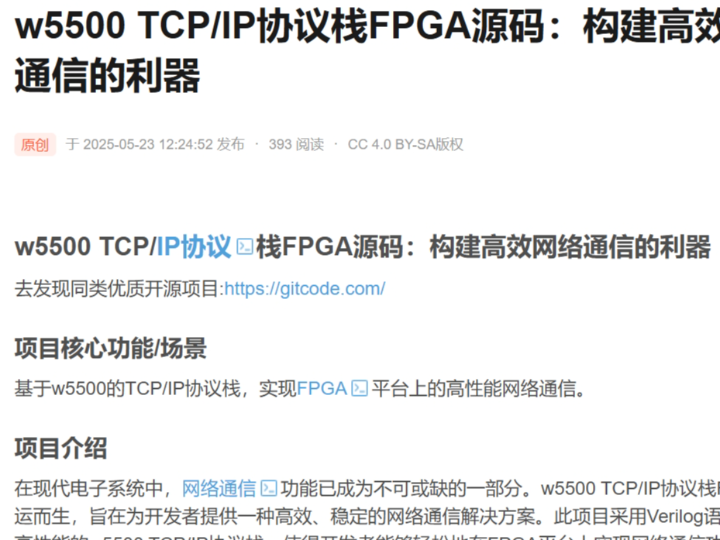
The CSDN blog presents the project as a W5500-based TCP/IP stack FPGA source design. It states that the goal is to implement high-performance network communication on an FPGA platform and that the project is developed using Verilog, a hardware description language commonly used for FPGA and ASIC design. The blog identifies three main components: a TCP/IP protocol stack, an FPGA hardware interface, and a configuration module for setting network parameters.
For an education use case, the value is not only that Ethernet works. The project can be used to teach how the system is divided into layers. The FPGA side can represent deterministic hardware logic, parallel data paths, packet buffering, user control logic, and application-specific state machines. The W5500 side represents the Ethernet controller and TCP/IP offload boundary. The external network side represents a PC, server, test tool, or embedded Ethernet peer.
A typical teaching data flow can be explained like this:
FPGA application logic → transmit FIFO or data path → W5500 socket write path → W5500 Ethernet MAC/PHY → Ethernet network.
In the opposite direction:
Ethernet packet → W5500 receive buffer → FPGA-side read path → parser or control logic → application-specific output.
This makes the project suitable for classroom or lab exercises covering hardware description language design, SPI-style peripheral control, register configuration, socket concepts, TCP/UDP behavior, Ethernet link status, and embedded system debugging.
4. Where WIZnet Fits
The WIZnet product in this architecture is W5500. WIZnet describes W5500 as a hardwired TCP/IP stack Internet controller that connects to an external host through SPI up to 80 MHz. It integrates a 10/100 Ethernet MAC and PHY, supports protocols such as TCP, UDP, ICMP, IPv4, ARP, IGMP, and PPPoE, provides eight independent sockets, and includes 32 KB internal memory for Tx/Rx buffers.
In the FPGA architecture, W5500 acts as the Ethernet and TCP/IP boundary. The FPGA does not need to implement every Ethernet and TCP/IP detail from scratch for a basic networked application. Instead, the FPGA logic can configure W5500, move data into and out of socket buffers, and focus on the educational goals: bus timing, register access, data-path design, state-machine control, and application-layer processing.
This division is especially useful for education because it allows students to study networking without immediately needing to implement a complete TCP/IP stack in HDL. The W5500 provides a concrete hardware target with visible constraints: eight sockets, finite buffer memory, link state, register configuration, and SPI transaction timing. Those constraints make the design realistic while still keeping the project approachable.
The CSDN blog describes the project as using Verilog and emphasizes FPGA hardware interface logic, configuration modules, network parameter setup, and high-speed data transfer. It also states that part of the article was AI-assisted and for reference, so the article should be used as architecture-level guidance rather than as a fully verified source-code audit.
5. Implementation Notes
The CSDN page confirms the project topic, Verilog direction, FPGA platform target, and W5500-oriented network communication concept, but it does not expose complete source files, module names, pin assignments, or register-level HDL code in the visible page. Therefore, this section does not claim exact repository file paths or quote hidden source code. It provides an architecture-level implementation outline consistent with the verified blog content and official WIZnet documentation.
A practical education-oriented FPGA + W5500 design can be divided into these blocks:
Clock and reset block: Generates stable internal reset timing for the FPGA logic and controls the W5500 reset sequence.
Host interface block: Implements the SPI-style control path or equivalent W5500 host access path used to read and write W5500 registers and buffers.
W5500 configuration block: Sets MAC address, IP address, subnet mask, gateway, socket mode, and socket port.
Socket control state machine: Opens a TCP or UDP socket, monitors socket status, handles send/receive conditions, and closes or reopens the socket when needed.
Transmit data path: Accepts user data from FPGA logic, buffers it, checks W5500 transmit availability, and writes payload data to W5500.
Receive data path: Checks received-size information, reads data from W5500, and passes it to a parser, FIFO, or application block.
Debug and teaching interface: Exposes status signals such as link state, socket state, packet count, error state, and current configuration step.
Conceptual integration example based on WIZnet ioLibrary:
/* Conceptual integration example based on WIZnet ioLibrary */

reset_fpga_network_logic();
reset_w5500();

configure_w5500_mac_ip_gateway();
configure_socket_mode(SOCKET_0, TCP_SERVER_MODE);
open_socket(SOCKET_0, local_port);

while (1) {
    socket_state = read_socket_status(SOCKET_0);

    if (socket_state == ESTABLISHED) {
        if (rx_available(SOCKET_0)) {
            read_w5500_rx_buffer(SOCKET_0, rx_buffer);
            process_application_payload(rx_buffer);
        }

        if (tx_ready(SOCKET_0) && application_has_data()) {
            write_w5500_tx_buffer(SOCKET_0, tx_buffer);
            trigger_socket_send(SOCKET_0);
        }
    }

    update_debug_status();
}
This code is not claimed from the CSDN page. It is a conceptual integration example showing how an FPGA or MCU-side controller can be taught around W5500 socket state, buffer access, and application payload handling.
For a Verilog lab, the same concept would usually be expressed as state machines rather than a C loop. For example, students can build separate HDL states for reset, register write, socket open, wait-for-link, wait-for-connection, receive-check, read-buffer, transmit-check, write-buffer, send-command, and error recovery.
6. Practical Tips / Pitfalls
Teach reset first. Many FPGA Ethernet bring-up problems come from unclear reset sequencing. Separate FPGA logic reset, W5500 hardware reset, and socket reset in the lab material.
Expose register transactions. Students should see that network configuration is not magic. MAC address, IP address, gateway, subnet, socket mode, socket command, and socket status can be treated as concrete register-level operations.
Use one socket first. W5500 supports eight independent sockets, but education projects should start with one TCP or UDP socket before introducing multi-socket scheduling.
Keep payloads small. The W5500 has 32 KB internal Tx/Rx buffer memory shared across socket use. Small fixed-size payloads make waveform debugging and state-machine validation much easier.
Add visible debug outputs. LEDs, UART logs, logic analyzer probes, or on-chip debug signals for link state, socket state, configuration step, and packet counters make the architecture easier to understand.
Separate transport from application logic. Do not mix W5500 register control directly with the student’s application algorithm. Keep one block for network transport and another block for application behavior.
Do not treat the blog as complete source verification. The CSDN article gives a useful project concept and architecture summary, but the visible page does not provide enough source-level detail to verify HDL quality, timing closure, pin constraints, or simulation coverage.
7. FAQ
Why use WIZnet W5500 for this project?
W5500 is useful in an FPGA education project because it provides a concrete Ethernet controller with hardwired TCP/IP behavior, 10/100 Ethernet MAC/PHY, eight sockets, and internal Tx/Rx buffers. This lets students focus on hardware control logic, register access, socket state, and payload movement instead of implementing a full TCP/IP stack in Verilog from the beginning.
How does W5500 connect to the platform?
W5500 connects to an external host through SPI. In an FPGA design, the FPGA must provide the host-side control logic that performs W5500 register and buffer access, controls reset, and handles data movement between FPGA logic and W5500 socket buffers. WIZnet documents W5500 as an SPI-connected hardwired TCP/IP controller for external hosts.
What role does W5500 play in this project?
W5500 is the Ethernet communication boundary. The FPGA implements the hardware interface, control state machines, data-path logic, and application-specific processing. W5500 handles Ethernet MAC/PHY behavior, hardwired TCP/IP protocols, socket state, and packet buffering.
Can beginners follow this project?
Yes, if the lab is staged carefully. Beginners should first learn reset, SPI transactions, register read/write, MAC/IP configuration, and a single UDP or TCP socket. After that, they can move to receive buffers, transmit buffers, socket recovery, and application-layer packet formats.
Why is this useful for education?
The architecture exposes several important embedded-system layers at once: HDL design, FPGA state machines, peripheral control, Ethernet configuration, socket-based communication, and application data handling. It provides a practical way to connect digital logic design with real network communication.
8. Source
Original CSDN blog:https://blog.csdn.net/gitblog_06769/article/details/148163171
The page title is “w5500 TCP/IP协议栈FPGA源码:构建高效网络通信的利器.” It was published on May 23, 2025 and is marked as CC 4.0 BY-SA. The page states that the project is based on W5500 TCP/IP stack concepts for high-performance FPGA network communication, uses Verilog, and includes TCP/IP stack, FPGA hardware interface, and configuration-module concepts. It also states that part of the article was AI-assisted and is for reference.
Official WIZnet W5500 documentation and product page:
Used for W5500 hardwired TCP/IP stack, SPI up to 80 MHz, integrated 10/100 Ethernet MAC/PHY, supported protocols, eight independent sockets, and 32 KB internal Tx/Rx buffer memory.
License status:
The CSDN blog page displays a CC 4.0 BY-SA copyright statement. The visible page does not expose a complete HDL repository license, so no separate source-code license is claimed.
Editorial workflow and source-handling rules followed the uploaded WIZnet UCC Curator Handover Notes.
9. Tags
WIZnet, W5500, FPGA, Verilog, Ethernet, TCP/IP, Hardware Design, Socket Programming, Education, HDL, Embedded Networking, Network Architecture
1. 제목
FPGA Platform에서 WIZnet W5500을 사용해 FPGA Ethernet Architecture를 교육하는 방법
2. 요약
이 글은 WIZnet W5500과 Verilog를 기반으로 한 education-oriented FPGA Ethernet architecture를 설명한다. 참조한 CSDN blog는 FPGA platform에서 high-performance network communication을 구현하기 위한 W5500 TCP/IP stack FPGA source project를 소개한다. 이 architecture에서 FPGA design은 hardware-side logic, data movement, configuration control, application-specific processing을 처리하고, W5500은 Ethernet interface, hardwired TCP/IP stack, 10/100 Ethernet MAC/PHY, socket engine, internal packet buffer를 제공한다. 이 글은 hardware logic, network configuration, TCP/UDP transport, embedded Ethernet component가 하나의 complete communication system 안에서 어떻게 연결되는지 가르치는 데 유용하다.
3. 프로젝트가 하는 일
CSDN blog는 이 project를 W5500 기반 TCP/IP stack FPGA source design으로 소개한다. 목표는 FPGA platform에서 high-performance network communication을 구현하는 것이며, project는 FPGA와 ASIC design에 널리 사용되는 hardware description language인 Verilog로 개발되었다고 설명한다. Blog는 주요 구성요소로 TCP/IP protocol stack, FPGA hardware interface, network parameter 설정을 위한 configuration module을 제시한다.
Education use case에서 이 project의 가치는 단순히 Ethernet이 동작한다는 점에만 있지 않다. 이 project는 system이 layer로 어떻게 나뉘는지 가르치는 데 사용할 수 있다. FPGA side는 deterministic hardware logic, parallel data path, packet buffering, user control logic, application-specific state machine을 나타낼 수 있다. W5500 side는 Ethernet controller와 TCP/IP offload boundary를 나타낸다. External network side는 PC, server, test tool 또는 embedded Ethernet peer를 나타낸다.
일반적인 teaching data flow는 다음과 같이 설명할 수 있다.
FPGA application logic → transmit FIFO 또는 data path → W5500 socket write path → W5500 Ethernet MAC/PHY → Ethernet network.
반대 방향은 다음과 같다.
Ethernet packet → W5500 receive buffer → FPGA-side read path → parser 또는 control logic → application-specific output.
따라서 이 project는 hardware description language design, SPI-style peripheral control, register configuration, socket concept, TCP/UDP behavior, Ethernet link status, embedded system debugging을 다루는 classroom 또는 lab exercise에 적합하다.
4. WIZnet이 들어가는 위치
이 architecture에서 사용하는 WIZnet 제품은 W5500이다. WIZnet은 W5500을 최대 80 MHz SPI를 통해 external host와 연결되는 hardwired TCP/IP stack Internet controller로 설명한다. W5500은 10/100 Ethernet MAC과 PHY를 통합하고, TCP, UDP, ICMP, IPv4, ARP, IGMP, PPPoE 같은 protocol을 지원하며, 8개의 independent socket과 Tx/Rx buffer용 32 KB internal memory를 제공한다.
FPGA architecture에서 W5500은 Ethernet 및 TCP/IP boundary 역할을 한다. FPGA는 basic networked application을 위해 모든 Ethernet 및 TCP/IP detail을 처음부터 구현할 필요가 없다. 대신 FPGA logic은 W5500을 configuration하고, socket buffer로 data를 넣고 빼며, bus timing, register access, data-path design, state-machine control, application-layer processing 같은 교육 목표에 집중할 수 있다.
이 역할 분리는 education에서 특히 유용하다. 학생들이 HDL로 완전한 TCP/IP stack을 바로 구현하지 않아도 networking을 학습할 수 있기 때문이다. W5500은 8개의 socket, 제한된 buffer memory, link state, register configuration, SPI transaction timing 같은 눈에 보이는 constraint를 가진 실제 hardware target을 제공한다. 이러한 constraint는 design을 현실적으로 만들면서도 project를 접근 가능한 수준으로 유지한다.
CSDN blog는 project가 Verilog를 사용한다고 설명하고, FPGA hardware interface logic, configuration module, network parameter setup, high-speed data transfer를 강조한다. 또한 article 일부가 AI-assisted이며 reference용이라고 명시하므로, 이 article은 fully verified source-code audit이 아니라 architecture-level guidance로 사용하는 것이 적절하다.
5. 구현 참고 사항
CSDN page는 project topic, Verilog 방향, FPGA platform target, W5500-oriented network communication concept를 확인해 주지만, visible page에서 complete source file, module name, pin assignment, register-level HDL code는 노출하지 않는다. 따라서 이 section은 정확한 repository file path나 hidden source code를 주장하지 않는다. 대신 검증된 blog content와 공식 WIZnet documentation에 맞는 architecture-level implementation outline을 제공한다.
Education-oriented FPGA + W5500 design은 다음 block으로 나눌 수 있다.
Clock and reset block: FPGA logic을 위한 안정적인 internal reset timing을 생성하고 W5500 reset sequence를 제어한다.
Host interface block: W5500 register와 buffer를 read/write하기 위한 SPI-style control path 또는 equivalent W5500 host access path를 구현한다.
W5500 configuration block: MAC address, IP address, subnet mask, gateway, socket mode, socket port를 설정한다.
Socket control state machine: TCP 또는 UDP socket을 open하고, socket status를 monitor하며, send/receive condition을 처리하고, 필요 시 socket을 close/reopen한다.
Transmit data path: FPGA logic에서 user data를 받아 buffer에 저장하고, W5500 transmit availability를 확인한 뒤 payload data를 W5500에 쓴다.
Receive data path: received-size information을 확인하고, W5500에서 data를 읽어 parser, FIFO 또는 application block으로 전달한다.
Debug and teaching interface: link state, socket state, packet count, error state, current configuration step 같은 status signal을 노출한다.
Conceptual integration example based on WIZnet ioLibrary:
/* Conceptual integration example based on WIZnet ioLibrary */

reset_fpga_network_logic();
reset_w5500();

configure_w5500_mac_ip_gateway();
configure_socket_mode(SOCKET_0, TCP_SERVER_MODE);
open_socket(SOCKET_0, local_port);

while (1) {
    socket_state = read_socket_status(SOCKET_0);

    if (socket_state == ESTABLISHED) {
        if (rx_available(SOCKET_0)) {
            read_w5500_rx_buffer(SOCKET_0, rx_buffer);
            process_application_payload(rx_buffer);
        }

        if (tx_ready(SOCKET_0) && application_has_data()) {
            write_w5500_tx_buffer(SOCKET_0, tx_buffer);
            trigger_socket_send(SOCKET_0);
        }
    }

    update_debug_status();
}
이 code는 CSDN page에서 가져온 것으로 주장하지 않는다. 이는 FPGA 또는 MCU-side controller가 W5500 socket state, buffer access, application payload handling을 중심으로 어떻게 교육될 수 있는지 보여주는 conceptual integration example이다.
Verilog lab에서는 동일한 개념이 C loop가 아니라 보통 state machine으로 표현된다. 예를 들어 학생들은 reset, register write, socket open, wait-for-link, wait-for-connection, receive-check, read-buffer, transmit-check, write-buffer, send-command, error recovery를 위한 별도 HDL state를 만들 수 있다.
6. 실용 팁 / 주의점
Reset부터 가르친다. 많은 FPGA Ethernet bring-up 문제는 불명확한 reset sequencing에서 발생한다. Lab material에서 FPGA logic reset, W5500 hardware reset, socket reset을 분리해서 설명하는 것이 좋다.
Register transaction을 노출한다. 학생들은 network configuration이 마법처럼 동작하는 것이 아니라는 점을 봐야 한다. MAC address, IP address, gateway, subnet, socket mode, socket command, socket status는 concrete register-level operation으로 다룰 수 있다.
Socket 하나부터 시작한다. W5500은 8개의 independent socket을 지원하지만, education project는 multi-socket scheduling을 소개하기 전에 TCP 또는 UDP socket 하나부터 시작하는 것이 좋다.
Payload는 작게 유지한다. W5500은 socket 사용 간에 공유되는 32 KB internal Tx/Rx buffer memory를 가진다. Small fixed-size payload는 waveform debugging과 state-machine validation을 훨씬 쉽게 만든다.
Visible debug output을 추가한다. LED, UART log, logic analyzer probe 또는 link state, socket state, configuration step, packet counter용 on-chip debug signal은 architecture를 더 쉽게 이해하게 해 준다.
Transport와 application logic을 분리한다. W5500 register control을 학생의 application algorithm과 직접 섞지 않는다. Network transport를 위한 block과 application behavior를 위한 block을 분리한다.
Blog를 complete source verification으로 다루지 않는다. CSDN article은 유용한 project concept와 architecture summary를 제공하지만, visible page만으로는 HDL quality, timing closure, pin constraint, simulation coverage를 검증하기에 충분하지 않다.
7. FAQ
왜 이 프로젝트에 WIZnet W5500을 사용하나?
W5500은 hardwired TCP/IP behavior, 10/100 Ethernet MAC/PHY, 8개의 socket, internal Tx/Rx buffer를 제공하는 concrete Ethernet controller이므로 FPGA education project에 유용하다. 학생들은 처음부터 Verilog로 완전한 TCP/IP stack을 구현하지 않고도 hardware control logic, register access, socket state, payload movement에 집중할 수 있다.
W5500은 platform과 어떻게 연결되나?
W5500은 SPI를 통해 external host와 연결된다. FPGA design에서는 FPGA가 W5500 register 및 buffer access를 수행하는 host-side control logic을 제공하고, reset을 제어하며, FPGA logic과 W5500 socket buffer 사이의 data movement를 처리해야 한다. WIZnet은 W5500을 external host용 SPI-connected hardwired TCP/IP controller로 문서화한다.
이 프로젝트에서 W5500의 역할은 무엇인가?
W5500은 Ethernet communication boundary이다. FPGA는 hardware interface, control state machine, data-path logic, application-specific processing을 구현한다. W5500은 Ethernet MAC/PHY behavior, hardwired TCP/IP protocols, socket state, packet buffering을 처리한다.
초보자도 이 project를 따라 할 수 있나?
Lab이 단계별로 구성되어 있다면 가능하다. 초보자는 reset, SPI transaction, register read/write, MAC/IP configuration, single UDP 또는 TCP socket을 먼저 학습해야 한다. 이후 receive buffer, transmit buffer, socket recovery, application-layer packet format으로 확장할 수 있다.
왜 이 구조가 education에 유용한가?
이 architecture는 HDL design, FPGA state machine, peripheral control, Ethernet configuration, socket-based communication, application data handling이라는 여러 embedded-system layer를 동시에 보여준다. Digital logic design과 실제 network communication을 연결하는 실용적인 방법을 제공한다.
8. 출처
Original CSDN blog:https://blog.csdn.net/gitblog_06769/article/details/148163171
Page title은 “w5500 TCP/IP协议栈FPGA源码:构建高效网络通信的利器”이다. 2025년 5월 23일에 게시되었고 CC 4.0 BY-SA로 표시되어 있다. Page는 project가 high-performance FPGA network communication을 위한 W5500 TCP/IP stack concept를 기반으로 하며, Verilog를 사용하고, TCP/IP stack, FPGA hardware interface, configuration-module concept를 포함한다고 설명한다. 또한 article 일부가 AI-assisted이며 reference용이라고 명시한다.
Official WIZnet W5500 documentation and product page:
W5500 hardwired TCP/IP stack, 최대 80 MHz SPI, integrated 10/100 Ethernet MAC/PHY, supported protocols, 8 independent sockets, 32 KB internal Tx/Rx buffer memory 확인에 사용했다.
License status:
CSDN blog page는 CC 4.0 BY-SA copyright statement를 표시한다. Visible page는 complete HDL repository license를 노출하지 않으므로, 별도의 source-code license는 주장하지 않는다.
Editorial workflow와 source-handling rule은 업로드된 WIZnet UCC Curator Handover Notes를 따랐다.
9. 태그
WIZnet, W5500, FPGA, Verilog, Ethernet, TCP/IP, Hardware Design, Socket Programming, Education, HDL, Embedded Networking, Network Architecture