



How to Implement MQTT Communication with W5500 Ethernet for Embedded IoT Devices?
This project explains how an embedded device can implement MQTT communication using the WIZnet W5500 Ethernet controller.
How to Implement MQTT Communication with W5500 Ethernet for Embedded IoT Devices?
Summary
EN
This project explains how an embedded device can implement MQTT communication using the WIZnet W5500 Ethernet controller. The W5500 provides a hardware TCP/IP stack and wired Ethernet interface, enabling microcontrollers to establish reliable TCP connections with an MQTT broker. This architecture is well suited for Industrial IoT and maker projects that require stable network communication.
KR
이 프로젝트는 WIZnet W5500 이더넷 컨트롤러를 사용하여 임베디드 장치에서 MQTT 통신을 구현하는 방법을 설명합니다. W5500은 하드웨어 TCP/IP 스택과 유선 Ethernet 인터페이스를 제공하여 MCU가 MQTT 브로커와 안정적인 TCP 연결을 유지할 수 있도록 합니다. 이러한 구조는 산업용 IoT 및 메이커 프로젝트에 적합합니다.
What the Project Does
EN
The project demonstrates a typical embedded IoT architecture using MQTT messaging over Ethernet.
The system consists of three main layers.
Device Layer
Microcontroller-based embedded system
WIZnet W5500 Ethernet controller
Sensors or device peripherals
Network Layer
Wired Ethernet communication
TCP/IP stack handled by the W5500
Router or gateway providing internet access
Application Layer
MQTT broker server
Message publishing and subscription system
Device monitoring and control services
Typical data flow:
The MCU initializes the W5500 Ethernet controller.
The device configures network parameters (MAC, IP, gateway, subnet).
A TCP socket connection is established with the MQTT broker.
The device publishes sensor data to MQTT topics.
The device subscribes to command topics and executes received instructions.
This architecture enables real-time data transmission, remote monitoring, and device control, which are essential features for Industrial IoT systems.
KR
이 프로젝트는 Ethernet 기반 MQTT 메시징을 사용하는 임베디드 IoT 시스템 구조를 설명합니다.
시스템은 다음 세 계층으로 구성됩니다.
Device Layer
MCU 기반 임베디드 장치
WIZnet W5500 이더넷 컨트롤러
센서 또는 장치 인터페이스
Network Layer
유선 Ethernet 통신
W5500 하드웨어 TCP/IP 스택
인터넷 연결을 위한 라우터
Application Layer
MQTT 브로커 서버
메시지 publish / subscribe 시스템
장치 모니터링 및 제어 서비스
데이터 흐름:
MCU가 W5500 이더넷 컨트롤러를 초기화합니다.
네트워크 파라미터(MAC, IP, Gateway, Subnet)를 설정합니다.
MQTT 브로커와 TCP 소켓 연결을 생성합니다.
센서 데이터를 MQTT 토픽으로 publish 합니다.
제어 명령 토픽을 subscribe 하여 장치 동작을 수행합니다.
이 구조는 실시간 데이터 전송, 원격 모니터링, 장치 제어를 가능하게 하며 산업용 IoT 시스템에서 널리 사용됩니다.
Where WIZnet Fits
EN
The WIZnet W5500 Ethernet controller serves as the networking interface for the embedded device.
Its functions include:
Hardware implementation of the TCP/IP protocol stack
Management of up to 8 independent network sockets
Ethernet MAC and PHY integration
Offloading network processing from the MCU
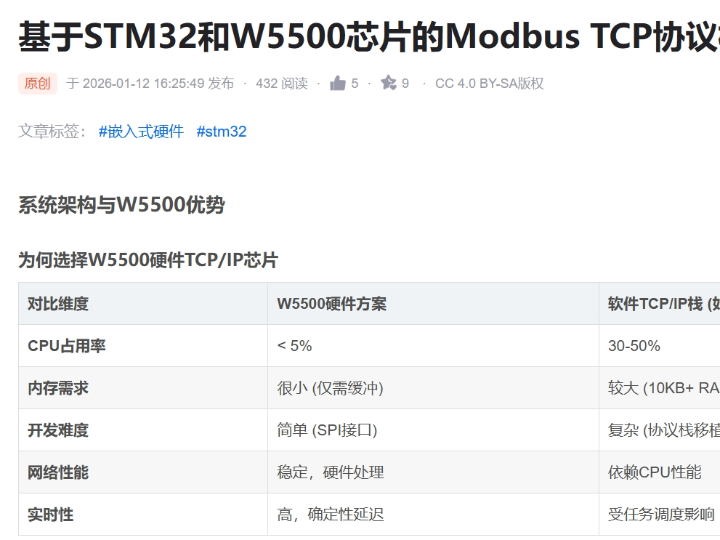
By handling TCP/IP communication in hardware, the W5500 allows the microcontroller to focus on application logic such as sensor processing or control algorithms.
This architecture reduces firmware complexity and improves system stability.
KR
WIZnet W5500 이더넷 컨트롤러는 임베디드 장치의 네트워크 인터페이스 역할을 합니다.
주요 기능:
TCP/IP 프로토콜 하드웨어 처리
최대 8개의 네트워크 소켓 관리
Ethernet MAC 및 PHY 통합
MCU의 네트워크 처리 부하 감소
W5500이 네트워크 처리를 담당하기 때문에 MCU는 센서 처리나 제어 로직과 같은 애플리케이션 기능에 집중할 수 있습니다.
이 구조는 펌웨어 복잡도를 줄이고 시스템 안정성을 향상시킵니다.
Implementation Notes
The article explains the basic steps required to initialize the W5500 and establish TCP communication.
Conceptual integration example based on WIZnet ioLibrary
// Register SPI communication callbacks
reg_wizchip_spi_cbfunc(spi_read, spi_write);
// Configure socket buffers
uint8_t txsize[8] = {2,2,2,2,2,2,2,2};
uint8_t rxsize[8] = {2,2,2,2,2,2,2,2};
wizchip_init(txsize, rxsize);
// Network configuration
wiz_NetInfo netinfo = {
.mac = {0x00,0x08,0xDC,0x11,0x22,0x33},
.dhcp = NETINFO_DHCP
};
wizchip_setnetinfo(&netinfo);
EN Explanation
Once initialized, the W5500 allows the device to open TCP sockets that can be used by an MQTT client library to communicate with a broker.
KR 설명
초기화 이후 W5500은 TCP 소켓을 생성할 수 있으며 MQTT 클라이언트 라이브러리를 통해 MQTT 브로커와 통신할 수 있습니다.
Practical Tips / Pitfalls
EN
Verify SPI pin connections between MCU and W5500.
Check Ethernet PHY link status before opening sockets.
Use static IP configuration for industrial deployments.
Monitor socket usage when running multiple connections.
Implement reconnect logic to maintain MQTT sessions.
KR
MCU와 W5500 사이 SPI 연결을 확인합니다.
소켓 연결 전에 Ethernet PHY 링크 상태를 확인합니다.
산업 환경에서는 고정 IP 사용을 권장합니다.
여러 연결 사용 시 소켓 사용량을 관리합니다.
MQTT 세션 유지를 위해 재연결 로직을 구현합니다.
FAQ
Q1: Why use W5500 for MQTT communication?
EN:
W5500 includes a hardware TCP/IP stack that reduces CPU load and simplifies network implementation.
KR:
W5500은 하드웨어 TCP/IP 스택을 제공하여 MCU의 CPU 부하를 줄이고 네트워크 구현을 단순화합니다.
Q2: How does W5500 connect to the MCU?
EN:
The W5500 connects through an SPI interface using MOSI, MISO, SCK, and CS pins.
KR:
W5500은 MOSI, MISO, SCK, CS 핀을 사용하는 SPI 인터페이스로 MCU와 연결됩니다.
Q3: What role does W5500 play in the MQTT system?
EN:
It provides the Ethernet network interface used to establish TCP connections with the MQTT broker.
KR:
W5500은 MQTT 브로커와 TCP 연결을 생성하기 위한 Ethernet 네트워크 인터페이스 역할을 합니다.
Q4: Can beginners implement this project?
EN:
Developers with basic embedded programming and networking knowledge should be able to implement it.
KR:
기본적인 임베디드 프로그래밍과 네트워크 지식이 있다면 구현할 수 있습니다.
Q5: How does W5500 compare with software TCP/IP stacks like LwIP?
EN:
W5500 handles networking in hardware, while LwIP runs in software on the MCU, increasing CPU and memory usage.
KR:
W5500은 네트워크 처리를 하드웨어에서 수행하지만 LwIP는 MCU에서 소프트웨어로 실행되어 CPU와 메모리 사용량이 증가합니다.
Source
Original Article
https://blog.csdn.net/ytttr873/article/details/156866013
License: CC BY-SA 4.0
Tags
#W5500
#MQTT
#EmbeddedNetworking
#EthernetIoT
#IndustrialIoT
#TCPIP
#EmbeddedSystems
#MakerProject