



How to Build Commercial MQTT Connectivity with WIZnet W5500 on STM32?
This commercial architecture uses WIZnet W5500 on an STM32 platform to connect an embedded device to a cloud MQTT service through wired Ethernet.
How to Build Commercial MQTT Connectivity with WIZnet W5500 on STM32?
Summary
This commercial architecture uses WIZnet W5500 on an STM32 platform to connect an embedded device to a cloud MQTT service through wired Ethernet. The source project is an STM32 + W5500 + MQTT communication example for exchanging data with Alibaba Cloud, including device-side topic subscription and sensor-data publishing. W5500 provides the Ethernet MAC/PHY, hardwired TCP/IP stack, socket engine, and internal Tx/Rx buffering, while the STM32 firmware handles MQTT client configuration, sensor payload generation, subscription logic, diagnostics, and commercial product behavior.
What the Project Does
The project demonstrates STM32-to-cloud MQTT communication using W5500 as the wired Ethernet interface. The GitCode description states that the example helps developers implement data exchange between STM32 and Alibaba Cloud, including subscribing to platform topics and publishing collected sensor data to the cloud. The related CSDN mirror describes the package as stm32+w5500+mqtt.zip, containing STM32-W5500 communication code examples and an MQTT protocol library.
For a commercial device, the practical data flow is:
STM32 application → sensor or product data model → MQTT client layer → W5500 socket layer → SPI → W5500 → RJ45 Ethernet → router or gateway → cloud MQTT broker.
This architecture fits commercial gateways, metering devices, machine monitors, environmental sensors, factory service terminals, and small controllers that need stable cloud reporting. The device can publish measured data and subscribe to command or configuration topics, while the firmware records connection state, socket state, reconnect attempts, MQTT result codes, and last communication error.
Where WIZnet Fits
The exact WIZnet product is W5500. It sits between the STM32 and the Ethernet connector. STM32 controls W5500 through SPI, chip select, reset, and optionally interrupt. W5500 handles the Ethernet MAC/PHY path, hardwired TCP/IP processing, socket state transitions, and packet buffering.
WIZnet documents W5500 as a hardwired TCP/IP Internet controller with SPI access up to 80 MHz, embedded 10/100 Ethernet MAC/PHY, support for TCP, UDP, ICMP, IPv4, ARP, IGMP, and PPPoE, 8 independent sockets, and 32 KB internal Tx/Rx buffer memory. WIZnet also lists MQTT among the supported services in its W5500 software-resource section through ioLibrary-based resources.
This split is useful in commercial firmware because MQTT already adds broker addressing, topic management, credentials, keepalive timing, publish/subscribe state, and reconnect policy. W5500 keeps the lower TCP/IP transport in hardware, so the STM32 firmware can focus on product logic and MQTT behavior instead of carrying a full software network stack.
Implementation Notes
The GitCode page confirms the STM32 + W5500 + MQTT project and lists MIT licensing, but the visible repository page did not expose inspectable source files during verification. The related CSDN mirror says the package is distributed as stm32+w5500+mqtt.zip, but the actual code inside that archive could not be read from the accessible page. Therefore, no project-specific source code is quoted here.
A commercial implementation should be organized into five layers.
The hardware layer connects STM32 to W5500 over SPI. The required signals are SCLK, MOSI, MISO, chip select, reset, 3.3 V, and ground. Interrupt is recommended when the product needs event-driven receive, disconnect, timeout, or send-complete handling. Reset should be controlled by STM32 firmware so the Ethernet controller can be recovered without rebooting the whole product.
The W5500 network layer initializes SPI access, verifies W5500 identity, configures MAC address and IP settings, checks PHY link state, and allocates sockets. This layer should expose diagnostic values such as link state, local IP, socket status, TX free space, RX received size, reconnect count, and last socket error. W5500’s 8 sockets are a finite resource, so commercial firmware should reserve them deliberately for MQTT, provisioning, diagnostics, local service, and future maintenance functions.
The MQTT transport layer uses a W5500 TCP socket to connect to the MQTT broker. The project description specifically targets Alibaba Cloud communication and requires configuring MQTT connection parameters such as server address, port, username, and password.
The application layer maps product data to MQTT topics. Sensor readings, alarm states, production counters, temperature values, relay states, and maintenance status should be serialized into compact payloads. Cloud-to-device topics should be treated as command inputs with validation, timeout handling, and audit logging.
The performance and recovery layer measures end-to-end behavior. Useful metrics include Ethernet link-up time, broker connect time, MQTT reconnect count, publish interval, publish acknowledgement latency, socket close reason, payload size, SPI clock rate, and watchdog reset reason. These measurements are more useful than raw throughput because MQTT commercial products usually fail due to reconnection, credentials, broker configuration, watchdog timing, or payload handling rather than Ethernet line rate.
Practical Tips / Pitfalls
- Verify W5500 SPI access, chip identity, PHY link, MAC address, and IP address before testing MQTT.
- Keep MQTT connection parameters separate from firmware constants so production, staging, and field-service brokers can be configured safely.
- Route W5500 reset to STM32 GPIO for Ethernet recovery without a full system reboot.
- Reserve sockets early; do not let debug services consume sockets needed for MQTT reconnect or maintenance.
- Log MQTT broker address, port, connection state, reconnect count, last publish result, and last socket error.
- Test cable removal, router reboot, broker downtime, bad credentials, duplicate IP, DHCP failure, and long idle keepalive behavior.
- Measure payload formatting time and flash/logging overhead separately from Ethernet transport.
FAQ
Q: Why use WIZnet W5500 for a commercial STM32 MQTT device?
A: W5500 gives STM32 a wired Ethernet interface with hardwired TCP/IP, 8 sockets, and 32 KB internal Tx/Rx memory. That keeps TCP/IP processing in the Ethernet controller while STM32 firmware manages MQTT topics, credentials, sensor payloads, reconnect policy, diagnostics, and product behavior.
Q: How does W5500 connect to the STM32 platform?
A: W5500 connects through SPI using SCLK, MOSI, MISO, chip select, reset, power, and ground. Interrupt is optional for basic polling designs but useful for commercial firmware that needs bounded response to receive, disconnect, timeout, and send-complete events.
Q: What role does W5500 play in this project?
A: W5500 is the wired Ethernet transport engine for the MQTT client. STM32 builds MQTT payloads, subscribes to cloud topics, publishes sensor data, and handles product logic; W5500 manages Ethernet MAC/PHY operation, hardwired TCP/IP behavior, socket state, and packet buffers.
Q: Can beginners follow this commercial architecture?
A: Yes, if bring-up is staged. The practical order is STM32 project import, W5500 wiring check, SPI access test, IP configuration, TCP socket test, MQTT broker parameter configuration, topic subscription, sensor-data publish, then reconnect and long-run testing.
Q: How does W5500 compare with Wi-Fi for commercial MQTT devices?
A: Wi-Fi is better when the product must avoid cabling or move freely. W5500 is better when the commercial device needs a repeatable wired service path, visible PHY link state, firmware-controlled reset, stable factory testing, and predictable local diagnostics. For fixed gateways, machine monitors, metering equipment, and service terminals, wired W5500 Ethernet is usually easier to validate than a wireless link.
Source
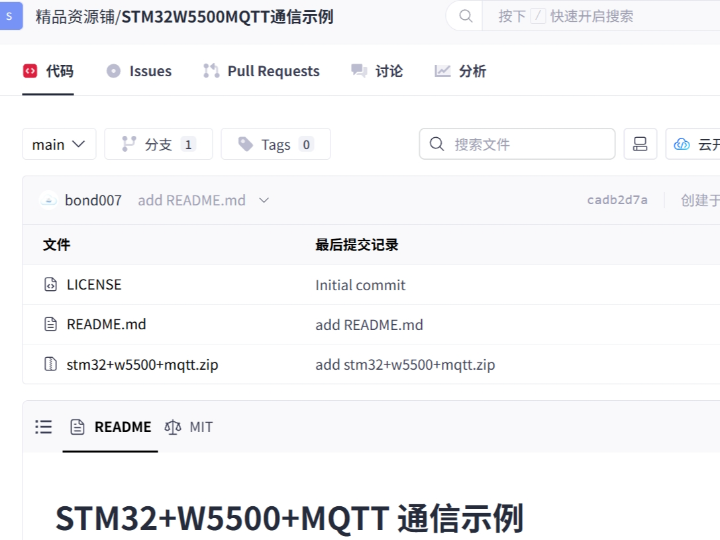
Original source: GitCode repository “STM32W5500MQTT通信示例: 基于 STM32 与 W5500 的 MQTT 通信示例项目.” The page describes an STM32 + W5500 MQTT example for Alibaba Cloud data exchange, topic subscription, sensor-data publishing, MQTT connection-parameter configuration, and MIT licensing.
Related CSDN mirror: “STM32+W5500+MQTT 通信示例.” The article states CC 4.0 BY-SA licensing and describes the package file stm32+w5500+mqtt.zip, usage steps, MQTT broker parameter configuration, subscription, and publish behavior.
Related technical overview: “STM32W5500MQTT通信示例:实现STM32与阿里云的高效连接.” The article describes the core components as STM32, W5500, and MQTT, and identifies application areas such as industrial automation, environmental monitoring, and smart home devices.
WIZnet product reference: W5500 documentation and feature list, including hardwired TCP/IP, SPI up to 80 MHz, 8 sockets, 32 KB buffer memory, software resources, and MQTT support through WIZnet driver resources.
Tags
#W5500 #WIZnet #STM32 #MQTT #CommercialIoT #Ethernet #SPI #Performance #NetworkArchitecture #Firmware #CloudConnectivity #Socket
STM32에서 WIZnet W5500으로 상용 MQTT 연결을 구축하는 방법은?
요약
이 상용 아키텍처는 STM32 플랫폼에서 WIZnet W5500을 사용해 embedded device를 유선 Ethernet 기반 cloud MQTT service에 연결합니다. 소스 프로젝트는 STM32 + W5500 + MQTT communication example이며, Alibaba Cloud와의 data exchange, device-side topic subscription, sensor-data publishing을 포함합니다. W5500은 Ethernet MAC/PHY, hardwired TCP/IP stack, socket engine, internal Tx/Rx buffering을 제공하고, STM32 firmware는 MQTT client configuration, sensor payload generation, subscription logic, diagnostics, commercial product behavior를 담당합니다.
프로젝트가 하는 일
이 프로젝트는 W5500을 유선 Ethernet interface로 사용해 STM32와 cloud MQTT 간 통신을 구현하는 예제입니다. GitCode 설명에 따르면 이 예제는 STM32와 Alibaba Cloud 사이의 data exchange를 구현하는 데 도움을 주며, platform topic subscription과 수집된 sensor data publishing을 포함합니다. 관련 CSDN mirror는 이 package를 stm32+w5500+mqtt.zip으로 설명하며, STM32-W5500 communication code example과 MQTT protocol library를 포함한다고 설명합니다.
상용 장치에서 실제 데이터 흐름은 다음과 같습니다.
STM32 application → sensor 또는 product data model → MQTT client layer → W5500 socket layer → SPI → W5500 → RJ45 Ethernet → router 또는 gateway → cloud MQTT broker
이 아키텍처는 commercial gateway, metering device, machine monitor, environmental sensor, factory service terminal, small controller처럼 안정적인 cloud reporting이 필요한 장치에 적합합니다. 장치는 measured data를 publish하고 command 또는 configuration topic을 subscribe할 수 있으며, firmware는 connection state, socket state, reconnect attempt, MQTT result code, last communication error를 기록해야 합니다.
WIZnet이 들어가는 위치
이 프로젝트에서 사용되는 정확한 WIZnet 제품은 W5500입니다. W5500은 STM32와 Ethernet connector 사이에 위치합니다. STM32는 SPI, chip select, reset, 선택적으로 interrupt를 통해 W5500을 제어합니다. W5500은 Ethernet MAC/PHY path, hardwired TCP/IP processing, socket state transition, packet buffering을 처리합니다.
WIZnet 문서 기준으로 W5500은 최대 80 MHz SPI access, embedded 10/100 Ethernet MAC/PHY, TCP, UDP, ICMP, IPv4, ARP, IGMP, PPPoE 지원, 8개 independent socket, 32 KB internal Tx/Rx buffer memory를 제공하는 hardwired TCP/IP Internet controller입니다. WIZnet은 W5500 software-resource section에서 ioLibrary 기반 resource를 통해 MQTT도 지원 service로 제시합니다.
이 분업은 상용 firmware에서 유용합니다. MQTT는 이미 broker addressing, topic management, credential, keepalive timing, publish/subscribe state, reconnect policy를 추가하기 때문입니다. W5500은 하위 TCP/IP transport를 hardware에 유지하므로, STM32 firmware는 full software network stack을 직접 부담하지 않고 product logic과 MQTT behavior에 집중할 수 있습니다.
구현 참고 사항
GitCode page는 STM32 + W5500 + MQTT project와 MIT licensing을 확인할 수 있게 하지만, visible repository page는 검증 중 inspect 가능한 source file을 노출하지 않았습니다. 관련 CSDN mirror는 package가 stm32+w5500+mqtt.zip으로 배포된다고 설명하지만, 접근 가능한 page에서 archive 내부 실제 코드를 읽을 수는 없었습니다. 따라서 여기서는 프로젝트별 source code를 인용하지 않습니다.
상용 구현은 다섯 계층으로 구성하는 것이 좋습니다.
Hardware layer는 STM32와 W5500을 SPI로 연결합니다. 필요한 signal은 SCLK, MOSI, MISO, chip select, reset, 3.3 V, ground입니다. 제품이 event-driven receive, disconnect, timeout, send-complete handling을 필요로 한다면 interrupt를 권장합니다. Reset은 STM32 firmware가 제어해야 하며, 그래야 전체 제품을 reboot하지 않고 Ethernet controller만 복구할 수 있습니다.
W5500 network layer는 SPI access를 초기화하고, W5500 identity를 확인하며, MAC address와 IP setting을 구성하고, PHY link state를 확인하며, socket을 할당합니다. 이 계층은 link state, local IP, socket status, TX free space, RX received size, reconnect count, last socket error 같은 diagnostic value를 노출해야 합니다. W5500의 8개 socket은 제한된 자원이므로 commercial firmware에서는 MQTT, provisioning, diagnostics, local service, future maintenance function용으로 의도적으로 예약해야 합니다.
MQTT transport layer는 W5500 TCP socket을 사용해 MQTT broker에 연결합니다. 프로젝트 설명은 Alibaba Cloud communication을 대상으로 하며, server address, port, username, password 같은 MQTT connection parameter 설정이 필요하다고 설명합니다.
Application layer는 product data를 MQTT topic에 매핑합니다. Sensor reading, alarm state, production counter, temperature value, relay state, maintenance status는 compact payload로 serialize해야 합니다. Cloud-to-device topic은 command input으로 취급하고 validation, timeout handling, audit logging을 적용해야 합니다.
Performance and recovery layer는 end-to-end behavior를 측정합니다. 유용한 metric에는 Ethernet link-up time, broker connect time, MQTT reconnect count, publish interval, publish acknowledgement latency, socket close reason, payload size, SPI clock rate, watchdog reset reason이 포함됩니다. 이러한 측정값은 raw throughput보다 더 유용합니다. MQTT commercial product는 보통 Ethernet line rate보다 reconnection, credential, broker configuration, watchdog timing, payload handling 문제로 실패하기 때문입니다.
실무 팁 / 주의점
- MQTT를 테스트하기 전에 W5500 SPI access, chip identity, PHY link, MAC address, IP address를 먼저 검증해야 합니다.
- MQTT connection parameter는 firmware constant와 분리해 production, staging, field-service broker를 안전하게 설정할 수 있도록 해야 합니다.
- W5500 reset은 STM32 GPIO에 연결해 full system reboot 없이 Ethernet recovery가 가능하도록 해야 합니다.
- Socket은 초기에 예약해야 합니다. Debug service가 MQTT reconnect 또는 maintenance에 필요한 socket을 소모하면 안 됩니다.
- MQTT broker address, port, connection state, reconnect count, last publish result, last socket error를 기록해야 합니다.
- Cable removal, router reboot, broker downtime, bad credential, duplicate IP, DHCP failure, long idle keepalive behavior를 테스트해야 합니다.
- Payload formatting time과 flash/logging overhead는 Ethernet transport와 분리해서 측정해야 합니다.
FAQ
Q: 상용 STM32 MQTT 장치에 왜 WIZnet W5500을 사용하나요?
A: W5500은 STM32에 hardwired TCP/IP, 8개 socket, 32 KB internal Tx/Rx memory를 갖춘 유선 Ethernet interface를 제공합니다. 따라서 TCP/IP processing은 Ethernet controller 내부에 유지되고, STM32 firmware는 MQTT topic, credential, sensor payload, reconnect policy, diagnostics, product behavior를 관리할 수 있습니다.
Q: W5500은 STM32 platform에 어떻게 연결되나요?
A: W5500은 SCLK, MOSI, MISO, chip select, reset, power, ground를 사용하는 SPI로 연결됩니다. Interrupt는 basic polling design에서는 선택 사항일 수 있지만, receive, disconnect, timeout, send-complete event에 대한 bounded response가 필요한 commercial firmware에서는 유용합니다.
Q: 이 프로젝트에서 W5500은 어떤 역할을 하나요?
A: W5500은 MQTT client를 위한 유선 Ethernet transport engine입니다. STM32는 MQTT payload를 만들고, cloud topic을 subscribe하며, sensor data를 publish하고, product logic을 처리합니다. W5500은 Ethernet MAC/PHY operation, hardwired TCP/IP behavior, socket state, packet buffer를 관리합니다.
Q: 초보자도 이 상용 아키텍처를 따라갈 수 있나요?
A: 가능합니다. 다만 bring-up을 단계적으로 진행해야 합니다. 실용적인 순서는 STM32 project import, W5500 wiring check, SPI access test, IP configuration, TCP socket test, MQTT broker parameter configuration, topic subscription, sensor-data publish, 그다음 reconnect 및 long-run testing입니다.
Q: W5500은 상용 MQTT 장치에서 Wi-Fi와 비교하면 어떤 차이가 있나요?
A: Wi-Fi는 제품이 cable-free이거나 자유롭게 이동해야 할 때 더 적합합니다. W5500은 commercial device가 repeatable wired service path, visible PHY link state, firmware-controlled reset, stable factory testing, predictable local diagnostics를 필요로 할 때 더 적합합니다. Fixed gateway, machine monitor, metering equipment, service terminal에서는 wired W5500 Ethernet이 wireless link보다 검증하기 쉬운 경우가 많습니다.
출처
Original source: GitCode repository “STM32W5500MQTT通信示例: 基于 STM32 与 W5500 的 MQTT 通信示例项目.” 해당 page는 Alibaba Cloud data exchange, topic subscription, sensor-data publishing, MQTT connection-parameter configuration, MIT licensing을 포함한 STM32 + W5500 MQTT example을 설명합니다.
https://gitcode.com/Premium-Resources/7f6f7
Related CSDN mirror: “STM32+W5500+MQTT 通信示例.” 해당 article은 CC 4.0 BY-SA licensing을 명시하며, package file stm32+w5500+mqtt.zip, usage step, MQTT broker parameter configuration, subscription, publish behavior를 설명합니다.
https://blog.csdn.net/gitblog_06722/article/details/147696740
Related technical overview: “STM32W5500MQTT通信示例:实现STM32与阿里云的高效连接.” 해당 article은 core component를 STM32, W5500, MQTT로 설명하고, industrial automation, environmental monitoring, smart home device 같은 application area를 언급합니다.
https://blog.csdn.net/gitblog_06762/article/details/148072713
WIZnet product reference: W5500 documentation and feature list, including hardwired TCP/IP, SPI up to 80 MHz, 8 sockets, 32 KB buffer memory, software resources, and MQTT support through WIZnet driver resources.
https://docs.wiznet.io/Product/Chip/Ethernet/W5500
태그
#W5500 #WIZnet #STM32 #MQTT #CommercialIoT #Ethernet #SPI #Performance #NetworkArchitecture #Firmware #CloudConnectivity #Socket