



How to Build an Embedded Network Stack with ioLibrary_Driver on W5500 or W6300?
This source is an architecture-level introduction to WIZnet’s ioLibrary_Driver rather than a board-specific implementation,
How to Build an Embedded Network Stack with ioLibrary_Driver on W5500 or W6300?
Summary
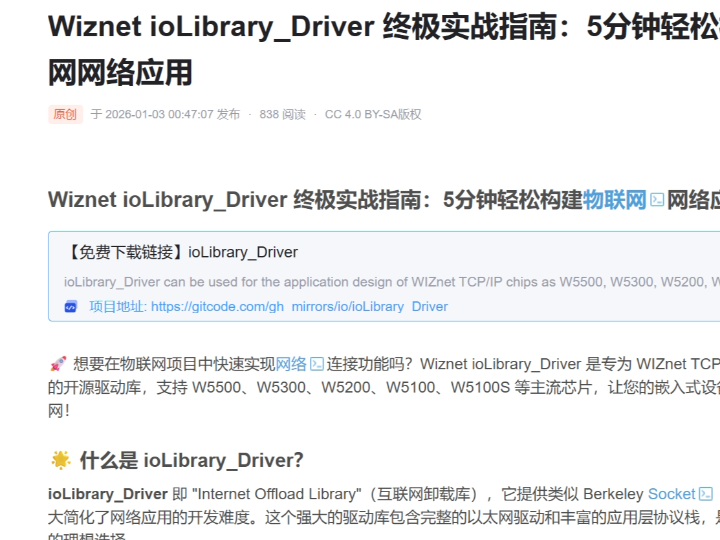
This source is an architecture-level introduction to WIZnet’s ioLibrary_Driver rather than a board-specific implementation, but it is still useful for education because it shows how WIZnet structures embedded networking around hardware TCP/IP chips such as W5500 and W6300. In this model, the WIZnet chip is the Ethernet transport engine, while ioLibrary_Driver supplies the chip abstraction, socket-style API, and protocol modules needed to turn low-level hardware access into a usable embedded network stack.
What the Project Does
The article presents ioLibrary_Driver as the software framework used to build applications on WIZnet TCP/IP chips. It describes support for W5500, W5300, W5200, W5100, W5100S, W6100, and W6300, and it organizes the stack into driver, protocol, and application layers. The visible feature list includes DHCP, DNS, MQTT, HTTP server, SNMP, and TFTP, which makes the source more of a stack overview than a single end-device tutorial.
For education, that layered structure is the main value. The article makes it clear that an embedded Ethernet application is not just a socket demo. First, the chip driver layer handles register-level communication with the WIZnet controller. Second, the Internet layer adds reusable protocol modules. Third, the application layer combines those pieces into a real MCU program. That is a useful teaching path because it explains how hardware offload, socket APIs, and application protocols fit together in one stack.
The article also shows that ioLibrary_Driver is designed to span multiple WIZnet chips with one software layout. That matters because a student can learn one framework and then apply the same structure to different parts, instead of treating each chip as a completely separate software ecosystem.
Where WIZnet Fits
The WIZnet devices relevant here are W5500 and W6300. In an ioLibrary_Driver-based system, those chips are the actual Ethernet endpoints, while the MCU supplies SPI or bus access, reset handling, callbacks, and application logic. ioLibrary_Driver sits between them and provides the standardized control path that lets the application configure the network, open sockets, and use higher-layer protocols.
For a network-stack education project, W5500 is the easier starting point because it is the most widely used WIZnet hardwired TCP/IP controller in MCU-class projects, and the article uses W5500 in its visible configuration example. W6300 appears in the supported-chip list, which shows that the same stack architecture extends to newer WIZnet devices as well. The educational lesson is not that the chips are identical, but that the same driver framework can organize both.
Implementation Notes
This source does use WIZnet products, but it is not a repository walkthrough, and it explicitly says some content was AI-assisted. I therefore treat it as an overview and limit implementation claims to what is directly visible in the article.
One visible configuration step is the chip-selection switch in wizchip_conf.h:
#define _WIZCHIP_ W5500 // 根据实际芯片修改
This matters because it is the core architectural switch inside ioLibrary_Driver. It tells the framework which WIZnet backend to build around, which is why the same stack can support multiple chips without rewriting the full application.
A second visible step is the hardware callback model:
reg_wizchip_spi_cbfunc(spi_readbyte, spi_writebyte);
This matters because it defines the platform boundary. ioLibrary_Driver does not directly own the MCU SPI peripheral. Instead, the developer provides hardware-access callbacks, and the library uses them to talk to the chip. That is exactly what makes the stack portable across MCU families.
The article also exposes the repository structure clearly enough to show the network-stack layout:
ioLibrary/├── Ethernet/│ ├── W5500/│ └── socket.c├── Internet/│ ├── DHCP/│ ├── MQTT/│ └── httpServer/
This matters because it shows the real stack layering: chip driver first, socket API next, protocol modules after that. For education, that is more important than any single example program.
Practical Tips / Pitfalls
Start with chip selection and hardware callback registration before touching DHCP, MQTT, or HTTP.
Treat wizchip_conf.h as the control center for the whole stack.
Learn the framework in layers: chip driver, socket API, then protocol modules.
Do not assume W5500 and W6300 are electrically interchangeable just because one library supports both.
Use the official upstream repository as the primary reference, and treat overview articles like this one as secondary guidance.
FAQ
Why use ioLibrary_Driver instead of writing directly to W5500 or W6300 registers?
Because ioLibrary_Driver adds a reusable chip driver layer, a socket-style API, and protocol modules on top of raw register access. That makes it much easier to move from low-level hardware control to real applications such as DHCP, DNS, MQTT, or HTTP server functions.
How does it connect to the platform?
Through platform callbacks. The visible article shows SPI callback registration, which means the MCU supplies the hardware access functions and ioLibrary_Driver uses those functions to communicate with the WIZnet chip.
What role does W5500 or W6300 play in this setup?
The chip is the Ethernet transport device. ioLibrary_Driver is the software layer that exposes that hardware to the MCU application through drivers, sockets, and protocol modules.
Can beginners follow this project?
Yes, as an education reference. It is useful for understanding how WIZnet organizes embedded networking software, but it is not a complete porting guide, so beginners should study the official repository alongside it.
How does this compare with a pure software stack?
This framework is built around WIZnet hardware TCP/IP chips, so the architecture centers on controlling dedicated Ethernet hardware rather than implementing the entire transport path in MCU software. That usually simplifies integration on small MCU systems.
Source
Original source: CSDN article, “Wiznet ioLibrary_Driver 终极实战指南:5分钟轻松构建物联网网络应用,” published January 15, 2026, under CC 4.0 BY-SA. The article notes that some content was AI-assisted. The primary upstream reference is the official ioLibrary_Driver repository linked from the page.
Tags
WIZnet, ioLibrary_Driver, W5500, W6300, Embedded Ethernet, Socket API, DHCP, DNS, MQTT, HTTP Server, Education, Network Stack
W5500 또는 W6300에서 ioLibrary_Driver 기반 임베디드 네트워크 스택을 어떻게 구축할 수 있을까?
Summary
이 소스는 특정 보드 구현 예제라기보다 WIZnet의 ioLibrary_Driver를 소개하는 아키텍처 수준 자료에 가깝다. 그럼에도 교육용으로는 충분히 가치가 있다. W5500이나 W6300 같은 하드웨어 TCP/IP 칩을 중심으로, WIZnet이 임베디드 네트워킹을 어떻게 구조화하는지 보여주기 때문이다. 이 모델에서 WIZnet 칩은 실제 이더넷 전송 엔진 역할을 하고, ioLibrary_Driver는 저수준 하드웨어 접근을 실제 임베디드 네트워크 스택으로 바꾸는 칩 추상화, 소켓 스타일 API, 프로토콜 모듈을 제공한다.
What the Project Does
이 글은 ioLibrary_Driver를 WIZnet TCP/IP 칩 위에서 애플리케이션을 구축하기 위한 소프트웨어 프레임워크로 설명한다. 글에 따르면 지원 칩은 W5500, W5300, W5200, W5100, W5100S, W6100, W6300까지 포함되며, 전체 스택은 드라이버 계층, 프로토콜 계층, 애플리케이션 계층으로 나뉜다. 보이는 기능 목록에는 DHCP, DNS, MQTT, HTTP 서버, SNMP, TFTP가 포함되어 있어, 이 자료는 단일 장치 튜토리얼이라기보다 네트워크 스택 개요에 가깝다.
교육 관점에서 가장 중요한 가치는 바로 이 계층 구조다. 이 자료는 임베디드 이더넷 애플리케이션이 단순한 소켓 데모가 아니라는 점을 분명히 보여준다. 먼저 칩 드라이버 계층이 WIZnet 컨트롤러와의 레지스터 수준 통신을 담당한다. 그다음 Internet 계층이 재사용 가능한 프로토콜 모듈을 얹는다. 마지막으로 애플리케이션 계층이 이 모든 요소를 실제 MCU 프로그램으로 묶는다. 이런 설명 방식은 하드웨어 오프로딩, 소켓 API, 애플리케이션 프로토콜이 하나의 스택 안에서 어떻게 맞물리는지 이해하는 데 적합하다.
또한 이 글은 ioLibrary_Driver가 여러 WIZnet 칩을 하나의 소프트웨어 구조로 포괄하도록 설계되었다는 점도 보여준다. 학습자는 한 프레임워크를 익힌 뒤 같은 구조를 다른 칩에도 적용할 수 있고, 칩마다 완전히 다른 소프트웨어 생태계를 새로 배우지 않아도 된다.
Where WIZnet Fits
여기서 관련되는 WIZnet 제품은 W5500과 W6300이다. ioLibrary_Driver 기반 시스템에서 이 칩들은 실제 이더넷 엔드포인트 역할을 하고, MCU는 SPI 또는 버스 접근, 리셋 처리, 콜백 등록, 애플리케이션 로직을 담당한다. ioLibrary_Driver는 그 중간에서 표준화된 제어 경로를 제공해, 애플리케이션이 네트워크 설정, 소켓 생성, 상위 프로토콜 사용을 할 수 있도록 만든다.
네트워크 스택 교육용으로는 W5500이 더 쉬운 출발점이다. W5500은 MCU급 프로젝트에서 가장 널리 쓰이는 WIZnet 하드와이어드 TCP/IP 컨트롤러이고, 이 글의 보이는 설정 예제 역시 W5500을 사용한다. 반면 W6300은 지원 칩 목록에 등장하며, 같은 스택 아키텍처가 더 새로운 WIZnet 디바이스까지 확장된다는 점을 보여준다. 핵심 교육 포인트는 두 칩이 완전히 같다는 것이 아니라, 동일한 드라이버 프레임워크가 둘 다를 조직할 수 있다는 점이다.
Implementation Notes
이 소스는 실제로 WIZnet 제품을 다루지만, 저장소를 줄 단위로 해설하는 문서는 아니며, 일부 내용이 AI 도움을 받아 작성되었다고 명시한다. 따라서 완전한 포팅 가이드로 보기보다는 개요 자료로 보는 편이 맞고, 구현 관련 설명도 글에서 직접 확인 가능한 범위로 제한해야 한다.
가시적인 설정 단계 중 하나는 wizchip_conf.h의 칩 선택 스위치다.
#define _WIZCHIP_ W5500 // 根据实际芯片修改
이 부분이 중요한 이유는 ioLibrary_Driver 내부의 핵심 아키텍처 스위치이기 때문이다. 어떤 WIZnet 백엔드를 기준으로 프레임워크를 구성할지 결정하므로, 동일한 스택이 여러 칩을 지원할 수 있는 이유가 여기에 있다.
두 번째로 보이는 구현 단계는 하드웨어 콜백 모델이다.
reg_wizchip_spi_cbfunc(spi_readbyte, spi_writebyte);
이 부분은 플랫폼 경계를 정의한다. ioLibrary_Driver가 MCU의 SPI 주변장치를 직접 제어하는 것이 아니라, 개발자가 하드웨어 접근 콜백을 제공하고 라이브러리가 그것을 이용해 칩과 통신한다. 이런 구조 덕분에 스택이 여러 MCU 계열로 포팅될 수 있다.
또한 글은 저장소 구조를 충분히 보여주어 네트워크 스택의 계층 배치를 확인할 수 있다.
ioLibrary/├── Ethernet/│ ├── W5500/│ └── socket.c├── Internet/│ ├── DHCP/│ ├── MQTT/│ └── httpServer/
이 구조가 중요한 이유는 실제 스택 배치를 그대로 보여주기 때문이다. 먼저 칩 드라이버가 있고, 그 위에 소켓 API가 있고, 그 위에 프로토콜 모듈이 얹힌다. 교육용으로는 단일 예제 프로그램보다 이 구조 이해가 더 중요하다.
Practical Tips / Pitfalls
DHCP, MQTT, HTTP를 보기 전에 먼저 칩 선택과 하드웨어 콜백 등록부터 이해하는 편이 좋다.
wizchip_conf.h를 전체 스택의 제어 중심 파일로 보는 것이 좋다.
프레임워크는 칩 드라이버, 소켓 API, 프로토콜 모듈 순서로 계층적으로 학습하는 편이 효과적이다.
W5500과 W6300을 하나의 라이브러리가 지원한다고 해서 전기적 특성까지 동일하다고 보면 안 된다.
이런 개요 글은 입문용으로 유용하지만, 최종 기준은 공식 상위 저장소로 잡는 편이 안전하다.
FAQ
왜 W5500이나 W6300 레지스터를 직접 다루지 않고 ioLibrary_Driver를 사용하는가?
ioLibrary_Driver는 원시 레지스터 접근 위에 재사용 가능한 칩 드라이버 계층, 소켓 스타일 API, 프로토콜 모듈을 제공한다. 그래서 저수준 제어에서 DHCP, DNS, MQTT, HTTP 서버 같은 실제 애플리케이션으로 넘어가는 과정이 훨씬 단순해진다.
플랫폼과는 어떻게 연결되는가?
플랫폼 콜백을 통해 연결된다. 글에 보이는 SPI 콜백 등록처럼 MCU가 하드웨어 접근 함수를 제공하고, ioLibrary_Driver는 그 함수를 이용해 WIZnet 칩과 통신한다.
이 구조에서 W5500이나 W6300의 역할은 무엇인가?
칩 자체는 이더넷 전송 장치다. ioLibrary_Driver는 그 하드웨어를 MCU 애플리케이션이 사용할 수 있도록 드라이버, 소켓, 프로토콜 모듈 형태로 감싸주는 소프트웨어 계층이다.
초보자도 따라갈 수 있는가?
가능하다. 교육용 참고 자료로는 충분히 좋다. 다만 완전한 포팅 가이드는 아니므로, 초보자라면 공식 저장소를 함께 보면서 구조를 익히는 편이 더 낫다.
순수 소프트웨어 스택과 비교하면 어떤 차이가 있는가?
이 프레임워크는 WIZnet 하드웨어 TCP/IP 칩을 중심으로 설계되어 있기 때문에, MCU 소프트웨어 안에서 전체 전송 경로를 직접 구현하는 구조와 다르다. 특히 소형 MCU 시스템에서는 이런 방식이 통합을 더 단순하게 만든다.
Source
원문 출처: CSDN 글 “Wiznet ioLibrary_Driver 终极实战指南:5分钟轻松构建物联网网络应用”, 2026년 1월 15일 게시, CC 4.0 BY-SA.
글에는 일부 내용이 AI 도움을 받아 작성되었다고 표시되어 있다.
실제 상위 기준 자료는 페이지에서 연결하는 공식 ioLibrary_Driver 저장소다.
Tags
WIZnet, ioLibrary_Driver, W5500, W6300, Embedded Ethernet, Socket API, DHCP, DNS, MQTT, HTTP Server, Education, Network Stack