



nerdqaxeplus2-lan-480x320
Open-source Bitcoin miners such as Bitaxe and NerdQAxe have gained significant popularity in the maker community by making ASIC mining hardware accessible, cust
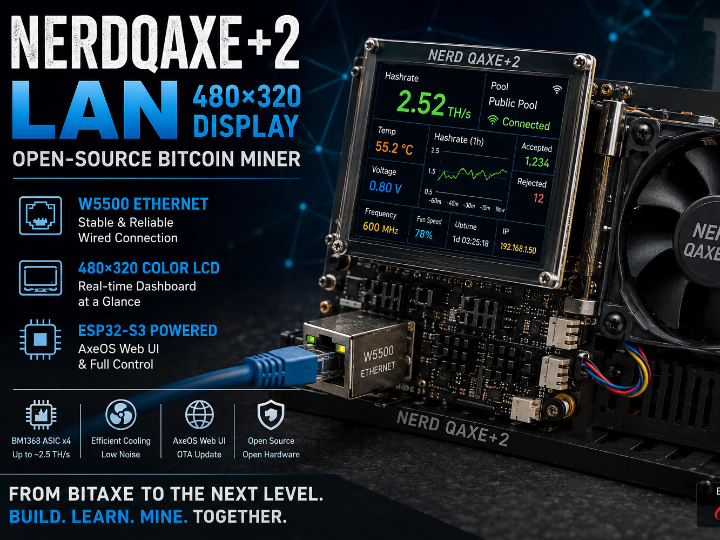
Adding Ethernet to the Open-Source NerdQAxePlus2 Bitcoin Miner with ESP32-S3 and W5500
Introduction
Open-source Bitcoin miners such as Bitaxe and NerdQAxe have gained significant popularity in the maker community by making ASIC mining hardware accessible, customizable, and easy to understand. Unlike commercial mining equipment, these projects publish their hardware designs and firmware, allowing developers to learn, modify, and build their own miners.
The project featured in this article, nerdqaxeplus2-lan-480x320, extends the NerdQAxePlus2 platform by adding W5500 Ethernet connectivity and support for a 480×320 3.5-inch TFT LCD. The result is a more stable, network-ready Bitcoin miner with a larger real-time dashboard while remaining fully compatible with the open-source Bitaxe ecosystem.
Why Are Bitaxe and NerdQAxe So Popular?
Traditional ASIC miners are closed platforms designed primarily for large-scale mining farms. Their hardware and firmware are proprietary, making them difficult to study or customize.
Bitaxe changed that by introducing one of the first fully open-source ASIC Bitcoin miner platforms. Developers can freely explore the PCB design, firmware, ASIC control logic, and web interface, making it an excellent learning platform for embedded systems and cryptocurrency mining.
NerdQAxe builds on the Bitaxe concept by using multiple ASIC chips to deliver higher hash rates while preserving the same open-source philosophy. Instead of focusing solely on mining performance, these projects have become valuable educational platforms for learning about:
Embedded firmware development
ASIC control
Network communication
Power and thermal management
Web-based device management
Open-source hardware design
From Bitaxe to Ethernet-Enabled NerdQAxe
The firmware used in this project originates from the official bitaxeorg/ESP-Miner repository, commonly known as AxeOS. NerdQAxePlus extends this firmware to support its quad-ASIC hardware, and nerdqaxeplus2-lan-480x320 further enhances it with Ethernet networking and a larger LCD interface.
Bitaxe (Open-Source ASIC Miner)
        │
        ▼
ESP-Miner (AxeOS)
        │
        ▼
ESP-Miner-NerdQAxePlus
        │
        ▼
nerdqaxeplus2-lan-480x320
This demonstrates how the open-source ecosystem continues to evolve through community contributions.
Project Highlights
The primary goal of this project is to upgrade the NerdQAxePlus2 hardware with features that improve usability and long-term reliability.
W5500 Ethernet Connectivity
Instead of relying solely on Wi-Fi, the project integrates a W5500 Ethernet Controller connected to the ESP32-S3 over SPI.
Because Bitcoin miners maintain persistent TCP connections with Stratum mining pools, Ethernet offers several advantages:
Stable wired connectivity
Reduced interference compared to Wi-Fi
Reliable 24/7 operation
Simple SPI integration with ESP32-S3
For continuously operating embedded systems, a wired connection provides a more predictable networking environment.
Large 480×320 TFT Dashboard
The original display has been upgraded to a 3.5-inch 480×320 TFT LCD, allowing far more information to be displayed simultaneously.
The dashboard can present:
Current Hashrate
ASIC Temperature
Core Voltage
Mining Frequency
Fan Speed
Accepted and Rejected Shares
Pool Status
Ethernet IP Address
System Uptime
The larger display provides a much more user-friendly monitoring experience than a small OLED screen.
ESP32-S3 System Controller
The ESP32-S3 manages the entire mining system, including:
W5500 Ethernet communication
Stratum client
ASIC management
LCD interface
Fan control
Temperature monitoring
Power monitoring
AxeOS Web UI
Meanwhile, the BM1368 ASICs perform the computationally intensive SHA-256 hashing.
AxeOS Web Interface
The project inherits the familiar AxeOS web interface from ESP-Miner.
Users can configure mining pools, monitor system status, adjust operating parameters, and update firmware directly from a web browser without additional software.
System Architecture
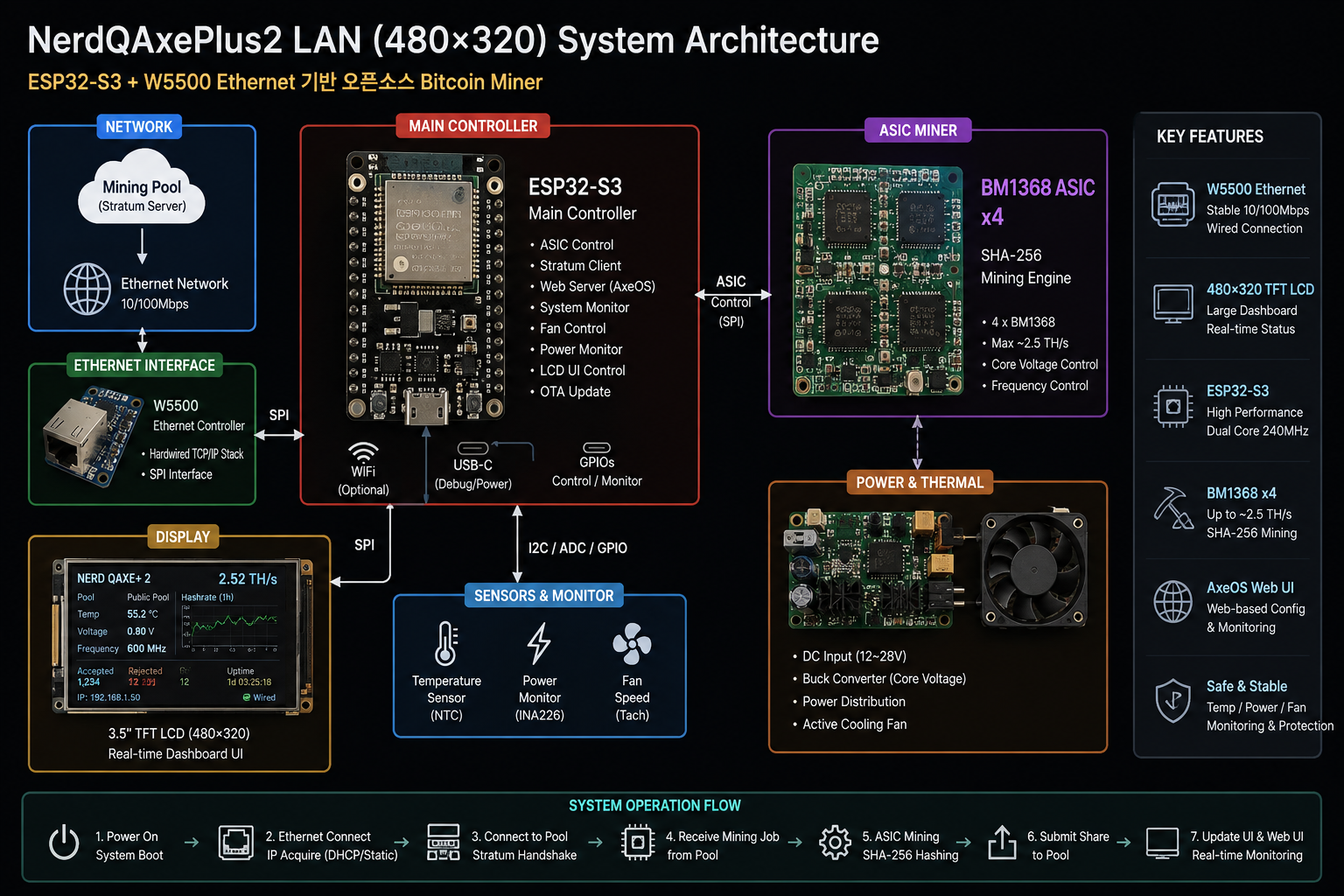
The system consists of several functional blocks:
ESP32-S3 as the main controller
W5500 Ethernet Controller for wired networking
BM1368 ASIC ×4 for SHA-256 Bitcoin mining
480×320 TFT LCD for the real-time dashboard
Power and thermal management including voltage regulation, temperature sensing, and cooling fan control
Together, these components create a compact standalone Bitcoin miner capable of connecting directly to a mining pool over Ethernet.
Why W5500?
Bitcoin mining does not require high network bandwidth, but it does require a reliable and persistent connection.
The W5500 is well suited for this application because it provides:
Stable wired Ethernet connectivity
Easy SPI integration with ESP32-S3
Reduced software complexity
Reliable long-term operation
For embedded systems that run continuously, Ethernet is often a better choice than Wi-Fi, particularly in environments with multiple devices or wireless interference.
Conclusion
nerdqaxeplus2-lan-480x320 demonstrates how an already successful open-source Bitcoin miner can be extended with new hardware while remaining compatible with the Bitaxe ecosystem.
By combining an ESP32-S3, W5500 Ethernet, quad BM1368 ASICs, and a 480×320 TFT display, the project delivers a more stable and user-friendly mining platform. Beyond cryptocurrency mining, it also serves as an excellent reference design for developers interested in Ethernet-enabled embedded systems, ASIC control, real-time dashboards, and open-source hardware development.
For anyone looking to explore embedded networking and hardware customization, this project is an excellent example of how the open-source maker community continues to push the Bitaxe platform forward.