


MicroNet
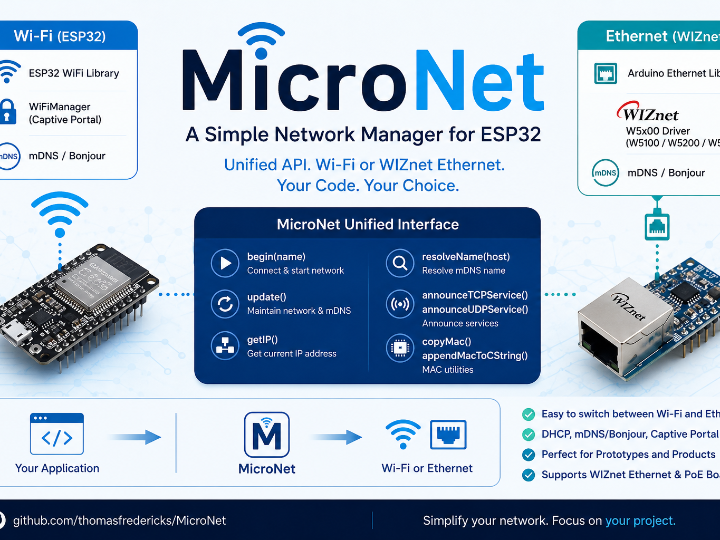
MicroNet is a lightweight network connection manager library for Arduino and PlatformIO

M5Stack - Development Board Watch Kit (Not Including Core)
x 1

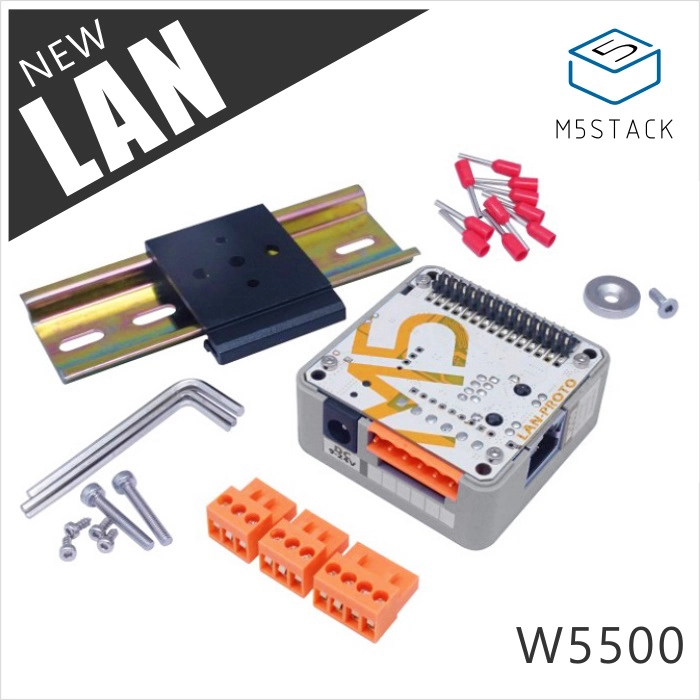
M5Stack - LAN Module with W5500
x 1
Arduino - Arduino IDE
x 1

platformio - PlatformIO Core
x 1
MicroNet: Managing Wi-Fi and WIZnet Ethernet with a Single Library on ESP32
Why This Library Exists
Most Ethernet implementations on microcontrollers rely on lwIP — a software TCP/IP stack that runs on the MCU itself, consuming CPU cycles for every network operation. WIZnet W5x00-series chips take a fundamentally different approach: a hardware TCP/IP Offload Engine (TOE) that processes the entire network stack on-chip, freeing the MCU for application logic.
The challenge has been that Wi-Fi and WIZnet Ethernet have required separate initialization and management code — making it difficult to share a codebase across both transport types, or to migrate from one to the other without significant rewrites.
MicroNet solves this by providing a unified API layer for both interfaces. A project that starts as a Wi-Fi prototype can be deployed with WIZnet Ethernet by changing two lines of code. The same firmware binary can manage either transport without modification to application logic.
Who This Is For
Developers and makers who:
- Prototype with Wi-Fi on ESP32 and need a clean migration path to wired Ethernet for production
- Maintain a single firmware that runs on both Wi-Fi and WIZnet Ethernet nodes
- Need zero-configuration device discovery (mDNS/Bonjour) without fixed IP addresses
- Work with M5Stack Atom POE or any SPI-connected WIZnet chip on ESP32
Applications where MicroNet is effective:
- Wired sensor nodes in factory or warehouse environments (RF interference avoidance, PoE power delivery)
- Distributed IoT systems where multiple devices discover each other via mDNS on a local network
- Demo or education devices in environments with unreliable Wi-Fi
- Development projects planned to transition from Wi-Fi prototype to WIZnet Ethernet product
Compatible Hardware
| Category | Details |
|---|---|
| MCU | ESP32 (Arduino Core) |
| Ethernet chips | WIZnet W5100 / W5500 / W6300 (SPI) |
| Verified boards | M5Stack Atom POE (with Atom Lite or Atom S3) |
| Development environment | Arduino IDE, PlatformIO |
Any ESP32 board with a WIZnet chip connected over SPI is supported in generic Ethernet mode. Boards like M5Stack Atom POE are supported via built-in presets that handle SPI initialization automatically.
Architecture
The block diagram above illustrates MicroNet's layered architecture.
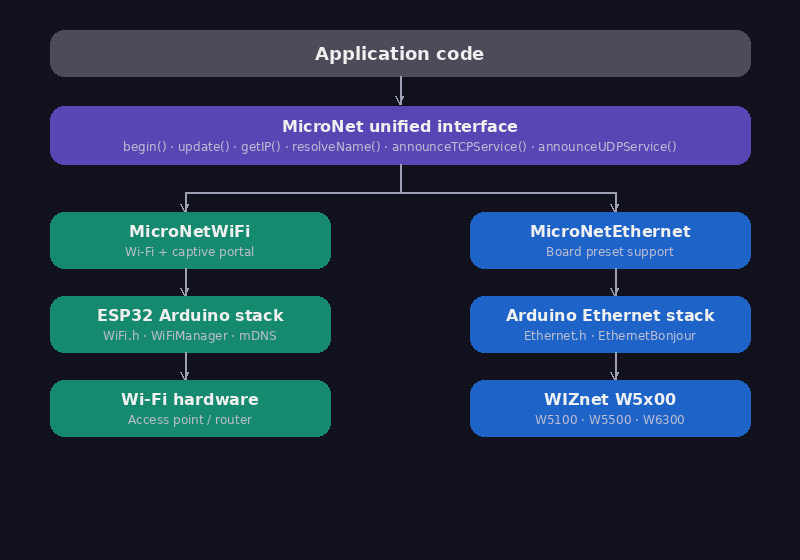
At the top sits the application code, which calls a unified set of API methods without any knowledge of the underlying network interface. Below it, the MicroNet unified interface acts as a middleware abstraction layer that routes calls to either MicroNetWiFi or MicroNetEthernet depending on which class is instantiated.
Each class then delegates to its respective platform library:
MicroNetWiFi→ ESP32 ArduinoWiFi.h,WiFiManager, andmDNSMicroNetEthernet→ ArduinoEthernet.h, andEthernetBonjour
At the hardware level, the Wi-Fi path connects to a wireless access point, while the Ethernet path interfaces directly with a WIZnet W5x00-series chip (W5100, W5500, or W6300).
Switching Between Wi-Fi and Ethernet
The most important design property of MicroNet is API symmetry. Both MicroNetWiFi and MicroNetEthernet expose identical method signatures:
// Wi-Fi
#include <MicroNetWiFi.h>
MicroNetWiFi myNet;

// Ethernet (swap only this)
#include <MicroNetEthernet.h>
MicroNetEthernet myNet;

void setup() {
    myNet.begin("myDevice");
}
void loop() {
    myNet.update();
}setup() and loop() code requires no modification when switching between transports.Available presets:
ATOM_POE_WITH_ATOM_LITE— M5Stack Atom POE with Atom LiteATOM_POE_WITH_ATOMS3— M5Stack Atom POE with Atom S3
With a preset, the begin() call handles SPI initialization internally. Without a preset (generic Ethernet), the developer configures the SPI bus manually before calling begin():
SPI.begin(22, 23, 33, 19); // SCK, MISO, MOSI, CS for Atom Lite POE
Ethernet.init(19);          // CS pin
myNet.begin("myDevice");
Note: Ethernet.begin() must not be called directly. MicroNet handles the DHCP handshake internally within begin().
For generic Ethernet (no preset), configure the SPI bus before calling begin(). Do not call Ethernet.begin() directly — MicroNet handles the DHCP handshake internally.
Full API Reference
| Method | Description |
|---|---|
begin(name) | Initializes the interface, obtains DHCP address, registers mDNS hostname. Blocking. |
update() | Runs periodic maintenance tasks (mDNS keepalive). Call every loop iteration. |
getIP() | Returns the current IPAddress assigned by DHCP. |
resolveName(host) | Resolves an mDNS hostname to IPAddress. Blocking until found. |
announceTCPService(name, port) | Advertises a TCP service over mDNS. |
announceUDPService(name, port) | Advertises a UDP service over mDNS. |
copyMac(mac[6]) | Copies the device MAC address into a 6-byte buffer. |
appendMacToCString(prefix, maxSize, numBytes) | Appends MAC bytes to a name prefix for unique device naming. |
Why This Matters for WIZnet Users
MicroNet directly addresses a common development workflow: starting a project on Wi-Fi and later migrating to WIZnet Ethernet.
Wi-Fi is convenient for rapid prototyping — no additional hardware, no cabling. But for deployments requiring reliability, deterministic latency, PoE power delivery, or RF-clean environments, WIZnet Ethernet is the right choice.
Without MicroNet, this migration typically requires a significant rewrite of the network initialization and management layer. With MicroNet, it reduces to a header swap and a class name change.
Additionally, the EthernetBonjour integration means that WIZnet-connected devices participate in zero-configuration networking — something usually associated only with Wi-Fi IoT devices. This makes WIZnet-based nodes equally discoverable on a LAN without requiring fixed IP addresses or manual DNS entries.
Tested Hardware
- MCU: ESP32
- Ethernet: WIZnet Ethernet controller chips (W5x00 series)
- Board: M5Stack Atom POE
Dependencies
WiFiManager(for Wi-Fi captive portal)EthernetBonjour(for Ethernet mDNS)- Arduino
Ethernet.h(standard library) - ESP32 Arduino Core
Repository
https://github.com/thomasfredericks/MicroNet
License: MIT | Platform: ESP32 | Latest: v0.1.2
QnA
Q: What is MicroNet for Arduino? MicroNet is a network connection manager library for Arduino and PlatformIO that provides a unified API for both Wi-Fi and WIZnet Ethernet on ESP32. It handles DHCP, mDNS/Bonjour, and Wi-Fi captive portal configuration through a consistent set of methods, regardless of the underlying network interface.
Q: Can I use Wi-Fi and WIZnet Ethernet with the same code on ESP32? Yes. MicroNet provides identical method signatures for both MicroNetWiFi and MicroNetEthernet. To switch between them, only the include header and the class instantiation need to change. All application logic in setup() and loop() remains the same.
Q: Which WIZnet chips are supported by MicroNet? MicroNet supports WIZnet W5x00-series chips including the W5100, W5500, and W6300, connected to an ESP32 via SPI. The M5Stack Atom POE (which uses a WIZnet chip) has been tested and has a built-in board preset.
Q: What is the difference between lwIP and WIZnet TOE in embedded Ethernet? lwIP is a software TCP/IP stack that runs on the MCU, consuming CPU cycles for every network operation. WIZnet chips implement a hardware TCP/IP Offload Engine (TOE), meaning the full TCP/IP stack is processed on-chip. This offloads the MCU from network processing, which is particularly valuable on resource-constrained devices like the ESP32.
Q: Does MicroNet support mDNS on WIZnet Ethernet? Yes. MicroNet integrates EthernetBonjour on the Ethernet path, providing full mDNS/Bonjour support including hostname registration, hostname resolution (resolveName()), and TCP/UDP service advertisement (announceTCPService(), announceUDPService()). This allows WIZnet-connected devices to participate in zero-configuration networking on a local network.


