



era-lib
era-lib
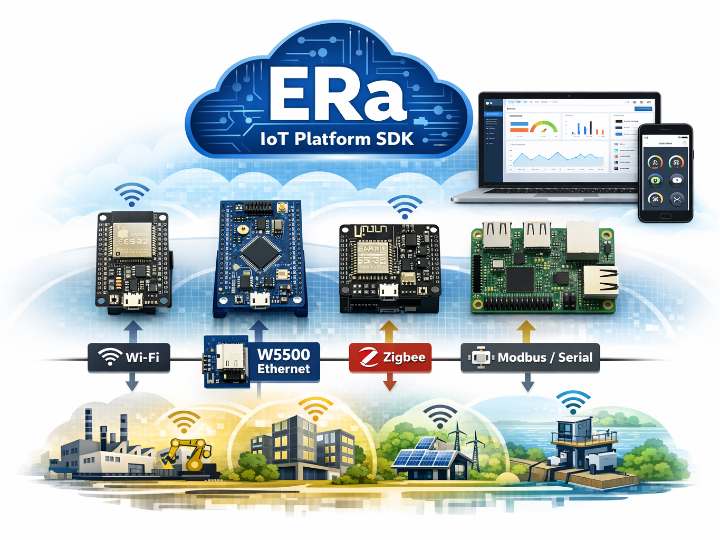
ERa: An IoT Platform SDK for Connecting Multiple MCU Targets to One Service Stack
Project Overview
era-lib is an open-source library used to connect devices to ERa IoT Platform, which is developed and operated by EoH. Rather than being a single-board demo, this project is better understood as a standard IoT connectivity SDK that allows boards such as ESP32, ESP8266, STM32, Raspberry Pi, and Arduino-class hardware to connect into one common service flow for data collection, monitoring, and remote control. The repository README explicitly states support for Wi-Fi, Ethernet, Zigbee, Modbus, and Serial, and points developers to Arduino IDE and PlatformIO as the main starting environments.
Where It Is Needed
This project fits best where the goal is not just reading a sensor locally, but building something closer to an operational IoT system. Based on the supported interfaces and EoH’s public positioning, that includes applications such as environmental monitoring, energy and utility data collection, equipment status monitoring, smart building systems, industrial gateways, and Modbus-connected field devices. EoH also publicly positions its platform and solutions around verticals such as smart city, smart hospitality, healthcare, and water-quality related deployments, which makes this a practical fit for real device-to-platform integration rather than a hobby-only dashboard library.
Project Characteristics
The main strength of ERa is its range of supported hardware and protocols. On the device side, the official ERa site lists support for ESP32 modules, Raspberry Pi, STM32 F4 Series, and ESP8266. On the connectivity side, the library README lists Wi-Fi, Ethernet, Zigbee, Modbus, and Serial. This makes the project useful when the hardware platform may change across products, but the cloud or app-side service model should remain consistent.
Another important characteristic is that ERa is not presented as a bare communication library. The official site describes the platform around three ideas: Friendly, Fluent, and Plug & Play. In practical terms, that means a user-facing mobile app and desktop dashboard, drag-and-drop widget-based device management, and simplified device onboarding. The GitBook documentation further describes a workflow centered on gateways, devices, datastreams, and dashboard widgets, which shows that the project is designed around an end-to-end IoT service model rather than firmware alone.
Technical Highlights
A key technical highlight is multi-hardware support. ERa is positioned to work across several MCU and edge computing classes instead of being locked to one vendor or one reference board. That is especially useful for teams building multiple device SKUs or migrating from prototype hardware to more product-oriented targets.
Another highlight is multi-protocol integration. Since the library supports Ethernet, Zigbee, Modbus, and Serial in addition to Wi-Fi, it can sit between application dashboards and mixed field devices such as sensors, controllers, meters, and gateways. The documentation also mentions E-Ra API, QR-based device configuration cloning, and support for 3rd-party MQTT gateways, which shows that the platform is intended to support integration and deployment workflows, not just board bring-up.
A third highlight is the service-oriented operating model. ERa combines device connectivity with web and mobile interfaces, dashboard widgets, and multi-device management. That makes it closer to an operational IoT framework than to a simple embedded communication library.
Why W5500 Is Used, and What It Changes
Because ERa explicitly supports Ethernet as one of its network paths, the W5500 is a very natural hardware choice for wired deployment. W5500 is a one-chip Ethernet controller that connects to the host MCU over SPI and integrates a hardwired TCP/IP stack, 10/100 Ethernet MAC/PHY, 8 independent sockets, and 32 KB internal buffer memory. That architecture makes it easier to add wired networking to boards such as ESP32, STM32, and ESP8266 without requiring the host MCU to carry the full burden of a software Ethernet implementation.
In practice, the ERa + W5500 combination has three clear effects. First, it enables more stable wired connectivity in installations where Wi-Fi is unreliable or undesirable. Second, it creates a more reusable common Ethernet architecture across different MCU families. Third, it makes more sense in field environments such as buildings, utility systems, and industrial monitoring nodes, where wired networking is often preferred. This last point is an engineering interpretation based on ERa’s published Ethernet support and W5500’s wired-network architecture.
What Kind of Company EoH Appears to Be
Based on ERa’s official documentation and EoH’s corporate site, EoH is not just a library developer. It presents itself as an IoT platform company and an IoT market enabler. The GitBook documentation says EoH, formerly TeslaTeq, originated in 2017 with industrial IoT work, especially water-quality measurement systems, and then expanded its direction in 2020 toward becoming an IoT platform company serving broader digital transformation needs.
The official EoH site reinforces that positioning. It describes EoH as a company focused on IoT platform development that supports developers and smart solution providers across multiple vertical industries, and it highlights E-Ra IoT Platform as one of its central offerings. EoH also presents itself as providing full-package IoT enabling services, from hardware to software to IoT platform integration.
What Services EoH and ERa Actually Provide
Publicly, EoH appears to offer more than just a SaaS dashboard. The ERa platform includes a web dashboard, mobile apps, multi-device management, and a library stack for device onboarding. The broader EoH site also describes a platform-as-a-service / full-package IoT solutions platform, saying customers can use its ecosystem to get hardware, software, and platform support together.
EoH also exposes a product line of IoT gateways, including models for smart home, hospitality, industrial, healthcare, smart city, and outdoor monitoring use cases. Those gateway pages explicitly mention combinations of Wi-Fi, Zigbee, Ethernet, Modbus RTU, Bluetooth, GPRS, and CAN Bus, depending on model. That suggests ERa is part of a broader ecosystem that includes both software platform services and field-deployable gateway hardware.
Target Customers
The ERa FAQ says the platform is for students and IoT developers who want to implement and manage their own IoT projects. At the same time, the EoH site describes its mission around helping developers and smart solution providers across many vertical industries, and its business pages emphasize helping customers deploy IoT solutions without needing to build their own full IoT team. Taken together, that suggests two layers of target users: individual developers and makers at the entry level, and solution providers or system builders at the business level.
Target Applications
Public examples from EoH include smart home / smart city deployments, Tele-ICU monitoring, hospitality platforms, and water-quality monitoring. Combined with the protocol support listed in era-lib, this makes ERa well suited for environmental sensing, industrial status monitoring, utility systems, building automation, healthcare observation systems, and protocol-bridging gateway applications.
Market Positioning and Future Direction
From the public material, ERa looks less like a hyperscale cloud IoT platform and more like a lightweight operational IoT platform aimed at helping developers and solution vendors get from connected hardware to a usable service faster. The official site’s emphasis on Friendly, Fluent, Plug & Play, the inclusion of mobile apps, and the availability of a 6-month free trial all support that positioning.
Its likely growth path is also visible from the company’s current structure. One direction is deeper vertical packaging for areas such as smart city, healthcare, hospitality, utilities, and environmental systems. Another is expansion through its gateway ecosystem, where different connectivity mixes can serve different field deployments. This is an inference from EoH’s current product, solution, and project pages rather than an explicit company roadmap.