IoT and Blockchain Paradigms for EV Charging System
IoT and Blockchain Paradigms for EV Charging System
0
Components
Hardware componentsArduino Ethernet Shield V1
x 1
Project description
One of the big challenges related with electric vehicle (EV) market penetration is the charging
process, where the main problems are related to the lack of proper infrastructure in residential buildings
(condominiums) since they are not prepared for this new reality. Condominiums have the problem
of shared electricity, which does not meet the EV owner’s requirements. Based on new advances in
the Internet of Things (IoT) [1], and the associated sensing devices and communication platforms,
blockchain and information systems have the potential to create new solutions for these problems.
Another facet of this challenge is the problem associated with rental houses and the eventual need for
supporting EV charging in these cases.
In condominiums, unfortunately, there is a general reluctance regarding the installation of EV
charging stations that will only be used by a few homeowners [2]. In addition, there is also an issue
regarding the safety of the electrical installations, since they are not built proactively to support EV
charging stations, and, adapting the condominium electrical infrastructure will require not only that
a consensus between the majority of the owners is reached, which may be hard to achieve, but also
authorizations issued by the government building safety entities.
Taking into consideration that most residential buildings have shared spaces with common
electrical installations and are not prepared for the installation of new EV charging systems, this is
a barrier to EV uptake [3]. A study by Lopez-Behar et al. [4] identified four main problem domains in
the context of sharing EV charging solutions in buildings: unavailable charging infrastructure, building
limitations, regulation issues and parking availability.
In this work, we propose a new IoT-based approach for handling the EV charging process,
which can be used in the context of a shared energy infrastructure without requiring a supervision
entity to control the process.
The proposed solution is supported by a decentralized blockchain approach, running on a mobile
device app. Figure 1 shows an overview of a condominium with the proposed EV charging platform.
This work allows the following features: (1) A pre-registration with a local EV charging provider is not
required, avoiding the problem of dierent cards in dierent charging infrastructures (every charging
infrastructure has its own cards, and this is a problem for EV owners because they need several
charging cards when dierent providers are available); (2) it can work with digital currency using
a peer-to-peer (P2P) framework on the same homogeneous blockchain infrastructure and technology;
and (3) reduced cost (almost zero fees), because there is no requirement for a third party management
entity, apart from the condominium, which would create additional costs.
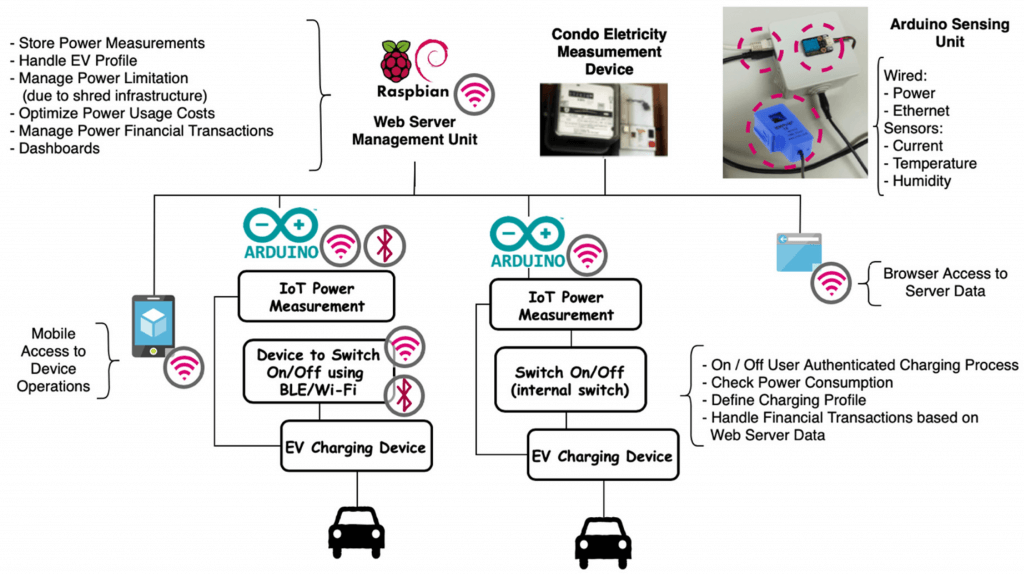 As illustrated in Figure 1, the major features of the proposed system are: (1) User authentication
with a mobile device using Bluetooth Low Energy (BLE) communication and, based on this, release of
energy for the EV charging process; and (2) energy consumption is monitored by Internet of Things (IoT)
sensors and a microcontroller board transmits the data to a web server (Raspberry Pi with Raspbian
operating system), which acts as the management unit, storing the data, handling the transactions in
a blockchain implementation and managing the charging according to the power limitations.
As illustrated in Figure 1, the major features of the proposed system are: (1) User authentication
with a mobile device using Bluetooth Low Energy (BLE) communication and, based on this, release of
energy for the EV charging process; and (2) energy consumption is monitored by Internet of Things (IoT)
sensors and a microcontroller board transmits the data to a web server (Raspberry Pi with Raspbian
operating system), which acts as the management unit, storing the data, handling the transactions in
a blockchain implementation and managing the charging according to the power limitations.
As illustrated in Figure 1, the major features of the proposed system are: (1) User authentication
with a mobile device using Bluetooth Low Energy (BLE) communication and, based on this, release of
energy for the EV charging process; and (2) energy consumption is monitored by Internet of Things (IoT)
sensors and a microcontroller board transmits the data to a web server (Raspberry Pi with Raspbian
operating system), which acts as the management unit, storing the data, handling the transactions in
a blockchain implementation and managing the charging according to the power limitations.
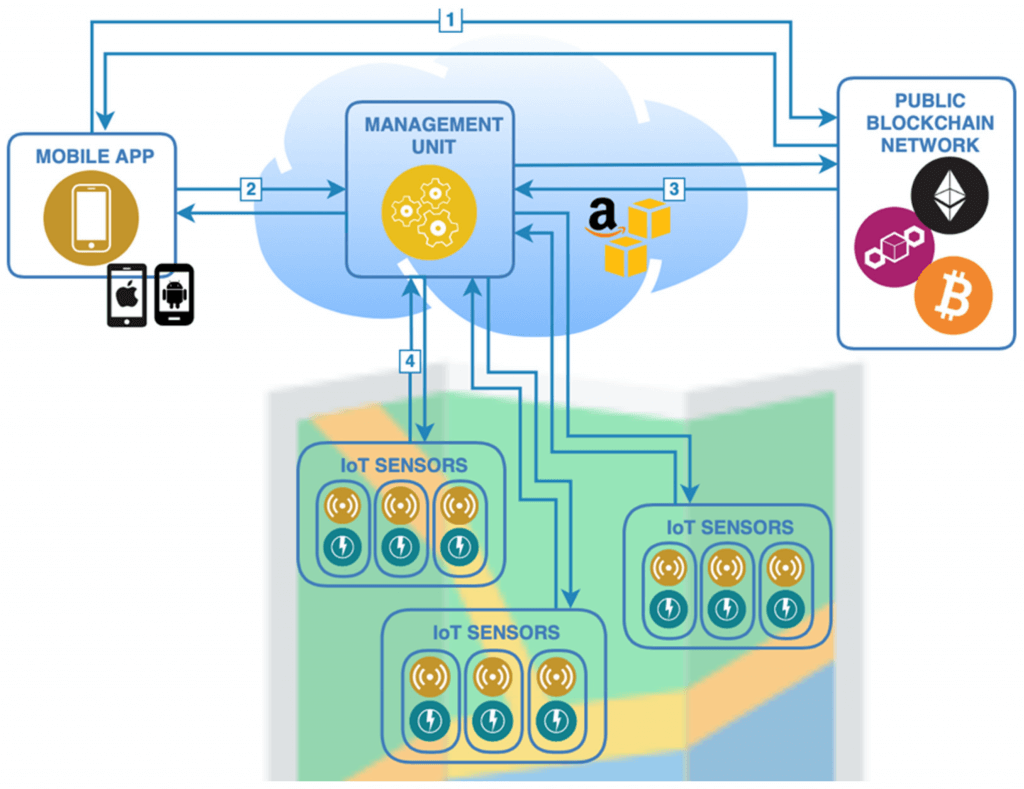
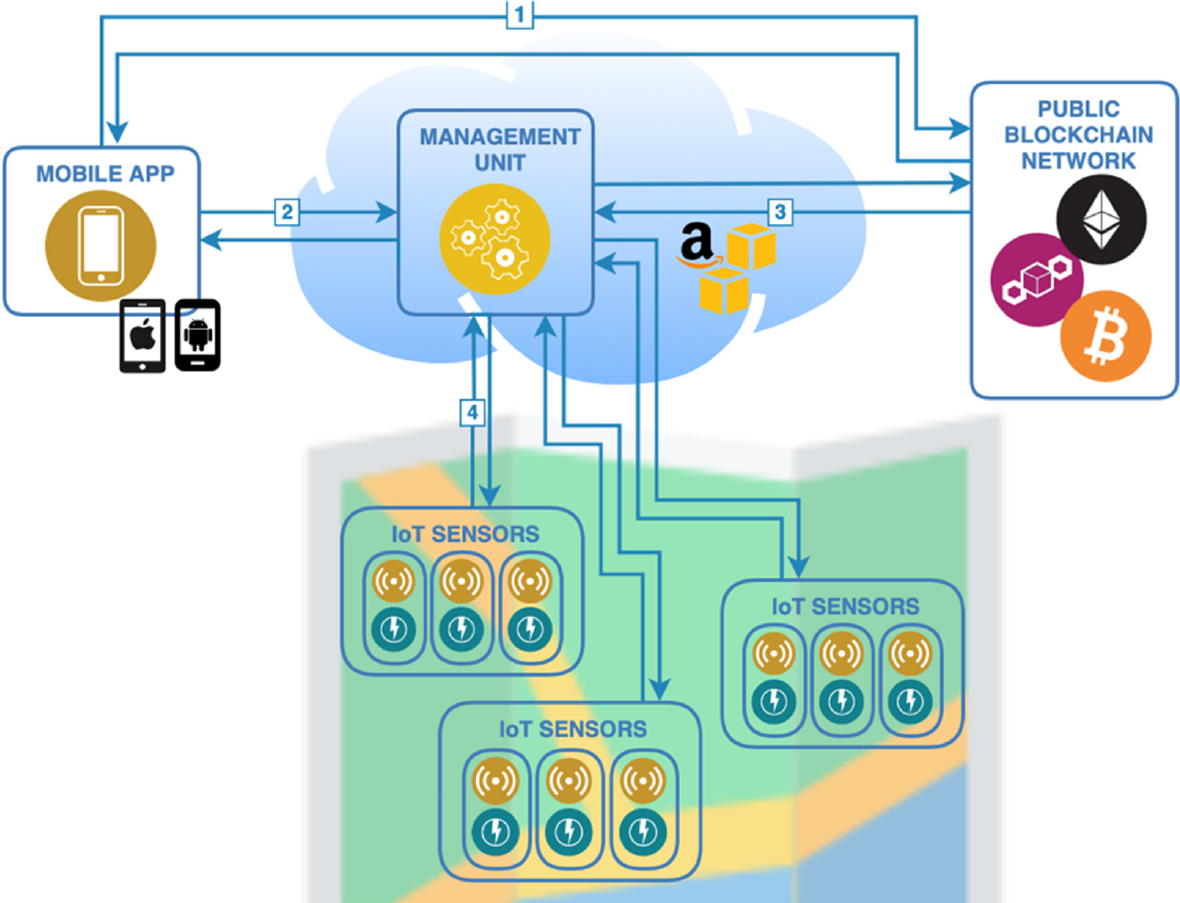
Complementary to the setup presented in Figure 1, which is suitable for deploying the solution at the local level, in the context of a single condominium, an equivalent model can be applied to scale the solution to a wider geographical area with an increased number of charging locations. In this sense, Figure 2 expands the proposed model to an IoT architecture that is suitable to explore cloud paradigms, such as Infrastructure as a Service (IaaS) or Software as a Service (SaaS), where the local management unit is replaced by a shared cloud computing platform. Without loss of generality and instantiating the model with existing platforms, the mobile app can be deployed on the Google Play store or Apple’s App Store, the Management Unit can be packaged in a Docker container [5], and deployed on the AWS (Amazon Web Services) cloud computing platform, and the Ethereum open blockchain network can be used to support the financial transactions originated by the EV charging operation.
Figure 2. Overview of an IoT/cloud model solution to handle the EV.
Figure 2 also enumerates the sequence steps to initiate a charging process: (1) Using the internet connection, the payment is sent from the mobile device to the open blockchain network (Ethereum); (2) the information related to the operation is exchanged between the mobile device and the Management Unit hosted on the AWS; (3) payment is received from the blockchain network, triggering the charging process on the Management Unit; and (4) the EV charging process is enabled on the IoT device (installed on the parking facilities), and the information related to the energy being delivered is sent back to the Management Unit on the AWS.
This paper is organized as follows. Section 2 presents the state of the art in related work. An overview of the proposed approach is presented in Section 3, and Section 4 describes the system implementation. Section 5 presents a case study at a condominium, and Section 6 discusses future implications of the presented work. Finally, Section 7presents the conclusions.
2. State of the Art
The proposed approach explores a set of works in several domain areas to create a new approach to handle the EV charging process in shared spaces, including the use of IoT sensing information to measure electricity taken on the EV charging process. Concerning driver profiles and EV charging with power limitations, several studies have been performed, and we apply an approach based on our previous work described in [6]. In our implementation, it was also considered an implicit authentication mechanism [7], applied on user’s mobile devices, which confirms the user authentication based on actions that he had performed on a daily basis. This implicit authentication mechanism can be used to prevent fraudulent credit transactions on a mobile device, verifying that the user is who he claims to be during the transaction. After researching systems that meet our criteria, we found some promising work [8,9,10,11,12]. We apply a solution with user privacy (no identification is performed) in an approach based on the system proposed by Frank et al., called Touchalytics [13]. We also apply the blockchain approach to handle distributed transactions without central supervision. The primary goal of the blockchain is to allow decentralized transactions with a digital currency, such as Bitcoin [14] or Etherum [15], without the need of a public authority to control the process. From the technical perspective, a blockchain is a sequence of blocks associated with transactional data using encryption based on a private and public key [16]. User A performs a transaction, and this process is associated with a block encrypted with his private key, in a hash process. User B checks the transaction using the public key of user A, allowing the following properties:
-
Decentralization, since we need confirmation from some party of each block transaction without central control;
-
Anonymity, since it allows for the authentication of transactions without giving up any personal information;
-
Auditability, which is performed based on the fact that each of the transactions is recorded and validated with a timestamp, where users can trace the previous transactions by accessing any node in the distributed network.
The application of blockchain in the domain of smart grids has great potential, providing a decentralized approach to implement management systems [17] and handle power transactions. Due to the large space occupied by the meter sampling information on a blockchain block, [17] presents a design to balance the amount of information kept onchain/offchain while keeping the properties of a block chain implementation. The authors of [18] note the use of an open public cryptocurrency network, such as Bitcoin or Ethereum, can introduce a high transactional cost, due to the fees associated with cryptocurrency transaction processing (eventually similar to the cost of the energy supplied), and propose the development of a private Bitcoin-based blockchain network for EV charging purposes. Other relevant application cases include micro-generation [19,20], as well as the contribution to handle the EV charging payment process without the use of propriety company payment systems.
The EV charging payment process is more frequent than fossil fuel refuelling and more complex due to the immaturity of the service. Specifically, the following issues are fairly common: (1) Transparency and clarity of rates and charges before they are incurred; (2) ability to pick-and-choose best rates and location of available charging points on the go; (3) ability to request priority charging and pay for it, when other EVs do not need priority; (4) ability to select a supplier or source of electricity, which would also enable greater competition and increase trust of customers; and (5) preferences for various types of payment, such as post-paid, pre-paid, or one-off payment.
We complement this work with our previous work on an EV charging system [21,22] and IoT energy measurements using local sensors [23], as well as new challenges of energy markets [19]. Some issues identified are also addressed in [24], which proposes a blockchain-based model with recourse to a bid to identify charging stations (and eventually schedule the charging), complementary to the approach suggested in [21]. Another issue originated by the increase of the EV charging needs is the impact on the energy demands and the power limitation of the existing infrastructure [25], which may not only increase the operational costs to fulfil the required demand, but also affects the voltage stability of the network. In [25], the authors introduced the AdBEV, which is an algorithm to optimize the EV charging schedule, maximizing the voltage stability at the power grid side, and minimizing the charging costs. In [26] the application of a blockchain-based process is suggested to support the EV charging queue management.
Together with mobile device authentication and a payment system, we developed a new approach to be used in shared EV charging spaces. Another interesting output is to use mobile devices to provide authentication and payment services in the context of the public EV charging systems, exploring recent advances in mobile device payment systems for public transportation [27] and other application areas [28]. As a new topic of research, new publications are appearing in the literature concerning the use of a blockchain approach to handling the EV charging process, such as: testing pilots to use digital currency for the EV charging process [29,30]; proposal of a P2P energy transaction model to handle the EV vehicle-to-grid (V2G) operation in smart grids [31]; handling the EV authentication issues based on a blockchain approach [32]; proposal of a cross-domain authentication scheme with blockchain [33]; and handling of security and privacy issues for energy transactions based on blockchain. Moreover, in this context, the EV is identified as part of the energy market [34], and as a contribution to the contextualization of the local energy market [35], where the blockchain plays an important role in the decentralization process, as well as for optimization purposes [36].
3. Proposed Approach?Conceptual Model
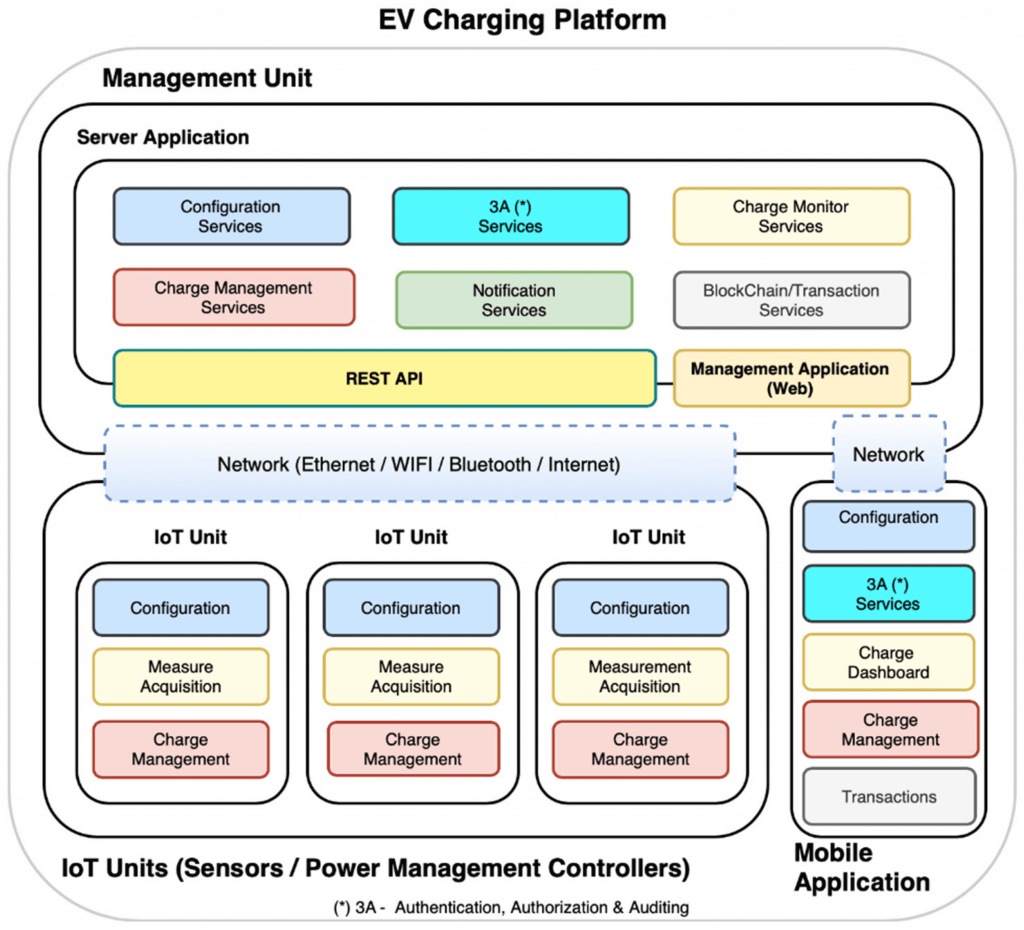
The EV charging platform is composed of the elements presented in Figure 3, whose roles are briefly described below, and the implementation details for each component is detailed in the next section:
-
IoT Units. Sensor and power management units that support the interaction with the EV charger, being used to enable or disable it (on/off switch), to measure the amount of power consumed, gather environment temperature and humidity (complementary measures), and to upload all the information to the management unit. Implemented with COTS (commercial off-the-shelf) components, Arduino microcontrollers, actuators and sensors. Depending on the installation requirements, different components can be combined to set up the IoT Unit.
-
Mobile App. The element that establishes the interaction between the EV owner and the platform, authenticates the user, starts/stops the charging process, and provides some common operations, such as configuration management, usage dashboards, transactions lists, etc.
-
Management Unit. This element is the heart of the platform, providing not only all the backend services to support the required operations, but also the management console for the platform. In the prototype presented in this paper, the management unit was implemented using a Raspberry Pi, which also acts as a Wi-Fi access point, providing network access to the sensor units and to the mobile app, but it could also be implemented using a cloud computing platform.
4. System Implementation
As previously described, the proposed EV charging platform is composed of three major elements: IoT units (sensors/actuators devices), a mobile app and a management unit. This section explores the implementation details of each element.
4.1. IoT Unit
The IoT unit was developed considering the approach described in our previous work [19], with improvements to the hardware and transmission process, as well as the creation of a prototype towards a possible commercial system. The first steps were the assessment of the surrounding environment and context, aiming to review the system design approach. The goal of reaching a potential commercial system’s architecture led to the consideration of a flexible design, where different network transmission requirements/devices, current sensor devices and power switching devices should be available to use, tailoring their combination to match a specific installation requirement. After an initial period of checking and testing hardware, we implemented a solution based on an Arduino Uno (microcontroller) combined with the devices listed in Table 1, where only one component for each type was used to assemble the IoT unit. ...
Documents
-
Overview of an IoT cloud model solution to handle the EV
-
Overview of the proposed electric vehicle (EV) charging platform in shared spaces
-
IoT and Blockchain Paradigms for EV Charging System
PDF Article
%20charging%20platform%20in%20shared%20spaces.png)


