



newRouter – Industrial Dual-W5500 & 4G Router on ESP32-S3
This project implements a compact embedded router architecture based on
ESP32-S3 + Dual W5500 Ethernet controllers + 4G Cat.1 modem + Wi-Fi AP.
[PROJECT INTRODUCTION & SYSTEM ARCHITECTURE]
This project implements a compact embedded router architecture based on
ESP32-S3 + Dual W5500 Ethernet controllers + 4G Cat.1 modem + Wi-Fi AP.
It reproduces the structure of commercial SOHO routers, but at MCU level, providing:
- WAN/LAN separation
- Auto role-switching Ethernet (W5500 Card0)
- Dedicated LAN port (W5500 Card1)
- Wi-Fi AP in independent subnet (192.168.5.x)
- Dual Ethernet subnet (192.168.4.x)
- 4G modem as backup WAN (PPP)
- DHCP, NAT, bridge, and routing on ESP32-S3
Key Components
- ESP32-S3 — NAT, bridge, PPP, DHCP, AP
- W5500 × 2 — Dual-port Ethernet over shared SPI bus
- EC600N / A7680C 4G Modem — USB PPP fallback WAN
- Wi-Fi AP — 192.168.5.x subnet
Port Roles
- W5500 Card0 — Dynamic WAN/LAN switching
- W5500 Card1 — Always LAN + DHCP server
- 4G LTE (PPP) — Backup WAN fallback
[DATA FLOW DIAGRAM]
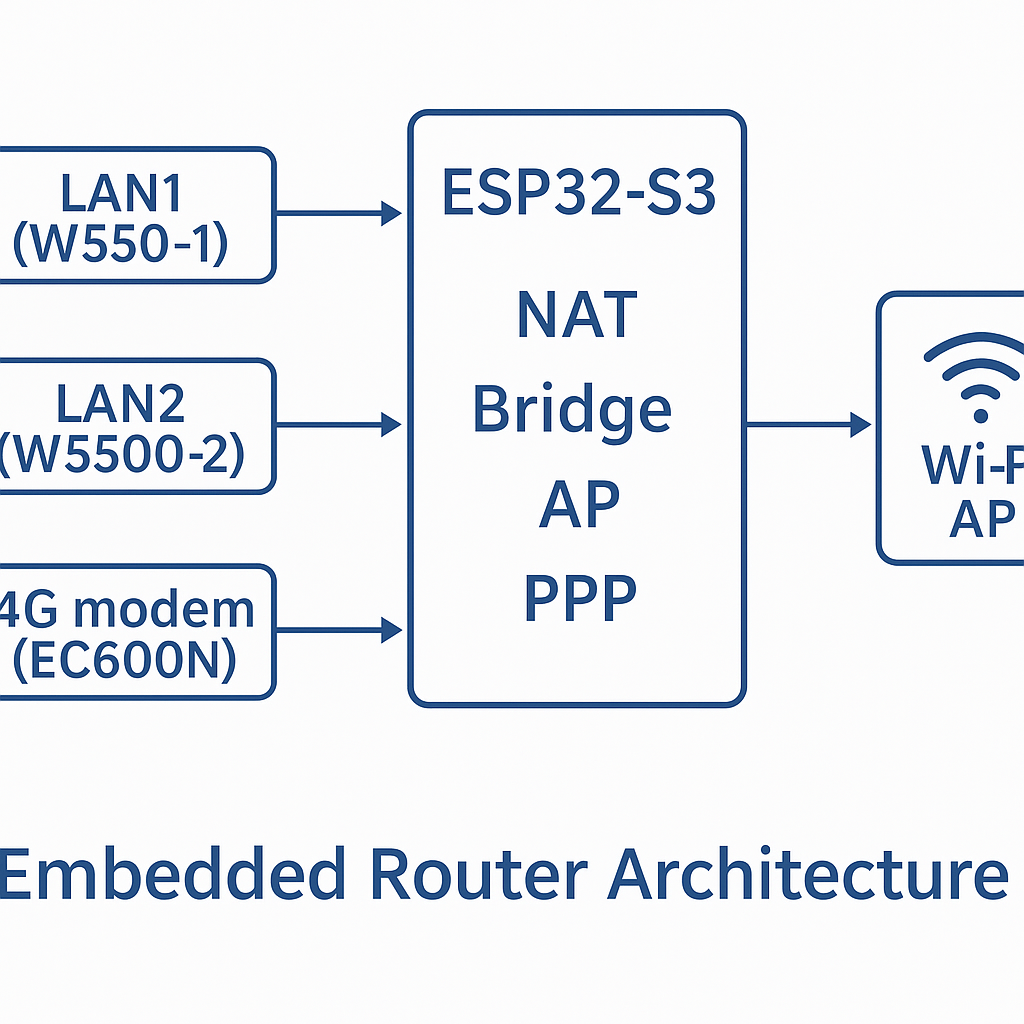
LAN1(W5500-1) ──┐
           │
LAN2(W5500-2) ──┤── ESP32-S3 (NAT/Bridge/AP/PPP) ── WiFi AP
4G PPP Modem (EC600N)   ─┘
[ENGINEERING SIGNIFICANCE & INDUSTRIAL VALUE]
1) Industrial router structure replicated on MCU
ESP32-S3 successfully implements:
- Dual Ethernet
- Wi-Fi AP
- 4G WAN failover
- NAT, DHCP, DNS, routing
This positions the architecture between:
Single-port W5500 devices ↔ Full OpenWRT Linux routers
2) Dual W5500 implementation is technically rare
- Shared SPI bus
- Independent CS/INT/RESET
- PHY addressing
- Auto WAN/LAN switching
This project becomes a valuable reference for dual-port embedded Ethernet design.
3) Ideal for low-power field gateways
Applicable to:
- Energy systems
- Factory devices
- Remote monitoring nodes
- Industrial telemetry
- Edge IoT with LTE redundancy
[ARCHITECTURE COMPARISON — TABLE]
| Category | MCU Router (ESP32-S3 + Dual W5500) | WizFi630S | OpenWRT Router |
|---|---|---|---|
| OS | FreeRTOS + ESP-IDF | Embedded Linux | Linux + OpenWRT |
| Wi-Fi PHY | 150 Mbps | 150–300 Mbps | 300 Mbps–1.2 Gbps |
| Real Wi-Fi | ~60 Mbps | 80–100 Mbps | 100–200 Mbps |
| NAT Throughput | 10–30 Mbps | 80–95 Mbps | 90–200 Mbps |
| Ethernet | Dual W5500 (100M each) | 1×WAN + 1×LAN | WAN + Switch LAN |
| 4G Backup | Built-in PPP | External | Model dependent |
| Power | Very low | Low | Medium–High |
| Customizability | Excellent | Moderate | Moderate |
| Strength | Full control + multi-interface | Stable & proven | High performance |
| Weakness | Low throughput | Limited customization | Big, costly |
[MARKET & STRATEGIC IMPLICATIONS]
1) Filling the “MCU router” market gap
A new tier emerges:
SPI NIC → MCU Router → Linux Router
2) Strengthens W5500 ecosystem
Demonstrates that W5500 can be used not only for single NIC but also:
- Dual-port router
- Field gateway
- LTE backup edge node
3) Synergy with WizFi630S
Not a competitor.
It’s a lower-tier hardware router suited for:
- industrial micro-gateways
- battery systems
- ultra-low power deployments
while WizFi630S covers: - mid-tier & consumer routing workloads
Together they form a portfolio, not a conflict.
[AUTHOR SUMMARY — Condensed]
lyxer123 is an applied embedded network engineer skilled in ESP-IDF, W5500, multi-interface routing, and USB-PPP modem integration.
He successfully reproduced a commercial router-grade architecture at MCU level, including dual Ethernet, Wi-Fi AP, 4G failover, and NAT/bridge logic.
His work provides a rare, high-quality reference that expands practical W5500 usage in real embedded gateway designs.
[PROJECT INTRODUCTION & SYSTEM ARCHITECTURE]
이 프로젝트는
ESP32-S3 + W5500 두 개 + 4G Cat.1 모뎀 + Wi-Fi AP로 구성된
초저가·초저전력 임베디드 라우터 구조다.
상용 SOHO 라우터의 구조를 MCU 수준에서 그대로 재현했으며,
- WAN / LAN 분리
- W5500 Card0 자동 WAN/LAN 전환
- Card1 고정 LAN + DHCP
- Wi-Fi AP 독립 서브넷(192.168.5.x)
- W5500 듀얼 서브넷(192.168.4.x)
- 4G PPP 백업 WAN
까지 완전한 형태로 구현됐다.
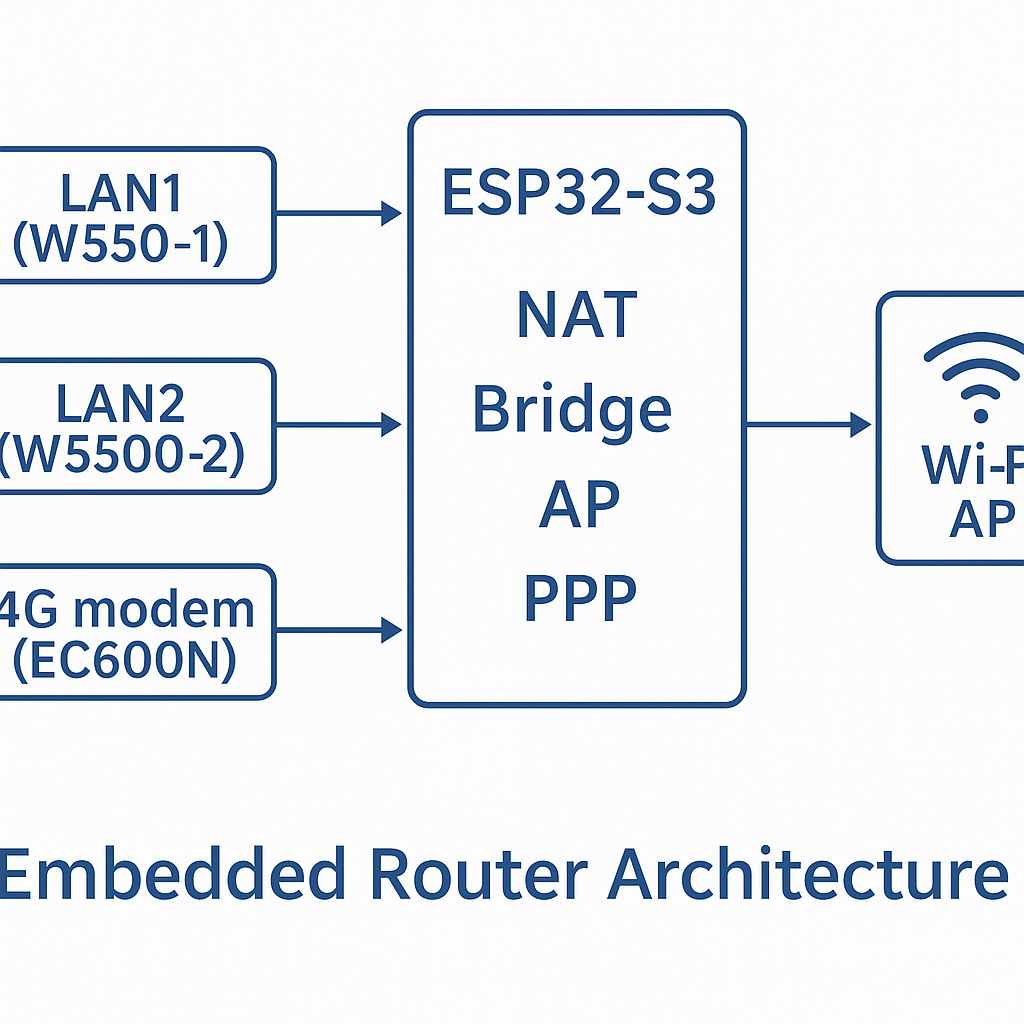
[전체 데이터 흐름도]
[ENGINEERING SIGNIFICANCE & INDUSTRIAL VALUE]
1) 산업용 라우터 구조를 MCU로 축소 구현
보통 Linux SoC(OpenWRT)에서 처리하는 기능을
ESP32-S3가 단독으로 수행.
2) 듀얼 W5500 완성형 레퍼런스로서 가치
- 공유 SPI 버스
- CS/INT/RESET 독립
- PHY Address 구분
- 자동 WAN/LAN 전환
이 조합은 실제 산업 설비에서도 유효한 고급 구조.
3) IoT 현장 게이트웨이에 최적화
- 전력 소모 최소
- 저비용 BOM
- 4G 백업 필수 장비에서 강점
- 임베디드 장비 내부 라우터로 적합
[비교 테이블 — MCU Router vs WizFi630S vs OpenWRT]
| 항목 | MCU Router (ESP32-S3 + Dual W5500) | WizFi630S | OpenWRT 라우터 |
|---|---|---|---|
| OS | FreeRTOS | Embedded Linux | Linux + OpenWRT |
| Wi-Fi PHY | 150 Mbps | 150~300 Mbps | 300 Mbps~1 Gbps |
| 실효 Wi-Fi | 약 60 Mbps | 80~100 Mbps | 100~200 Mbps |
| NAT 성능 | 10~30 Mbps | 80~95 Mbps | 90~200 Mbps |
| Ethernet | 듀얼 W5500 | WAN+LAN | WAN+스위치 |
| 4G 백업 | 내장 PPP | 외부 조합 | 모델 차이 |
| 전력 | 매우 낮음 | 낮음 | 중간~높음 |
| 커스터마이징 | 최고 | 중간 | 중간 |
| 장점 | 완전 제어, 저전력, 4G 결합 | 안정적 성능 | 고성능 |
| 단점 | 고대역폭엔 부적합 | 제한된 수정 | 전력·비용 부담 |
[시장·전략적 시사점]
- W5500 생태계 확장: “Dual Ethernet Router” 레퍼런스
- WizFi630S와 충돌이 아니라 포트폴리오 상호보완
- 초소형 산업 게이트웨이 분야에 현실적 수요 존재
- 초저전력·초저비용 라우터 시장층을 새로 창출
[AUTHOR SUMMARY]
lyxer123는 ESP-IDF, W5500, 멀티인터페이스 라우팅, USB-PPP 모뎀 통합에 숙련된
실무형 임베디드 네트워크 엔지니어.
그는 듀얼 W5500, 4G PPP, Wi-Fi AP, NAT/브리지까지
상용 라우터 구조를 MCU에서 완성도 있게 재현했으며,
이는 W5500 기반 설계의 확장성과 생태계 활용 가능성을 실제로 입증.