


HeavyButter-Bruce-F0rK: A Hardened Bruce Firmware Fork for ESP32 Security Devices
An ESP32 Bruce firmware fork focused on reducing risky defaults, exposed credentials, unsafe remote access, and runtime attack surfaces.
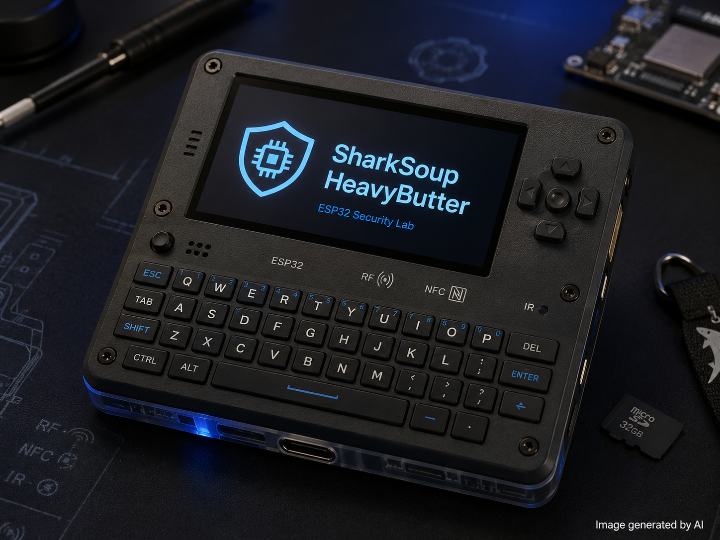
Espressif - ESP32-C5
x 1
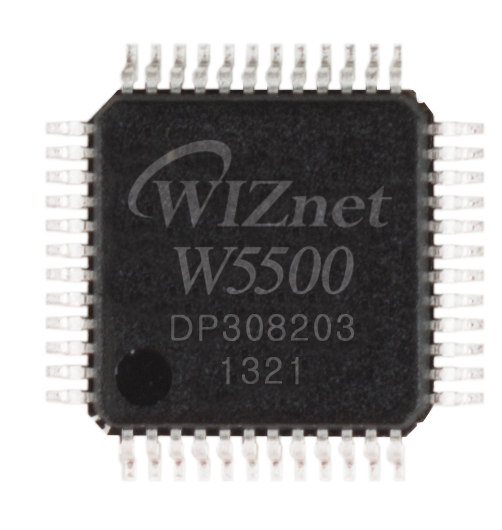
WIZnet - W5500
x 1

SharkSoup HeavyButter: A Hardened Firmware Path for Bruce-Based ESP32 Security Devices
Bruce-based ESP32 devices are powerful because they gather many security-tool functions into a small handheld form factor. Wi-Fi tools, BLE functions, RF modules, NFC/RFID, IR control, USB HID, scripting, WebUI, and file storage can all live inside one firmware environment.
That power also creates a problem. A handheld security tool is not only a tool for testing networks or devices. It is also a networked embedded device with its own credentials, remote access paths, wireless states, download mechanisms, and scripting permissions. If those defaults are weak, the tool itself becomes part of the risk.
SharkSoup HeavyButter is a hardened fork of Bruce firmware that focuses on this problem. Rather than presenting itself mainly as another feature-expansion fork, it shifts attention toward safer runtime behavior: reducing exposed credentials, requiring authentication for sensitive access paths, tightening script permissions, verifying downloaded payloads, preferring secure transport, and powering down radios during sleep.
Its value is not that it turns ESP32 into a new kind of hardware platform. The value is that it treats firmware safety as part of the system design.
From Multi-Tool Firmware to Managed Attack Surface
Bruce firmware belongs to a class of ESP32 projects that turn small boards into compact security-lab devices. A single supported board may provide a display, buttons or keyboard, storage, Wi-Fi, BLE, RF peripherals, NFC/RFID, IR, USB features, and a menu-driven interface.
In a simple embedded demo, the firmware usually has one job. Connect to Wi-Fi, read a sensor, publish data, or serve a small web page. Bruce-style firmware is different. It is a dense runtime environment where many interfaces and functions are exposed from one device.
That makes the security model more important. A WebUI needs access control. A script engine needs permission boundaries. A remote shell needs authentication. Downloaded modules need integrity checks. Wireless modules need clear power-state behavior. Credentials should not be reused as static defaults across devices.
HeavyButter reads the Bruce firmware family from that angle. The central question is not “how many more tools can this device include?” but “how safely can this device expose the tools it already has?”
System Structure
The project follows the structure of a full Bruce-family firmware fork rather than a small standalone example. It uses a PlatformIO-based build flow and supports multiple ESP32 handheld targets, including M5Stack-style, LilyGO-style, CYD-style, and ESP32-C5-based devices.
At runtime, the firmware prepares the device hardware, loads configuration, initializes display and input handling, prepares storage, manages serial and USB-related paths, starts wireless-related tasks where applicable, and enters a menu-driven user interface. From that interface, users can access the inherited Bruce-style feature modules.
HeavyButter adds its main contribution around that runtime. It does not replace the entire Bruce model. It hardens the way the firmware behaves while those modules are available.
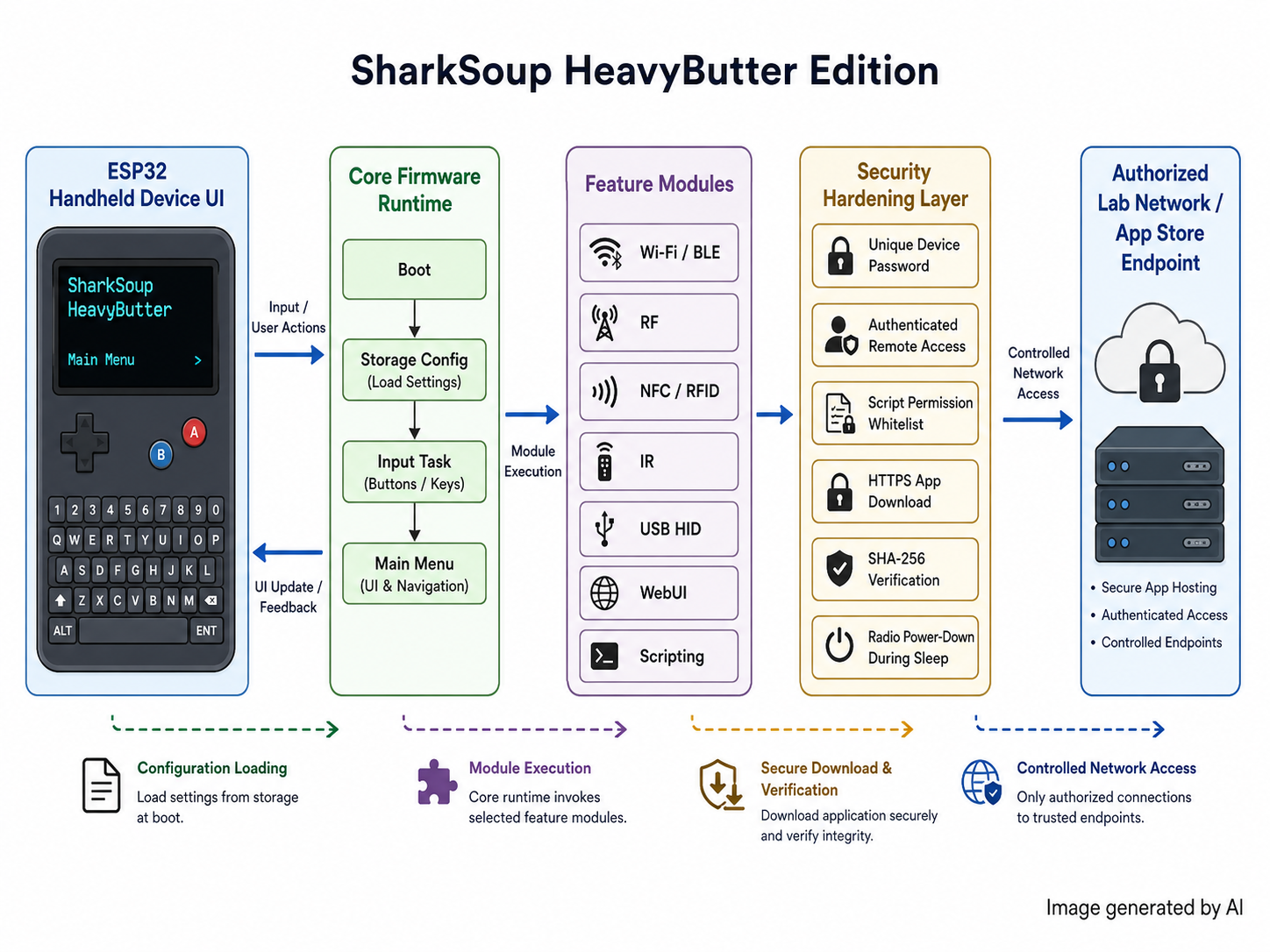
A practical way to understand the structure is:
- The ESP32 handheld device provides the physical interface.
- The firmware runtime initializes storage, display, input, tasks, and menus.
- Feature modules expose Wi-Fi, BLE, RF, NFC/RFID, IR, USB HID, WebUI, and scripting functions.
- HeavyButter hardening changes how sensitive paths behave.
- The device is used in an authorized lab or controlled testing environment.
The important layer is step 4. That is where HeavyButter’s identity becomes clear.
Network Perspective and WIZnet Context
HeavyButter should not be described as a W5500-centered project. Its main focus is firmware hardening, not Ethernet hardware integration.
W5500 appears in the broader Bruce ecosystem because Bruce-style ESP32 tools can be paired with wired Ethernet hardware. Existing Maker content around BruceUSB-Firmware shows WIZnet W5500 being used as a wired LAN path for security-testing workflows such as DHCP, ARP discovery, SSH, and port scanning. In that context, W5500 gives a handheld ESP32 security device a stable physical Ethernet interface.
HeavyButter sits above that hardware layer. It does not primarily answer the question, “How do we add wired Ethernet?” It answers a different question: “Once a powerful handheld security tool has network paths, wireless modules, scripting, and remote interfaces, how do we keep the tool itself from becoming unsafe?”
This distinction matters. W5500 can improve connectivity. It can reduce dependence on Wi-Fi. It can place an ESP32 device directly on wired LAN infrastructure. But W5500 does not automatically solve weak credentials, unsafe remote shells, loose script permissions, insecure downloads, or radios left active in sleep mode.
That is where HeavyButter becomes relevant.
TOE Interpretation
W5500 includes hardware TCP/IP offload capability, but TOE usage should not be assumed from the chip name alone.
In ESP32 projects, W5500 may be used in different ways. Some designs directly use WIZnet socket APIs or hardware socket commands. Other designs attach W5500 below the ESP networking layer and let the application communicate through standard network APIs.
For HeavyButter, available evidence is not enough to claim direct application-level control of W5500 hardware sockets. The safer interpretation is that W5500 belongs to the wider Bruce/WIZnet hardware context, while HeavyButter’s confirmed focus remains firmware hardening.
So the correct wording is conservative:
HeavyButter is not a direct W5500 TOE demonstration. It is a hardened Bruce-family firmware fork that can be discussed alongside Bruce/W5500 Maker projects because they occupy adjacent layers of the same device ecosystem.
Connection with Existing Maker Content
1. T-embedCC1101 BruceUSB-Firmware
This is the closest Maker comparison. It shows Bruce Firmware running in a handheld ESP32-S3-style environment where WIZnet W5500 provides wired Ethernet access for LAN-oriented security workflows.
The similarity is the Bruce ecosystem itself: handheld ESP32 hardware, multiple interfaces, and security-tool behavior. The difference is the center of gravity. The Maker project explains how W5500 expands the device into wired Ethernet testing. HeavyButter explains how the firmware should reduce its own operational risks.
Together, they show two sides of the same class of device: network reach and firmware restraint.
2. ESP32 + W5500 Ethernet Quick Start Guide
This Maker guide explains the foundation: how ESP32 can bring up W5500 as an Ethernet interface, attach it to the network stack, obtain an IP address, and validate network behavior.
Compared with HeavyButter, it sits at a lower layer. It is about making wired Ethernet work. HeavyButter is about making a security-tool firmware behave more safely once powerful interfaces are available.
This comparison is useful because it prevents a common misunderstanding. Adding W5500 gives a device a network path. It does not define the safety of the firmware running above that path.
3. W5500 on ESP32 with ESP-IDF for Commercial Ethernet Applications
This Maker content helps clarify how W5500 can be integrated through ESP-IDF networking layers such as Ethernet driver and network interface components.
That comparison is useful for TOE judgment. It shows why W5500 should not automatically be described as directly controlled through hardware socket commands in every ESP32 project.
For HeavyButter, this matters because the available project evidence does not justify a direct TOE claim. The WIZnet connection is best treated as part of the surrounding Bruce hardware ecosystem, not as the main technical claim of the fork.
Position in the Maker Ecosystem
The existing ESP32 + W5500 guides answer the question of wired connectivity.
BruceUSB-Firmware answers the question of how a Bruce-style handheld security tool can use W5500 for wired LAN workflows.
HeavyButter answers a higher-level operational question: how should a feature-rich ESP32 security tool reduce its own exposure?
That puts HeavyButter in a complementary position. It is not competing with W5500 integration guides. It completes the story from the firmware side.
A useful way to present the relationship is:
- W5500 gives the device a more stable network path.
- Bruce gives the device a broad security-tool feature set.
- HeavyButter reduces risky firmware behavior inside that feature set.
That layered explanation is more accurate than forcing HeavyButter into a W5500 project category.
Practical Usage Perspective
HeavyButter belongs in authorized security labs, training environments, and controlled testing workflows. It should not be framed as a general IoT product or as a casual gadget firmware.
The practical value is in the mindset it demonstrates. A security tool should not only provide capabilities. It should also protect its own control paths.
The risky areas are predictable:
- default or static credentials,
- unauthenticated remote access,
- insecure download paths,
- unverified payloads,
- overly permissive scripting,
- unclear radio behavior during sleep,
- exposed services on trusted or wired networks.
HeavyButter addresses these areas as firmware design concerns.
When discussed with WIZnet-related Maker projects, the lesson becomes sharper. Wired Ethernet can make a device more reliable, but it can also make unsafe services more consistently reachable. A stable network path is useful only when the firmware above it is disciplined.
Key Takeaway
HeavyButter is best understood as a firmware hardening case for the Bruce ESP32 ecosystem.
It does not replace W5500 integration examples. It does not prove a new Ethernet architecture. It does not need to be stretched into a WIZnet-centered project.
Its role is different and more precise: it shows why powerful ESP32 security-tool firmware needs safer defaults, tighter access control, verified downloads, constrained scripting, and better runtime discipline.
For Maker readers, the strongest connection is not “HeavyButter uses W5500.” The stronger connection is this:
Bruce/W5500 projects show how ESP32 security tools gain wired network reach. HeavyButter shows why that reach must be paired with firmware-level hardening.
HeavyButter-Bruce-F0rK: Bruce 계열 ESP32 보안 도구 펌웨어의 하드닝 포크
1. 프로젝트 개요
HeavyButter-Bruce-F0rK는 ESP32 기반 보안 도구 펌웨어인 Bruce를 기반으로 한 보안 강화 포크입니다. 저장소는 SharkSoup HeavyButter Edition이라는 이름을 사용하며, Bruce 계열 펌웨어에서 문제가 될 수 있는 평문 자격 증명, 인증 없는 reverse shell, HTTP 호출, 절전 중 무선 모듈 동작 같은 위험 요소를 줄이기 위해 만들어졌다고 설명합니다.
중심은 새로운 하드웨어 보드나 단일 네트워크 기능이 아닙니다. Bruce가 Wi-Fi, BLE, RF, RFID/NFC, IR, USB HID, WebUI, 스크립트 실행 같은 여러 기능을 한 장치에 묶는 ESP32 보안 실험 펌웨어라면, HeavyButter는 그 기능 묶음이 실제 운용 중 스스로 위험한 장치가 되지 않도록 기본 동작을 더 보수적으로 바꾸는 쪽에 가깝습니다. upstream Bruce 저장소도 Bruce를 ESP32 기반 red-team 작업용 다기능 펌웨어로 설명하고, M5Stack, LilyGO, Cardputer, T-Deck, T-Embed 계열 장치를 지원한다고 밝힙니다.
보안 도구는 기능이 많을수록 편해지지만, 동시에 노출면도 넓어집니다. 인간은 이상하게도 “기능이 많다”를 “안전하다”로 착각하곤 하는데, 임베디드 보안 장비에서는 그 둘이 거의 반대편에 앉아 있습니다. HeavyButter는 Bruce 계열의 기능성을 유지하면서, 장치가 저장하고, 브로드캐스트하고, 다운로드하고, 원격 접근을 허용하는 방식을 더 조심스럽게 다루려는 포크입니다.
2. 시스템 구조와 동작 흐름
저장소 구조는 단순 README 수준이 아닙니다. GitHub 파일 트리에는 boards, embedded_resources/web_interface, include, lib, media, pcbs, releases, sd_files, src, platformio.ini 등이 확인됩니다. 저장소 이력도 3,161 commits로 표시되어, 작은 예제 프로젝트라기보다 기존 Bruce 펌웨어 전체를 이어받은 대형 포크에 가깝습니다.
빌드는 PlatformIO 기반입니다. platformio.ini에는 M5Stack Cardputer, M5Stack StickS3, M5Stack CPlus2, CYD-2432S028, LilyGO T-Embed CC1101, LilyGO T-Deck, ESP32-C5 TFT, ESP32-C5, NM-CYD-C5 등이 기본 빌드 타깃으로 잡혀 있고, 공통 환경은 Arduino framework를 사용합니다.
실행 구조는 src/main.cpp에서 확인됩니다. 전역 객체로 설정, 시리얼 CLI, USB serial, startup app, main menu, SPI 객체 등이 잡히고, 입력 처리 태스크, 전원 절약 확인, 메뉴 이동 플래그, Wi-Fi/BLE 상태 플래그 등이 함께 구성됩니다. 특히 CC_NRF_SPI는 NRF24, CC1101, LoRa, W5500 사이의 SPI 접근을 조율하는 공유 버스 mutex와 함께 언급됩니다.
전체 흐름을 정리하면 다음과 같습니다.
- 사용자는 보드에 맞는 SharkSoup 바이너리를 플래시합니다. README는 M5Stack Cardputer, StickS3, Core2/Plus2, LilyGO T-Deck, LilyGO T-Embed CC1101, CYD-2432S028, ESP32-C5 계열 등을 지원 대상으로 제시합니다.
- 부팅 후 펌웨어는 디스플레이, 입력, 저장소, 무선 기능, 메뉴 구조, 시리얼 명령, BLE 태스크, startup app을 준비합니다.
- 사용자는 장치 UI를 통해 Wi-Fi, BLE, RF, NFC/RFID, IR, USB HID, WebUI, 스크립트, 파일 관리 기능에 접근합니다. upstream Bruce는 Wi-Fi 도구, Telnet, SSH, RAW sniffer, scan hosts, ARP 관련 기능, WireGuard tunneling, BLE, RF, WebUI, USB keyboard 등을 기능 목록에 포함합니다.
- HeavyButter 쪽 변경은 이 기능 묶음 위에 MAC-derived password, reverse shell authentication, JS module whitelist, SHA-256 download verification, HTTPS-only App Store, sleep mode radio power-down 같은 하드닝 동작을 얹습니다.
따라서 동작 구조는 “하나의 기능을 수행하는 펌웨어”라기보다, 여러 인터페이스를 가진 휴대형 ESP32 보안 도구의 런타임 위에 보안 기본값을 강제하는 구조로 보는 편이 정확합니다.
3. 핵심 기술 맥락
Bruce 계열 펌웨어의 특징은 ESP32 장치를 작은 보안 실험 플랫폼처럼 만든다는 점입니다. 일반적인 ESP32 예제는 Wi-Fi 연결, 센서 읽기, 웹서버 구동처럼 하나의 목적을 중심으로 구성됩니다. 반면 Bruce는 Wi-Fi, BLE, RF, RFID/NFC, IR, USB HID, WebUI, 파일 시스템, 스크립트 기능을 한 장치에 엮습니다.
이런 구조에서는 “기능이 동작한다”만으로 충분하지 않습니다. WebUI가 있으면 인증과 노출 범위를 봐야 하고, 스크립트 엔진이 있으면 접근 가능한 모듈을 봐야 하며, 앱 다운로드가 있으면 전송 경로와 무결성 검증을 봐야 합니다. RF 기능이 있으면 절전 상태에서도 실제로 송신부가 꺼지는지 확인해야 합니다. 작은 장치 하나에 너무 많은 권한이 모이면, 테스트 도구가 아니라 들고 다니는 사고 덩어리가 됩니다. 아주 효율적인 인간식 재앙 제조법입니다.
HeavyButter는 이 지점을 건드립니다. README는 MAC-derived unique passwords, reverse shell authentication, JS module whitelist, SHA-256 App Store verification, HTTPS-only App Store, sleep mode radio power-down, HeavyButter SSID/BLE naming을 기본 하드닝 항목으로 제시합니다. v0.2.1 릴리스 설명도 strcpy 제거, system/popen 제거, sprintf의 snprintf 전환, USB composite mode, ESP32-C5 타깃 추가, 9개 타깃 빌드 경고 제거를 언급합니다.
다만 보안 관련 주장은 그대로 보증 문장으로 옮기면 안 됩니다. 저장소가 제시하는 방향은 분명하지만, 그것이 외부 보안 감사 완료나 모든 환경에서의 안전을 의미하지는 않습니다. 여기서 읽어야 할 핵심은 “완전히 안전한 펌웨어”가 아니라, Bruce 계열의 넓은 공격면을 줄이기 위해 기본 동작을 하드닝한 포크입니다.
4. WIZnet 역할과 네트워크 관점
HeavyButter의 중심은 W5500 연결이 아니라 Bruce 계열 펌웨어의 운영 보안 하드닝입니다. 저장소 README의 주요 설명은 평문 자격 증명, reverse shell, HTTP 호출, sleep mode radio, JS module, App Store 검증 같은 소프트웨어 운용 위험에 집중되어 있습니다.
W5500은 HeavyButter에서 전면 기능으로 확인되지는 않습니다. 다만 src/main.cpp의 공유 SPI 버스 주석에는 NRF24, CC1101, LoRa, W5500 사이의 접근 조율이 언급됩니다. 이 정도 근거만으로 W5500 Ethernet 초기화, IP 이벤트 처리, 실제 데이터 송수신 경로까지 HeavyButter에서 연결된다고 말하면 과장입니다. 현재 확인 가능한 범위에서는 Bruce 계열 펌웨어가 다룰 수 있는 주변 인터페이스 후보 또는 공유 SPI 맥락의 흔적으로 보는 편이 안전합니다.
WIZnet 관점은 기존 Maker 사례와 연결할 때 더 분명해집니다. T-embedCC1101----BruceUSB-Firmware는 ESP32-S3 기반 Bruce Firmware에서 WIZnet W5500을 wired Ethernet security test 경로로 사용한다고 설명합니다. 해당 글은 W5500이 DHCP, ARP scanning, SSH, port scanning 같은 wired LAN 작업을 가능하게 하고, ESP32-S3와 SPI로 연결되며, esp_netif, esp_eth, lwIP, SPI master support 아래에서 네트워크 인터페이스로 동작한다고 설명합니다.
TOE 관점도 선을 그어야 합니다. W5500은 하드웨어 TCP/IP 스택을 가진 Ethernet controller로 알려져 있지만, ESP-IDF 경로에서 항상 그 하드웨어 socket 모델을 직접 쓰는 것은 아닙니다. Maker의 ESP32-S3/W5500 ESP-IDF 구성 글은 W5500을 esp_eth와 esp_netif 아래에 붙이고, 애플리케이션은 W5500 register나 hardware socket API를 직접 다루기보다 ESP-IDF 네트워크 스택을 통해 일반 Ethernet interface처럼 사용한다고 설명합니다.
정리하면, HeavyButter는 WIZnet 칩을 전면에 둔 구현 사례라기보다 Bruce/W5500 계열 장치가 유선 네트워크에 들어갈 때 함께 고려해야 할 펌웨어 보안 하드닝 축에 놓입니다.
5. 기존 Maker 콘텐츠와의 비교
1) T-embedCC1101----BruceUSB-Firmware
- 링크: https://maker.wiznet.io/TheoIm/projects/t-embedcc1101-bruceusb-firmware/
- 유사점: Bruce 계열 펌웨어, ESP32-S3 기반 휴대형 보안 도구, Wi-Fi/BLE/RF/NFC/IR/USB HID/스토리지/스크립팅 같은 다중 인터페이스 성격을 공유합니다. 해당 Maker 콘텐츠는 W5500을 wired Ethernet security test 경로로 설명합니다.
- 차이점: T-Embed CC1101 사례는 W5500이 DHCP, ARP host discovery, SSH, port scanning 같은 유선 LAN 테스트 흐름에 들어가는 구조를 중심으로 합니다. HeavyButter는 W5500 경로 자체보다, Bruce 계열 펌웨어가 자격 증명, 원격 접근, 앱 다운로드, 무선 모듈 전원 관리에서 위험을 줄이는 방식을 중심으로 읽힙니다.
- 연결 가치: 두 사례를 함께 보면 Bruce 계열 장치를 두 축으로 나누어 설명할 수 있습니다. 하나는 W5500을 통한 물리 네트워크 경로 확장이고, 다른 하나는 HeavyButter를 통한 펌웨어 운용 보안 강화입니다.
2) ESP32 + W5500 Ethernet Quick Start Guide
- 링크: https://maker.wiznet.io/TheoIm/projects/esp32-w5500-ethernet-quick-start-guide/
- 유사점: ESP32와 W5500의 기본 연결, SPI Ethernet driver 초기화, TCP/IP stack attach, Ethernet start, DHCP/IP 할당 흐름을 다룹니다. 해당 글은 Network Test, Speed Test, Time Sync 흐름을 통해 ESP32 + W5500의 기본 네트워크 구성을 설명합니다.
- 차이점: Quick Start Guide는 W5500 연결의 기초를 보여주는 플랫폼 입문형 콘텐츠입니다. HeavyButter는 W5500 연결 예제가 아니라, 이미 여러 기능을 가진 Bruce 계열 펌웨어의 보안 기본값을 바꾸는 포크입니다.
- 연결 가치: 청중이 W5500이 ESP32에서 어떤 방식으로 네트워크 인터페이스가 되는지 모를 때, Quick Start Guide를 바탕으로 계층을 먼저 잡을 수 있습니다. 그다음 HeavyButter를 보면 “유선 연결을 붙이는 문제”와 “그 연결을 가진 보안 도구가 안전하게 동작하는 문제”가 서로 다른 층위라는 점이 분명해집니다.
3) How to Configure W5500 on ESP32 with ESP-IDF for Commercial Ethernet Applications?
- 링크: https://maker.wiznet.io/chen/projects/how-to-configure-w5500-on-esp32-with-esp-idf-for-commercial-ethernet-applications/
- 유사점: ESP32-S3에서 W5500을 SPI Ethernet 장치로 붙이고,
esp_eth,esp_netif, TCP/IP stack 위로 올리는 구조를 설명합니다. - 차이점: 해당 콘텐츠는 W5500을 ESP-IDF 기반 상용 Ethernet 애플리케이션의 표준 네트워크 인터페이스로 통합하는 설명에 가깝습니다. HeavyButter는 네트워크 장치 구성 자체가 아니라, Bruce 계열 보안 펌웨어의 공격면을 줄이는 소프트웨어 하드닝 흐름에 있습니다.
- 연결 가치: TOE 판단을 분명하게 설명할 때 유용합니다. W5500 이름이 보인다고 해서 곧바로 애플리케이션이 W5500 hardware socket engine을 직접 사용한다고 보면 안 되며, ESP-IDF 네트워크 스택 아래의 Ethernet interface로 쓰이는 경우와 구분해야 합니다.
6. 기존 사례와 비교한 위치
ESP32 + W5500 Quick Start류의 콘텐츠는 “ESP32에 유선 Ethernet을 붙이는 방법”을 다룹니다. 여기서 W5500은 SPI로 연결되는 Ethernet controller이고, 주요 관심사는 driver init, TCP/IP stack attach, DHCP, IP event, 속도 테스트, 시간 동기화입니다.
BruceUSB-Firmware 콘텐츠는 그보다 한 단계 올라갑니다. W5500이 단순히 인터넷 연결을 제공하는 부품이 아니라, Bruce 계열 휴대형 보안 도구가 wired LAN에서 ARP discovery, SSH, port scanning 같은 작업을 수행할 수 있게 하는 물리 네트워크 경로로 배치됩니다.
HeavyButter는 다시 다른 축에 있습니다. W5500 연결 방법이나 wired LAN 테스트 기능 자체를 설명하는 자료가 아니라, 그런 기능을 가진 Bruce 계열 펌웨어가 자기 자신을 얼마나 덜 위험하게 노출하는가를 다룹니다. 기존 Maker 사례들이 네트워크 경로를 열어주는 쪽이라면, HeavyButter는 그 경로를 가진 장치 내부의 자격 증명, 원격 접근, 다운로드 검증, 스크립트 권한, 무선 모듈 동작을 다루는 쪽입니다.
이 위치를 혼동하면 설명이 흐려집니다. HeavyButter를 W5500 프로젝트처럼 말하면 원문을 과장하게 되고, Bruce/W5500 사례와 완전히 무관하다고 말하면 Maker 연결 축을 놓치게 됩니다. 가장 정확한 위치는 Bruce 계열 W5500 활용 사례를 보완하는 펌웨어 보안 하드닝 사례입니다.
7. 적용 관점과 주의할 경계
HeavyButter는 일반 IoT 제품 펌웨어라기보다, 권한 있는 보안 실험 환경에서 사용하는 ESP32 기반 도구 펌웨어에 가깝습니다. 원본 저장소도 SharkSoup을 cyber offensive와 red team operation을 위한 도구로 설명하면서, 합법적이고 승인된 보안 테스트 용도에 한정해야 한다고 밝힙니다.
적용 관점에서 중요한 것은 기능 목록의 화려함이 아닙니다. 이런 장치에는 Wi-Fi, BLE, RF, USB HID, WebUI, 파일 시스템, 스크립트 엔진, 앱 다운로드 경로가 함께 들어갑니다. 각 기능은 편의성이면서 동시에 위험면입니다. 특히 원격 접근, 자격 증명 저장, 앱 무결성 검증, HTTP/HTTPS 경로, sleep mode의 radio power-down은 실제 운용에서 실패 비용이 큰 지점입니다.
WIZnet과 함께 볼 때도 관점은 같습니다. W5500은 Bruce 계열 장치가 무선 대신 안정적인 wired LAN 경로를 갖게 해 줄 수 있습니다. 하지만 유선 네트워크 경로가 생긴다고 해서 펌웨어 내부 위험이 자동으로 사라지지는 않습니다. 네트워크가 안정적일수록 잘못 노출된 서비스도 안정적으로 노출됩니다. 기술적으로는 멋지고, 보안적으로는 골치 아프며, 인간적으로는 참 일관된 재난입니다.
따라서 HeavyButter는 “W5500을 쓴 프로젝트”보다 “W5500 같은 네트워크 경로를 가질 수 있는 Bruce 계열 장치에서 펌웨어 기본값을 어떻게 더 조심스럽게 가져갈 것인가”를 설명하는 데 더 적합합니다.
8. 자주 묻는 질문
Q. HeavyButter-Bruce-F0rK는 무엇인가요?
Bruce 계열 ESP32 보안 도구 펌웨어를 기반으로 한 보안 강화 포크입니다. 원문은 평문 자격 증명, 인증 없는 reverse shell, HTTP 호출, 절전 중 radio 동작 같은 문제를 줄이는 방향을 설명합니다.
Q. W5500을 실제로 사용하는 프로젝트인가요?
HeavyButter의 중심 기능으로 W5500 사용이 전면 확인되는 구조는 아닙니다. 다만 src/main.cpp에는 W5500이 공유 SPI 버스 조율 대상 중 하나로 언급되고, 기존 BruceUSB-Firmware Maker 콘텐츠에서는 W5500이 Bruce 계열 장치의 wired Ethernet 경로로 설명됩니다.
Q. TOE를 사용하나요?
현재 확인 가능한 HeavyButter 근거만으로 W5500 hardware socket API를 직접 사용하는 TOE 구조라고 말하기 어렵습니다. ESP32-S3/W5500 ESP-IDF 구성 사례는 W5500을 esp_eth와 esp_netif 아래의 Ethernet interface로 붙이는 구조를 설명하며, W5500의 native hardware TCP/IP stack을 직접 노출하는 방식과 구분합니다.
Q. 기존 Bruce와 무엇이 다른가요?
기능 확장보다 공격면 축소에 초점이 있습니다. README는 MAC-derived unique passwords, reverse shell authentication, JS module whitelist, SHA-256 verification, HTTPS-only App Store, sleep mode radio power-down 등을 하드닝 항목으로 제시합니다.
Q. 완성형 제품으로 볼 수 있나요?
릴리스 바이너리와 다중 보드 타깃이 제공되는 펌웨어 배포물입니다. 다만 일반 상용 제품이라기보다, 승인된 보안 실험 환경에서 사용하는 ESP32 보안 도구 펌웨어 포크로 보는 것이 정확합니다.
9. 저자 및 원문 작성 특징
저장소 소유자는 GitHub 기준 r13xr13입니다. README의 Attribution에는 Author/Maintainer로 HeavyButter / TheRealHeavyButter가 표기되어 있으며, 원본 펌웨어는 BruceDevices 계열 Bruce로 연결됩니다.
문체는 일반적인 오픈소스 README보다 훨씬 직접적입니다. “plaintext credentials”, “unauthenticated reverse shell”, “HTTP calls”, “radios that stay on during sleep”처럼 문제 지점을 강하게 언급하고, 기능 추가보다 attack surface 제거를 강조합니다. 이 표현은 원문의 성격을 이해하는 데는 도움이 되지만, 그대로 발표 자료에 옮기면 과격하거나 홍보성으로 보일 수 있습니다. 기술 설명에서는 원문의 문제의식은 살리되, 검증된 사실과 주장 사이의 선을 분명히 두는 편이 좋습니다.
파일 구성과 릴리스 흐름은 기존 Bruce 계열 대형 펌웨어를 짧은 기간에 하드닝 방향으로 재정리한 흔적을 보여줍니다. 2026년 6월 릴리스에는 v0.2.0, v0.1.0, v0.2.1, v0.2.2가 확인되며, v0.2.1은 Wi-Fi refactor, codebase audit, USB composite mode, ESP32-C5 타깃 추가, 9개 타깃 빌드 경고 제거 등을 언급합니다.
-
HeavyButter-Bruce-F0rK
