



Express for ESP32: Minimal HTTP Routing and Middleware on Arduino
A small Express-like framework for ESP32 Arduino that routes HTTP requests, chains middleware, and can run over Wi-Fi or W5500 Ethernet networking.
Overview
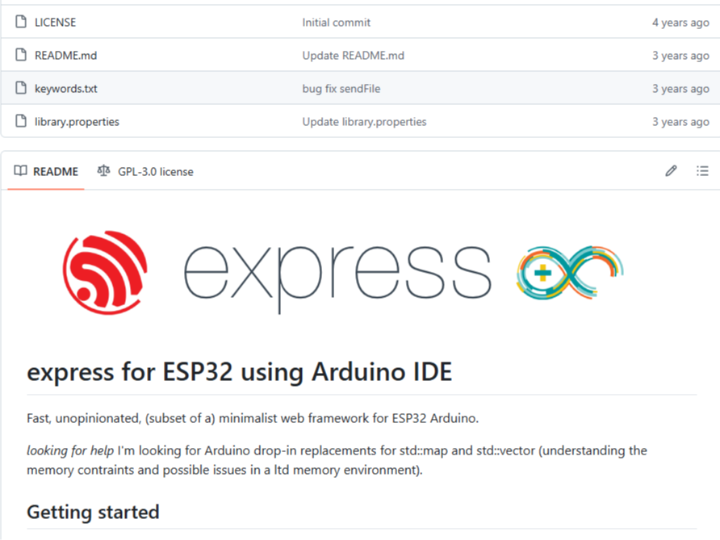
This repository brings an Express-inspired programming model to ESP32 Arduino: define routes, process requests in a loop, and compose reusable handler steps. The README banner signals the intended stack: ESP32 platform plus Arduino environment, using an Express-like mental model rather than Node.js itself.
Main Content
Key behaviors
Route registration: attach handlers to paths (for example, a GET on "/") and generate responses via a response object.
Loop-driven processing: call a run function repeatedly from the Arduino loop to serve incoming requests.
Composable handling: a middleware-like chain can express cross-cutting steps (logging, access gates, common headers) without duplicating code per route.
What differs from a typical Arduino HTTP sketch
Instead of scattered conditional branching in callbacks, the framework emphasizes explicit routing and reusable handler pipelines, which tends to scale better as endpoints grow.
System Context
This framework is an application-layer organizer on top of the ESP32 Arduino networking stack. Connectivity and sockets are still provided by the underlying Wi-Fi or Ethernet libraries. For wired Ethernet, the README explicitly calls out an Ethernet dependency for ESP32 with W5500.
Architecture / Design Considerations
Primary structure choice
Routing + handler chaining is the main architectural bet: clearer structure and reuse, at the cost of some overhead.
Constraint pressure points
The project notes reliance on vector and map and highlights that Arduino-class memory constraints can make these container choices problematic in limited-memory environments. This is a practical risk for route tables, header parsing, and long-running stability.
WIZnet / Ethernet boundary risk
The README describes a brittle integration detail for ESP32 + WIZnet W5500: patching the ESP32 Arduino core Server interface declaration in Server.h. This indicates an interface boundary where core updates or mismatches can break server startup or behavior.
Possible Implications
Where it helps
Teams familiar with Express can structure embedded HTTP services faster using a recognizable route-and-chain model.
Highest failure-cost segment
The most expensive failures are typically runtime instability under real traffic: memory growth or fragmentation from parsing/routing data structures can surface as hangs or resets rather than clean errors. The ESP32 + W5500 boundary also concentrates risk because a small core interface mismatch can block wired deployments outright.
Why it is an auxiliary layer
It does not provide connectivity by itself; it organizes HTTP behavior above whichever transport stack is present (Wi-Fi or W5500 Ethernet).
Component removal and system character change
If routing and chaining are removed, the system tends to revert to ad-hoc request handling with manual branching and duplicated cross-cutting logic. If W5500 Ethernet support is removed, the deployment shifts away from wired-network assumptions and becomes dependent on the remaining transport only.
Conclusion
This is a small Express-inspired framework for ESP32 Arduino that prioritizes structured routing and composable request handling. Its main engineering risks concentrate around container memory behavior and the ESP32 Arduino core interface boundary when using WIZnet W5500 Ethernet.
전체 개요
해당 저장소는 ESP32의 Arduino 환경에서 Express와 유사한 개발 경험을 제공하려는 초경량 웹 프레임워크로 해석될 수 있습니다. 라우팅과 미들웨어형 핸들러 체이닝을 통해 HTTP 서버 코드를 구조화하는 데 목적이 있는 것으로 보입니다.
배경과 목적
임베디드에서 HTTP 서버를 직접 구성하면 라우팅 분기, 공통 처리(로깅, 인증, 헤더), 예외 흐름이 빠르게 복잡해지기 쉽습니다. 이 프로젝트는 이러한 복잡도를 줄이기 위해, 경로 기반 라우팅과 재사용 가능한 처리 단계를 제공하려는 목적일 수 있습니다.
기술 흐름 설명 (신호/데이터/동작 순서 중심)
- 사용자가 setup 단계에서 앱 인스턴스를 만들고 라우트를 등록합니다.
- 지정 포트에서 listen을 통해 서버를 시작합니다.
- loop에서 run을 반복 호출하며 네트워크 입력을 처리합니다.
- 요청이 들어오면 요청 정보가 구성되고, 라우팅 규칙에 따라 핸들러(필요 시 체인)가 실행됩니다.
- 응답은 response를 통해 생성되어 전송 계층으로 내려갑니다.
- 유선 Ethernet을 쓰는 경우, ESP32 + W5500 조합에 대해 Ethernet 라이브러리 의존 및 추가 주의점이 언급됩니다.
왜 이런 구조가 나왔는지에 대한 해설
기존 접근 대비 핵심 차이는, 단일 스케치 수준의 콜백과 조건 분기 중심 구조 대신 명시적 라우팅과 공통 처리 단계의 재사용을 우선한다는 점으로 보입니다. 이 방식은 엔드포인트가 늘어날수록 중복이 줄고, 변경 범위를 좁히기 쉬운 편입니다.
다만 임베디드에서는 추상화 계층이 늘수록 메모리 및 장기 안정성 리스크가 커질 수 있어, “작은 프레임워크”로 유지하려는 방향성이 함께 나타나는 것으로 해석될 여지가 있습니다.
생소한 개념에 대한 풀어쓴 설명
라우팅은 “URL과 메서드에 따라 어떤 처리 함수를 실행할지 정하는 규칙”입니다.
미들웨어형 체이닝은 “요청 하나가 여러 처리 단계를 순서대로 지나가게 하는 방식”입니다. 예를 들어 로깅, 접근 제어, 공통 헤더 설정을 분리해두면 라우트마다 같은 코드를 반복하지 않아도 됩니다.
시스템 구성 및 선택지 해석
이 프레임워크는 통신 스택을 대체하기보다, 통신 위에서 동작하는 HTTP 애플리케이션 로직을 정리하는 보조 계층으로 위치하는 편이 자연스럽습니다. 따라서 Wi-Fi 또는 Ethernet 구성은 하위 네트워크 라이브러리의 제약을 그대로 받기 쉽습니다.
컨테이너로 vector와 map을 사용한다고 언급되어 있으며, Arduino 환경의 메모리 제약 때문에 대체 수단을 찾고 있다는 내용이 포함됩니다. 이는 라우트 테이블과 요청 처리 자료구조가 커질 때 부담이 될 가능성을 시사합니다.
유선 Ethernet을 고려하는 경우, W5500 조합에서 Server.h의 인터페이스 선언을 수정해야 한다는 주의가 있습니다. 이 지점은 코어 버전 변화에 취약할 수 있어 운영 리스크로 해석될 수 있습니다.
내부 관점에서의 시사점
실패 비용이 가장 큰 구간은 (1) 요청 파싱과 라우팅 과정에서의 메모리 사용 증가 및 단편화, (2) 장시간 구동 시 누수 또는 처리 지연 누적으로 인한 불안정, (3) ESP32 + W5500 환경에서 코어 인터페이스 불일치로 인해 구동이 막히는 경계 구간으로 볼 수 있습니다.
왜 보조 수단으로 위치하는지는, 네트워크 연결과 소켓 처리를 이 프레임워크가 직접 제공하지 않고, 하위 Wi-Fi/Ethernet 라이브러리 위에서 HTTP 로직을 구성하기 때문으로 보입니다.
특정 구성요소 제거 시 시스템 성격 변화는 다음처럼 해석될 수 있습니다. 라우팅과 체이닝을 제거하면 구조화된 웹 앱이라기보다, 요청 처리 코드가 분산된 형태로 되돌아가 유지보수 비용이 커지기 쉽습니다. W5500 유선 Ethernet 구성을 제거하면 배치 환경이 유선 전제에서 벗어나며, 네트워크 신뢰성 및 운영 시나리오가 달라질 수 있습니다.
또한 README가 모든 동작을 완전히 기술한다고 단정하기는 어려우며, 정보 제한이 있는 범위에서는 코드와 문서의 괴리가 운영 리스크가 될 수 있습니다.
FAQ
Q1. 기존의 단순 Arduino 웹서버 예제와 비교했을 때 차별 지점은 무엇인가요
라우팅과 공통 처리 단계를 코드 구조로 분리할 수 있다는 점이 핵심 차이로 보입니다. 엔드포인트가 늘어날수록 조건 분기 중심 구조보다 변경 범위를 줄이기 쉬울 가능성이 있습니다.
Q2. 핵심 데이터 흐름은 어떻게 이해하면 되나요
하위 네트워크 라이브러리가 연결과 바이트 스트림을 제공하고, 프레임워크가 이를 요청으로 구성한 뒤 라우팅과 핸들러 체인을 통해 처리하는 흐름으로 볼 수 있습니다. 응답은 response를 통해 구성되어 다시 전송 계층으로 내려갑니다.
Q3. 구조 선택(라우팅 + 체이닝)의 이유는 무엇으로 해석할 수 있나요
로깅, 인증, 공통 헤더 같은 관심사를 라우트마다 복사하지 않고 재사용하려는 목적일 수 있습니다. 다만 임베디드에서는 단계가 늘수록 메모리와 실행 시간 부담이 커질 수 있어, 규모 조절이 중요해질 수 있습니다.
Q4. 시스템 연계 또는 통신 역할은 어디까지인가요
이 프레임워크는 통신 자체를 제공하기보다, 통신 위의 HTTP 애플리케이션 로직을 정리하는 보조 계층으로 위치하는 편이 안전합니다. 따라서 Wi-Fi 또는 W5500 Ethernet의 기능과 제약은 하위 스택에 의해 좌우되기 쉽습니다.
Q5. 실패 비용이 가장 큰 판단 지점은 어디인가요
요청 파싱과 라우팅 자료구조에서 메모리 사용이 커지는 구간, 장시간 구동에서 단편화나 누수가 누적되는 구간이 비용이 커질 수 있습니다. 또한 ESP32 + W5500 조합에서 코어 인터페이스 수정 필요성이 언급되므로, 이 경계는 배포 안정성에 직접적인 영향을 줄 수 있습니다.
저자 정보 (반드시 마지막)
lathoub
공개된 정보가 제한적임. 오픈소스 저장소 운영자로서 Arduino ESP32 환경의 네트워크 및 웹 프레임워크 구현에 관심이 있을 수 있으나, 구체 이력은 정보 제한으로 단정하기 어렵습니다.