



EtherCAT Motor Control Example on Raspberry Pi 4 (SOEM + SPI-W5500)
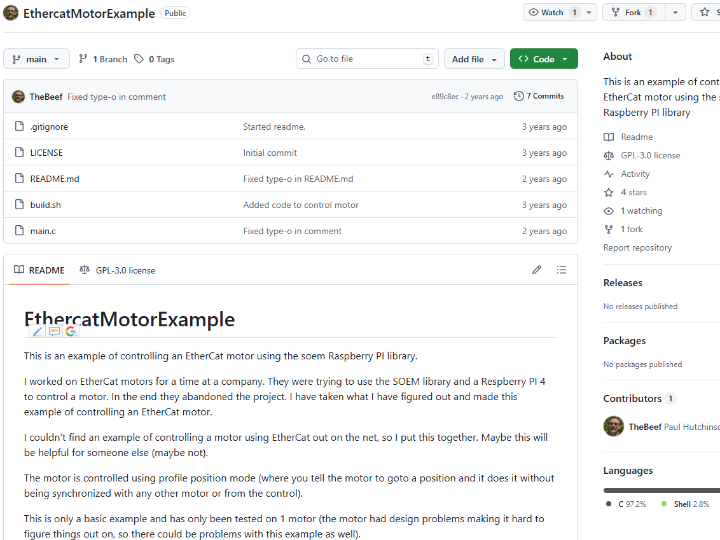
A minimal EtherCAT master example that drives a single motor in CiA 402 Profile Position Mode using SOEM on a Raspberry Pi 4 with a WIZnet W5500 SPI Ethernet.
Overview
This repository focuses on one practical goal: get an EtherCAT motor moving from a Raspberry Pi using SOEM, without building a full multi-axis real-time motion controller. The example issues position targets (in degrees) and lets the drive execute the motion profile internally, then polls until the move completes.
Main Content
- What it demonstrates
- Bringing an EtherCAT network to OP state via SOEM initialization, slave discovery, IO map setup, and state transitions to SAFE_OP and OP.
- Drive control through CoE SDO writes/reads using CiA 402-style objects (e.g., controlword/statusword, mode of operation, target position).
- Profile Position Mode command pattern: set mode, reset/enable sequence, configure profile accel/decel/velocity, write target position, trigger a new setpoint, then wait for completion by reading status/position.
- What it deliberately does not try to be
- Not a synchronized multi-axis motion loop.
- Not an example of cyclic synchronous position/velocity/torque with strict deterministic cycle timing.
- Not a generic “works for every drive” template (tested on a single motor per the repository notes).
System Context
Role in a broader automation stack
The Pi acts as an EtherCAT master that performs configuration and issues motion targets.
The drive remains the primary motion executor (trajectory generation happens inside the motor drive in Profile Position Mode). This makes the master a coordination/command layer rather than the hard real-time servo controller.
Ethernet interface choice (WIZnet requirement)
The setup assumes a WIZnet W5500 (SPI) Ethernet interface connected to a Raspberry Pi 4, and the SOEM init path is configured to use the “wiznet” interface.
In this system, the W5500 is not a “generic Ethernet mention,” it is the concrete NIC path that the example code configures before ec_init("wiznet").
Architecture / Design Considerations
Design flow (why it’s structured this way)
- Hardware/OS baseline: Raspberry Pi OS 32-bit is required by the provided setup notes.
- Kernel/tooling alignment: the instructions point to a kernel change intended to make SOEM + W5500 workable in this environment (prebuilt deployment steps).
- EtherCAT stack initialization: configure W5500 SPI parameters, initialize the SOEM “wiznet” NIC, scan/configure slaves, map process data, and drive the network to OP.
- Control by SDOs: implement small helpers for 8/16/32-bit SDO access and build a Profile Position Mode sequence on top.
- Completion detection: poll position and statusword until the target is reached (or the relevant “busy” bit clears).
High-cost failure points
- Network not reaching OP state: if slaves do not transition to OP, nothing else matters. The example prints per-slave state and AL status codes, reflecting that this is the first “make-or-break” gate.
- Drive state machine sequencing: Profile Position Mode depends on correct controlword transitions and setpoint triggering. A wrong sequence can leave the drive disabled or ignoring targets.
- Assuming portability across motors: the repo itself warns it was only tested on one motor and that the motor had design issues, which increases integration risk when applied elsewhere.
Component removal and how it changes the system
- Remove W5500 / “wiznet” path: the project no longer has its configured EtherCAT NIC and will require a different SOEM NIC driver and interface name, changing both wiring and software integration.
- Remove the kernel/tooling assumptions from the setup notes: the environment described by the repo is no longer matched, increasing the chance that SOEM + SPI NIC behavior diverges from the example’s expectations.
- Remove Profile Position Mode as the control strategy: you shift from “drive executes motion internally” to designs that may require cyclic real-time command streaming, which changes timing requirements and the overall control architecture.
Possible Implications
As a learning scaffold, this is useful for engineers who need a concrete reference for (a) getting OP, (b) doing basic CiA 402 positioning via SDOs, and (c) validating that the EtherCAT link is functioning.
For production multi-axis motion, the “profile position + polling” structure will likely become an auxiliary layer (setup, homing triggers, coarse moves, diagnostics), while the core motion loop may migrate to a more deterministic cyclic scheme or dedicated motion controller.
Conclusion
This repository is best read as a pragmatic “first successful motion” reference: it shows the end-to-end plumbing from SPI-W5500 NIC configuration to EtherCAT OP state and a minimal CiA 402 Profile Position command sequence. Its boundaries are explicit: single-motor testing, non-synchronized motion strategy, and environment-specific setup steps.
전체 개요
이 저장소는 “라즈베리파이에서 EtherCAT 모터를 일단 움직이게 만드는” 것을 목표로 한, 매우 실무 지향의 예제입니다. 핵심은 SOEM 기반 EtherCAT 마스터 초기화(OP 상태 진입)와, CiA 402 계열의 Profile Position Mode로 목표 위치를 쓰고 완료를 확인하는 흐름입니다.
문제의식과 기술적 맥락 재구성
현장에서 EtherCAT 모터 제어를 시도할 때 첫 번째 벽은 보통 두 가지입니다.
- EtherCAT 네트워크가 OP(Operational)까지 올라가지 않는다
- OP는 됐는데 드라이브(CiA 402) 상태머신/모드 설정이 맞지 않아 모터가 반응하지 않는다
이 예제는 위 두 벽을 넘는 데 필요한 “최소한의 골격”을 보여줍니다. 다만, 멀티축 동기 제어나 초정밀 주기 제어를 목표로 한 구조는 아닙니다(아래에 설명드리겠습니다).
기술 흐름 설명 (신호 / 데이터 / 동작 순서 중심)
1) 하드웨어/드라이버 경로 고정: SPI-W5500 기반 NIC
README에서 Raspberry Pi 4 + SPI W5500 연결을 전제로 합니다.
코드에서도 wiznet_hw_config(...) 후 ec_init("wiznet")로 들어가며, “wiznet” NIC 경로가 이 예제의 출발점입니다.
즉, “EtherCAT은 Ethernet 물리층을 쓰지만 아무 NIC나 되겠지”가 아니라, 이 프로젝트는 W5500(SPI)라는 매우 구체적인 경로에 묶여 있습니다.
2) EtherCAT 마스터 기동: OP 상태까지 올리는 절차
코드 상 흐름은 전형적인 SOEM 절차를 따릅니다.
ec_init("wiznet")
ec_config_init(false)로 슬레이브 스캔/자동 설정
ec_config_map(&IOmap)로 프로세스 데이터 맵 구성
SAFE_OP 상태 확인 후 OP 요청 및 확인 (ec_statecheck, ec_writestate)
OP 실패 시 슬레이브별 상태/AL status code를 출력하여 어디서 막혔는지 드러냅니다.
여기서 OP 진입이 사실상 1차 관문입니다. OP가 되지 않으면 뒤의 “모터 제어”는 의미가 없습니다.
3) 모터 제어 전략: Profile Position Mode + SDO 기반 설정/트리거
이 예제는 “동기 제어”가 아니라, 드라이브 내부 프로파일러에 맡기는 Profile Position Mode를 사용합니다. README에서도 “다른 모터와 동기화되지 않는다”고 명시되어 있습니다.
GotoPos(pos) 내부에서 중요한 순서는 아래처럼 정리됩니다.
- Mode of Operation(0x6060) 설정
- Controlword(0x6040)로 “shutdown → switch on → enable” 유사 시퀀스
- Profile accel/decel/velocity(0x6083/0x6084/0x6081) 설정
- Target position(0x607A) 설정 (각도→펄스 변환)
- Controlword로 새 setpoint 트리거(절대 위치)
- 완료 대기: position actual value(0x6064)와 statusword(0x6041)를 반복 읽기
이 흐름의 특징은 “마스터가 매 주기마다 위치/속도를 밀어넣는 구조”가 아니라, 한 번 목표를 던지고 드라이브가 알아서 움직인 뒤 완료를 확인한다는 점입니다.
왜 이런 구조가 나왔는지에 대한 해설
기존 접근 대비 핵심 차이
흔히 기대하는 EtherCAT 모션 제어는 “주기적으로 PDO를 교환하면서 동기 제어(예: CSP/CSV/CST)” 쪽으로 상상하기 쉽습니다.
그런데 이 예제는 반대로 ‘드라이브 내부의 모션 기능(Profile Position)’을 적극 활용해서, 마스터의 역할을 “명령/확인” 수준으로 낮춥니다.
즉, EtherCAT을 “초정밀 동기 제어 버스”로만 쓰지 않고, 현장에서 ‘일단 움직이게 만들기’에 유리한 방식으로 절충한 구조입니다.
왜 보조 수단으로 위치하는지
이 구조에서 주 제어 루프(trajectory/servo loop)는 드라이브 내부에 있고, 라즈베리파이+SOEM은 “목표/파라미터 세팅 및 상태 확인”에 가깝습니다.
그래서 시스템 관점에서 이 예제는 다음 같은 “보조 수단” 역할에 더 가깝습니다.
- 초기 구동/통신 검증
- 단발성 이동(홈 포지션, 기본 각도 이동)
- 상태 모니터링 및 장애 포착
- 추론임: 멀티축 동기 제어, 고정 주기 서보 제어가 목표라면 이 구조를 그대로 확장하기보다, PDO 기반의 cyclic control 구조로 재설계가 필요할 가능성이 높습니다(특히 타이밍/지터 요구가 올라가는 경우).
설계 선택의 배경, 제약 조건, 대안 가능성
(1) W5500(SPI) 선택
이 저장소는 W5500을 “있으면 좋음” 정도가 아니라, 아예 예제의 NIC 경로로 박아넣은 형태입니다(ec_init("wiznet")).
README에서도 하드웨어 전제로 명시합니다.
대안은 크게 두 갈래입니다.
- 라즈베리파이의 기본 Ethernet 포트(또는 USB Ethernet)로 SOEM을 붙이는 방향
- EtherCAT 마스터 역할을 라즈베리파이 밖(산업용 PC/전용 마스터)으로 옮기는 방향
다만, 저장소 토론에서는 “노트북 Ethernet 포트로 하려면 작업이 꽤 필요하다”는 취지의 언급이 있습니다.
(2) 커널/OS 제약
README에 따르면 Raspberry Pi OS는 32-bit를 요구하고, 커널을 교체하는 절차를 안내합니다.
여기서 중요한 포인트는 “단순 빌드”가 아니라, 환경 자체를 예제에 맞추는 과정이 포함된다는 점입니다.
추론임: 이런 커널/환경 고정은 EtherCAT의 타이밍 민감도 및 SPI NIC 경로의 동작 안정성과 연관될 수 있습니다. 따라서 이 부분을 건너뛰면 “빌드는 되는데 OP가 안 올라가거나, 올라가도 통신이 불안정한” 류의 실패가 날 수 있습니다.
실패 비용이 가장 큰 판단 지점
이 프로젝트 관점에서 “여기서 틀리면 시간을 크게 잃는 구간”은 보통 아래 두 군데입니다.
- OP 상태 진입 실패
- 슬레이브 스캔, 상태 천이에서 막히면 이후 단계가 전부 무의미해집니다. 코드도 OP 실패 시 슬레이브 상태와 AL status code를 찍어 원인 추적을 유도합니다.
- 드라이브 상태머신/모드/세트포인트 트리거 실수
- Profile Position은 “목표만 쓰면 움직이겠지”가 아니라, controlword 시퀀스와 setpoint 트리거가 맞아야 합니다. 이 부분이 어긋나면 조용히 아무 일도 안 일어나는 경우가 흔합니다.
특정 구성요소 제거 시 시스템 성격 변화
- W5500 제거 시: 이 예제의 “wiznet NIC” 전제가 깨져서, EtherCAT 통신 경로 자체를 다시 설계해야 합니다(다른 NIC 드라이버/인터페이스로 SOEM 초기화부터 변경).
- Profile Position 제거 시: 드라이브 내부 모션에 맡기던 구조가 무너지고, 마스터가 더 촘촘한 주기 제어를 떠안게 될 가능성이 커집니다. 즉, 시스템이 “명령/확인”에서 “실시간 제어” 쪽으로 성격이 바뀝니다.
- README의 커널/OS 절차 제거 시: 예제가 가정한 실행 환경과 달라져, “OP 불가/불안정” 같은 형태로 실패가 터질 수 있습니다. (이 부분은 README가 환경 고정을 강하게 요구한다는 점까지만 ‘사실’이고, 실패 양상은 추론임입니다.)
FAQ
- 기존 EtherCAT 모션 예제들과 비교했을 때 가장 큰 차이는 무엇인가요?
Profile Position Mode를 사용해서 드라이브 내부 프로파일러에 움직임을 맡기고, 마스터는 목표 설정과 완료 확인에 집중합니다. 그래서 “주기적 동기 제어”보다는 “일단 구동 성공”에 초점이 맞춰져 있습니다. - 왜 W5500(SPI) 같은 구성이 선택되었나요?
이 저장소는 W5500을 단순 참고가 아니라, 코드 레벨에서ec_init("wiznet")로 고정된 NIC 경로로 사용합니다. 즉, 예제의 재현성을 위해 통신 경로를 명확히 하나로 고정한 선택으로 해석할 수 있습니다. (후반 문장은 추론임입니다.) - 핵심 신호/데이터 흐름을 한 줄로 요약하면 무엇인가요?
“OP 상태 진입 → SDO로 모드/파라미터/목표 위치 설정 → controlword로 setpoint 트리거 → statusword/position을 읽으며 완료 대기”입니다. - 실패 비용이 가장 큰 판단 지점은 어디인가요?
첫째는 슬레이브가 OP에 올라오느냐이고, 둘째는 CiA 402 제어 시퀀스가 맞느냐입니다. 이 둘이 틀리면 나머지 디버깅은 대부분 “의미 없는 로그”만 쌓이기 쉽습니다. (마지막 문장은 추론임입니다.) - W5500을 빼고 라즈베리파이 기본 Ethernet으로 하면 그대로 쓸 수 있나요?
그대로는 어렵고, 최소한 SOEM 초기화 인터페이스와 NIC 드라이버 경로를 바꿔야 합니다. 저장소 토론에서도 다른 환경(노트북 포트 등)으로 가는 경우 작업이 필요하다는 취지의 언급이 있습니다. - 이 예제가 ‘보조 수단’으로 위치한다고 말하는 근거는 무엇인가요?
Profile Position Mode에서는 실제 궤적 생성과 구동이 드라이브 내부에서 이뤄지고, 마스터는 목표와 트리거, 확인에 집중합니다. 그래서 시스템 전체에서 마스터가 “서보 루프의 중심”이라기보다, “명령/검증 레이어”로 배치되기 쉽습니다. (두 번째 문장은 추론임입니다.)
저자 정보 (Author Information)
- Paul Hutchinson
- 공개된 정보가 제한적임
- (추론임) GitHub 프로필 자기소개 기준, 임베디드 C 중심 개발 배경으로 보임