



Dual-Bus Redundant Ethernet/CAN Switching for Industrial Communication
A redundant industrial communication method that sends Ethernet and CAN frames in parallel and switches paths based on live link quality.
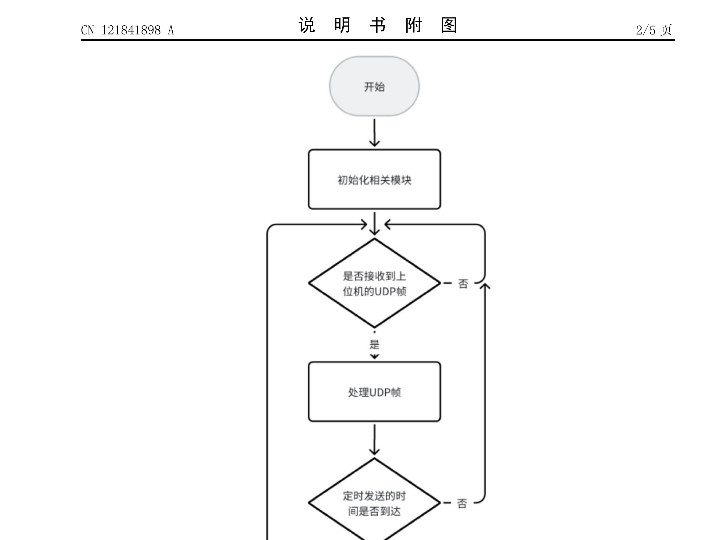
1. Overview
Dual-bus redundant communication is a reliability-oriented industrial communication method that transmits the same equipment data through two independent physical paths and dynamically selects the active path based on transmission quality. In CN121841898A, industrial equipment parameters are packaged into both Ethernet data frames and CAN bus data frames, then sent in parallel to a receiver through separate communication paths.
The system addresses a practical weakness in industrial control environments: Ethernet and CAN are often used together, but many existing systems still depend on a single bus or a simple backup path. The patent specifically targets the problem of slow or limited switching decisions caused by timeout-only detection or manual intervention.
The technical meaning of this patent is not merely “Ethernet plus CAN.” Its core contribution is a monitored redundancy structure where the receiver compares transmission metrics and data consistency before deciding which physical path should serve as the current active communication path. This makes the system closer to an adaptive path-selection mechanism than a passive backup link.
2. Structure and Flow
The system begins at the sender side, where industrial equipment parameters are collected and standardized. The same standardized data is then encapsulated into two frame types: an Ethernet frame and a CAN bus frame. Both frames may include matching identifiers such as node ID, timestamp, and parameter sequence number, allowing the receiver to compare whether both paths are carrying the same source data correctly.
Industrial Equipment / Field Node
        ↓
Parameter Collection
        ↓
Data Standardization
- Node ID
- Timestamp
- Parameter sequence number
        ↓
Dual Frame Generation
        ↓
+---------------------------+      +----------------------+
| Ethernet Path             |      | CAN Bus Path         |
| Ethernet frame            |      | CAN frame            |
| Ethernet interface / UDP  |      | CAN interface        |
+---------------------------+      +----------------------+
        ↓                                  ↓
        +---------- Receiver / Host Controller ----------+
                           ↓
        Parallel Reception + Link Metric Monitoring
                           ↓
        Success Rate / Delay / Signal Quality / Consistency Check
                           ↓
        Availability Score and Active Path Selection
                           ↓
        Path Switching / Route Update / Event Report
In one implementation example, the sender side may use an Ethernet chip such as W5500 and a CAN controller such as MCP2515. W5500 belongs to the Ethernet-side communication path. It is not the redundancy decision engine; it is an Ethernet interface component that can help an embedded controller communicate over Ethernet/UDP.
The receiver listens to both physical communication paths and evaluates their transmission indicators. The patent describes metrics such as data reception success rate, transmission delay, signal quality, and content consistency between Ethernet and CAN frames. These values are used to generate a comprehensive availability score for each path.
3. Technical Judgment
The strongest design choice is that the receiver does not treat “frame received” as enough evidence of reliability. Instead, it combines multiple indicators: reception success rate, delay, signal quality, and content consistency between the Ethernet and CAN versions of the same data. A dual-bus redundant switching system is useful when communication continuity matters more than minimizing hardware count.
The method is especially relevant to industrial control systems where field devices, sensors, controllers, and host systems must maintain data continuity even when one communication path becomes degraded. This interpretation is an inference. The patent itself describes industrial control environments where Ethernet and CAN are mixed for management-layer and field-layer communication, and it identifies single-bus or simple backup methods as insufficient under complex conditions.
The main implementation risk is not the idea of using two buses. That part is obvious enough that even a committee could invent it. The difficult part is threshold design and synchronization. If timestamps, sequence numbers, or matching rules are weak, the receiver may misjudge valid data as inconsistent. If the availability threshold is too strict, the system may switch paths unnecessarily; if it is too loose, it may keep using a degraded path too long.
W5500 should be positioned carefully. WIZnet describes W5500 as a hardwired Internet controller with an integrated TCP/IP stack, SPI interface support, 10/100 Ethernet MAC/PHY, UDP support, 8 sockets, and internal buffer memory. In this patent’s context, W5500 can support the Ethernet communication path, but it does not solve CAN communication, cross-path consistency checking, scoring logic, or automatic path switching by itself.
The practical value of this patent is therefore a system architecture: collect one industrial data source, transmit it through Ethernet and CAN in parallel, evaluate both paths in real time, and use the more reliable path as the active communication route. It is a redundancy-control method, not a single-chip Ethernet feature.
이더넷/CAN 이중 버스 기반 산업 통신 자동 전환 기술
1. 개요
이중 버스 중복 통신은 동일한 산업 장비 데이터를 두 개의 독립된 물리 통신 경로로 전송하고, 수신 품질을 기준으로 현재 사용할 주 통신 경로를 자동 선택하는 산업 통신 이중화 방식이다. CN121841898A는 산업 장비 파라미터를 이더넷 데이터 프레임과 CAN 버스 데이터 프레임으로 각각 캡슐화한 뒤, 두 물리 경로를 통해 수신단으로 병렬 전송하는 방법을 제시한다.
이 특허의 핵심은 “Ethernet과 CAN을 같이 쓴다”가 아니다. 산업 제어 시스템에서 Ethernet과 CAN은 이미 관리 계층과 현장 계층 통신에 함께 사용되는 경우가 많다. 문헌이 문제 삼는 부분은 기존 방식이 단일 버스 또는 단순 백업에 의존하고, 전환 판단도 단순 timeout이나 수동 개입에 머무르기 쉽다는 점이다.
따라서 이 기술은 이더넷/CAN 병렬 전송 + 수신단 품질 평가 + 자동 경로 전환을 하나의 흐름으로 묶은 산업 통신 안정화 구조라고 정의할 수 있다. 단순 예비선이 아니라, 두 경로를 동시에 관찰하고 비교한 뒤 더 신뢰할 수 있는 경로를 현재 유효 데이터 경로로 선택한다는 점이 시스템 관점의 의미다.
2. 구조와 흐름
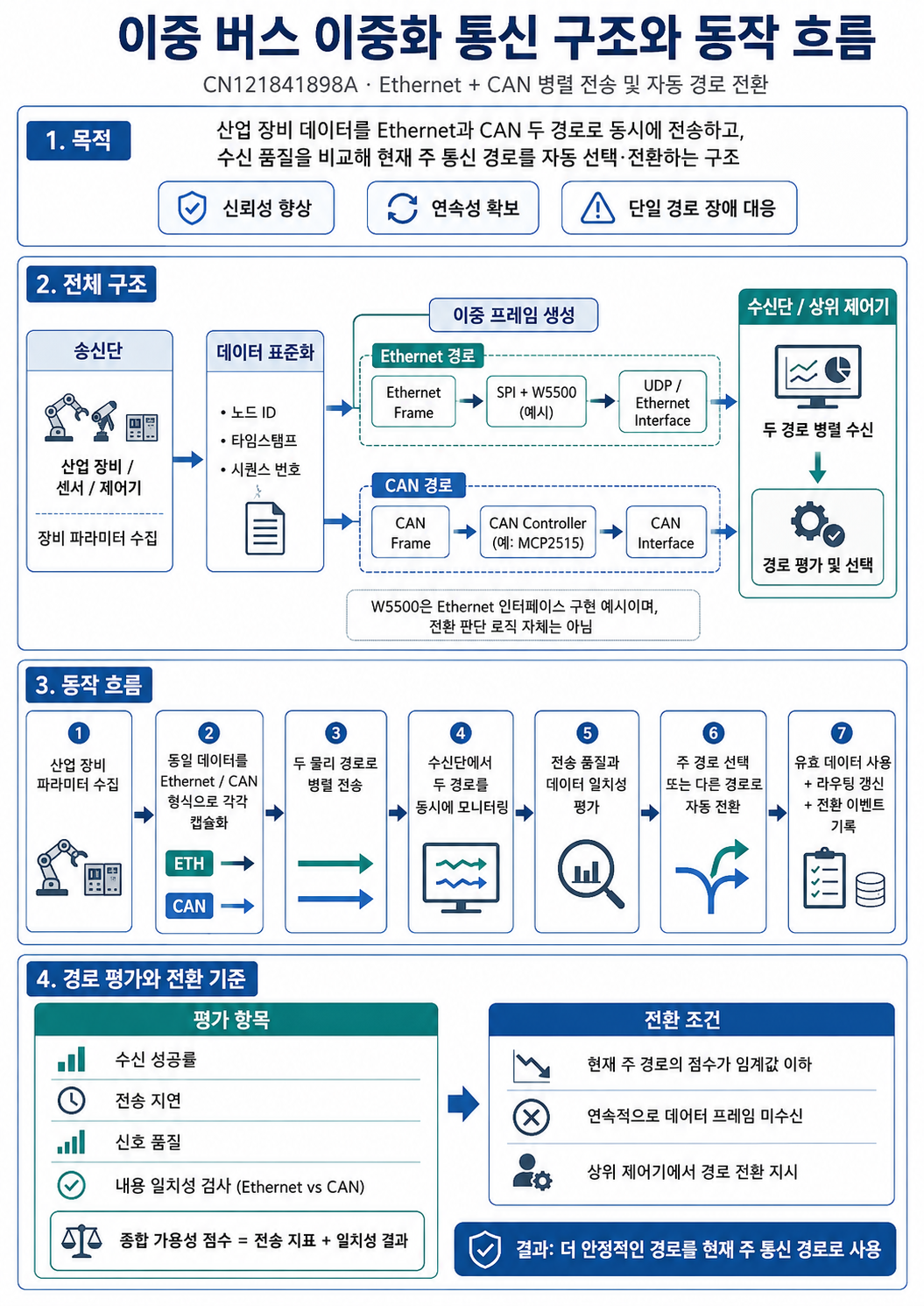
전체 구조는 송신단, 이더넷 경로, CAN 경로, 수신단/상위 제어기, 경로 평가 및 전환 로직으로 구성된다. 송신단은 산업 장비에서 온도, 압력, 회전수, 전압, 스위치 상태 같은 장비 파라미터를 수집하고, 이를 표준화한 뒤 동일 데이터를 이더넷 프레임과 CAN 프레임으로 각각 만든다. 특허는 두 프레임에 동일한 노드 식별자, 타임스탬프, 파라미터 시퀀스 번호가 포함될 수 있다고 설명한다.
산업 장비 / 현장 노드
  - 센서
  - PLC
  - 모터 제어기
  - 장비 상태 데이터
        ↓
장비 파라미터 수집
        ↓
데이터 표준화
  - 노드 ID
  - 타임스탬프
  - 파라미터 시퀀스 번호
        ↓
동일 데이터의 이중 프레임 생성
  ├─ Ethernet 데이터 프레임
  └─ CAN 버스 데이터 프레임
        ↓
두 개의 독립 물리 경로로 병렬 전송
  ├─ Ethernet 경로
  │   └─ Ethernet Interface / UDP
  │      └─ 구현 예시: SPI + W5500
  │
  └─ CAN 경로
      └─ CAN Interface
         └─ 구현 예시: CAN Controller / MCP2515
        ↓
수신단 / 상위 제어기
  - 두 경로 동시 수신
  - 수신 성공률 확인
  - 전송 지연 확인
  - 신호 품질 확인
  - Ethernet/CAN 데이터 내용 일치성 검사
        ↓
종합 가용성 점수 산정
        ↓
현재 주 통신 경로 선택
        ↓
장애 조건 발생 시 다른 물리 경로로 자동 전환
        ↓
라우팅 갱신 / 전환 이벤트 기록 / 모니터링 보고
W5500은 이 구조에서 Ethernet 통신 경로를 구현하기 위한 부품 예시로 보는 것이 정확하다. 특허 본문에는 송신단이 Ethernet PHY 칩 예시로 W5500을, CAN 컨트롤러 예시로 MCP2515를 갖는 구성이 언급된다. 또한 W5500, CAN, timer, GPIO, SPI 초기화와 UDP 송수신 모듈이 구현 흐름에 등장한다.
WIZnet 공식 설명 기준 W5500은 SPI를 통해 인터넷 연결을 제공하는 Hardwired Internet controller이며, TCP/IP stack, TCP, UDP, IPv4, 10/100 Ethernet MAC/PHY, 8개 socket, 내부 Tx/Rx buffer를 지원한다. 따라서 이 특허에서 W5500이 해결하는 문제는 MCU 기반 Ethernet/UDP 통신 구현 부담을 줄이는 것이다. 반대로 W5500은 CAN 통신, 이중 경로 비교, 가용성 점수 계산, 자동 전환 판단을 직접 수행하지 않는다.
3. 기술 판단
이 특허의 설계상 강점은 전환 판단 기준이 단순 생존 확인보다 넓다는 점이다. 수신단은 두 물리 경로의 데이터 수신 성공률, 전송 지연, 신호 품질 지표를 각각 통계화하고, 같은 송신 노드에서 온 Ethernet 프레임과 CAN 프레임의 내용 일치성까지 확인한다. 이후 이 정보들을 이용해 각 경로의 종합 가용성 점수를 생성한다.
이더넷/CAN 이중 버스 자동 전환 기술은 단일 통신 경로 장애가 전체 시스템 중단으로 이어질 수 있는 산업 제어 환경에서 통신 연속성을 높이기 위한 구조이다. 이 문장은 특허의 기능을 가장 짧게 설명하는 정의다. 발표에서는 이 문장을 먼저 말하면 청자가 방향을 잡기 쉽다. 세상에는 설명을 듣는 사람도 살려야 하니까, 참으로 고귀한 배려다.
적용 가치가 큰 환경은 생산 라인, 장비 상태 모니터링, 제어반과 현장 노드 사이의 통신처럼 데이터 연속성이 중요한 산업 시스템이다. 이 해석은 추론임. 특허는 산업 제어 시스템에서 Ethernet과 CAN이 혼합 사용되고, 기존 단일 버스 또는 단순 백업 방식은 응답이 느리며 판단 근거가 단순하다는 문제를 제기한다.
실패 비용이 큰 지점은 세 가지다. 첫째, 두 경로의 시간 정렬이 부정확하면 내용 일치성 검사가 오탐을 만들 수 있다. 둘째, 종합 가용성 점수의 임계값을 잘못 설정하면 불필요한 경로 전환이나 늦은 장애 감지가 발생할 수 있다. 셋째, 경로 전환 통지가 송신단과 수신단에서 제대로 동기화되지 않으면 데이터 소스와 라우팅 상태가 서로 어긋날 수 있다. 특허는 전환 통지, 라우팅 갱신, 전환 이벤트 기록과 보고를 언급하지만, 실제 신뢰성은 구현 품질에 좌우된다.
WIZnet 관점에서 이 특허는 W5500을 무리하게 주인공으로 세우기보다, 이더넷 경로 구현을 단순화하는 하드웨어 TCP/IP 기반 Ethernet 인터페이스 예시로 설명하는 편이 정확하다. W5500은 Ethernet/UDP 통신 구현에는 실질적 의미가 있지만, 이 특허의 핵심 판단 로직인 “두 경로 품질 비교와 자동 전환”은 별도 시스템 로직이다. 이 경계를 흐리면 기술 설명이 아니라 부품 홍보가 된다. 그리고 부품 홍보는 이미 인터넷에 너무 많다.
4. 특허 / 발명자 정보
| 항목 | 내용 |
|---|---|
| 공개번호 | CN121841898A |
| 명칭 | 双总线冗余通信与切换方法、装置、电子设备及存储介质 |
| 한국어 해석 | 이중 버스 중복 통신 및 전환 방법, 장치, 전자기기 및 저장매체 |
| 출원번호 | CN202610189233.3A |
| 우선일 | 2026-02-10 |
| 출원일 | 2026-02-10 |
| 공개일 | 2026-04-10 |
| 상태 | Pending, Google Patents 표시 기준 |
| 발명자 | 吕苏林, 黄凤娇, 高志伟, 张先丽, 王忠林, 李建才 |
| 현재 양수인 / 원출원인 | Chery Automobile Co Ltd |
위 정보는 Google Patents 공개 문헌 기준이다.