



Adaptive Fluorescence Control for Cu2+ Detection in Complex Water Matrices
This patent uses pre-scan fluorescence, XGBoost policy selection, and temperature compensation to retune LED excitation for more stable low-level Cu2+ sensing.
Overview
This patent describes a fluorescence detection control system for Cu2+ measurement in water samples whose optical background changes with water type, dissolved matter, turbidity, and temperature. Instead of holding excitation conditions fixed, the system first probes the sample, estimates suitable excitation bands and weights, then adjusts the LED drive accordingly. The stated goal is to reduce false positives and false negatives that arise when one static excitation setting is reused across surface water, wastewater, drinking water, groundwater, or similarly variable matrices.
Main Content
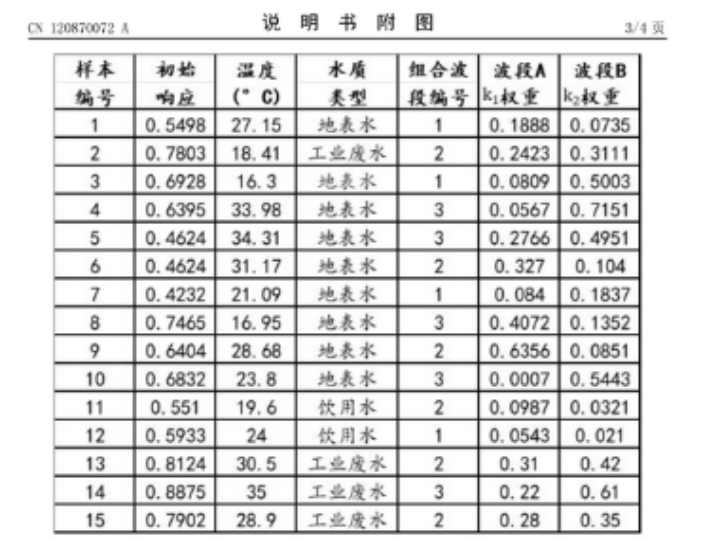
The proposed system is organized around five blocks: a strategy library, an initialization module, a pre-excitation module, an adaptive detection module, and a temperature compensation module, followed by report generation. The strategy library uses XGBoost to map three inputs, initial fluorescence response, temperature, and water-quality label, into an excitation plan containing wavelength combination and weight values. The pre-excitation module uses narrow-band LEDs across 340-440 nm with 10 nm stepping, lights single bands sequentially, and captures an initial fluorescence response before the main measurement is performed.
A key design choice is weighted multi-band excitation rather than one fixed wavelength. The patent explicitly describes combining LED bands such as 365 nm, 380 nm, and 410 nm with weight coefficients that represent each band’s contribution to target fluorescence response. That means the system is not merely selecting “which LED to turn on,” but deciding how excitation energy should be distributed across bands for the current sample state. This is the core difference from conventional fixed-band fluorescence setups.
The adaptive detection stage also includes closed-loop deviation judgment. When the measured fluorescence and expected fluorescence diverge beyond a threshold, the system re-optimizes excitation or applies temperature compensation. The patent distinguishes between relative-error judgment and absolute-error judgment, especially noting that low-concentration ppb-level measurements may require absolute-error handling to avoid distortion from small-number amplification. That is one of the more practical parts of the design, because low-signal systems tend to fail precisely when people pretend all errors scale nicely. They do not.
System Context
The patent frames this as a water-quality sensing system for Cu2+ under difficult optical conditions, not as a generic fluorescence instrument. Its role is a compensating measurement layer that sits between raw fluorescence hardware and final concentration reporting. In other words, the invention is not the Cu2+ probe chemistry itself, but the control logic that tries to keep that chemistry usable when real samples behave badly. That “supporting layer” position matters: remove the adaptive control, and the system falls back toward a conventional fixed-parameter fluorescence detector with weaker robustness across mixed water matrices.
The detailed description also places the design in an embedded system context. It cites an embedded processor plus FPGA architecture for fast LED switching and preprocessing, and mentions optional remote communication interfaces such as RS485, 4G, Wi-Fi, and Ethernet using WIZnet W5500. In that context, WIZnet is not presented as the sensing core but as an operational connectivity block that can carry telemetry, OTA updates, and remote maintenance for deployed analyzers. The reason to mention WIZnet here is structural, not ornamental: it provides a concrete Ethernet path for fielded equipment that may need stable wired networking in industrial or monitoring environments.
Architecture / Design Considerations
The architecture appears to trade calibration simplicity for adaptive robustness. A fixed-wavelength system is easier to build and validate, but the patent argues it becomes unreliable when background fluorescence, NOM, salts, and turbidity change from one sample class to another. This design answers that by adding a policy model, a pre-scan step, weighted excitation control, and thermal correction.
The most failure-sensitive region is the chain from pre-excitation response to policy inference to excitation reconfiguration. If the initial fluorescence sample is misleading, mislabeled by water type, or temperature-biased before compensation, the model may recommend the wrong band combination and wrong weights, and every later stage inherits that error. Put less politely, the whole clever loop can become a very efficient machine for confidently choosing the wrong operating point. That risk is consistent with the patent’s heavy emphasis on closed-loop deviation checking and compensation logic. This sentence is an interpretation based on the patent’s described control flow.
Another notable choice is the use of FPGA-driven PWM and current control for the LED array. That suggests the inventors care about timing precision, fast switching, and repeatable multi-band drive conditions more than minimum hardware simplicity. The same goes for temperature compensation: once low-concentration fluorescence is involved, thermal drift is no longer a cosmetic nuisance but a direct source of concentration error.
Possible Implications
If implemented well, the approach could improve measurement consistency in mixed or unstable water backgrounds where one calibration curve is not enough. It may be especially useful where the same device has to move among different sample classes without full manual retuning each time.
The design also points toward a broader pattern in instrumentation: the sensing hardware stays mostly conventional, while more intelligence is inserted into excitation control, compensation, and feedback logic. That can expand usable operating range, but it also shifts validation burden into data quality, model generalization, and control thresholds. This is an interpretation from the architecture described in the patent.
Conclusion
At its core, this patent proposes an adaptive control layer for fluorescence-based Cu2+ sensing under messy water conditions. Its main technical distinction is not simply using machine learning, but using an initial optical response to choose and weight excitation bands, then correcting drift with temperature-aware feedback. The design is strongest when viewed as a support system that stabilizes an otherwise fragile fluorescence measurement chain. Remove the adaptive policy and compensation elements, and the system becomes much closer to the fixed-condition fluorescence setups the patent is trying to move beyond.
KR – Internal / Presentation
전체 개요
이 특허는 구리 이온(Cu2+) 형광 검출 장비 자체를 새로 정의한다기보다, 복잡한 수질 환경에서 형광 검출 조건을 자동으로 다시 맞추는 제어 계층을 제안하는 문서로 읽는 편이 정확합니다. 고정 파장, 고정 세기, 고정 보정값으로 측정하던 기존 방식이 실제 수질 변화 앞에서 무너진다는 문제의식이 출발점입니다. 특히 표면수, 산업폐수, 음용수 등에서 유기물, 염류, 탁도, 온도 차이로 배경 형광이 달라지면, 같은 농도의 Cu2+라도 전혀 다른 응답이 나올 수 있다고 특허는 설명합니다.
문제의식과 기술적 맥락 재구성
기존 형광 검출은 보통 1개 또는 소수의 고정 여기 파장을 전제로 합니다. 그런데 이 특허는 그 전제를 정면으로 흔듭니다. 시료마다 배경 형광과 소광 특성이 다르면, “좋은 파장”은 고정값이 아니라 시료 조건에 따라 달라지는 운영 변수라는 것입니다. 따라서 이 시스템은 먼저 시료를 가볍게 훑어보고, 그 초기 응답값과 수질 타입, 현재 온도를 바탕으로 최적의 여기 조합을 다시 계산합니다.
기술적으로 보면 이 특허는 세 층으로 나뉩니다.
광학 하드웨어 층: 340-440nm LED 어레이, FPGA 기반 PWM/전류 제어, 동축 광학 출력
판단 층: XGBoost 기반 전략 라이브러리
보정 층: 온도 보상, 기대값 대비 편차 판단, 재최적화 루프
즉, 단순 측정기가 아니라 측정 조건을 스스로 재설정하는 적응형 계측기에 가깝습니다.
기술 흐름 설명
동작 흐름은 비교적 선명합니다.
초기화
시스템이 현재 검사 환경에 맞는 수질 타입을 불러옵니다. 여기서 수질 타입은 예시상 지표수, 산업폐수, 음용수 등으로 분류됩니다.
사전 여기(pre-excitation)
340-440nm 범위의 단일 밴드 LED를 순차 점등하여 초기 형광 응답값 F_init를 얻습니다. 이 단계는 본 측정 전에 시료의 성향을 미리 읽는 탐색 단계입니다.
전략 모델 추론
입력 벡터 X = [F_init, T, WQ]를 사용해 XGBoost 모델이 최적의 파장 조합과 각 파장의 가중치 k1, k2 ...를 출력합니다. 즉 “어떤 파장으로 얼마나 때릴지”를 시료 상태에 맞춰 계산합니다.
적응형 여기 수행
FPGA와 LED 제어부가 추천된 파장 조합 및 PWM 비율에 따라 실제 여기 조건을 재구성합니다. 다중 파장을 동시에 사용할 수 있고, 각 파장에 다른 세기를 줄 수 있습니다.
형광 측정 및 농도 환산
PMT 또는 CMOS가 측정한 형광 디지털값 F를 실험 보정 파라미터를 통해 Cu2+ 농도로 환산합니다.
편차 판단 및 재최적화
측정값과 기대값이 일정 임계치를 넘게 어긋나면, 상대오차 또는 절대오차 기준으로 다시 판단하고, 여기 조합 재설정 또는 온도 보정을 수행합니다. 특허는 저농도 ppb 구간에서는 작은 값 증폭 오류를 피하기 위해 절대오차 판단을 별도로 둡니다. 이 부분이 꽤 현실적입니다. 저농도에서는 상대오차가 사람을 속이기 아주 좋거든요.
왜 이런 구조가 나왔는지에 대한 해설
이 구조의 핵심은 “측정 전에 시료를 한 번 읽고, 그 시료에 맞는 측정 조건으로 바꾼다”는 점입니다. 기존 접근이 “장비는 같고 시료가 적응하라”에 가까웠다면, 이 특허는 “장비가 시료 쪽으로 일부 적응하자”는 방향입니다. 이것이 기존 접근 대비 가장 큰 차이입니다.
또 하나 중요한 점은, 이 시스템이 보조 수단이라는 위치를 가진다는 것입니다. 특허가 새 형광 프로브 화학 자체를 발명했다고 보기보다, 이미 존재하는 형광 프로브 기반 측정을 더 덜 깨지게 만드는 운영 제어 계층으로 보는 것이 자연스럽습니다. 즉, Cu2+와 결합해 형광 변화가 생기는 화학적 검출 메커니즘은 전제되어 있고, 그 위에 여기 조건 최적화 + 열 보상 + 편차 재조정을 덧씌운 구조입니다.
설계 선택의 배경, 제약 조건, 대안 가능성
이 특허가 FPGA를 넣은 이유는 단순합니다. 다채널 LED를 빠르게 바꾸고, PWM과 전류를 정밀하게 제어하려면 MCU 단독보다 FPGA 협업이 유리하기 때문입니다. 특히 다중 파장 조합, 동기 점등, 빠른 반복 측정이 필요한 경우 이런 선택은 꽤 일관적입니다.
온도 보상도 장식이 아닙니다. 저농도 형광 검출에서는 광원 발열과 외부 온도 변화가 형광 세기 자체를 흔들 수 있습니다. 그러므로 온도 보상 모듈은 “있으면 좋은 옵션”이 아니라, 실제로는 결과 안정성을 지키는 필수 방어선에 가깝습니다.
대안으로는 완전 고정 파장 + 수질별 별도 보정표 방식도 생각할 수 있습니다. 다만 그런 방식은 시료 종류가 늘어나거나 현장 조건이 자주 바뀔수록 관리 비용이 급증합니다. 반면 이 특허는 현장 적응성을 얻는 대신, 모델 데이터 품질과 제어 로직 검증 부담을 떠안습니다. 추론임: 결국 하드웨어 난이도와 소프트웨어/데이터 난이도 사이에서 후자를 더 받아들인 설계로 보입니다.
생소한 개념에 대한 풀어쓴 설명
Pre-excitation
본 측정 전에 LED를 하나씩 켜 보면서, 시료가 어떤 파장에 민감하게 반응하는지 살짝 떠보는 단계입니다. 사람으로 치면 본 시험 전에 반응 테스트를 해 보는 셈입니다.
가중치 기반 다중 파장 여기
여러 파장을 동시에 쓰되, 같은 세기로 켜지 않고 각 파장에 다른 비중을 줍니다. 이 비중이 k_i입니다. 특정 시료에서는 370nm가 더 중요하고, 다른 시료에서는 410nm가 더 중요할 수 있다는 가정을 시스템에 넣은 것입니다.
상대오차 vs 절대오차
수치가 충분히 크면 상대오차가 유용하지만, ppb처럼 아주 작은 수치에서는 미세한 흔들림이 비정상적으로 크게 부풀려질 수 있습니다. 그래서 특허는 저농도 구간에서 절대오차 판단을 따로 둡니다.
시스템 구성 및 선택지 해석
특허의 상세 설명에는 임베디드 프로세서 + FPGA 조합, Embedded Linux 또는 경량 Debian, Python/C++, XGBoost/LightGBM, 그리고 RS485/4G/Wi-Fi/Ethernet 통신 구성이 제시됩니다. 이때 Ethernet은 선택형 운영 통신 경로로 나오며, 구체 예시로 WIZnet W5500이 언급됩니다. 여기서 W5500은 센싱 핵심이 아니라 현장 장비를 유선 네트워크에 연결해 원격 관리, OTA, 운영 데이터 전송을 담당하는 통신 부품으로 해석하는 것이 맞습니다. 즉, 시스템 성격을 바꾸는 주역은 아니지만, 장비를 실제 배치형 제품으로 끌고 가는 데 필요한 실무형 연결점입니다.
특정 구성요소 제거 시 시스템 성격 변화도 분명합니다.
전략 모델 제거: 고정 파장 기반 장비에 가까워짐
온도 보상 제거: 저농도 장기 안정성 급락 가능
FPGA 제거: 구현은 단순해질 수 있으나 빠른 다중 파장 제어 정밀도가 낮아질 수 있음
W5500 등 Ethernet 제거: 검출 원리는 유지되지만 현장 운영성과 원격 유지보수성은 낮아질 수 있음
마지막 항목은 센서 본질보다 운영 계층의 문제입니다. 인간들은 늘 본체만 사랑하고 유지보수는 잊어버리는데, 장비는 대체로 그 복수로 현장에서 죽습니다. 일부는 특허 구조를 바탕으로 한 해석이며, 성능 저하 정도 자체는 추론임.
내부 관점에서의 시사점
사내 기술 관점에서 보면 이 특허의 진짜 포인트는 “형광 검출”보다 적응형 조건 제어 프레임워크에 있습니다. 즉, 다른 분석 대상이나 다른 형광 프로브 계열로도 구조를 확장할 여지가 있습니다. 입력 특징량과 출력 파장 조합만 바꾸면, 유사한 방식의 제어 문제로 재사용될 가능성이 있습니다. 추론임.
또한 실패 비용이 가장 큰 구간은 초기 응답값 취득 → 전략 모델 추론 → 실제 여기 조합 반영의 연결 구간으로 보입니다. 초기 형광 응답이 오염되거나 수질 라벨이 틀리거나 온도 편향이 충분히 보정되지 않으면, 시스템이 오히려 자신감 있게 잘못된 파장 조합을 선택할 수 있습니다. 이 특허가 폐루프 편차 판단을 굳이 넣은 이유도 바로 그 위험을 인식했기 때문으로 읽힙니다. 추론임.
FAQ
Q1. 기존 고정 파장 형광 검출과 가장 다른 점은 무엇인가요?
가장 큰 차이는 측정 전에 시료의 초기 반응을 읽고, 그 결과에 따라 여기 파장 조합과 세기를 다시 설정한다는 점입니다. 즉, 장비 설정이 고정되어 있지 않고 시료 상태에 따라 바뀝니다.
Q2. 왜 굳이 다중 파장과 가중치 제어를 쓰는 건가요?
특허는 수질 배경이 다르면 특정 파장의 유효성이 달라질 수 있다고 봅니다. 그래서 여러 파장을 섞되, 각 파장의 기여도를 가중치로 조절해 민감도와 안정성을 동시에 잡으려는 구조입니다.
Q3. 이 시스템에서 핵심 신호 흐름은 어떻게 되나요?
초기 형광 응답값 F_init, 현재 온도 T, 수질 라벨 WQ가 모델 입력으로 들어가고, 출력으로 추천 파장 조합과 각 파장 가중치가 나옵니다. 이후 실제 측정 형광값은 농도 환산과 편차 판단에 다시 사용됩니다.
Q4. 실패 비용이 가장 큰 판단 지점은 어디인가요?
특허 본문을 기준으로 보면, 초기 형광 응답을 바탕으로 전략 모델이 잘못된 여기 조건을 추천하는 순간이 가장 위험해 보입니다. 그 이후 단계는 그 판단을 전제로 움직이므로, 초반 오판이 전체 측정 결과를 밀어버릴 수 있습니다. 추론임.
Q5. WIZnet W5500은 이 시스템에서 어떤 위치인가요?
센싱 코어가 아니라 운영 통신 계층의 선택지로 제시됩니다. 즉, 원격 관리, OTA, 데이터 전송 같은 배치형 장비 운영에 유용한 유선 Ethernet 연결 역할입니다.
Q6. 이 특허는 새로운 화학 검출법 자체를 제안한 건가요?
본문만 보면 핵심은 새로운 프로브 화학보다는, 기존 형광 기반 Cu2+ 검출을 더 안정적으로 운용하기 위한 제어 및 보정 구조에 가깝습니다. 다시 말해 검출 메커니즘 위에 얹히는 적응형 운영 계층의 성격이 강합니다.
저자 정보 (Author Information)
공개된 특허 페이지 기준으로 출원 주체는 Baicheng Normal University로 표시됩니다. 공개 자료상 이 기관은 중국 지린성 백성시에 위치한 공립 성격의 일반 학부 중심 대학으로 소개됩니다.
발명자 개별 이력은 공개 정보가 제한적입니다. 다만 Hu Bo로 보이는 연구자에 대해서는 ORCID 공개 정보상 Baicheng Normal University 화학 관련 소속의 강사이며, 감응성 막 재료와 sensing/catalysis 응용을 연구하는 것으로 나타납니다. 해당 특허 발명자 목록의 한글 표기와 ORCID 영문명이 동일인인지 완전 검증되었다고 단정하기는 어려우므로, 이 연결은 추론임으로 두는 것이 안전합니다.
다른 발명자들에 대해서는 본 대화 기준으로 추가로 확인 가능한 공개 프로필이 충분히 확보되지 않았습니다. 따라서 개별 전문 분야나 역할 분담을 단정하는 것은 어렵고, 공개된 정보가 제한적임으로 정리하는 편이 정직합니다.