


PoE-Powered PIR Sensor System Built with W5500 Ethernet Controller
This prototype PoE-powered PIR sensor combines TI MSPM0 MCU and W5500 Ethernet for reliable industrial Ethernet sensing and remote monitoring.

WIZnet - W5500
x 1

Step 1: Understanding the Hardware
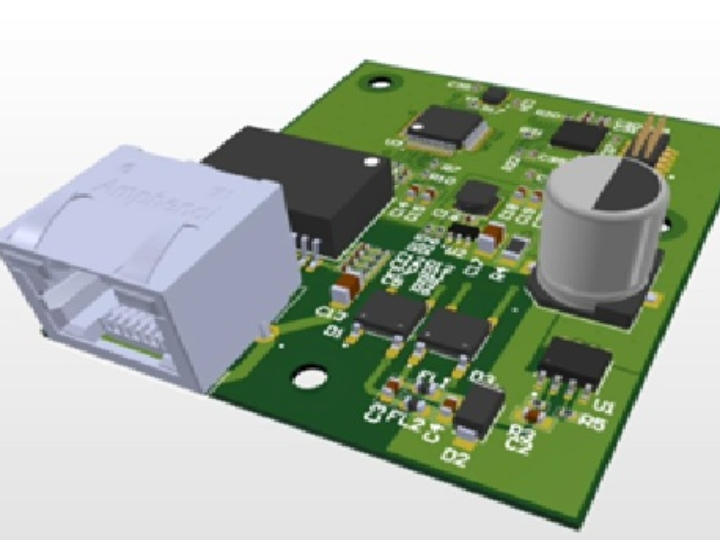
This project implements a PoE-powered infrared sensing platform using the WIZnet W5500 Ethernet controller and Texas Instruments components for industrial Ethernet communication.
The system architecture includes:
- Murata IRS-D200ST00R1 pyroelectric infrared sensor
- Texas Instruments MSPM0L1306 MCU
- WIZnet W5500 Ethernet controller
- Texas Instruments TPS2378 PoE PD controller
- RJ45 Ethernet connectivity
- I2C sensor communication
- IEEE 802.3af / 802.3at PoE compatibility
The W5500 provides:
- Hardwired TCP/IP stack
- Integrated Ethernet MAC + PHY
- 8 hardware sockets
- 32KB internal TX/RX buffer
- SPI interface up to 80MHz
The PoE architecture allows both:
- power delivery
- Ethernet communication
through a single Ethernet cable, simplifying industrial deployment and remote installation.
Step 2: Ethernet Sensor Communication Architecture
The Murata PIR sensor communicates with the MSPM0 MCU through I2C.
The MSPM0 then exchanges Ethernet data using the W5500 controller through SPI communication.
Typical data flow:
- PIR sensor detects motion or thermal changes
- MSPM0 processes sensor data
- W5500 transmits Ethernet packets
- Remote monitoring system receives real-time sensor status
This architecture is well suited for:
- industrial monitoring
- smart buildings
- occupancy detection
- factory automation
- Ethernet-based security systems
- remote sensor networks
Step 3: Why W5500 Fits PoE Sensor Applications
The W5500 is particularly useful in PoE-enabled sensor systems because:
- Ethernet processing is hardware-offloaded
- MCU workload is reduced
- firmware complexity is minimized
- deterministic communication timing is improved
- integration is simpler than software TCP/IP stacks
Unlike lwIP-based MCU Ethernet implementations, the W5500 independently processes:
- TCP
- UDP
- ARP
- ICMP
- socket management
This enables the MSPM0 MCU to focus on sensor acquisition and application logic.
Step 4: Firmware Integration Example
// Conceptual integration example based on WIZnet ioLibrary
// Not project-specific source code

#include "wizchip_conf.h"

uint8_t tx_size[] = {2,2,2,2,2,2,2,2};
uint8_t rx_size[] = {2,2,2,2,2,2,2,2};

void ethernet_init(void)
{
    wizchip_init(tx_size, rx_size);

    wiz_NetInfo netinfo = {
        .mac = {0x00,0x08,0xdc,0x12,0x34,0x56},
        .ip = {192,168,1,50},
        .sn = {255,255,255,0},
        .gw = {192,168,1,1}
    };

    wizchip_setnetinfo(&netinfo);
}
The W5500 communicates with the MCU over SPI while handling Ethernet packet processing internally.
This architecture simplifies firmware development for Ethernet-connected industrial sensors.
FAQ
Q1: Why use W5500 for Ethernet sensor systems?
A: W5500 provides a hardwired TCP/IP stack that reduces MCU overhead and simplifies Ethernet firmware development. This allows the MCU to focus on sensor processing while W5500 independently handles Ethernet communication and socket management.
Q2: Why combine PoE with W5500?
A: PoE simplifies deployment by delivering both power and Ethernet connectivity through a single cable. Combined with W5500, this creates compact industrial sensor nodes that are easier to install and maintain in remote environments.
Q3: How is the W5500 connected to the MCU?
A: The W5500 interfaces with the MSPM0 MCU through SPI communication. The MCU processes PIR sensor data while the W5500 independently manages TCP/IP networking and Ethernet packet transmission.
Q4: What are the advantages of hardwired TCP/IP in industrial sensing?
A: Hardwired TCP/IP improves deterministic timing, reduces firmware complexity, lowers CPU utilization, and increases communication stability. These characteristics are valuable in industrial monitoring and long-term Ethernet sensor deployments.
Q5: What applications fit this architecture?
A: Suitable applications include occupancy monitoring, industrial motion detection, smart building automation, Ethernet-connected alarm systems, environmental sensing, and distributed industrial IoT sensor networks.