


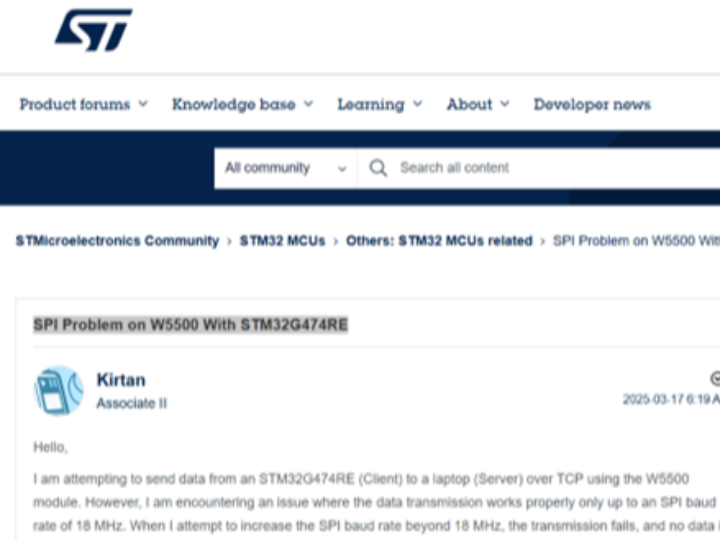
SPI Problem on W5500 With STM32G474RE
Discussion about trouble intergrating W5500 SPI with an STM32G474RE MCU on a Nucleo board but facing troubles due to communication speed.
STmicro - STM32G474RE
x 1

WIZnet - W5500
x 1

🔎 Context & Setup
A community user reported trouble interfacing W5500 SPI with an STM32G474RE MCU on a Nucleo board. The intention was to communicate over SPI from the STM32 to the W5500 to run Ethernet services (e.g., TCP/IP). However, the interface failed above a certain communication speed.
🧪 Symptom of the Problem
- The user observed that data transmission over SPI to the W5500 worked only up to ~18 MHz.
- Above ~18 MHz, the data packets did not reach the W5500 — as if nothing was transmitted.
- Attempts to push SPI baud rates higher caused communication failure without clear error feedback.
The general implication is that the STM32’s SPI master configuration may exceed reliable timing limits for the W5500 at faster SPI clocks on that hardware setup.
🛠 Key Technical Observations & Community Input
Although the thread itself doesn’t show complete fixes, the following practical insights emerge:
👉 SPI Clock Sensitivity
- The W5500 reliably responds at SPI speeds below a certain threshold (around 18 MHz in this case), but higher clocks can break timing, sampling, or signal integrity.
- Differences in how the STM32 sets SPI clock prescalers and how the W5500 latches data on SCK edges could cause this behavior.
👉 CubeMX/HAL Configuration Matters
- The STM32G4 series has advanced clock gating and high-speed peripheral configurations that affect SPI timing and prescalers. Mismatches in SPI mode, phase (CPOL/CPHA), and prescaler can cause partial or no data reception at higher speeds.
- Typical recommendations are to start with lower SPI rates (e.g., 10–18 MHz) that the W5500 reliably supports, then incrementally test higher prescalers.
👉 Different Projects Show Varied Results
Another thread on the ST Community (unrelated to this specific one) also shows users having trouble receiving any valid DHCP + web responses from W5500 on other Nucleo boards — suggesting SPI network stacks may be sensitive to subtle configurations in Cube HAL, clock trees, and pin assignments.
📌 Why This Is Useful for Makers
This thread highlights a real integration challenge that shows up when mixing:
- A modern MCU (STM32G474RE) with
- A hardware Ethernet controller (W5500)
- Over the SPI peripheral
Even if basic register read/write appears functional at lower speeds, raising the clock can silently break communication, likely due to:
- timing mismatches,
- SPI prescaler/clock domain limitations,
- signal integrity or sampling edge misconfiguration.
Understanding these limitations is essential for makers building high-speed Ethernet interfaces without native MAC PHY on MCUs.
📌 Practical Takeaways / Tips
- Start with conservative SPI speeds (≤18 MHz) when interfacing with WIZnet SPI Ethernet parts such as W5500.
- Confirm SPI mode (CPOL/CPHA) — W5500 typically uses Mode 0 (0,0).
- Use logic analyzer or oscilloscopes to verify clock timing and ensure the W5500 samples at proper edges.
- Incrementally raise SPI clock and monitor register read/write success before deploying in a full TCP/IP server scenario.
If communication fails silently above a threshold, reduce SPI speed and retest — this often indicates timing/signal handshake limits on certain MC