



How W55RP20 Can Add Industrial Ethernet Control to an Automated Variac and Stepper System
The original project uses local AVR control, but community members recommended W55RP20 as a practical Ethernet upgrade for remote industrial control.
Introduction
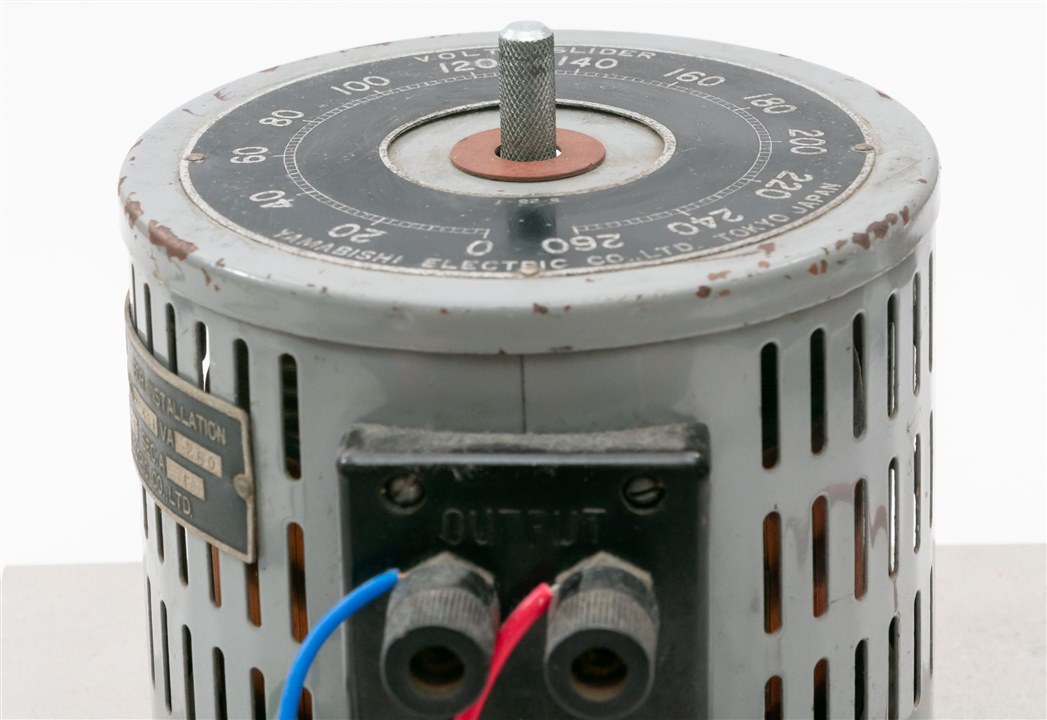
What Is a Variac?
A Variac, also known as a variable autotransformer, is an adjustable AC power supply that allows users to manually increase or decrease output voltage. Unlike fixed transformers, a Variac provides smooth voltage adjustment, making it a valuable tool for:
- Electronics development and testing
- Equipment calibration
- Motor speed control
- Burn-in testing
- Laboratory experiments
- Repair and troubleshooting
Because the output voltage is adjusted by rotating the Variac's shaft, precise motor control is often required when automating the process.
Project Background
This project is Part 5 of the author's element14 Start a Movement design challenge series.
The objective is to automate a laboratory Variac by replacing manual knob adjustment with a stepper motor. The controller precisely rotates the Variac shaft, enabling repeatable voltage adjustments without manual intervention.
The article documents:
- Mechanical mounting
- Stepper motor installation
- Coupling design
- Variac integration
- Motion testing
At this stage, the system operates as a standalone controller and does not include Ethernet or remote networking capabilities.
(Insert original mechanical assembly photos from the thread.)
Original System Architecture
AVR MCU
    │
Stepper Driver
    │
Stepper Motor
    │
 Variac
    │
Adjustable AC OutputCommunity Discussion
One of the most interesting developments occurred in the discussion following the article.
Community member maxpowerr suggested evaluating W55RP20 as a future controller for the project.
While the original author did not implement this recommendation, it introduced a practical direction for expanding the design beyond a standalone laboratory controller into a network-connected automation platform.
The suggestion is technically compelling because W55RP20 integrates:
- RP2040 dual-core MCU
- W5500 Hardwired TCP/IP Ethernet
- Hardware TCP/IP offload
- Compact System-in-Package architecture
This reduces hardware complexity while enabling reliable wired Ethernet connectivity.
Proposed W55RP20 Integration
The following section is a conceptual engineering proposal inspired by the community discussion. It was not implemented in the original project.
Replacing the AVR controller with W55RP20 could enable:
- Ethernet remote control
- Browser-based voltage adjustment
- Modbus TCP
- MQTT
- Remote diagnostics
- SCADA integration
- PLC communication
- Industrial HMI connectivity
Updated architecture:
Remote PC / PLC
       │
 Ethernet
       │
    W55RP20
       │
Stepper Control
       │
Stepper Driver
       │
VariacThe recommendation received positive recognition from the community because W55RP20 combines the RP2040 MCU and W5500 hardwired TCP/IP Ethernet controller into a single package. Although the integration was not implemented by the original author, it presents a practical path for adding industrial networking, remote monitoring, and Ethernet-based control without significantly increasing hardware complexity.
Why W55RP20 Is a Good Fit
The community recommendation is technically well aligned with the project's objectives because W55RP20 provides:
- RP2040 dual-core MCU
- Integrated W5500 Ethernet controller
- Hardwired TCP/IP offload
- Simplified PCB design
- Fewer external components
- Reliable wired Ethernet connectivity
- Lower firmware complexity than software TCP/IP implementations
These characteristics make it a compelling option for evolving the original laboratory prototype into a network-connected industrial controller.