


How to Run Fuzix on W5500-EVB-PICO2 with RP2350
W5500-EVB-PICO2 enables Fuzix on RP2350 with integrated Ethernet hardware, eliminating external W5500 wiring.
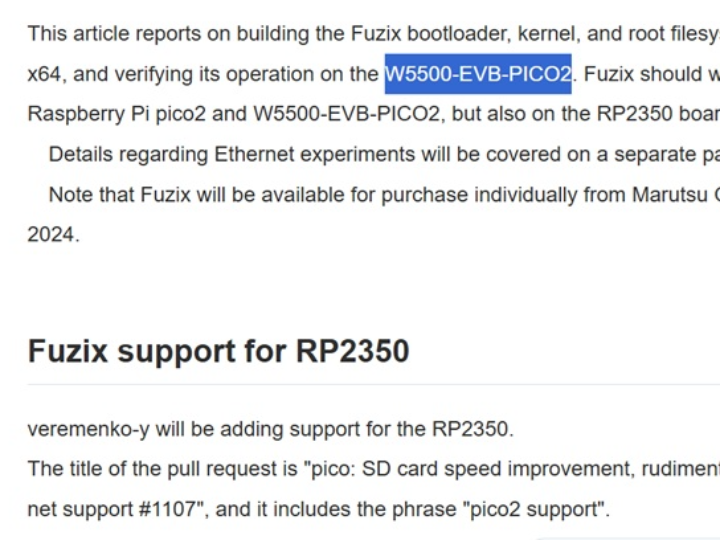
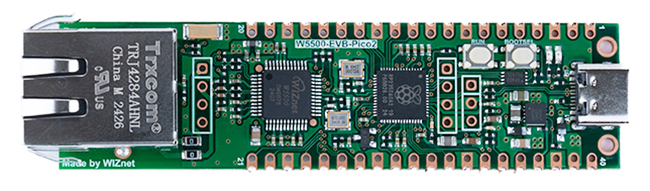
WIZnet - W5500-EVB-Pico2
x 1

EtchedPixels - Fuxiz
x 1
Step 1: Understanding the Hardware
This project demonstrates running the lightweight UNIX-like operating system Fuzix on the W5500-EVB-PICO2 development board.
The platform integrates:
- RP2350 microcontroller
- W5500 Ethernet controller
- On-board SPI connection between RP2350 and W5500
- Ethernet networking capability
- SD card support
- Fuzix UNIX-like operating system environment
Unlike traditional Raspberry Pi Pico Ethernet setups that require external wiring between a Pico board and a W5500 module, the W5500-EVB-PICO2 integrates both devices on a single PCB. This simplifies hardware setup and accelerates Ethernet-enabled embedded Linux-style experimentation.
Key W5500 specifications:
- Hardwired TCP/IP stack
- 10/100 Ethernet MAC + PHY
- SPI interface up to 80MHz
- 8 independent sockets
- 32KB internal TX/RX buffer
These features make the board particularly attractive for lightweight operating systems where MCU resources are limited.
Step 2: Why Fuzix on RP2350?
Fuzix is a UNIX-like operating system originally designed for resource-constrained processors and retro-computing platforms.
The project explores:
- UNIX-style multitasking
- File system operations
- Shell command execution
- Networking on microcontrollers
- Embedded operating system development
The author's objective was to investigate whether RP2350 could provide enough resources to run Fuzix while also supporting Ethernet networking through the integrated W5500 controller.
This is particularly interesting because Fuzix has historically been deployed on:
- Z80 systems
- Z180 systems
- ESP8266 platforms
- Raspberry Pi Pico boards
The RP2350 platform expands Fuzix support into a newer and more capable microcontroller family.
Step 3: Integrated Ethernet Advantage
One of the biggest advantages of W5500-EVB-PICO2 is that Ethernet hardware is already connected internally.
Traditional approach:
RP2350
   │
 SPI Wiring
   │
W5500 Module
   │
 Ethernet
W5500-EVB-PICO2 approach:
RP2350
   │
 On-board SPI
   │
 W5500
   │
 Ethernet
This eliminates:
- jumper wires
- SPI routing mistakes
- signal integrity concerns
- additional hardware assembly
For developers experimenting with Fuzix networking, this significantly reduces setup complexity.
Step 4: Fuzix Build Environment
The article describes building:
- Fuzix bootloader
- Fuzix kernel
- Root filesystem
on Ubuntu 22.04 before deploying to the W5500-EVB-PICO2 board.
Conceptual initialization structure:
// Conceptual example based on WIZnet ioLibrary
// Not project-specific source code

uint8_t tx_size[] = {2,2,2,2,2,2,2,2};
uint8_t rx_size[] = {2,2,2,2,2,2,2,2};

void ethernet_init(void)
{
    wizchip_init(tx_size, rx_size);
}
The actual project uses modifications within the Fuzix networking subsystem and RP2350 platform support layers rather than a standalone application. The article references upstream Fuzix work that added preliminary RP2350 and networking support.
Step 5: Why This Project Matters
This project highlights a unique use case for W5500-EVB-PICO2:
Rather than functioning solely as an embedded Ethernet controller platform, it serves as a complete experimental environment for:
- UNIX-like operating systems
- networking research
- embedded OS development
- retro-computing projects
- educational operating system studies
The integrated W5500 removes much of the networking complexity normally associated with bringing Ethernet to lightweight operating systems running on microcontrollers.
FAQ
Q1: Why use W5500-EVB-PICO2 instead of a standard Pico 2 with an external W5500?
A: W5500-EVB-PICO2 integrates the RP2350 and W5500 on the same board. This eliminates manual SPI wiring, reduces hardware setup complexity, and provides a ready-to-use Ethernet platform for operating system experimentation and embedded networking development.
Q2: What is Fuzix?
A: Fuzix is a lightweight UNIX-like operating system designed for resource-constrained processors and microcontrollers. It provides multitasking, file systems, shell utilities, and networking capabilities while remaining suitable for embedded hardware.
Q3: Why is W5500 useful for Fuzix networking?
A: W5500 provides a hardwired TCP/IP stack that offloads Ethernet processing from the MCU. This reduces software complexity and allows Fuzix developers to add Ethernet functionality without implementing a complete networking stack from scratch.
Q4: What networking capabilities are demonstrated?
A: The follow-up Ethernet article demonstrates network configuration, IP address assignment, telnet connectivity, and file retrieval over Ethernet using the integrated W5500 controller. These tests validate successful network operation under Fuzix.
Q5: Who would benefit from this platform?
A: Developers interested in embedded operating systems, retro-computing, networking experiments, UNIX internals, educational projects, and Ethernet-enabled microcontroller systems can all benefit from the W5500-EVB-PICO2 platform.