


How to Implement OpenPLC on STM32 with W5500 Ethernet and Modbus TCP
OpenPLC natively supports W5100 and W5500 Ethernet controllers, enabling Modbus TCP on STM32 using the Arduino Ethernet API.

Espressif - ENC28J60
x 1
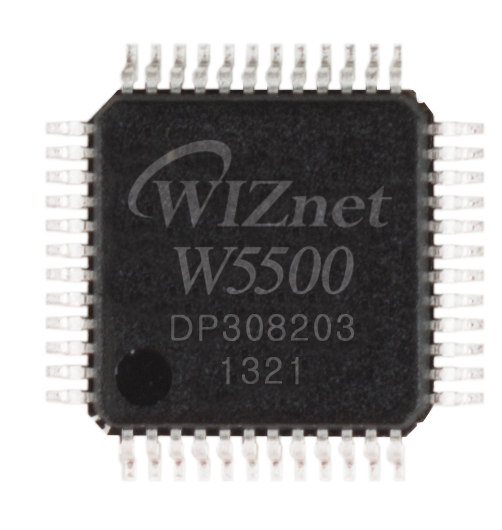
WIZnet - W5500
x 1

Step 1: Understanding the Hardware
This discussion explores implementing OpenPLC Runtime on an STM32 microcontroller with Ethernet connectivity for Modbus TCP communication.
The developer considered using either:
- WIZnet W5500
- WIZnet W5100
- ENC28J60
However, the OpenPLC project maintainer confirmed that the current runtime already supports W5100 and W5500, while ENC28J60 would require a custom Ethernet driver.
Typical hardware includes:
- STM32 microcontroller
- W5500 Ethernet controller
- SPI interface
- OpenPLC Runtime
- Modbus TCP communication
The W5500 provides:
- Hardwired TCP/IP stack
- Integrated Ethernet MAC + PHY
- 8 independent hardware sockets
- 32 KB internal TX/RX buffer
- SPI interface up to 80 MHz
Using the W5500 allows developers to add industrial Ethernet networking without implementing a software TCP/IP stack.
Step 2: Native W5500 Support in OpenPLC
One of the most valuable insights from this discussion is that OpenPLC Runtime already includes support for WIZnet Ethernet hardware.
According to the OpenPLC maintainer:
- Modbus TCP can be enabled directly from the upload dialog.
- The runtime supports W5100 and W5500.
- Ethernet communication uses the Arduino Ethernet libraries.
- Hardware wiring follows the same approach as a standard Arduino Ethernet Shield.
This means developers can focus on PLC logic rather than low-level Ethernet driver development.
Step 3: System Architecture
The communication architecture is straightforward:
OpenPLC Runtime
        │
   Arduino Ethernet API
        │
        ▼
      W5500
        │ SPI
        ▼
      STM32 MCU
        │
    PLC Logic
        │
        ▼
  Modbus TCP Clients
The W5500 handles:
- TCP/IP processing
- Socket management
- ARP
- ICMP
- UDP
- TCP communication
Meanwhile, the STM32 executes ladder logic and application-specific PLC tasks.
This separation simplifies firmware development and helps maintain deterministic PLC execution.
Step 4: Firmware Integration
OpenPLC leverages the Arduino Ethernet API, so developers do not need to create a custom Ethernet stack for the W5500.
Conceptual initialization:
// Conceptual example based on WIZnet ioLibrary
// Not project-specific source code

uint8_t tx_size[] = {2,2,2,2,2,2,2,2};
uint8_t rx_size[] = {2,2,2,2,2,2,2,2};

void ethernet_init(void)
{
    wizchip_init(tx_size, rx_size);

    wiz_NetInfo netinfo = {
        .ip = {192,168,1,100},
        .sn = {255,255,255,0},
        .gw = {192,168,1,1}
    };

    wizchip_setnetinfo(&netinfo);
}
Conceptual integration example based on WIZnet ioLibrary (not project-specific).
The OpenPLC maintainer also notes that developers can reference the Arduino examples included with the OpenPLC editor when adapting the runtime for supported hardware.
Step 5: Industrial Applications
Combining STM32, W5500, and OpenPLC creates a compact and cost-effective industrial controller suitable for:
- PLC-based machine control
- Factory automation
- Modbus TCP remote I/O
- Industrial gateways
- Building automation
- Process control
- Educational PLC platforms
Because the W5500 offloads Ethernet communication in hardware, the STM32 can dedicate more processing time to real-time PLC execution.
FAQ
Q1: Why use W5500 with OpenPLC?
A: W5500 is officially supported by the OpenPLC runtime and provides a hardwired TCP/IP stack. This reduces software complexity and allows developers to implement Modbus TCP without writing a custom Ethernet driver.
Q2: Does OpenPLC support ENC28J60?
A: Not natively. According to the OpenPLC maintainer, developers would need to implement their own driver for ENC28J60, whereas W5100 and W5500 are already supported by the runtime.
Q3: How is the W5500 connected to STM32?
A: The W5500 connects via SPI and is accessed using the Arduino Ethernet API. OpenPLC uses this API, so wiring follows the same approach as an Arduino Ethernet Shield.
Q4: What advantages does W5500 provide for PLC applications?
A: The W5500 offloads TCP/IP processing, manages eight hardware sockets, and integrates the Ethernet MAC and PHY. This reduces MCU workload and improves communication reliability in industrial Ethernet applications.
Q5: What applications are suitable for this architecture?
A: Typical applications include industrial control systems, Modbus TCP gateways, educational PLC projects, machine automation, distributed I/O controllers, and Ethernet-enabled process monitoring.