


How to Connect an EM540 Energy Meter to VenusOS Cerbo GX with W5500
Custom W5500-based Modbus TCP client enables EM540 energy meter integration with Victron Cerbo GX and VenusOS.
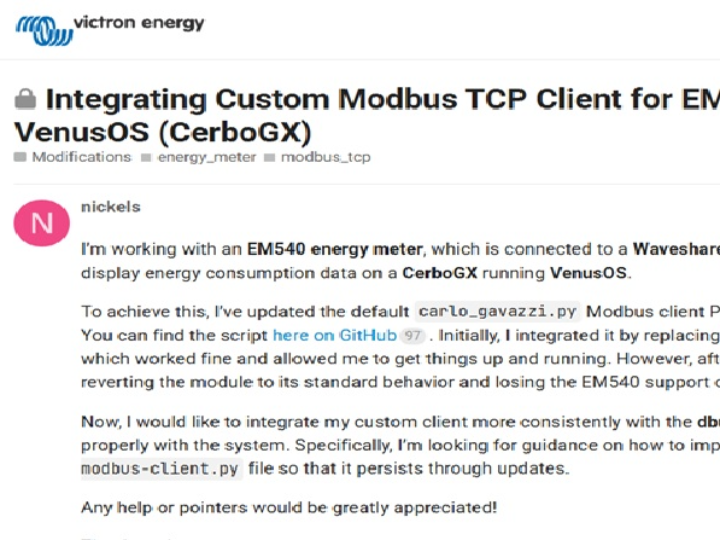
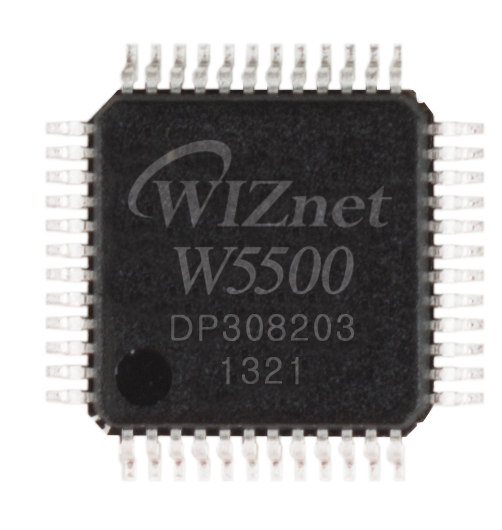
WIZnet - W5500
x 1

Step 1: Understanding the System
This project integrates a Carlo Gavazzi EM540 three-phase energy meter with Victron's Cerbo GX running VenusOS.
The architecture consists of:
- EM540 energy meter
- Microcontroller-based gateway
- WIZnet W5500 Ethernet controller
- Modbus TCP communication
- Victron Cerbo GX
- VenusOS monitoring environment
The goal is to expose power measurements from the EM540 to the Victron ecosystem without requiring additional proprietary hardware.
The W5500 provides:
- Hardwired TCP/IP stack
- Integrated MAC + PHY
- 8 hardware sockets
- 32 KB internal buffer
- SPI interface up to 80 MHz
This allows the MCU to focus on Modbus register handling while Ethernet communication is offloaded to dedicated hardware.
Step 2: Modbus TCP Communication Architecture
The communication flow is:
EM540 Energy Meter
        │
  Modbus Registers
        │
        ▼
     MCU Logic
        │ SPI
        ▼
      W5500
        │ Ethernet
        ▼
  Victron Cerbo GX
        │
      VenusOS
The gateway periodically acquires measurements including:
- Voltage
- Current
- Frequency
- Active power
- Energy consumption
and publishes them through Modbus TCP so that Cerbo GX can recognize the device as an energy source.
This architecture allows existing industrial meters to participate in the Victron energy ecosystem.
Step 3: Why W5500 Fits Energy Monitoring Applications
Energy monitoring systems require:
- High uptime
- Reliable communication
- Low CPU overhead
- Stable Ethernet connectivity
Unlike software TCP/IP stacks, the W5500 handles:
- TCP
- UDP
- ARP
- ICMP
- Socket management
internally.
This reduces firmware complexity and allows the application firmware to concentrate on:
- Modbus register mapping
- Data acquisition
- Measurement conversion
- System diagnostics
making it suitable for continuously operating power systems.
Step 4: Firmware Integration
The implementation uses Modbus TCP communication over Ethernet.
// Conceptual example based on WIZnet ioLibrary
// Not project-specific source code

uint8_t tx_size[] = {2,2,2,2,2,2,2,2};
uint8_t rx_size[] = {2,2,2,2,2,2,2,2};

void ethernet_init(void)
{
    wizchip_init(tx_size, rx_size);

    wiz_NetInfo netinfo = {
        .ip = {192,168,1,100},
        .sn = {255,255,255,0},
        .gw = {192,168,1,1}
    };

    wizchip_setnetinfo(&netinfo);
}
The application layer then polls EM540 registers and makes the measurements available to VenusOS through Modbus TCP.
Conceptual integration example based on WIZnet ioLibrary (not project-specific).
Step 5: Applications
This architecture is suitable for:
- Solar energy systems
- Battery storage systems
- Smart grid monitoring
- Industrial power measurement
- EV charging infrastructure
- Home energy management
- Remote power monitoring
By combining Modbus TCP with W5500 Ethernet, developers can build custom gateways that seamlessly integrate third-party power meters into Victron ecosystems.
FAQ
Q1: Why use W5500 for a Modbus TCP gateway?
A: W5500 provides a hardwired TCP/IP stack that simplifies Ethernet implementation and reduces MCU overhead. This improves reliability and makes continuous energy monitoring applications easier to maintain.
Q2: What advantages does Modbus TCP offer over serial communication?
A: Modbus TCP enables Ethernet-based monitoring, remote access, and easier integration with energy management systems such as Victron VenusOS while maintaining compatibility with industrial devices.
Q3: What applications can benefit from this architecture?
A: Typical applications include solar systems, battery energy storage, industrial metering, EV charging, smart buildings, and remote monitoring systems.