


Building "The Hammer": A 1W LoRa Mesh Radio with WIZ850io Ethernet and PoE
The Hammer combines a 1W LoRa radio, W5500 Ethernet, PoE, and GPS to create a rugged Meshtastic-compatible mesh communication platform.
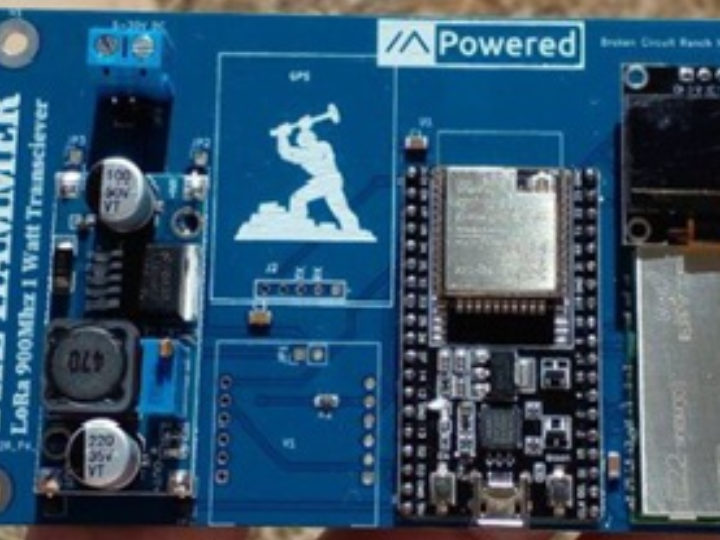
Ebyte - E22-900
x 1
Ebyte - Ebyte E22-400M30S
x 1
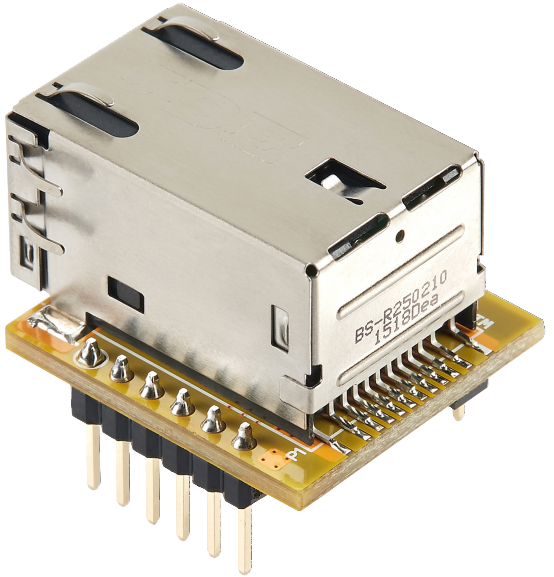
WIZnet - WIZ850io
x 1

What Is "The Hammer"?
"The Hammer" is an open-source 1-watt LoRa mesh radio developed for permanent infrastructure deployments rather than portable battery-powered nodes. While many Meshtastic devices emphasize mobility, this project targets installations such as rooftops, towers, gateways, and industrial monitoring stations where continuous power and reliable Ethernet connectivity are essential.
To achieve this, the design combines an ESP32 microcontroller, a high-power LoRa transceiver, GPS, Power over Ethernet (PoE), and a WIZnet Ethernet module into a compact, rugged communication platform.
(Insert original overview photos from the Hackaday project.)
Project Background
The project was created to address a common limitation of existing Meshtastic hardware: the lack of native Ethernet and PoE support for fixed installations.
Instead of relying solely on wireless backhaul and batteries, the author designed a node that can receive both power and network connectivity over a single Ethernet cable. This makes the platform well suited for:
- Permanent mesh gateways
- Remote telemetry
- Smart agriculture
- Industrial IoT
- Emergency communication infrastructure
- Community mesh networks
The design supports both Meshtastic and MeshCore firmware, providing flexibility for different mesh networking ecosystems.
Hardware Overview
The Hammer integrates several key components:
- ESP32 microcontroller
- Modified WIZ850io Ethernet module (based on the W5500 hardwired TCP/IP controller)
- IEEE 802.3af PoE
- Ebyte E22-400M30S 1 W LoRa module (SX1268-based, SPI interface)
- GPS receiver
- External high-gain antenna
Although the schematic labels the Ethernet footprint as WIZ820io, the assembled hardware and project documentation indicate that a modified WIZ850io is used. This is possible because the WIZ850io is hardware-compatible with the WIZ820io footprint while replacing the W5200 with the newer W5500 Ethernet controller.
(Insert original PCB and assembled board photos from the Hackaday project.)
System Architecture
             Ethernet / PoE
                    │
                    ▼
      Modified WIZ850io (W5500)
                    │ SPI
                    ▼
                 ESP32
            ┌──────────────┐
            │              │
         GPS Receiver   Ebyte E22-400M30S
                           │
                     1W LoRa Mesh
The WIZ850io provides reliable wired Ethernet while the ESP32 manages the mesh networking stack and application logic. The E22-400M30S extends communication over long distances using the LoRa physical layer.
Why WIZ850io Is a Good Fit
Using the WIZ850io simplifies the networking portion of the design by offloading TCP/IP processing to the W5500 hardware engine. This allows the ESP32 to focus on LoRa communication, routing, and application tasks.
Benefits include:
- Hardwired TCP/IP offload
- Integrated MAC and PHY
- Eight independent hardware sockets
- Stable wired Ethernet backhaul
- Reduced ESP32 networking overhead
- Reliable PoE-powered infrastructure deployment
Unlike portable LoRa devices, this architecture enables continuous operation in demanding outdoor and industrial environments.
Why the E22-400M30S Was Chosen
The project employs an Ebyte E22-400M30S, a 1 W LoRa transceiver based on the Semtech SX1268 operating in the 400 MHz band.
Its combination of high transmit power and SPI interface makes it well suited for infrastructure nodes requiring:
- Extended communication range
- Improved link reliability
- Better penetration through vegetation and buildings
- Long-distance mesh networking
When paired with Ethernet backhaul, the design bridges long-range wireless communication with reliable wired networking.
Applications
This architecture is suitable for:
- Meshtastic gateway nodes
- Industrial telemetry
- Smart agriculture
- Environmental monitoring
- Utility infrastructure
- Emergency communication systems
- Campus-wide sensor networks
- Remote monitoring stations
Conceptual Firmware Example
// Conceptual example using WIZnet ioLibrary
// Not from the original project

wizchip_init(tx_size, rx_size);

wiz_NetInfo netinfo = {
    .ip = {192,168,1,100},
    .sn = {255,255,255,0},
    .gw = {192,168,1,1}
};

wizchip_setnetinfo(&netinfo);

// ESP32 continues handling LoRa and application tasks
FAQ
Q1: Which WIZnet product is used in the project?
A: The assembled hardware uses a modified WIZ850io, which integrates the W5500 hardwired TCP/IP Ethernet controller. Although the schematic footprint is labeled "WIZ820io," the project documentation and hardware indicate a W5500-based implementation.
Q2: Why is the schematic labeled WIZ820io?
A: The WIZ850io was designed to be hardware-compatible with the WIZ820io footprint. Developers can therefore use the same connector layout while upgrading from the W5200 to the W5500.
Q3: Which LoRa module is used?
A: The project uses an Ebyte E22-400M30S, a 1 W SPI LoRa module based on the Semtech SX1268 operating in the 400 MHz band.
Q4: Why combine Ethernet with LoRa?
A: LoRa provides long-range wireless communication between mesh nodes, while Ethernet offers reliable backhaul, remote management, and PoE for always-on infrastructure deployments.
Q5: What makes this design different from typical Meshtastic devices?
A: Unlike battery-powered portable nodes, The Hammer is designed as a fixed infrastructure platform, combining 1 W LoRa, GPS, PoE, and WIZnet Ethernet for continuous operation in industrial and outdoor environments.