


ESP32-S3 Dual Interface Network Example
The project focuses on dual-interface coexistence, showing how the ESP32-S3 can initialize and manage both interfaces at the same time.
Espressif - ESP32-S3
x 1
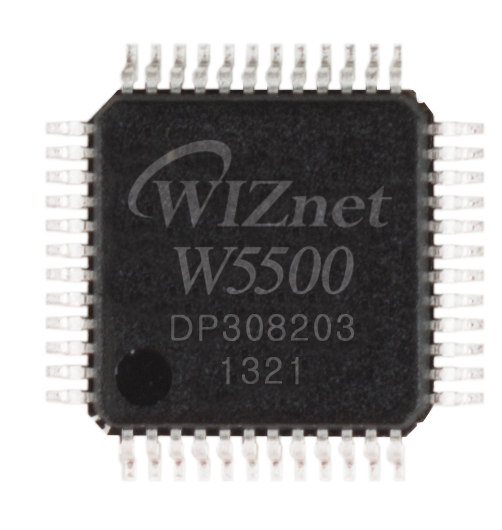
WIZnet - W5500
x 1

✨ Project Description
This project demonstrates how an ESP32-S3 can be configured to operate with both Wi-Fi and Ethernet network interfaces enabled simultaneously.
The example focuses on network interface coexistence, showing that an ESP32-S3 device does not need to choose between wired and wireless connectivity. Instead, both interfaces can be initialized and managed within the same firmware.
This project is presented as a reference example, not a complete application.
🧠 Motivation
In many embedded designs, Ethernet and Wi-Fi are treated as mutually exclusive options. This example challenges that assumption by showing a multi-interface networking model, where:
- Wi-Fi and Ethernet can coexist
- Network flexibility is increased
- Application logic is decoupled from transport choice
This approach is useful for modern embedded and edge devices that require resilience, flexibility, or multiple access paths.
🧩 Hardware Environment
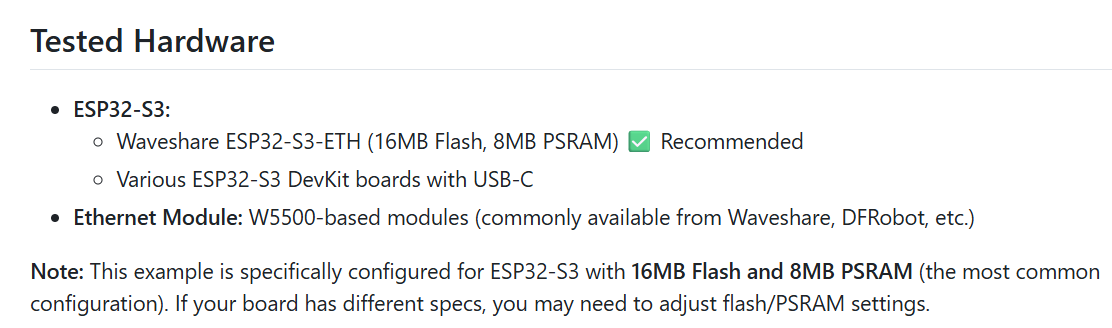
💻 Software Environment
ESP-IDF framework
- ESP32-S3 networking stack
- Multiple network interfaces enabled in the same application
The example focuses on:
- Network interface initialization
- Interface coexistence
- Runtime network configuration
It does not include application-layer protocols such as HTTP, MQTT, or cloud services.
⚙️ Key Features
✅ Dual Interface Support: WiFi and Ethernet work simultaneously
✅ Automatic Failover: Prefers Ethernet when available, falls back to WiFi
✅ Non-blocking Connection: Both interfaces connect asynchronously
✅ Clean API: Simple functions to check status and get IP addresses
✅ Production Ready: Proper error handling and logging
✅ Fully Documented: Every configuration option explained
🛠️ What This Project Demonstrates
- How ESP32-S3 handles multiple active network interfaces
- How W5500 can be introduced without removing Wi-Fi support
- A reusable architectural pattern for dual-interface embedded systems
- How ESP-IDF abstracts network interfaces at a system level
For WIZnet users, this example helps clarify where SPI-based Ethernet devices fit within ESP32 designs that already include Wi-Fi.
🎯 Use Cases
- Hybrid Ethernet + Wi-Fi embedded devices
- Ethernet-first edge devices with wireless configuration
- Prototyping dual-network designs on ESP32-S3
- Reference for ESP32-S3 + W5500 integration projects
📌 Summary
This project provides a clear example of dual-interface networking on ESP32-S3 and W5500, showing how Wi-Fi and Ethernet can coexist within a single embedded system. Its value lies in demonstrating a flexible network architecture rather than a specific hardware or protocol implementation.