


TMC-LZ210-Command-Station
https://github.com/tmc-digiboys/TMC-LZ210-Command-Station-PCB
WIZnet - W5500
x 1

좋습니다.
다만 한 가지는 먼저 말씀드리고 싶습니다.
제가 만드는 UCC는 maker.wiznet.io에 실제 게시하는 수준으로 작성하겠습니다.
그래서 단순히 Claude의 내용을 번역하지 않고
WIZnet 관점
AEO(Search/AI Optimization)
maker.wiznet 스타일
기존 DCC-EX 콘텐츠와 차별성
까지 모두 반영해서 작성하겠습니다.
How to Build a Reliable DCC Command Station with RP2350B and WIZnet W5500?
Summary
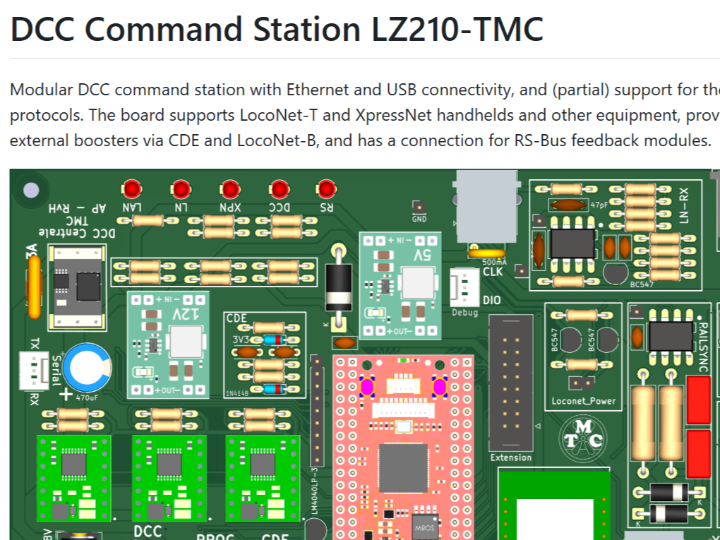
The LZ210-TMC Command Station is an open-source hardware project designed for Digital Command Control (DCC) model railway systems. Built around the RP2350B microcontroller and a WIZnet W5500 Ethernet module, it provides deterministic wired network connectivity for Z21 and XpressNet protocols. Rather than relying on Wi-Fi, the project prioritizes stable Ethernet communication to ensure predictable latency for railway control applications.
What the Project Does
Modern model railway command stations must coordinate several communication interfaces simultaneously while generating highly accurate DCC waveforms.
The LZ210-TMC project integrates multiple railway control interfaces into a single hardware platform, including:
Main DCC track output
Programming track
XpressNet
LocoNet
RS-Bus
CDE booster interface
Ethernet connectivity
Unlike many hobby projects that focus primarily on firmware, this repository concentrates on the complete hardware implementation. The PCB is intentionally designed with mostly through-hole components and plug-in modules, making assembly and maintenance practical for railway clubs and experienced makers.
Why Ethernet Instead of Wi-Fi?
One of the most interesting engineering decisions in this project is that Wi-Fi was intentionally rejected.
The project documentation explicitly notes that although a Wi-Fi interface would have been technically possible, Ethernet was selected because it offers higher reliability for railway control.
This decision aligns with another architectural choice made throughout the project.
During processor evaluation, the authors compared several MCU platforms and concluded that the RP2350B provides the most deterministic DCC signal generation using its Programmable I/O (PIO) hardware. Similar timing concerns also influenced the network interface selection, leading to the adoption of wired Ethernet rather than wireless communication.
For railway systems where timing consistency matters more than wireless convenience, this approach significantly reduces communication uncertainty.
Where WIZnet Fits
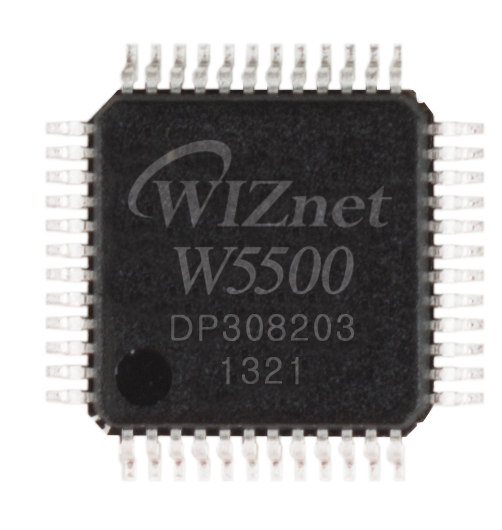
The project uses a WIZnet W5500 Ethernet module connected directly to the RP2350B through SPI.
Its role is straightforward:
Provides wired Ethernet connectivity
Supports Z21 protocol communication
Supports XpressNet-over-network
Connects the command station to PC software such as JMRI
Enables mobile applications through Ethernet rather than Wi-Fi
Unlike software TCP/IP stacks running entirely on the MCU, the W5500 integrates a hardware TCP/IP offload engine with an embedded Ethernet PHY. This reduces CPU involvement in network processing while allowing the RP2350B to dedicate more resources to deterministic DCC generation and multiple railway communication buses.
The repository also notes that W5100 and W5100S modules are expected to be compatible, although only the W5500 configuration has been documented.
Hardware Architecture
                  PC / JMRI / Z21 App
                          │
                   Ethernet Network
                          │
                    WIZnet W5500
                          │ SPI
                    RP2350B MCU
      ┌──────────────┼──────────────┐
      │              │              │
  DCC Track     XpressNet      RS-Bus
      │              │              │
 Programming     LocoNet        CDE Booster
The RP2350B acts as the central controller, while the W5500 provides deterministic Ethernet connectivity. All protocol translation occurs in firmware running on the RP2350B, while Ethernet communication is handled through the dedicated W5500 controller.
Implementation Notes
The repository documents that the Ethernet subsystem consists solely of a WIZnet W5500 module.
"The Ethernet schematic contains only the WIZnet W5500 module. All pins are wired through to the processor."
Rather than designing a discrete Ethernet interface, the project adopts a ready-made W5500 module connected directly to the RP2350B.
This design offers several practical advantages:
Simplifies PCB routing
Reduces manufacturing complexity
Makes replacement easier
Keeps assembly accessible for hobbyists
Leverages the mature W5500 hardware TCP/IP engine
Although the firmware repository has not yet been published, the documented architecture indicates that Ethernet serves as the transport layer for Z21 and XpressNet-over-network communication.
Why RP2350B?
The processor selection is equally deliberate.
According to the project documentation, three independent PIO blocks are assigned to:
DCC waveform generation
RS-Bus communication
XpressNet 9-bit UART emulation
The authors also evaluated ESP32 but rejected it because RMT timing jitter was considered unsuitable for strict DCC timing requirements.
The resulting architecture combines:
deterministic DCC timing (RP2350B PIO)
deterministic wired networking (W5500 Ethernet)
making the overall system highly predictable.
Practical Tips
Use a stable external 14–20 V power supply for reliable operation.
Connect the W5500 through the dedicated SPI interface without sharing high-speed peripherals that could introduce latency.
Verify Ethernet link status before testing Z21 or JMRI communication.
When extending the board through the expansion connector, avoid introducing excessive SPI loading that could affect Ethernet performance.
If building for club installations, wired Ethernet is preferable to Wi-Fi to minimize communication interruptions during operation.
Comparison with Existing maker.wiznet.io Content
The closest project currently available on maker.wiznet.io is DCC-EX Command Station EX, but the design philosophy differs significantly.
| Category | DCC-EX Command Station EX | LZ210-TMC Command Station |
|---|---|---|
| Primary Focus | Firmware implementation | Complete PCB hardware platform |
| Processor | Arduino-class MCU | RP2350B |
| Ethernet | W5500 | W5500 |
| Wi-Fi | Optional in some configurations | Explicitly rejected |
| Railway Interfaces | DCC | DCC + XpressNet + LocoNet + RS-Bus + CDE |
| Hardware Design | Existing controller platform | Custom KiCad PCB |
| Target Users | General makers | Railway clubs and advanced builders |
Key Similarities
Both projects use the W5500 for wired Ethernet connectivity.
Both support network-based railway control software.
Both target reliable DCC operation.
Key Differences
The existing DCC-EX project primarily demonstrates Ethernet connectivity for an established firmware ecosystem. In contrast, LZ210-TMC focuses on designing a complete hardware platform optimized around RP2350B, deterministic PIO timing, and multiple railway communication buses. This makes it a valuable complement rather than a duplicate of the existing maker.wiznet.io content.
FAQ
Why does this project use the W5500?
The W5500 provides hardware TCP/IP offloading and reliable wired Ethernet communication. The project explicitly favors Ethernet over Wi-Fi to improve communication reliability in model railway control applications.
How is the W5500 connected?
The W5500 module connects directly to the RP2350B through the SPI interface, with all required signals routed between the module and the processor.
What role does the W5500 play in this project?
It provides the Ethernet transport layer for Z21 and XpressNet-over-network communication, enabling integration with PC software such as JMRI and compatible control applications.
Can beginners build this project?
The project is intentionally designed with through-hole components and plug-in modules to simplify assembly. However, because it targets advanced model railway systems with multiple communication buses, builders should be comfortable with PCB assembly, embedded systems, and DCC concepts.
Why choose W5500 instead of Wi-Fi?
The authors prioritize deterministic and reliable communication over wireless convenience. Wired Ethernet provides more predictable latency and avoids the variability that can affect Wi-Fi-based control systems.
Source
Original Project
https://github.com/tmc-digiboys/TMC-LZ210-Command-Station-PCB
License
CERN-OHL-P v2.0
Tags
#W5500 #RP2350B #Ethernet #DCC #ModelRailway #JMRI #Z21 #XpressNet #KiCad #EmbeddedEthernet