


streamline blade ethernet
W5500 streamline ethernet
WIZnet - W5500
x 1

How to Add Ethernet to Any MCU with the Streamline SPI-Ethernet Blade?
Summary
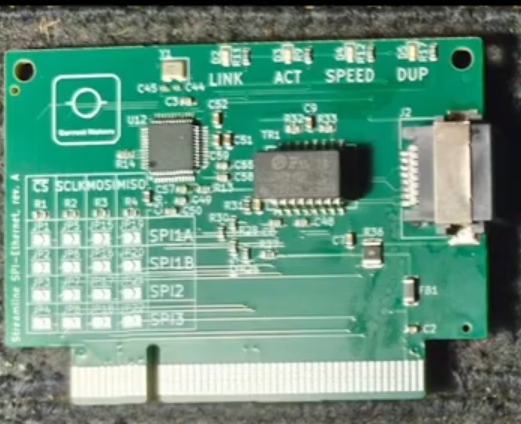
The Streamline SPI-Ethernet Blade extends the CurrentMakers Streamline modular platform with wired Ethernet connectivity using the WIZnet W5500. Rather than requiring an MCU with a native Ethernet MAC, the blade connects through the Streamline backplane over SPI, allowing a wide range of MCU blades to share the same Ethernet hardware. By offloading the TCP/IP stack into the W5500, the platform reduces firmware complexity while providing a reusable networking module across multiple processor families.
What the Project Does
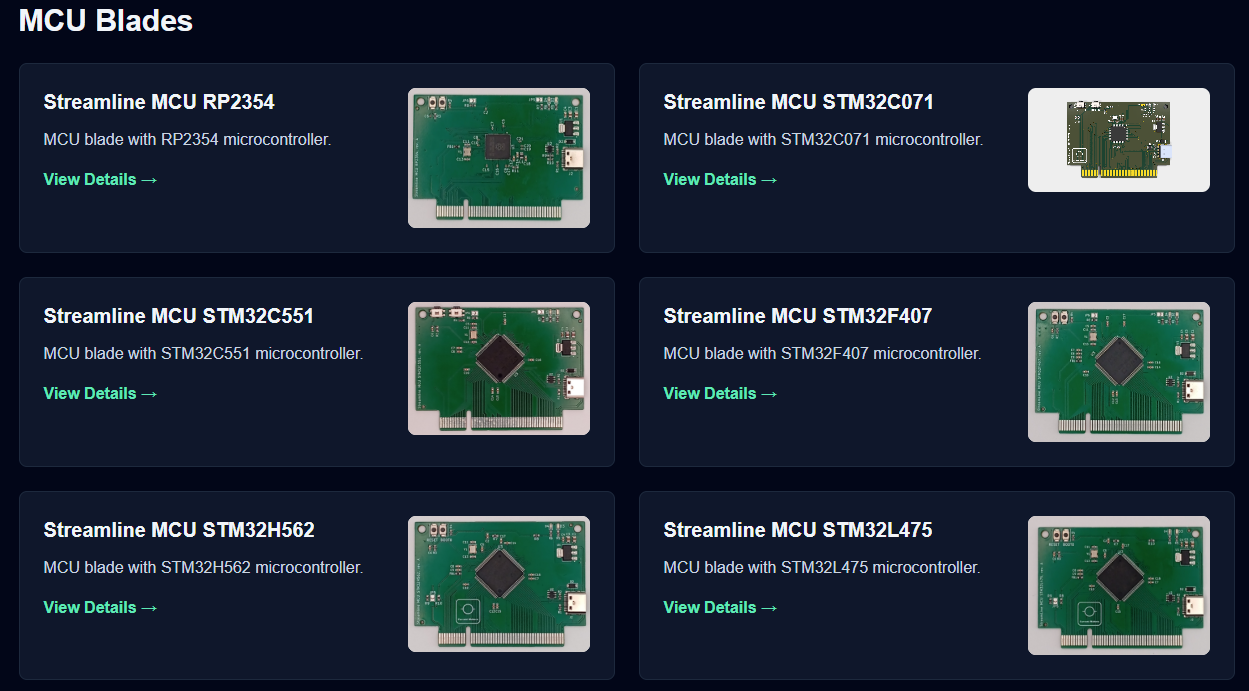
The Streamline platform is a modular embedded development system built around a passive backplane. Individual "Blade" boards provide different functions, such as MCU processing, storage, communication interfaces, or peripheral expansion. Instead of designing a dedicated PCB for every project, developers can combine blades to create different hardware configurations.
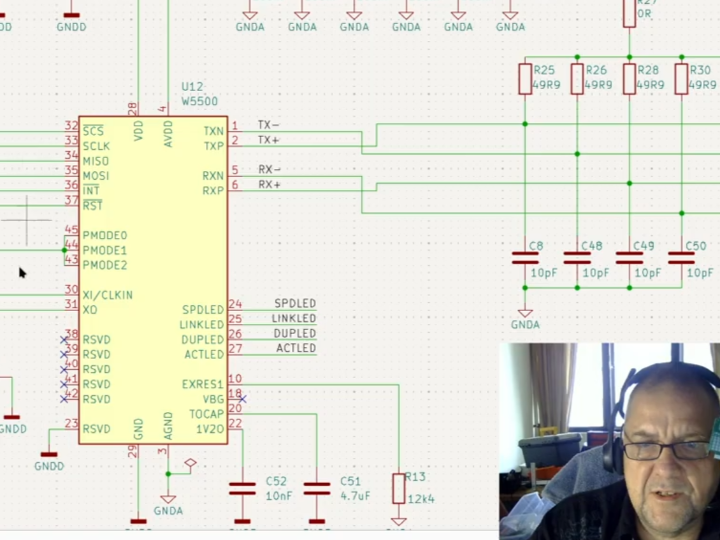
The Streamline SPI-Ethernet Blade adds wired Ethernet capability to this ecosystem. It contains a WIZnet W5500 Ethernet controller, an integrated RJ45 interface with Ethernet magnetics, and a Streamline edge connector that interfaces directly with the backplane.
Unlike a standalone Ethernet module, the SPI-Ethernet Blade relies on an MCU Blade to execute the application. Communication between the MCU and the W5500 takes place over the shared SPI bus, while the Ethernet controller handles network transport independently.
The result is a modular architecture where the same Ethernet hardware can be reused with multiple MCU boards without redesigning the networking subsystem.
Where WIZnet Fits
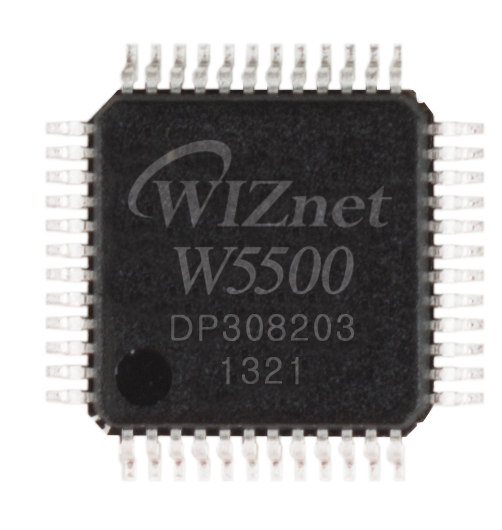
The Streamline SPI-Ethernet Blade is built around the WIZnet W5500, which functions as the platform's dedicated Ethernet controller.
Within the Streamline architecture, the W5500 provides:
Hardware TCP/IP processing
Integrated 10/100 Ethernet MAC and PHY
Eight independent hardware sockets
Internal packet buffering
SPI interface to the host MCU
This architecture allows almost any MCU equipped with an SPI peripheral to gain Ethernet capability without requiring an integrated Ethernet MAC or external software TCP/IP stack.
This approach is particularly attractive for compact MCU platforms with limited Flash and RAM resources. Instead of allocating memory and CPU cycles to a software stack such as LwIP, the application communicates with the W5500 through socket registers while the controller manages packet transmission, acknowledgements, retransmissions, ARP, and checksum processing internally.
Within the Streamline ecosystem, the same SPI-Ethernet Blade can therefore be paired with different MCU Blades, including STM32 devices without Ethernet peripherals or other SPI-capable microcontrollers, making the networking hardware reusable across multiple projects.
Implementation Notes
At the time of writing, the Streamline SPI-Ethernet page primarily documents the hardware architecture and board design. Public firmware examples or W5500 driver integration are not yet available.
The hardware consists of three primary building blocks:
MCU Blade
     │
     │ SPI
     ▼
┌─────────────────────────┐
│ Streamline SPI-Ethernet │
│                         │
│      WIZnet W5500       │
│ Hardware TCP/IP Engine  │
│ 10/100 MAC + PHY        │
└──────────┬──────────────┘
           │
        RJ45 Ethernet
One notable design choice throughout the Streamline platform is the use of PCI Express edge connectors as a mechanical interface rather than a PCIe communication interface.
Instead of implementing PCI Express signaling, the connector simply distributes power and embedded interfaces such as SPI, UART, GPIO, CAN, and other control signals across the passive backplane. This provides several practical hardware advantages:
SMT-compatible connectors suitable for automated assembly
Improved mechanical rigidity compared to long pin headers
Easier blade insertion and replacement
A common interconnect shared by multiple expansion boards
This modular approach allows developers to exchange communication blades without modifying the MCU hardware, making Ethernet another interchangeable subsystem within the Streamline ecosystem.
Because no publicly available firmware repository currently demonstrates W5500 initialization or application software for this board, no implementation code is included here. The current documentation supports an architecture-level analysis rather than firmware-level discussion.
Comparison with Similar UCCs
| Platform | How W5500 is Integrated | Similarity to Streamline | Key Differentiator |
|---|---|---|---|
MIKROE ETH WIZ Click 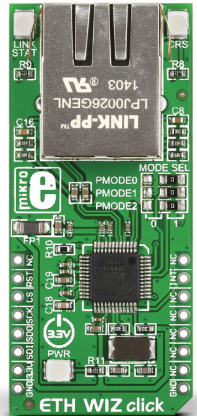 | W5500-based Ethernet Click Board for the mikroBUS™ ecosystem | Integrates W5500 as a standard Ethernet module within a third-party hardware platform | Designed as a single expansion module for one host board, whereas Streamline uses a passive backplane with interchangeable Blades that can operate together in one system. |
SparkFun MicroMod Ethernet Function Board 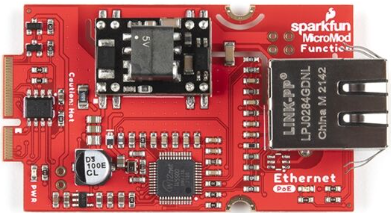 | W5500-based Ethernet Function Board for the SparkFun MicroMod ecosystem | Adds Ethernet connectivity to a modular hardware platform using W5500 | MicroMod follows a Processor Board + Carrier Board architecture, while Streamline adopts a Backplane + Blade architecture for greater modularity and scalability. |
Adafruit WIZ5500 Ethernet Co-Processor Breakout 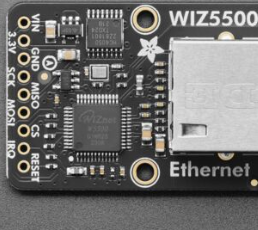 | W5500 breakout board for Adafruit development boards via SPI | Provides Ethernet as a reusable hardware module for an existing ecosystem | A generic breakout requiring manual wiring, whereas Streamline offers a dedicated plug-in Ethernet Blade integrated into the platform. |
Arduino Ethernet Shield 2 (W5500) 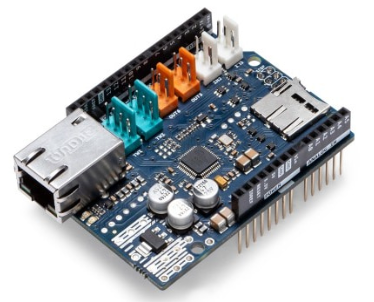 | Arduino Shield providing Ethernet connectivity through W5500 | Expands an established third-party hardware platform with W5500 | Limited to the Arduino Shield form factor, while Streamline allows the MCU Blade itself to be replaced or upgraded without changing the Ethernet module. |
Seeed Studio W5500 Ethernet Shield 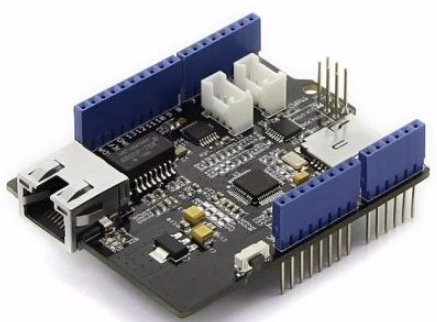 | W5500 Ethernet Shield for the Arduino/Grove ecosystem | Uses W5500 to extend an existing maker platform | Primarily focused on Grove/Arduino expansion, whereas Streamline is designed as a modular embedded hardware platform with interchangeable functional Blades. |
| CurrentMakers Streamline SPI-Ethernet Blade | Dedicated Ethernet Blade integrating the W5500 into the Streamline modular backplane | — | Functions as a shared network resource within a modular hardware ecosystem, enabling multiple MCU Blades to reuse the same Ethernet interface through a passive backplane. |
Practical Tips / Pitfalls
Verify SPI signal routing and chip-select assignment when multiple SPI peripherals share the Streamline backplane.
Since the backplane distributes common signals, ensure that interrupt and GPIO assignments do not conflict between installed blades.
Configure appropriate socket buffer allocation for the application's traffic profile to maximize W5500 performance.
Although Ethernet operates at 100 Mbps, application throughput depends on SPI clock speed, DMA efficiency, and MCU processing capability.
The W5500 is designed for IPv4 networking. Projects requiring native IPv6 should consider devices such as the W6100 instead.
For applications requiring raw Ethernet frame access or IEEE 1588/PTP features, an MCU with a native Ethernet MAC may be a better architectural choice.
FAQ
Why does this project use the WIZnet W5500 instead of an Ethernet PHY?
The W5500 integrates the TCP/IP stack, Ethernet MAC, and PHY into a single device. This significantly reduces firmware complexity because the MCU communicates through SPI socket commands rather than executing a full software networking stack.
How does the SPI-Ethernet Blade connect to the Streamline platform?
The blade plugs into the Streamline passive backplane through its edge connector. SPI, power, interrupt, reset, and other control signals are routed through the backplane, allowing the MCU Blade to communicate with the W5500 without additional wiring.
What role does the W5500 play in this project?
The W5500 acts as the dedicated Ethernet communication processor. It manages TCP/UDP communication, packet buffering, retransmissions, and Ethernet protocol handling while the host MCU focuses on the application itself.
Can beginners build projects with the Streamline SPI-Ethernet Blade?
Developers familiar with SPI communication and embedded C should find the hardware straightforward to understand. However, because the project documentation is still evolving and firmware examples are not yet publicly available, some embedded networking experience is beneficial.
How does the SPI-Ethernet Blade compare with the Streamline Native Ethernet Blade?
The SPI-Ethernet Blade can be used with nearly any SPI-capable MCU, making it highly portable across different processor families. In contrast, the Native Ethernet Blade depends on MCUs with an integrated Ethernet MAC and typically requires a software TCP/IP stack such as LwIP, providing greater protocol flexibility at the cost of higher software complexity and increased MCU resource usage.
Source
Original Project: https://stm32world.com/wiki/Streamline_SPI-Ethernet
Streamline Platform: https://stm32world.com/wiki/Streamline
CurrentMakers: https://currentmakers.com/products/streamline/
WIZnet W5500 Documentation: https://docs.wiznet.io/Product/Chip/Ethernet/W5500
License: Not explicitly specified on the project page.
Tags
#W5500 #WIZnet #Streamline #SPIEthernet #EmbeddedSystems #STM32 #HardwareDesign #Ethernet #CurrentMakers #ModularHardware