


SIGNAL CONVERTING DEVICE AND METHOD FOR IP-to-ASI
SIGNAL CONVERTING DEVICE AND METHOD FOR IP-to-ASI
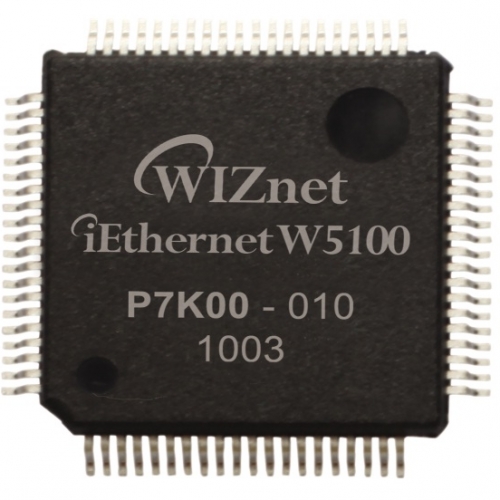
WIZnet - W5100
x 1

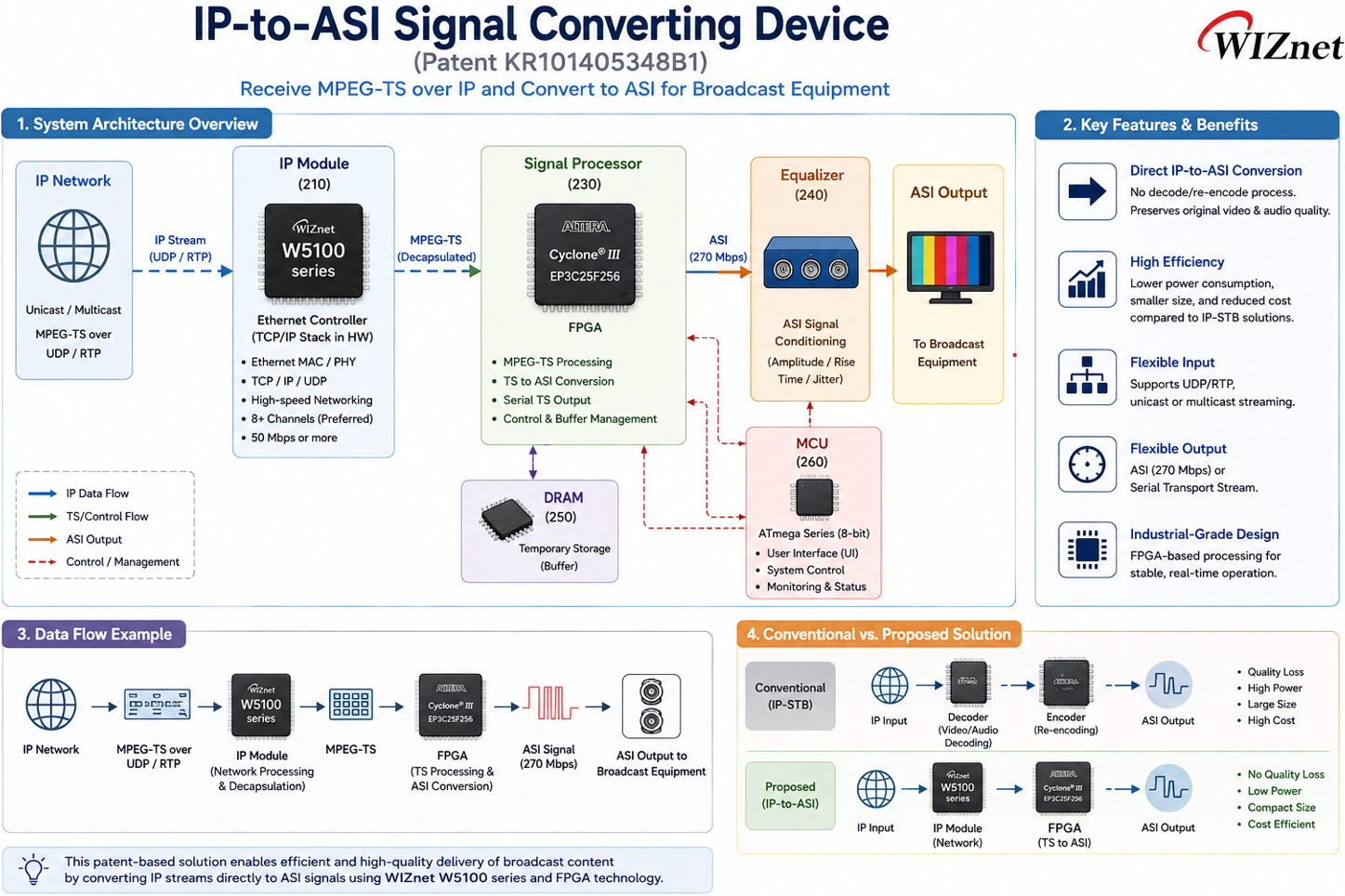
The IP-to-ASI system described in this patent is a converter that takes an MPEG Transport Stream delivered over an IP network and outputs it as an ASI signal that professional broadcast equipment can use.
1. What Is IP-to-ASI?
Broadcast video is typically compressed using formats such as MPEG-2 or MPEG-4, while video, audio, and related information can be multiplexed into an MPEG Transport Stream (MPEG-TS). When that TS is transported over an Ethernet/IP network, it becomes a form of TS over IP (TSoIP).
ASI (Asynchronous Serial Interface), on the other hand, is a serial interface used to transport MPEG-TS between broadcast devices.
The architecture described in the patent can therefore be simplified as:
IPTV / Network
      │
      │ Ethernet
      │ UDP/RTP + MPEG-TS
      ▼
┌──────────────┐
│ W5100 Series │
│ IP Module    │
└──────┬───────┘
       │
       │ Decapsulated MPEG-TS
       ▼
┌──────────────┐
│    FPGA      │
│ EP3C25F256   │
└──────┬───────┘
       │
       │ ASI
       ▼
┌──────────────┐
│  Equalizer   │
└──────┬───────┘
       │
       ▼
    Modulator
   (e.g. 8-VSB)
The important point is that this is not primarily a video decoding and re-encoding system. The patent proposes extracting the TS from the incoming IP stream and converting it directly into the required broadcast transport format, avoiding the conventional decode/re-encode path.
2. What Does the W5100 Do?
The patent specifically identifies the WIZnet W5100 series as a suitable implementation of the IP Module (210).
The patent describes IP streams transported using protocols such as UDP/RTP, including unicast and multicast transmission. The IP Module receives this stream, performs IP-stream processing and decapsulation, and reconstructs the TS carried in the payload.
Conceptually:
Ethernet Packet
┌──────────────────────────────┐
│ Ethernet / IP / UDP(RTP)     │
│                              │
│ ┌──────────────────────────┐ │
│ │ MPEG Transport Stream    │ │
│ │ TS packet / TS packet... │ │
│ └──────────────────────────┘ │
└──────────────────────────────┘
             │
             ▼
      W5100 / IP Module
             │
       Network Processing
             │
             ▼
┌──────────────────────────┐
│ MPEG Transport Stream    │
│ TS packet / TS packet... │
└──────────────────────────┘
             │
             ▼
           FPGA
The W5100 does not decode the video. It does not need to understand the MPEG video or audio content itself.
Its role is on the network side of the system: it provides the Ethernet/TCP/IP interface needed to receive the IP stream so that the encapsulated MPEG-TS can be delivered to the following processing stage.
3. What Data Is Sent Through the W5100?
It is important to distinguish the direction and format of the data.
The data arriving from the external network into the W5100/IP Module is an IP stream carrying broadcast content. The patent describes UDP/RTP as typical transport protocols.
Conceptually:
Ethernet
   ↓
IP
   ↓
UDP / RTP
   ↓
MPEG-TS
   ↓
Compressed Video / Audio / Broadcast Data
After network processing and decapsulation, the important data delivered toward the FPGA is the:
MPEG Transport Stream (TS)Therefore, ASI data is not what is sent into the W5100.
A useful way to divide the responsibilities is:
W5100 = IP/Ethernet side
FPGA = TS-to-ASI conversion side
4. What Does the FPGA Do?
The FPGA is identified as the Signal Processor (230). The patent gives EP3C25F256 as a specific implementation.
Its main input is the decapsulated MPEG-TS produced by the preceding IP processing stage.
The FPGA can then generate two output paths:
                     ┌──→ ASI Encoding ──→ ASI Output
MPEG-TS → FPGA ──────┤
                     └──→ Serial TS ─────→ Serial TS Output
The patent describes the Signal Processor as encoding the decapsulated TS according to the ASI format for one output while also being capable of converting it into a conventional serial TS format for another output.
This means that the FPGA is not re-encoding the MPEG video, for example from one video codec to another.
Instead, its main job is to preserve the MPEG Transport Stream content while converting its transport/output representation into a form suitable for the ASI broadcast interface.
5. Why Use a W5100 + FPGA Architecture?
The responsibilities of the two devices are clearly separated:
| Component | Role |
|---|---|
| W5100 series | Ethernet and hardware TCP/IP interface |
| W5100 / IP Module | Receives the IP stream and supports extraction of the TS payload |
| FPGA EP3C25F256 | Processes the TS and generates ASI/serial TS output |
| DRAM | Temporary storage for FPGA processing |
| Equalizer | Conditions the ASI signal |
| ATmega 8-bit MCU | System and user-interface control |
| Modulator | Converts the transport stream into a broadcast modulation format such as 8-VSB |
Therefore, saying “the W5100 converts IP into ASI” would be technically misleading.
A more accurate description is:
The W5100 series provides the Ethernet/TCP/IP interface for receiving an IP stream carrying MPEG-TS data. After the transport stream is extracted from the IP stream, the FPGA processes the MPEG-TS and converts it into an ASI-compatible output for broadcast equipment.
The complete data path can be summarized as:
IP (UDP/RTP + MPEG-TS)
        ↓
      W5100
        ↓
     MPEG-TS
        ↓
       FPGA
        ↓
       ASI
        ↓
    Equalizer
        ↓
 Broadcast System
The key idea of the patent is therefore to perform transport conversion rather than video transcoding: the MPEG-TS is moved from an IP-based transport environment to an ASI-based broadcast interface without requiring the video to be decoded and encoded again.