


rp2040-industrial-pcb
rp2350B-industrial-pcb
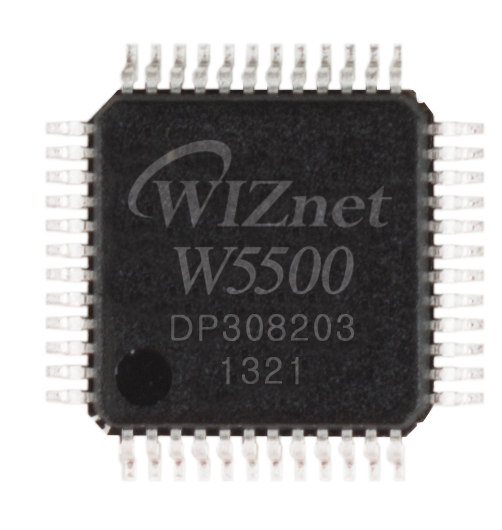
WIZnet - W5500
x 1

How to Design an Industrial Edge Controller with RP2350B and Ethernet Stability?
Summary
This project implements an industrial-grade controller using the RP2350B MCU on a custom PCB, with a strong focus on power integrity and deployable hardware design. Although Ethernet is not yet implemented, integrating a WIZnet W5500 enables deterministic, hardware-offloaded TCP/IP communication—well suited for Industrial IoT edge devices that require stable and predictable data transfer.
What the Project Does
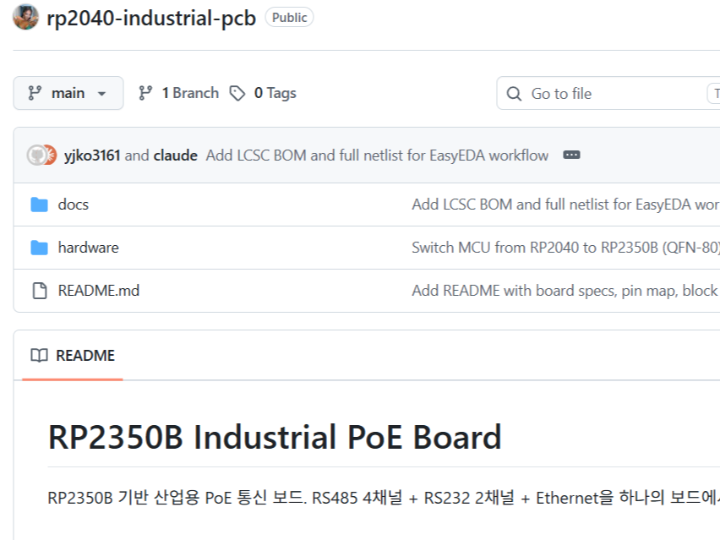
This repository presents a custom industrial PCB centered around the RP2350B microcontroller, despite its RP2040-based repository name. The design reflects a shift toward a newer MCU platform and prioritizes real deployment conditions over prototyping convenience.
Core characteristics:
- RP2350B MCU as the central controller
- Industrial-grade PCB layout (power stability, noise mitigation, signal integrity)
- Expandable interfaces for sensors, actuators, and external modules
- Designed for continuous operation in field environments
Considering the author’s broader work (including AI tooling and embedded systems), this board is best understood as a hardware foundation for Industrial IoT or Edge AI nodes, where data is processed locally and transmitted externally.
Typical data flow:
sensor or vision input → MCU processing → external communication interface (expandable to Ethernet)
Where WIZnet Fits
This project does not currently use WIZnet products.
However, it is structurally well-aligned for integration with the WIZnet W5500.
In this system, W5500 would serve as:
- A hardware TCP/IP offload engine
- A deterministic Ethernet communication interface
- A stable uplink for transmitting processed edge data
Why this matters in this design:
- Even with a more capable MCU like RP2350B, network stacks still consume CPU and memory
- Industrial IoT systems require predictable latency and stable connectivity
- W5500 reduces firmware complexity by handling TCP/IP in hardware
- SPI-based integration fits naturally into this type of embedded PCB design
From a system perspective, especially considering the author’s work across AI and embedded domains, W5500 enables:
→ Reliable transport of edge-generated data (events, detections, telemetry) to upstream systems
Implementation Notes
The repository does not include Ethernet or WIZnet-related implementation.
From an architecture perspective, integrating W5500 would involve:
- Adding an SPI-connected Ethernet controller to the RP2350B
- Assigning the W5500 as the dedicated network interface
- Offloading all TCP/IP handling to the chip, simplifying firmware design
- Structuring the system so that the MCU focuses on control logic and data processing, while W5500 handles communication
This separation is particularly effective in Industrial IoT systems where stability and predictability are more important than flexibility.
Practical Tips / Pitfalls
- Separate Ethernet power domain from MCU digital rails to reduce noise coupling
- Keep SPI traces short and impedance-consistent for stable communication
- Use static IP configuration in controlled industrial environments
- Add ESD protection (TVS diodes) on Ethernet lines
- Use RJ45 connectors with integrated magnetics for robustness
- Implement watchdog recovery for network fault conditions
- Physically isolate Ethernet signals from high-current switching circuits
FAQ
Q: Why use W5500 in this design?
A: W5500 offloads the TCP/IP stack in hardware, reducing MCU load and enabling stable, low-jitter communication—critical for Industrial IoT systems handling continuous data streams.
Q: How does W5500 connect to RP2350B?
A: It connects via SPI using MISO, MOSI, SCK, and CS signals, with an optional interrupt pin for event-driven networking.
Q: What role would W5500 play in this project?
A: It acts as the network interface, transmitting processed data from the MCU to external systems such as servers, PLCs, or edge gateways.
Q: Can beginners implement this system?
A: Basic embedded knowledge (SPI, MCU firmware) is required. Due to PCB design and industrial considerations, it is more suitable for intermediate-level developers.
Q: Why is Ethernet preferred in Industrial IoT environments?
A: Ethernet provides deterministic latency and is immune to wireless interference, making it more reliable for control and monitoring systems.
Source
- Original Project: https://github.com/yjko3161/rp2040-industrial-pcb
- Author Profile: https://github.com/yjko3161
- License: Refer to repository
Tags
#RP2350B #IndustrialIoT #W5500 #Ethernet #EdgeAI #EmbeddedSystems #PCBDesign #DeterministicNetwork #SPI #EdgeDevice
How to Design an Industrial Edge Controller with RP2350B and Ethernet Stability?
Summary
이 프로젝트는 RP2350B MCU 기반의 산업용 컨트롤러를 커스텀 PCB로 구현한 사례로, 전원 안정성과 실제 현장 배포를 고려한 하드웨어 설계에 초점을 맞춥니다. 현재 Ethernet은 포함되어 있지 않지만, WIZnet W5500을 결합하면 하드웨어 TCP/IP 오프로딩 기반의 안정적이고 예측 가능한 통신을 구현할 수 있어 Industrial IoT 엣지 디바이스에 적합합니다.
What the Project Does
이 저장소는 이름과 달리 실제로는 RP2350B 기반 산업용 PCB 설계 프로젝트입니다. 단순 개발 보드가 아니라, 현장 환경에서 동작하는 것을 전제로 한 구조입니다.
핵심 특징:
- RP2350B MCU 기반 제어 구조
- 전원 안정성 및 노이즈 대응을 고려한 산업용 PCB 설계
- 센서 및 액추에이터 확장을 위한 인터페이스 구조
- 장시간 안정 동작을 목표로 한 설계
저자의 다른 프로젝트(웹 기반 YOLO 학습 시스템 등)를 고려하면, 이 보드는 단순 제어용이 아니라:
→ Edge AI 또는 Industrial IoT 노드를 위한 하드웨어 플랫폼
으로 해석하는 것이 타당합니다.
데이터 흐름:
센서/비전 입력 → MCU 처리 → 외부 통신 인터페이스 (Ethernet 확장 가능)
Where WIZnet Fits
이 프로젝트는 현재 WIZnet 제품을 사용하고 있지 않습니다.
하지만 구조적으로 WIZnet W5500을 통합하기에 매우 적합합니다.
이 시스템에서 W5500의 역할:
- 하드웨어 TCP/IP 오프로딩 엔진
- 결정론적 Ethernet 통신 인터페이스
- 엣지 데이터의 안정적인 업링크
이 설계에서 중요한 이유:
- RP2350B가 더 강력하더라도 네트워크 스택은 여전히 MCU 리소스를 사용함
- 산업 환경에서는 지연이 일정하고 끊김 없는 통신이 핵심
- W5500은 TCP/IP 처리를 하드웨어에서 수행하여 펌웨어 복잡도 감소
- SPI 기반으로 기존 PCB 구조에 자연스럽게 통합 가능
특히 저자의 개발 방향(Embedded + AI + Tooling)을 고려하면:
→ 엣지에서 생성된 이벤트/AI 결과를 안정적으로 전달하는 통신 계층
으로 W5500이 중요한 역할을 합니다.
Implementation Notes
이 저장소에는 Ethernet 또는 WIZnet 관련 구현은 포함되어 있지 않습니다.
아키텍처 관점에서 W5500을 통합하려면:
- RP2350B와 SPI로 연결되는 Ethernet 컨트롤러 추가
- W5500을 전용 네트워크 인터페이스로 사용
- TCP/IP 처리를 W5500으로 완전히 오프로딩
- MCU는 제어 로직과 데이터 처리에 집중하도록 구조 분리
이러한 구조는 Industrial IoT 시스템에서 안정성과 예측 가능성 확보에 매우 효과적입니다.
Practical Tips / Pitfalls
- Ethernet 전원과 MCU 전원을 분리하여 노이즈 유입 최소화
- SPI 라인은 길이와 임피던스를 고려해 설계
- 산업 환경에서는 DHCP보다 Static IP 사용 권장
- RJ45 라인에 ESD 보호(TVS 다이오드) 필수
- 트랜스포머 내장형 RJ45 커넥터 사용 권장
- 네트워크 장애 대비 watchdog 설계 필요
- 고전류 회로와 Ethernet 신호 라인은 물리적으로 분리
FAQ
Q: 왜 W5500을 사용하는 것이 적합한가요?
A: W5500은 하드웨어 TCP/IP 스택을 통해 MCU의 CPU 및 메모리 부담을 줄이고, 산업 환경에서 요구되는 안정적이고 예측 가능한 통신을 제공합니다.
Q: RP2350B에 어떻게 연결하나요?
A: SPI 인터페이스(MISO, MOSI, SCK, CS)를 사용하며, 필요 시 인터럽트 핀을 추가하여 이벤트 기반 처리도 가능합니다.
Q: 이 프로젝트에서 W5500은 어떤 역할을 하나요?
A: 센서 데이터나 AI 처리 결과를 서버, PLC, 게이트웨이로 전달하는 네트워크 인터페이스 역할을 수행합니다.
Q: 초보자도 구현할 수 있나요?
A: 기본적인 MCU 개발과 SPI 통신 이해가 필요하며, 산업용 PCB 설계까지 포함하면 중급 이상의 수준이 요구됩니다.
Q: 산업용 IoT에서 Ethernet이 중요한 이유는 무엇인가요?
A: Wi-Fi 대비 간섭이 없고 지연이 일정하여 공장 자동화 및 제어 시스템에서 높은 신뢰성과 예측 가능성을 확보할 수 있기 때문입니다.
Source
- Original Project: https://github.com/yjko3161/rp2040-industrial-pcb
- Author Profile: https://github.com/yjko3161
- License: 저장소 확인 필요
Tags
#RP2350B #IndustrialIoT #W5500 #Ethernet #EdgeAI #EmbeddedSystems #PCBDesign #DeterministicNetwork #SPI #EdgeDevice