


product aspberry pico W5500 board
product aspberry pico W5500 board
WIZnet - W5500
x 1

How to Build a Modular Ethernet Development Platform with Raspberry Pi Pico and W5500?
Summary
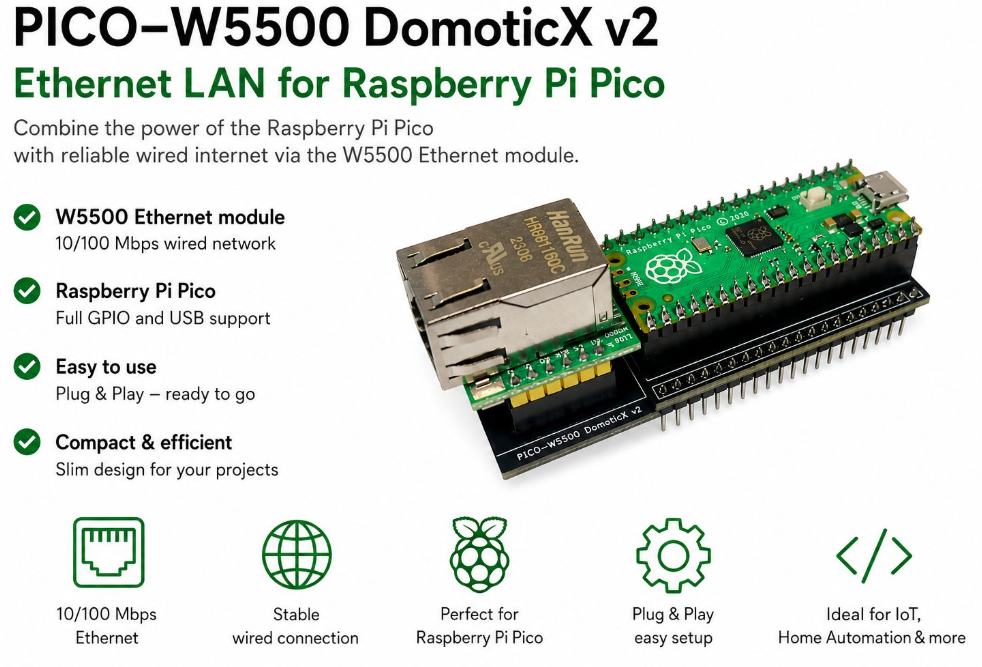
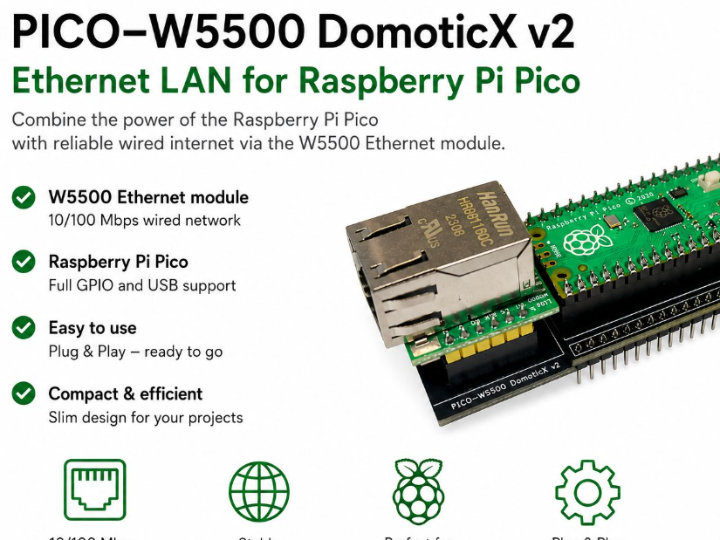
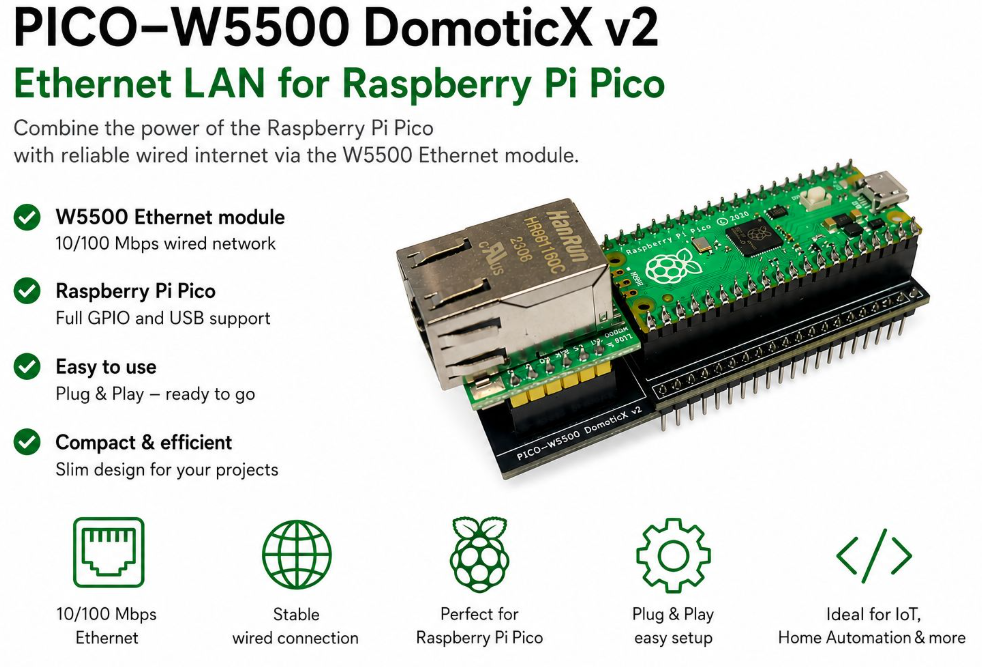
The DomoticX PICO-W5500 project combines a Raspberry Pi Pico with a WIZnet W5500 Ethernet module using a modular hardware architecture. Rather than replicating the W5500-EVB-PICO evaluation board, the project focuses on a replaceable Ethernet module approach that allows different WIZnet network chips to be tested on the same platform. Thanks to the W5500 hardware TCP/IP offload engine, the RP2040 can focus on application logic while maintaining stable Ethernet connectivity for IoT and Home Automation systems.
What the Project Does
This project provides a custom PCB that connects a Raspberry Pi Pico to a W5500 Ethernet module.
The overall architecture combines:
- Raspberry Pi Pico
- WIZnet W5500 Ethernet module
- SPI communication
- RJ45 Ethernet connectivity
One of the most important design choices is that the W5500 is not permanently integrated onto the PCB.
Instead, the project uses a modular Ethernet design where:
- the Pico can be replaced,
- the Ethernet module can be replaced,
- and multiple WIZnet network modules can be tested on the same base board.
This makes the platform suitable for:
- Ethernet-based IoT systems
- Home Automation
- Industrial prototyping
- Customer-specific embedded Ethernet development
The repository and related tutorials demonstrate:
- MQTT communication
- MicroPython Ethernet initialization
- Home Assistant integration
- Wired IoT networking
Who is DomoticX?
DomoticX is a Netherlands-based Home Automation and Embedded IoT company focused on practical Ethernet-enabled embedded systems.
The company operates as more than just a hardware reseller. Their ecosystem includes:
- custom PCB development
- open-source tutorials
- Raspberry Pi / ESP32 / Pico integration
- MQTT and Ethernet-based IoT systems
- customer-oriented embedded development
What makes DomoticX interesting is that their projects consistently emphasize:
- stable wired networking
- modular hardware
- Home Assistant integration
- embedded Ethernet communication
This suggests that the company targets not only the Maker market, but also practical long-running IoT deployments where Ethernet reliability matters more than wireless convenience.
From an engineering perspective, DomoticX behaves more like a small embedded systems integration company than a traditional consumer electronics vendor.
Where WIZnet Fits
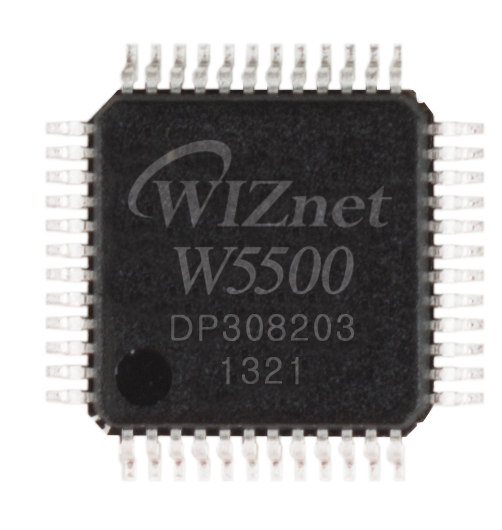
In this project, the WIZnet W5500 acts as the Ethernet network controller.
The most important architectural decision is that DomoticX did not directly copy the W5500-EVB-PICO integrated design.
Instead, they created a modular structure where:
- Raspberry Pi Pico remains independent,
- Ethernet hardware remains replaceable,
- and future WIZnet modules can be swapped without redesigning the entire board.
1. Modular Ethernet Architecture
The W5500-EVB-PICO integrates RP2040 and W5500 onto a single PCB.
By contrast, the DomoticX PICO-W5500 separates:
- MCU platform
- Ethernet platform
This allows easier experimentation with:
- W5500
- W5100S
- W6100
- future W6300/W630io-class modules
without redesigning the main controller board.
This approach is particularly useful for:
- engineering consulting
- customer-specific prototyping
- rapid network hardware validation
2. Hardware TCP/IP Offloading
The W5500 provides:
- hardware TCP/IP stack
- 8 hardware sockets
- 32 KB internal buffer memory
Because the TCP/IP processing happens inside the W5500 itself, the RP2040 can focus on:
- sensor logic
- GPIO control
- MQTT messaging
- Home Assistant integration
Compared to software stacks such as LwIP, this architecture can reduce:
- MCU RAM usage
- CPU overhead
- network timing instability
which is especially valuable on resource-constrained microcontrollers.
3. Ethernet Stability for IoT Systems
Many DomoticX projects repeatedly prioritize Ethernet connectivity over Wi-Fi.
In practical deployments, Wi-Fi systems may encounter:
- AP roaming issues
- RSSI fluctuations
- wireless interference
- DHCP reconnect delays
By contrast, W5500-based Ethernet systems offer:
- deterministic latency
- stable MQTT sessions
- long-term connection reliability
This becomes important in:
- Home Assistant deployments
- industrial IoT systems
- always-on automation infrastructure
Implementation Notes
The repository and related tutorials include MicroPython examples for Ethernet initialization.
Ethernet Initialization Example
Source: README.md
from machine import Pin,SPI
import network

spi = SPI(0, 2_000_000, mosi=Pin(19), miso=Pin(16), sck=Pin(18))
nic = network.WIZNET5K(spi, Pin(17), Pin(20))

nic.active(True)
nic.ipconfig(dhcp4=True)

while not nic.isconnected():
    time.sleep(1)

print(nic.ifconfig())
This code configures:
- SPI communication
- W5500 RESET/CS pins
- DHCP-based Ethernet initialization
The key point is:
network.WIZNET5K()MicroPython directly interfaces with the WIZnet hardware TCP/IP engine rather than relying entirely on a software TCP/IP stack running on the RP2040.
Why the PCB Structure Matters
The most important engineering idea behind this project is that the Ethernet interface is modular rather than fixed.
This effectively separates:
- the MCU platform
- the network platform
For embedded consulting or customer-specific product development, this architecture is highly practical.
For example:
- Customer A may require W5500 IPv4 Ethernet
- Customer B may require W6100 IPv6 support
- Customer C may require evaluation of future WIZnet chips
without redesigning the entire base platform.
Practical Tips / Pitfalls
- Excessively high SPI clock speeds may cause initialization failures when using long jumper wires.
- Static IP configuration is often more stable than DHCP for Home Assistant deployments.
- Implementing proper W5500 RESET control is strongly recommended.
- Verify CS pin compatibility when replacing Ethernet modules.
- USB-powered Pico boards may experience voltage drops during Ethernet link-up events.
- MQTT keepalive intervals should not be configured too aggressively in unstable networks.
FAQ
Q: Why use a modular Ethernet structure instead of W5500-EVB-PICO?
A: W5500-EVB-PICO is an integrated evaluation board where RP2040 and W5500 are permanently combined. The DomoticX design separates the Ethernet module from the MCU platform, allowing easier module replacement and customer-specific Ethernet validation.
Q: What role does the W5500 play in this project?
A: The W5500 functions as the Ethernet network controller. Its hardware TCP/IP offload engine handles network communication so the RP2040 can focus on application-level processing.
Q: How is the W5500 connected to the Raspberry Pi Pico?
A: The board uses SPI communication with MOSI, MISO, SCK, CS, and RESET signals. The MicroPython network.WIZNET5K() interface initializes the hardware.
Q: Can beginners follow this project?
A: Basic Raspberry Pi Pico and SPI knowledge is recommended. However, the project includes MicroPython examples that make Ethernet-based IoT development relatively accessible.
Q: How does W5500 compare to LwIP-based Ethernet implementations?
A: LwIP relies on the MCU to process the TCP/IP stack in software. The W5500 instead performs TCP/IP processing in dedicated hardware, reducing RAM usage and CPU overhead on the RP2040.
Source
- Original Project: https://github.com/DomoticX/product-raspberry-pico-W5500-board
- Related Tutorial: https://domoticx.net/docs/raspberry-pico-ethernet-lan-with-w5500-mqtt/
- W5500 Documentation: https://docs.wiznet.io/Product/Chip/Ethernet/W5500/w5500-evb-pico
License information was not explicitly specified in the repository at the time of writing.
Tags
#W5500
#RaspberryPiPico
#RP2040
#Ethernet
#MicroPython
#HomeAutomation
#MQTT
#IndustrialIoT
#WIZnet
#EmbeddedSystems
How to Build a Modular Ethernet Development Platform with Raspberry Pi Pico and W5500?
Summary
DomoticX의 PICO-W5500 프로젝트는 Raspberry Pi Pico와 WIZnet W5500 Ethernet 모듈을 분리형 구조로 결합한 개발 플랫폼입니다. 이 프로젝트는 단순한 W5500 평가보드 복제가 아니라, 다양한 WIZnet Ethernet 모듈을 교체하며 검증할 수 있는 모듈형 아키텍처에 초점을 둡니다. W5500의 하드웨어 TCP/IP 오프로딩 기능 덕분에 RP2040은 애플리케이션 로직에 집중할 수 있으며, Ethernet 기반의 안정적인 IoT 및 Home Automation 시스템 구현이 가능합니다.
What the Project Does
이 프로젝트는 Raspberry Pi Pico에 W5500 Ethernet 모듈을 연결하기 위한 커스텀 PCB 설계를 제공합니다.
구조적으로는:
- Raspberry Pi Pico
- WIZnet W5500 Ethernet Module
- SPI 인터페이스
- RJ45 Ethernet 연결
을 조합하는 형태입니다.
특징적인 부분은 W5500이 PCB에 직접 실장된 구조가 아니라 “모듈 형태”라는 점입니다.
즉:
- Pico 교체 가능
- Ethernet 모듈 교체 가능
- 다양한 WIZnet 칩 테스트 가능
한 플랫폼에서 여러 네트워크 구성을 실험할 수 있는 구조입니다.
README와 예제 문서에서는:
- MQTT 통신
- MicroPython 기반 Ethernet 초기화
- Home Assistant 연동
- 유선 네트워크 기반 IoT
구성이 소개됩니다.
이 프로젝트는 특히:
- Ethernet 기반 IoT
- Home Automation
- 산업용 프로토타이핑
- 고객 맞춤형 네트워크 장비 개발
같은 분야에서 활용하기 적합합니다.
DomoticX는 어떤 회사인가?
DomoticX는 네덜란드 기반의 Home Automation 및 Embedded IoT 중심 업체로 알려져 있습니다.
단순 쇼핑몰 형태가 아니라:
- 자체 PCB 제작
- 오픈소스 기반 튜토리얼 제공
- Raspberry Pi / ESP32 / Pico 기반 제품 개발
- Ethernet 및 MQTT 기반 IoT 시스템 구성
- 고객 맞춤형 개발 지원
을 함께 수행하는 형태에 가깝습니다.
특히 특징적인 부분은:
“완제품 제조사”보다는
“실제 프로젝트 중심의 엔지니어링 플랫폼 업체”에 가깝다는 점입니다.
DomoticX의 문서들을 보면:
- Home Assistant
- MQTT
- Ethernet IoT
- Modbus
- Industrial-style connectivity
같은 주제가 반복적으로 등장합니다.
즉 단순 Maker 시장보다는:
- 실사용형 IoT
- 안정적인 유선 네트워크
- 장기 운영 시스템
에 관심이 높은 업체로 해석할 수 있습니다.
Where WIZnet Fits
이 프로젝트에서 WIZnet W5500은 Ethernet 네트워크 컨트롤러 역할을 담당합니다.
특히 중요한 점은:
DomoticX가 W5500-EVB-PICO 같은 통합형 평가보드 대신,
“Pico + Ethernet Module” 구조를 선택했다는 점입니다.
이 구조의 장점은 명확합니다.
1. 모듈 교체형 아키텍처
W5500-EVB-PICO는 RP2040과 W5500이 하나의 PCB에 고정된 구조입니다.
반면 PICO-W5500 보드는:
- Pico 분리 가능
- Ethernet 모듈 교체 가능
- 다른 WIZnet 모듈 적용 가능
한 보드에서 다양한 Ethernet 구성을 실험할 수 있습니다.
즉:
- W5500
- W5100S
- W6100
- 향후 W6300/W630io 계열
같은 칩 검증 플랫폼으로 확장하기 쉬운 구조입니다.
2. 하드웨어 TCP/IP 오프로딩
W5500은:
- 하드웨어 TCP/IP 스택
- 8개 하드웨어 소켓
- 32KB 내부 버퍼
를 제공합니다.
이 구조 덕분에 RP2040은:
- MQTT 처리
- GPIO 제어
- 센서 로직
- Home Assistant 통신
같은 애플리케이션 처리에 집중할 수 있습니다.
LwIP 같은 소프트웨어 TCP/IP 스택 대비:
- MCU RAM 사용량 감소
- CPU 부하 감소
- 네트워크 안정성 향상
효과를 기대할 수 있습니다.
3. Ethernet 기반 IoT 안정성
DomoticX 프로젝트들이 Ethernet을 반복적으로 사용하는 이유도 여기와 연결됩니다.
Wi-Fi 기반 시스템은:
- AP 재접속 문제
- RSSI 변화
- 전파 간섭
- DHCP timeout
문제가 발생할 수 있습니다.
반면 W5500 기반 Ethernet은:
- deterministic latency
- 안정적인 MQTT 연결
- 장시간 연결 유지
같은 장점이 있습니다.
특히 Home Assistant나 Industrial IoT 환경에서는 이런 안정성이 중요합니다.
Implementation Notes
README와 예제 문서에서는 MicroPython 기반 Ethernet 초기화 예제가 제공됩니다.
Ethernet 초기화 예제
Source: README.md
from machine import Pin,SPI
import network

spi = SPI(0, 2_000_000, mosi=Pin(19), miso=Pin(16), sck=Pin(18))
nic = network.WIZNET5K(spi, Pin(17), Pin(20))

nic.active(True)
nic.ipconfig(dhcp4=True)

while not nic.isconnected():
    time.sleep(1)

print(nic.ifconfig())
이 코드는:
- SPI 초기화
- W5500 RESET/CS 설정
- DHCP 기반 네트워크 연결
을 수행합니다.
여기서 중요한 부분은:
network.WIZNET5K()MicroPython이 WIZnet 하드웨어 TCP/IP 칩을 직접 사용한다는 점입니다.
즉 MCU 내부 소프트웨어 스택이 아니라 W5500 자체의 네트워크 엔진을 활용하는 구조입니다.
PCB 구조의 의미
프로젝트 핵심은 Ethernet PHY를 PCB에 직접 고정하지 않았다는 점입니다.
즉:
- Pico는 범용 MCU 플랫폼
- Ethernet은 교체형 네트워크 모듈
로 분리됩니다.
이 방식은 개발 외주나 고객 맞춤형 제품 개발에서 매우 유리합니다.
예를 들어:
- 고객 A → IPv4 기반 W5500
- 고객 B → IPv6 기반 W6100
- 고객 C → 향후 신규 Ethernet 칩
같이 대응하기 쉬워집니다.
Practical Tips / Pitfalls
- SPI 클럭을 너무 높이면 긴 점퍼 환경에서 Ethernet 초기화 실패가 발생할 수 있습니다.
- DHCP 대신 Static IP를 사용하면 Home Assistant 연동 안정성이 높아질 수 있습니다.
- W5500 RESET 핀 제어를 반드시 구현하는 것이 좋습니다.
- Ethernet 모듈 교체 시 CS 핀 충돌 여부를 확인해야 합니다.
- Pico USB 전원만 사용하는 경우 Ethernet link up 시 전압 강하가 발생할 수 있습니다.
- MQTT keepalive 시간을 너무 길게 설정하면 연결 장애 감지가 늦어질 수 있습니다.
FAQ
Q: 왜 W5500-EVB-PICO 대신 모듈형 구조를 사용했나요?
A: W5500-EVB-PICO는 RP2040과 W5500이 고정된 평가보드입니다. 반면 DomoticX PICO-W5500은 Ethernet 모듈을 교체할 수 있는 구조라서, 다양한 WIZnet 칩 검증과 고객 맞춤형 개발에 더 유리합니다.
Q: 이 프로젝트에서 W5500은 어떤 역할을 하나요?
A: W5500은 Ethernet 네트워크 컨트롤러 역할을 담당합니다. TCP/IP 처리를 하드웨어에서 수행하므로 RP2040은 애플리케이션 로직과 센서 처리에 집중할 수 있습니다.
Q: Raspberry Pi Pico와 어떻게 연결되나요?
A: SPI 인터페이스를 사용합니다. 일반적으로 MOSI, MISO, SCK, CS, RESET 핀을 사용하며 MicroPython의 network.WIZNET5K() API로 초기화합니다.
Q: 초보자도 따라할 수 있나요?
A: 기본적인 Raspberry Pi Pico 사용 경험과 SPI 개념 이해가 필요합니다. MicroPython 기반 예제가 제공되므로 Ethernet IoT 입문용으로는 비교적 접근성이 좋은 편입니다.
Q: W5500과 LwIP 기반 Ethernet의 차이는 무엇인가요?
A: LwIP는 MCU가 TCP/IP 스택을 직접 처리하는 구조입니다. 반면 W5500은 하드웨어 TCP/IP 오프로딩을 제공하므로 MCU RAM 사용량과 CPU 부하를 줄일 수 있습니다.
Source
- Original Project: https://github.com/DomoticX/product-raspberry-pico-W5500-board
- Related Tutorial: https://domoticx.net/docs/raspberry-pico-ethernet-lan-with-w5500-mqtt/
- W5500 Documentation: https://docs.wiznet.io/Product/Chip/Ethernet/W5500/w5500-evb-pico
License information was not explicitly specified in the repository at the time of writing.
Tags
#W5500
#RaspberryPiPico
#RP2040
#Ethernet
#MicroPython
#HomeAutomation
#MQTT
#IndustrialIoT
#WIZnet
#EmbeddedSystems