



Mythic industrial HMI
Wireframes for the 7" touchscreen UI on the Ark HCG-50K chlorine generator.
How to Connect WIZnet W5500 Ethernet to an ESP32-S3 Industrial Chlorine Generator?
Summary
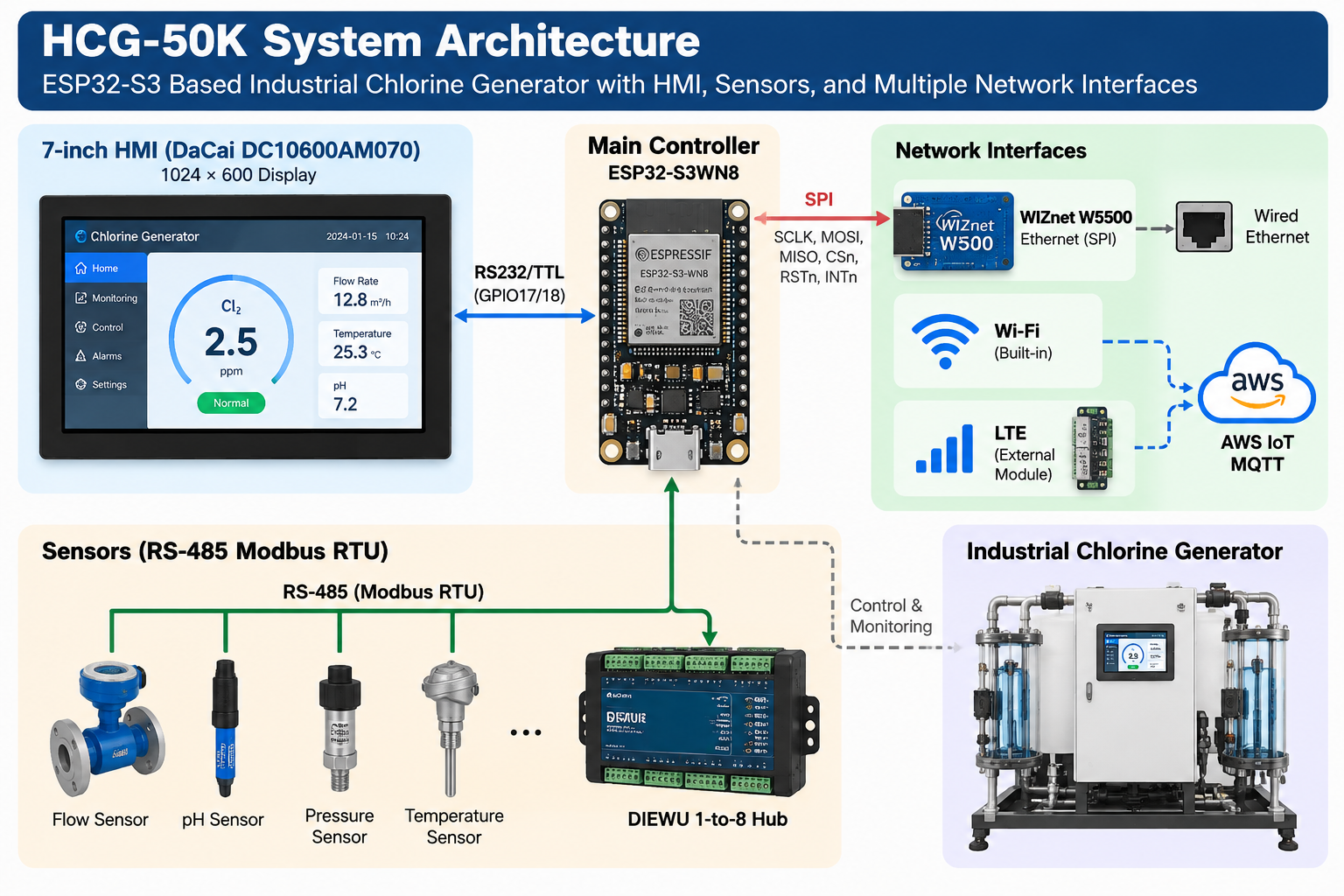
The Ark HCG-50K UI project defines the user interface for an industrial chlorine generator built around an ESP32-S3WN8, a 7-inch HMI, an RS-485 Modbus RTU sensor network, WIZnet W5500 Ethernet, Wi-Fi, LTE, and AWS IoT MQTT. In this architecture, the W5500 provides the ESP32-S3 with a wired Ethernet interface over SPI. The public repository is an HMI wireframe project, so the actual W5500 GPIO assignments and PCB schematic cannot be verified from the available source.
What the Project Does
rkurani/hcg50-ui is a 7-inch industrial HMI wireframe project for the Ark HCG-50K chlorine generator. The interface is designed for a 1024×600 display and provides operators with equipment status, process information, alarms, and control screens.
The project README identifies the following hardware context:
- Main MCU: ESP32-S3WN8
- HMI: DaCai DC10600AM070, 7-inch 1024×600
- HMI interface: RS232/TTL on GPIO17/18
- Sensor network: RS-485 Modbus RTU
- Sensor hub: DIEWU 1-to-8 hub
- Wired networking: WIZnet W5500 Ethernet
- Other network paths: Wi-Fi and LTE
- Cloud connectivity: AWS IoT MQTT
Based on those documented components, the high-level system architecture can be represented as:
RS-485 / Modbus RTU Sensors
            │
            ▼
      ┌─────────────┐
      │ ESP32-S3WN8 │
      └──────┬──────┘
             │
      ┌──────┴───────────────┐
      │                      │
      ▼                      ▼
  7-inch HMI          Network Interfaces
  RS232/TTL        W5500 / Wi-Fi / LTE
                            │
                            ▼
                       AWS IoT MQTT
One notable hardware characteristic is that Ethernet is not the system's only connectivity path. The README explicitly lists the W5500 alongside Wi-Fi and LTE, giving the controller multiple network interfaces.
Where WIZnet Fits
The WIZnet device explicitly identified by the original project is the W5500.
The Hardware Context section of the repository README states:
Connectivity: WiFi, Ethernet (W5500), LTE
This provides direct source evidence that the W5500 is part of the intended HCG-50K hardware architecture.
The W5500 is a Hardwired TCP/IP Ethernet controller that can communicate with the ESP32-S3 through SPI. According to WIZnet's official specifications, the W5500 integrates a 10/100 Ethernet MAC and PHY, hardware TCP/IP processing, eight hardware sockets, and 32 KB of internal TX/RX memory.
From a hardware perspective, its position in the HCG-50K architecture can be represented as:
ESP32-S3WN8
     │
     │ SPI
     │
     ├── SCLK ─────────►
     ├── MOSI ─────────►
     ├── MISO ◄─────────    W5500
     ├── CSn  ─────────►
     ├── RSTn ─────────►
     └── INTn ◄─────────
                           │
                           │ Ethernet PHY
                           ▼
                     Magnetics / RJ45
                           │
                           ▼
                     Wired Ethernet
There is an important distinction between project-specific evidence and the diagram above.
The repository confirms that the system uses an ESP32-S3WN8 and W5500. However, the SPI signals shown above describe the W5500's standard hardware interface. The public repository does not contain the PCB schematic or Ethernet firmware, so the actual HCG-50K GPIO assignments, SPI clock configuration, reset GPIO, and interrupt GPIO cannot be verified.
Implementation Notes
The public hcg50-ui repository does not contain W5500 initialization firmware or PCB design files. It is an HTML/CSS-based HMI wireframe repository, so there is no verified W5500 initialization code that can be presented as code from the HCG-50K implementation.
For hardware integration, the interfaces required by the W5500 can instead be separated according to the official W5500 hardware specification:
| ESP32-S3 Side | W5500 Side | Function |
|---|---|---|
| SPI SCLK | SCLK | SPI clock |
| SPI MOSI | MOSI | ESP32-S3 to W5500 data |
| SPI MISO | MISO | W5500 to ESP32-S3 data |
| GPIO | CSn | SPI device selection |
| GPIO | RSTn | W5500 hardware reset |
| GPIO | INTn | W5500 interrupt |
| 3.3 V / GND | Power / GND | Power and common ground |
WIZnet specifies support for SPI Mode 0 and Mode 3, with an SPI clock of up to 80 MHz. This is a W5500 device specification, not evidence that the HCG-50K operates its W5500 at 80 MHz.
The Ethernet side requires similar care. Although the W5500 integrates its Ethernet PHY, that does not mean the W5500 Ethernet pins should simply be routed directly to an RJ45 connector. A practical PCB implementation requires the appropriate Ethernet magnetics, connector, and supporting circuitry based on the W5500 hardware design requirements.
Practical Tips / Pitfalls
- Do not invent the HCG-50K W5500 GPIO assignments. The repository identifies GPIO17/18 for the HMI interface, but it does not publish the W5500 SPI GPIO mapping.
- Keep the W5500 SPI routing short and controlled. Signal integrity becomes increasingly important as SPI clock frequency increases, particularly for SCLK and the data lines.
- Consider connecting RSTn and INTn to the ESP32-S3. These signals can support controlled Ethernet reset and event handling, although the repository does not confirm how the production HCG-50K uses them.
- Distinguish the integrated PHY from Ethernet magnetics. The W5500 includes the Ethernet PHY, but an actual PCB still requires an appropriate magnetics and connector implementation.
- Use PHY link status for equipment diagnostics where appropriate. Monitoring the physical Ethernet link can help distinguish a disconnected cable from higher-level IP or application communication failures.
- Review power and grounding at the complete system level. An industrial controller containing an ESP32-S3, W5500, RS-485 interfaces, and HMI should be evaluated as one system rather than treating each interface's power and grounding independently.
FAQ
Q1. Why is the W5500 used in the HCG-50K?
The original README identifies the W5500 as the HCG-50K Ethernet device, but it does not document the developer's specific reason for selecting it. Technically, the W5500 provides an SPI-connected 10/100 Ethernet interface with integrated MAC/PHY, Hardwired TCP/IP processing, eight hardware sockets, and 32 KB of internal TX/RX memory.
Q2. How does the W5500 connect to the ESP32-S3?
According to the W5500 interface specification, the ESP32-S3 communicates with it over SPI using SCLK, MOSI, MISO, and CSn. RSTn and INTn can also be connected to MCU GPIOs for reset control and interrupt handling. However, the actual W5500 GPIO mapping used by the HCG-50K is not available in the public repository.
Q3. What does the W5500 do in this specific project?
Its directly verifiable role is to provide Ethernet connectivity. The system context separately identifies an RS-485 Modbus RTU sensor network, an HMI, Wi-Fi, LTE, and AWS IoT MQTT. Because the public UI repository does not contain the networking firmware, it cannot be verified whether AWS IoT MQTT traffic is specifically routed through the W5500.
Q4. Can beginners build the ESP32-S3 and W5500 hardware?
Connecting an ESP32-S3 development board to a W5500 module is approachable for developers familiar with SPI and basic IP networking. Designing a custom industrial PCB similar to the HCG-50K requires additional knowledge of Ethernet magnetics, SPI signal integrity, power distribution, grounding, reset handling, and EMI considerations.
Q5. Can the HCG-50K W5500 implementation be reproduced from this repository?
Not completely. The repository provides useful system-level facts including the ESP32-S3WN8, W5500 Ethernet, GPIO17/18 HMI connection, RS-485 Modbus RTU network, Wi-Fi, LTE, and AWS IoT MQTT. It does not provide the W5500 SPI pin mapping, PCB schematic, Ethernet magnetics implementation, or networking firmware. Those details should therefore not be inferred as project-specific facts.
Source
Original Project:
rkurani/hcg50-ui
https://github.com/rkurani/hcg50-ui
WIZnet W5500 Official Documentation:
https://docs.wiznet.io/Product/Chip/Ethernet/W5500
Source scope:
Project-specific information is based on the original repository README. W5500 details concerning SPI, TCP/IP processing, hardware sockets, internal memory, and Ethernet PHY functionality are based on WIZnet's official product documentation.
License:
No separate LICENSE file is available in the referenced public repository. A specific redistribution or derivative-work license should therefore not be assumed.
Tags
#W5500 #WIZnet #ESP32S3 #IndustrialEthernet #IndustrialIoT #HMI #Ethernet #RS485 #ModbusRTU #AWSIoT #HCG50K