



MoonLight
open-source lighting platform that transforms an ESP32 into a professional lighting controller supporting Art-Net, sACN, DMX512
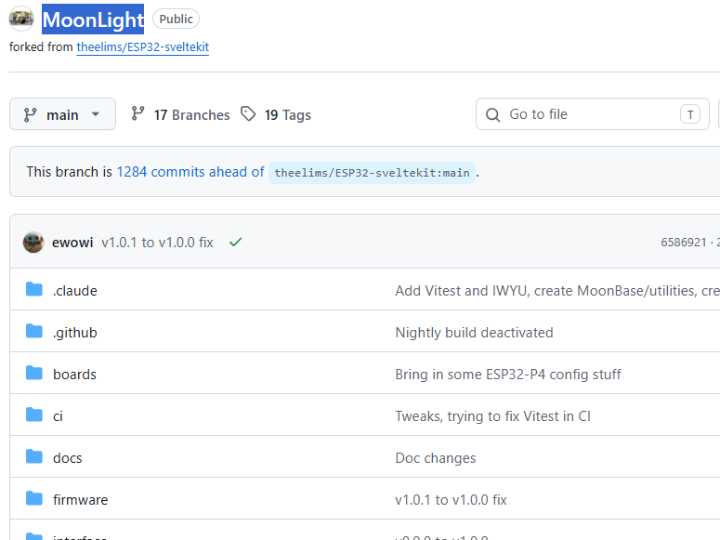
How to Build a Professional Art-Net Lighting Platform with W5500 and ESP32?
Summary
MoonLight is an open-source lighting platform that transforms an ESP32 into a professional lighting controller supporting Art-Net, sACN, DMX512, and addressable LEDs. Unlike conventional DMX controllers, MoonLight combines lighting effects, scripting, synchronization, and network management into a single platform. By supporting the WIZnet W5500 Ethernet controller, it provides reliable wired networking for stage lighting, media art, and architectural lighting applications where deterministic Ethernet communication is preferred over Wi-Fi.
What the Project Does
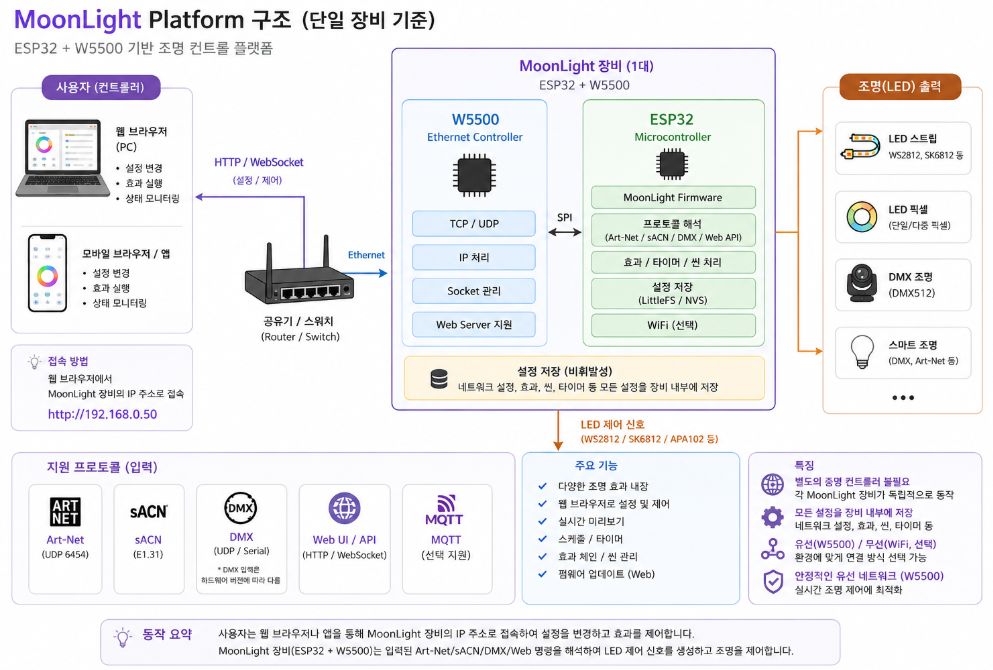
Professional stage lighting has evolved beyond simple DMX512 cables. Modern productions commonly distribute lighting data over Ethernet using protocols such as Art-Net and sACN, allowing thousands of DMX channels to be synchronized across multiple controllers.
MoonLight was developed to simplify this workflow by providing a unified lighting platform rather than a dedicated DMX node.
The project integrates:
Art-Net lighting control
sACN (E1.31)
DMX512 Input and Output
Addressable LED control
Browser-based Live Scripts
REST API
Multi-device synchronization (SuperSync)
Web-based configuration interface
Instead of requiring separate devices for Ethernet communication, LED effects, scripting, and DMX output, MoonLight consolidates these functions into a single ESP32-based controller.
This architecture makes the project suitable for:
Stage lighting
Theater automation
Architectural lighting
Media art
Interactive exhibitions
Permanent lighting installations
Where WIZnet Fits
MoonLight officially supports the WIZnet W5500 Ethernet controller as one of its supported Ethernet interfaces.
Within the system architecture, the W5500 serves as the wired networking interface responsible for receiving and transmitting Art-Net and sACN packets while also supporting REST API communication and controller synchronization.
Lighting Console
        │
     Art-Net
        │
 Ethernet Network
        │
   WIZnet W5500
        │
      SPI Bus
        │
      ESP32
        │
 ├── DMX512 Output
 ├── LED Engine
 ├── REST API
 ├── Live Scripts
 └── SuperSync
This role is particularly important in stage lighting.
Art-Net distributes lighting data using UDP packets. During a live performance, delayed or lost packets may result in visible lighting glitches or synchronization errors across multiple fixtures.
Compared with Wi-Fi, wired Ethernet provides:
Stable communication
Lower packet loss
Predictable latency
Better synchronization between controllers
The W5500 further reduces software complexity by integrating a hardware TCP/IP Offload Engine, allowing the ESP32 to dedicate more CPU time to lighting effects and DMX processing.
Implementation Notes
MoonLight is not an Ethernet driver project.
Instead, it demonstrates how Ethernet networking can be integrated into a complete lighting application.
Its software architecture is divided into four logical layers.
Hardware Layer
ESP32
W5500 Ethernet Controller
RS-485 DMX Interface
Addressable LED Outputs
Network Layer
Art-Net
sACN
REST API
SuperSync
Control Layer
Live Scripts
Browser UI
JSON Configuration
Effect Engine
Application Layer
Lighting Effects
DMX Universe Management
Multi-controller Synchronization
Fixture Mapping
This separation allows the lighting engine to remain independent of the networking interface. Whether communication occurs through Wi-Fi or the W5500 Ethernet controller, the application logic remains unchanged.
Rather than exposing hardware-specific APIs, MoonLight treats Ethernet as a communication service underneath the lighting engine.
Comparison with Similar WIZnet Maker Projects
MoonLight shares several technologies with other WIZnet Maker projects, but each project solves a different problem within the professional lighting ecosystem.
1. MoonLight vs. ESP32 Art-Net Node Receiver
Similarities
Both projects:
Use ESP32
Support Art-Net
Support W5500 Ethernet
Receive lighting data over Ethernet
Target LED and stage lighting applications
Differences
The ESP32 Art-Net Node Receiver focuses on receiving Art-Net packets and driving addressable LED strips.
MoonLight is significantly broader.
Besides receiving Art-Net data, it also supports:
DMX512 input/output
sACN
Browser scripting
REST APIs
Multi-controller synchronization
Lighting effects
| ESP32 Art-Net Node Receiver | MoonLight |
|---|---|
| Art-Net Receiver | Complete Lighting Platform |
| LED Output | LED + DMX + Art-Net + sACN |
| Single-purpose Application | Full Lighting Ecosystem |
2. MoonLight vs. ArtGateOne_2
Similarities
Both projects use W5500 Ethernet to receive Art-Net packets and deliver lighting data through Ethernet.
Both are intended for professional lighting installations and support browser-based configuration.
Differences
ArtGateOne_2 functions primarily as an Art-Net Node.
Its responsibility is converting Art-Net packets into DMX or LED output.
MoonLight extends this concept into a programmable lighting platform capable of generating lighting effects internally while managing multiple lighting controllers simultaneously.
| ArtGateOne_2 | MoonLight |
|---|---|
| Art-Net Node | Lighting Platform |
| Packet Conversion | Lighting Generation |
| Fixed Function | Programmable Platform |
3. MoonLight vs. Open-Source Art-Net LED Controller
Similarities
Both projects target Ethernet-based LED control using ESP32 and W5500.
Both are designed for installations requiring reliable wired networking and high-speed Art-Net communication.
Differences
The Open-Source Art-Net LED Controller is optimized for driving very large LED installations, supporting more than 2,700 LEDs at approximately 40 FPS.
MoonLight emphasizes flexibility rather than maximum LED throughput.
Instead of focusing solely on LED rendering performance, it integrates:
DMX512
Art-Net
sACN
Live Scripts
REST APIs
Synchronization
making it suitable for hybrid lighting systems combining conventional fixtures and addressable LEDs.
| Art-Net LED Controller | MoonLight |
|---|---|
| High-density LED Rendering | Complete Lighting Workflow |
| LED Performance | Lighting Flexibility |
| Large LED Walls | Mixed Lighting Systems |
4. MoonLight vs. Art-Net to ESP-NOW DMX512 Bridge
Similarities
Both projects use Art-Net as the primary lighting protocol.
Both adopt W5500 Ethernet for reliable wired networking.
Both target stage lighting environments.
Differences
The Art-Net to ESP-NOW Bridge converts Ethernet Art-Net packets into ESP-NOW wireless communication, allowing wireless DMX distribution.
MoonLight keeps all lighting logic inside the controller itself.
It performs lighting generation, synchronization, scripting, and network management without requiring an intermediate protocol conversion layer.
| Art-Net to ESP-NOW Bridge | MoonLight |
|---|---|
| Protocol Bridge | Lighting Platform |
| Ethernet → ESP-NOW | Ethernet → DMX / LED |
| Wireless Distribution | Centralized Controller |
Technical Positioning
Viewed together, these projects represent different layers of professional lighting systems.
| Project | Primary Purpose |
|---|---|
| ESP32 Art-Net Node Receiver | Art-Net LED Receiver |
| ArtGateOne_2 | Art-Net DMX Node |
| Open-Source Art-Net LED Controller | High-performance LED Controller |
| Art-Net to ESP-NOW Bridge | Protocol Gateway |
| MoonLight | Complete Lighting Platform |
Unlike the other projects, MoonLight is not designed around a single communication function. Instead, it integrates Ethernet networking, lighting effects, scripting, synchronization, and fixture management into one cohesive software platform.
This makes MoonLight the most application-oriented example among the WIZnet Maker projects related to Art-Net and stage lighting.
Practical Tips / Pitfalls
Use dedicated Gigabit Ethernet switches for Art-Net traffic instead of sharing general-purpose office networks.
Assign static IP addresses to all Art-Net nodes to simplify discovery and troubleshooting.
Organize fixtures by Art-Net Universe to improve scalability.
Separate lighting traffic using VLANs or dedicated switches when possible.
Verify SPI clock configuration and signal integrity when connecting the W5500 to the ESP32.
Prefer wired Ethernet over Wi-Fi during live performances to minimize packet loss and synchronization issues.
FAQ
Why use the W5500 for Art-Net lighting?
Art-Net continuously transmits UDP packets containing DMX data. The W5500 provides reliable wired Ethernet connectivity with hardware TCP/IP support, reducing packet loss and improving synchronization across multiple lighting nodes.
How does the W5500 connect to the ESP32?
The W5500 communicates through an SPI interface and serves as the Ethernet interface for Art-Net, sACN, REST API communication, and controller synchronization.
What role does the W5500 play in MoonLight?
The W5500 provides the wired Ethernet connection used to transport lighting protocols while the ESP32 focuses on generating lighting effects, processing DMX data, and executing user-defined scripts.
Can beginners build this project?
Yes. Developers familiar with ESP32 programming, Ethernet networking, and DMX concepts should be able to build and customize MoonLight. Larger installations require a basic understanding of Art-Net Universes and network addressing.
How does MoonLight compare with traditional DMX controllers?
Traditional DMX controllers primarily communicate over RS-485 with limited networking capabilities. MoonLight expands this model by integrating Art-Net, sACN, browser-based scripting, REST APIs, and multi-controller synchronization into a unified lighting platform while using the W5500 for reliable Ethernet connectivity.
Source
Original Project
https://github.com/MoonModules/MoonLight
Project Website
https://moonmodules.org/MoonLight/
Related WIZnet Maker Projects
MoonLight ESP32 DMX LED Lighting Software
ESP32 Art-Net Node Receiver
ArtGateOne_2
Open-Source Art-Net LED Controller (2700+ LEDs @40 FPS)
Art-Net to ESP-NOW DMX512 Bridge
License
GPL-3.0
Tags
#W5500 #ESP32 #ArtNet #DMX512 #StageLighting #LightingControl #Ethernet #sACN #MediaArt #WIZnet