



HMI dla sterownika S7-1200
HMI dla sterownika S7-1200

How to Control Siemens S7-1200 PLC via Ethernet Using W5500?
Project Summary
This project demonstrates an industrial Ethernet control system that allows a custom STM32H5-based touch controller to send LAN commands to a Siemens S7-1200 PLC. By using the WIZnet W5500 hardware TCP/IP Ethernet controller, the system achieves reliable, deterministic PLC control over wired Ethernet, enabling precise relay actuation without relying on proprietary Siemens HMI panels.
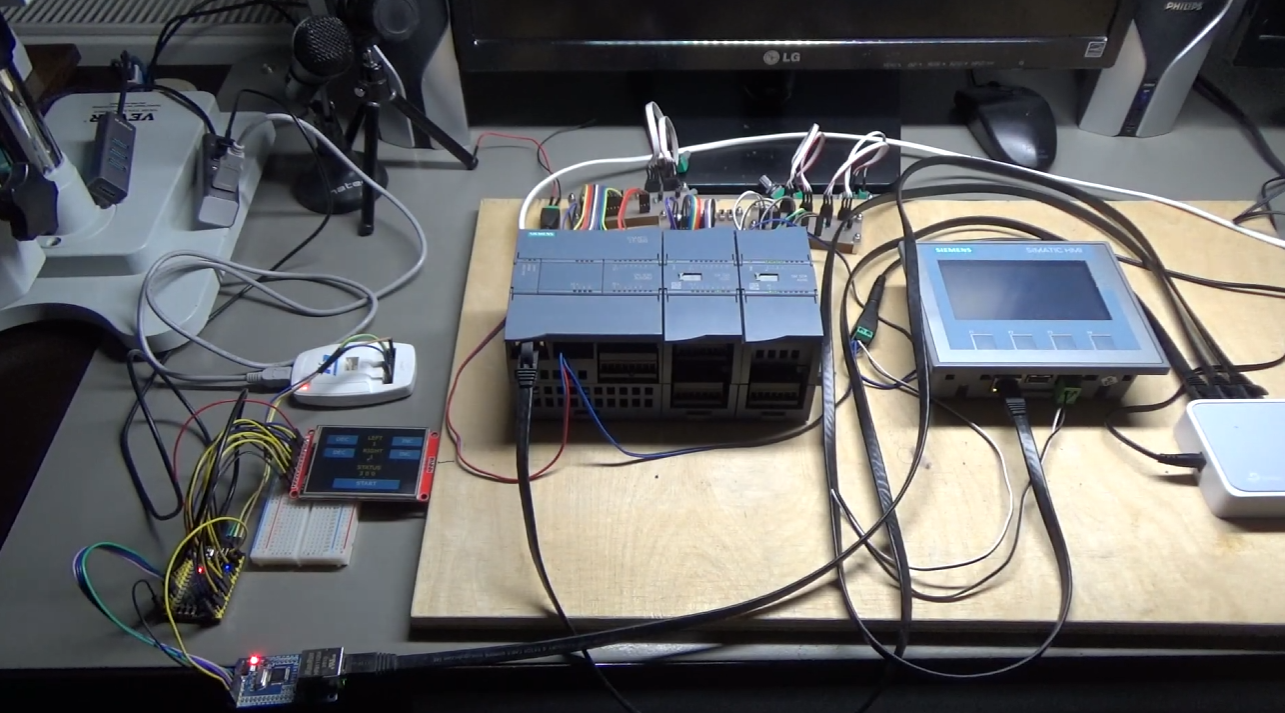
Project Overview and Industrial Context
In industrial automation environments, Siemens S7-1200 PLCs are commonly controlled through dedicated Siemens HMI panels. While these HMIs are robust, they often introduce limitations in terms of customization cost, UI flexibility, and system scalability.
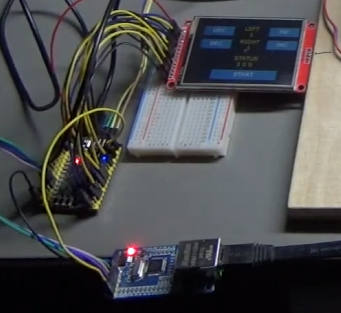
This project presents an alternative architecture:
a custom Ethernet-based HMI/control node built around an STM32H5 MCU, an XPT2046 touch display, and a WIZnet W5500 Ethernet controller.
The system operates entirely within a local LAN. When a user touches the display, the STM32H5 interprets the input and generates a predefined LAN command. This command is transmitted via the W5500 to a Siemens S7-1200 PLC on the same network. The PLC then executes deterministic control logic, such as opening and closing a specific relay a defined number of times.
From an industrial perspective, this architecture preserves the PLC’s core logic and reliability while enabling flexible, cost-effective, and highly customizable external control interfaces.
Why WIZnet W5500 Is Technically Essential
In this project, the W5500 is not a generic Ethernet interface—it is a critical industrial transport component.
Key Technical Role
Acts as the hardware TCP/IP transport layer between STM32H5 and Siemens S7-1200
Offloads all TCP/IP processing from the MCU
Ensures predictable, low-jitter Ethernet communication
Why Hardware TCP/IP Matters Here
PLC control over Ethernet is sensitive to:
Latency variation (jitter)
Packet loss
Unpredictable CPU load
Using a software TCP/IP stack (such as LwIP) on the MCU would introduce:
Increased CPU utilization
Timing variability during UI and protocol handling
More complex real-time scheduling
By contrast, the W5500 provides:
A fully hardwired TCP/IP stack
8 independent hardware sockets
32 KB internal buffer memory
Deterministic Ethernet behavior suitable for industrial LANs
This allows the STM32H5 to focus on:
Touch input processing (XPT2046)
Command logic and protocol framing
System-level reliability
While the W5500 handles Ethernet communication independently.
System Architecture Explanation
Input Layer
XPT2046 resistive touch controller
Connected to STM32H5 via SPI
Provides precise user input suitable for industrial environments (gloves, noise immunity)
Control & Logic Layer
STM32H5 MCU
Translates touch events into predefined PLC commands
Maintains application logic without networking overhead
Network Transport Layer
WIZnet W5500 Ethernet Controller
SPI-connected to STM32H5
Handles all TCP/IP and socket management in hardware
PLC Execution Layer
Siemens S7-1200
Receives LAN commands
Executes deterministic relay control logic
Maintains safety and sequencing within PLC program
This separation of responsibilities aligns well with industrial design principles: deterministic control, predictable communication, and clear functional boundaries.
Industrial Value Proposition
This project highlights several important industrial advantages:
HMI Cost Reduction
Custom MCU-based HMIs can be significantly cheaper than proprietary panels while still maintaining industrial-grade Ethernet communication.
UI and Function Customization
The STM32-based interface allows rapid changes to UI layout, workflows, and command mapping without modifying PLC hardware.
Ethernet Reliability Over Wi-Fi
In electrically noisy factory environments, wired Ethernet provides stable, interference-free communication essential for control systems.
IT/OT Network Integration
Ethernet-based PLC control simplifies integration with higher-level monitoring systems and industrial networks.
Author Background
The project is developed by microtronics.pl, a company and technical team specializing in professional electronics and industrial automation solutions.
According to their published scope of work, microtronics.pl provides:
Industrial Electronics Design
Designing industrial-grade electronic circuits using leading-edge technologies, with a focus on reliability and long-term operation.
Consumer Electronics Design
Development of consumer electronics circuits for various device categories, balancing performance and manufacturability.
Electronics Production and Drivers
Providing electronic drivers and circuit production services for embedded and industrial devices.
Industrial Automation Design
Designing industrial automation systems based on Siemens solutions, including PLC-based control architectures.
This background explains the project’s strong alignment with real industrial requirements, particularly its integration with Siemens S7-1200 PLCs and emphasis on wired Ethernet reliability.
FAQ
Q: Why use WIZnet W5500 instead of a software TCP/IP stack?
A: The W5500 provides a fully hardwired TCP/IP stack, eliminating CPU load and timing variability associated with software stacks like LwIP. This is critical for deterministic PLC control where communication jitter can affect relay sequencing and system reliability.
Q: How is the STM32H5 connected to the Siemens S7-1200?
A: The STM32H5 communicates with the S7-1200 over wired Ethernet using the W5500. Both devices are connected to the same LAN, allowing direct TCP/IP-based command exchange.
Q: What role does the W5500 play in this project?
A: The W5500 acts as the Ethernet transport layer, handling socket management and TCP/IP communication in hardware so the MCU can focus on UI input and control logic.
Q: Why is Ethernet preferred over Wi-Fi in this industrial setup?
A: Ethernet provides predictable latency, immunity to wireless interference, and stable long-term connections, all of which are essential in factory and automation environments.
Q: Could this system be simplified using W55RP20?
A: Yes. W55RP20 integrates an RP2040 MCU and W5500 Ethernet controller into a single chip, reducing BOM cost and PCB complexity for similar industrial control nodes.
Korean version
W5500과 STM32H5로 Siemens S7-1200 PLC를 LAN 제어하는 방법
프로젝트 요약 (Project Summary)
이 프로젝트는 STM32H5 기반의 커스텀 터치 컨트롤러가 LAN 명령어를 통해 Siemens S7-1200 PLC를 제어하는 산업용 이더넷 제어 시스템을 보여줍니다. WIZnet W5500 하드웨어 TCP/IP 이더넷 컨트롤러를 사용함으로써, 전용 Siemens HMI 패널에 의존하지 않고도 신뢰성과 결정론적 동작을 갖춘 PLC 제어를 구현합니다.
프로젝트 개요 및 산업적 배경
산업 자동화 환경에서 Siemens S7-1200 PLC는 일반적으로 전용 Siemens HMI 패널을 통해 제어됩니다. 이러한 HMI는 높은 신뢰성을 제공하지만, UI 커스터마이징, 비용, 시스템 확장성 측면에서는 제약이 따르는 경우가 많습니다.
이 프로젝트는 이러한 구조에 대한 대안으로,
STM32H5 MCU, XPT2046 터치 디스플레이, WIZnet W5500 이더넷 컨트롤러로 구성된
커스텀 이더넷 기반 HMI / 제어 노드 아키텍처를 제시합니다.
시스템은 동일한 로컬 LAN 환경에서 동작합니다. 사용자가 터치 디스플레이를 통해 입력을 하면, STM32H5는 해당 입력을 PLC가 인식할 수 있는 사전 정의된 LAN 명령어로 변환합니다. 이 명령어는 W5500을 통해 같은 네트워크에 연결된 Siemens S7-1200 PLC로 전송되며, PLC는 이에 대응하는 제어 로직을 실행합니다.
PLC 측에서는 특정 릴레이를 정해진 횟수와 시퀀스로 On/Off 하는 등, 결정론적 제어 동작을 수행합니다.
산업적 관점에서 볼 때, 이 구조는 PLC의 핵심 제어 로직과 안정성은 그대로 유지하면서도, 비용 효율적이고 유연한 외부 제어 인터페이스를 추가할 수 있는 실용적인 접근 방식입니다.
왜 WIZnet W5500이 중요한가
이 프로젝트에서 W5500은 단순한 “이더넷 인터페이스 칩”이 아닙니다.
산업용 이더넷 통신을 위한 핵심 전송 계층(Transport Layer) 역할을 수행합니다.
핵심 기술적 역할
STM32H5와 Siemens S7-1200 사이의 하드웨어 TCP/IP 전송 계층
MCU에서 TCP/IP 처리를 완전히 오프로딩
지연 시간과 지터가 예측 가능한 안정적인 Ethernet 통신 제공
시스템 아키텍처 설명
입력
XPT2046 저항막 방식 터치 컨트롤러
STM32H5와 SPI 인터페이스로 연결
장갑 착용, 노이즈 환경에서도 안정적인 입력 제공
제어 및 로직
STM32H5 MCU
터치 이벤트를 PLC 제어 명령으로 변환
네트워크 처리 부담 없이 애플리케이션 로직 수행
네트워크 전송
WIZnet W5500 이더넷 컨트롤러
SPI 인터페이스로 STM32H5와 연결
TCP/IP 및 소켓 관리 기능을 하드웨어에서 처리
PLC 실행
Siemens S7-1200 PLC
LAN 명령어 수신
릴레이 제어 등 결정론적 제어 로직 수행
안전성과 시퀀스 제어는 PLC 내부 로직으로 유지
이와 같은 역할 분리는 산업 제어 시스템에서 요구되는
결정론성, 신뢰성, 명확한 기능 분리를 잘 충족합니다.
산업적 가치 (Industrial Value Proposition)
이 프로젝트는 다음과 같은 산업적 장점을 명확히 보여줍니다.
HMI 비용 절감
MCU 기반 커스텀 HMI는 전용 패널 대비 비용을 크게 절감하면서도 산업용 이더넷 통신을 유지할 수 있습니다.
UI 및 기능 커스터마이징 용이성
STM32 기반 구조를 통해 UI 레이아웃과 제어 시퀀스를 빠르게 변경할 수 있으며, PLC 하드웨어 변경이 필요 없습니다.
Wi-Fi 대비 유선 Ethernet의 신뢰성
공장 환경의 전기적 노이즈와 간섭 조건에서 유선 Ethernet은 안정적이고 예측 가능한 통신을 제공합니다.
IT/OT 네트워크 통합 용이성
Ethernet 기반 제어 구조는 상위 모니터링 시스템 및 산업 네트워크와의 통합을 단순화합니다.
저자 소개
저자는 Krzysztof Cyganek라는 폴란드 국적의 개발자로 microtronics.pl 라는 웹 페이지를 운영하고 있습니다.
microtronics.pl는 다음과 같은 서비스를 제공하고 있습니다.
저자 웹사이트:
산업용 전자 회로 설계
최신 기술을 활용한 산업용 전자 회로 설계, 장기 신뢰성과 안정성에 중점
소비자 전자 회로 설계
다양한 디바이스를 위한 소비자 전자 제품 회로 설계
전자 회로 생산 및 드라이버 제공
임베디드 및 산업용 장치를 위한 전자 드라이버 및 회로 생산
산업 자동화 설계
Siemens 솔루션 기반의 산업 자동화 시스템 설계
이러한 배경은 본 프로젝트가 단순한 데모가 아니라, 실제 산업 환경 요구사항을 충실히 반영하고 있음을 잘 보여줍니다.
FAQ
Q: 왜 소프트웨어 TCP/IP 대신 WIZnet W5500을 사용하나요?
A: W5500은 하드웨어 TCP/IP 스택을 제공하여 LwIP와 같은 소프트웨어 스택 대비 CPU 부하와 타이밍 변동을 제거합니다. 이는 릴레이 시퀀스 제어와 같은 결정론적 PLC 제어에 매우 중요합니다.
Q: STM32H5는 Siemens S7-1200과 어떻게 연결되나요?
A: STM32H5는 W5500을 통해 유선 Ethernet으로 S7-1200과 연결되며, 동일한 LAN 환경에서 TCP/IP 기반 명령어를 주고받습니다.
Q: 이 프로젝트에서 W5500의 역할은 무엇인가요?
A: W5500은 Ethernet 전송 계층을 담당하며, 소켓 관리와 TCP/IP 처리를 하드웨어에서 수행합니다.
Q: 산업 환경에서 Wi-Fi 대신 Ethernet을 사용하는 이유는 무엇인가요?
A: Ethernet은 지연 시간 예측이 가능하고 무선 간섭에 영향을 받지 않기 때문에, 장시간 안정적인 제어가 요구되는 산업 환경에 적합합니다.
Q: W55RP20으로도 구현이 가능한가요?
A: 가능합니다. W55RP20은 RP2040 MCU와 W5500을 단일 칩으로 통합한 솔루션으로, 유사한 제어 노드에서 BOM 비용과 PCB 복잡도를 줄일 수 있습니다.