



ESP32-S3 Voice Assistant
ESP32-S3 Voice Assistant
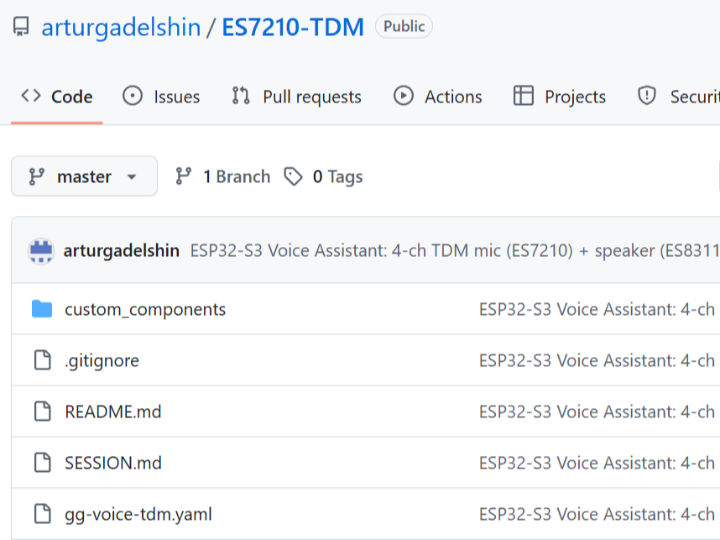
How to Capture Multi-Channel Audio with ES7210 TDM on ESP32?
Summary
This project demonstrates how to interface the ES7210 multi-channel audio ADC with ESP32 using TDM (Time Division Multiplexing) mode. The system is designed for synchronized microphone array input, enabling applications such as voice assistants, beamforming, wake-word detection, and far-field audio processing. Instead of standard stereo I2S audio, the project focuses on deterministic multi-channel microphone capture for DSP-oriented voice systems.
What the Project Does
The repository implements a multi-channel audio input pipeline using the ES7210 audio ADC and the ESP32 I2S peripheral configured in TDM mode.
The system architecture is structured as follows:
MEMS Microphones
        ↓
ES7210 Audio ADC
        ↓ (TDM Stream)
ESP32 I2S Peripheral
        ↓
PCM Audio Data
Unlike conventional stereo audio systems, this implementation is designed for microphone array synchronization. Multiple microphones share a single serial audio stream through TDM slot allocation.
This structure is commonly used in:
- Voice assistant front-ends
- Beamforming systems
- Noise suppression pipelines
- Direction-of-arrival estimation
- Wake-word detection systems
The important distinction is that the project is not a complete voice assistant implementation. Instead, it provides the synchronized audio acquisition layer required by voice AI frameworks.
Where WIZnet Fits
This project does not currently use WIZnet products.
However, the architecture strongly relates to Ethernet-based embedded voice systems where deterministic latency and stable streaming are important.
A practical WIZnet integration approach would be:
Microphone Array
        ↓
ESP32 + ES7210
        ↓
W5500 Ethernet Controller
        ↓
Voice Processing Server / Edge AI
In embedded voice systems, Wi-Fi can introduce:
- RF interference
- DMA contention
- Variable latency
- Packet jitter
These issues become more visible when:
- multiple microphone channels are active,
- DSP processing is continuous,
- real-time wake-word detection is required.
A W5500-based Ethernet architecture can reduce CPU overhead by using hardware TCP/IP offload while also providing more deterministic transport behavior than Wi-Fi-based streaming.
For industrial voice terminals or edge AI gateways, this is often preferable to wireless transport.
Implementation Notes
The repository configures the ESP32 I2S peripheral for TDM audio capture from the ES7210 ADC.
Example structure observed in the project:
// Configure ESP32 I2S in TDM mode
i2s_config.mode = I2S_MODE_MASTER | I2S_MODE_RX;
i2s_config.channel_format = I2S_CHANNEL_FMT_MULTIPLE;
i2s_config.bits_per_sample = I2S_BITS_PER_SAMPLE_32BIT;
Source:
main/*.c
This configuration enables multiple microphone channels to be packed into a single synchronized audio frame.
The ES7210 operates as a multi-channel ADC:
Slot0 → Mic1
Slot1 → Mic2
Slot2 → Mic3
Slot3 → Mic4
This synchronization is important for:
- beamforming,
- phase alignment,
- direction estimation,
- echo cancellation.
The project also configures DMA buffering to continuously stream PCM audio from the ESP32 peripheral.
Because TDM increases audio bandwidth significantly compared to stereo I2S, DMA stability and clock quality become important engineering constraints.
Practical Tips / Pitfalls
- TDM requires stable BCLK and LRCK timing; clock jitter directly affects microphone phase alignment.
- ESP32 DMA buffer sizing is critical for multi-channel audio stability.
- Long microphone traces can introduce synchronization noise and EMI issues.
- Wi-Fi activity on ESP32 can interfere with real-time audio DMA performance.
- 32-bit TDM samples significantly increase memory bandwidth requirements.
- Beamforming quality depends heavily on microphone spacing consistency.
- External Ethernet transport can improve reliability in industrial voice systems.
FAQ
Q: Why use ES7210 instead of a standard stereo codec?
A: ES7210 supports synchronized multi-channel microphone acquisition, which is required for beamforming and far-field voice processing. Standard stereo codecs are usually limited to two audio channels.
Q: Why is TDM important in voice assistant systems?
A: Voice assistants rely on multiple microphones to perform direction estimation, noise suppression, and wake-word enhancement. TDM allows all microphone channels to remain sample-synchronized within a single audio frame.
Q: How does ES7210 connect to ESP32?
A: The ES7210 connects through the ESP32 I2S peripheral configured in TDM mode. The interface typically uses BCLK, LRCK, DATA, and optionally MCLK depending on clock configuration.
Q: What role does this project play in a voice assistant architecture?
A: This project implements the audio front-end layer. It captures synchronized microphone data before higher-level DSP or AI frameworks process the audio stream.
Q: Why consider Ethernet instead of Wi-Fi for voice systems?
A: Real-time multi-channel audio systems are sensitive to latency variation and RF interference. Ethernet provides more deterministic transport behavior and avoids many Wi-Fi coexistence issues during continuous DSP streaming.
Source
Original Project:
License:
- Refer to the original repository license.
Tags
#ESP32 #ES7210 #TDM #I2S #VoiceAssistant #Beamforming #AudioDSP #MicrophoneArray #EmbeddedAudio #W5500
ES7210 TDM으로 ESP32에서 멀티채널 오디오를 수집하는 방법
Summary
이 프로젝트는 ES7210 멀티채널 오디오 ADC를 ESP32와 TDM(Time Division Multiplexing) 방식으로 연결하는 방법을 보여줍니다. 시스템은 동기화된 마이크 배열 입력을 목표로 하며, Voice Assistant, 빔포밍, 웨이크워드 감지, 원거리 음성 인식과 같은 오디오 DSP 시스템의 프론트엔드 구조에 적합합니다. 일반적인 스테레오 I2S 오디오가 아니라, 다채널 음성 수집 인프라 구현에 초점이 맞춰져 있습니다.
What the Project Does
이 저장소는 ES7210 오디오 ADC와 ESP32 I2S 주변장치를 이용해 멀티채널 오디오 입력 파이프라인을 구현합니다.
시스템 구조는 다음과 같습니다.
MEMS 마이크
      ↓
ES7210 오디오 ADC
      ↓ (TDM 스트림)
ESP32 I2S Peripheral
      ↓
PCM 오디오 데이터
일반적인 스테레오 오디오 시스템과 달리, 이 프로젝트는 여러 개의 마이크 입력을 정확히 동기화하는 데 목적이 있습니다.
TDM 슬롯 구조를 이용해 하나의 직렬 데이터 스트림으로 여러 채널을 전송합니다.
이 구조는 다음과 같은 시스템에서 자주 사용됩니다.
- Voice Assistant 프론트엔드
- Beamforming 시스템
- 노이즈 제거 시스템
- 음성 방향 추정
- Wake-word Detection
중요한 점은, 이 프로젝트 자체가 완성형 Voice Assistant는 아니라는 것입니다.
대신 Voice AI 프레임워크가 필요로 하는 “동기화된 오디오 입력 계층”을 구현하는 프로젝트에 가깝습니다.
Where WIZnet Fits
이 프로젝트는 현재 WIZnet 제품을 직접 사용하지 않습니다.
하지만 구조적으로는 Ethernet 기반 임베디드 음성 시스템과 매우 밀접한 관련이 있습니다.
예를 들면 다음과 같은 구조로 확장할 수 있습니다.
마이크 배열
      ↓
ESP32 + ES7210
      ↓
W5500 Ethernet Controller
      ↓
Voice Processing Server / Edge AI
실시간 음성 시스템에서 Wi-Fi는 다음 문제를 유발할 수 있습니다.
- RF 간섭
- DMA 충돌
- 지연시간 변동
- 패킷 지터
특히:
- 멀티채널 마이크 입력,
- 지속적인 DSP 처리,
- 실시간 웨이크워드 감지
같은 조건에서는 문제가 더 커집니다.
W5500 기반 Ethernet 구조는:
- 하드웨어 TCP/IP 오프로딩,
- 안정적인 유선 연결,
- 결정론적 전송 지연
측면에서 산업용 음성 시스템에 더 적합할 수 있습니다.
Implementation Notes
저장소는 ESP32 I2S 주변장치를 TDM 모드로 설정하여 ES7210 데이터를 수신합니다.
프로젝트에서 확인되는 구조 예시는 다음과 같습니다.
// ESP32 I2S TDM 모드 설정
i2s_config.mode = I2S_MODE_MASTER | I2S_MODE_RX;
i2s_config.channel_format = I2S_CHANNEL_FMT_MULTIPLE;
i2s_config.bits_per_sample = I2S_BITS_PER_SAMPLE_32BIT;
Source:
main/*.c
이 설정을 통해 여러 마이크 채널이 하나의 동기화된 프레임으로 전송됩니다.
ES7210은 다음과 같이 동작합니다.
Slot0 → Mic1
Slot1 → Mic2
Slot2 → Mic3
Slot3 → Mic4
이 구조는 다음 기능에 매우 중요합니다.
- 빔포밍
- 위상 정렬
- 방향 추정
- 에코 제거
프로젝트는 DMA 버퍼를 사용해 PCM 오디오 데이터를 지속적으로 스트리밍합니다.
TDM은 일반 스테레오 I2S보다 훨씬 높은 데이터 대역폭을 사용하기 때문에:
- DMA 안정성
- 클럭 품질
- 메모리 처리량
이 중요한 설계 요소가 됩니다.
Practical Tips / Pitfalls
- TDM에서는 BCLK/LRCK 클럭 안정성이 매우 중요합니다.
- ESP32 DMA 버퍼 크기가 작으면 오디오 드롭이 발생할 수 있습니다.
- 긴 마이크 배선은 EMI 및 위상 오차를 유발할 수 있습니다.
- ESP32 Wi-Fi 동작은 실시간 오디오 DMA와 충돌할 수 있습니다.
- 32bit 멀티채널 샘플은 메모리 대역폭 사용량이 큽니다.
- Beamforming 정확도는 마이크 배열 정렬 품질에 크게 영향을 받습니다.
- 산업용 시스템에서는 Ethernet 기반 스트리밍이 더 안정적일 수 있습니다.
FAQ
Q: 왜 일반 스테레오 코덱 대신 ES7210을 사용하나요?
A: ES7210은 동기화된 멀티채널 마이크 입력을 지원하기 때문에 Beamforming 및 Far-field Voice Processing에 적합합니다. 일반 스테레오 코덱은 보통 2채널까지만 지원합니다.
Q: Voice Assistant에서 왜 TDM이 중요한가요?
A: Voice Assistant는 여러 마이크를 사용해 방향 추정, 노이즈 제거, 웨이크워드 강화 처리를 수행합니다. TDM은 모든 마이크 샘플을 동일한 프레임 안에서 동기화할 수 있습니다.
Q: ES7210은 ESP32와 어떻게 연결되나요?
A: ESP32의 I2S Peripheral을 TDM 모드로 설정하여 연결합니다. 일반적으로 BCLK, LRCK, DATA, 그리고 경우에 따라 MCLK를 사용합니다.
Q: 이 프로젝트는 Voice Assistant 구조에서 어떤 역할을 하나요?
A: 이 프로젝트는 오디오 프론트엔드 계층 역할을 합니다. DSP 또는 AI 엔진이 처리하기 전에 동기화된 마이크 데이터를 수집하는 역할입니다.
Q: 왜 Wi-Fi 대신 Ethernet을 고려하나요?
A: 멀티채널 실시간 오디오 시스템은 지연시간 변동과 RF 간섭에 민감합니다. Ethernet은 보다 안정적이고 결정론적인 데이터 전송 환경을 제공합니다.
Source
Original Project:
License:
- 원본 저장소 라이선스 참고
Tags
#ESP32 #ES7210 #TDM #I2S #VoiceAssistant #Beamforming #AudioDSP #MicrophoneArray #EmbeddedAudio #W5500