


ESP USBIP bridge
ESP USBIP bridge
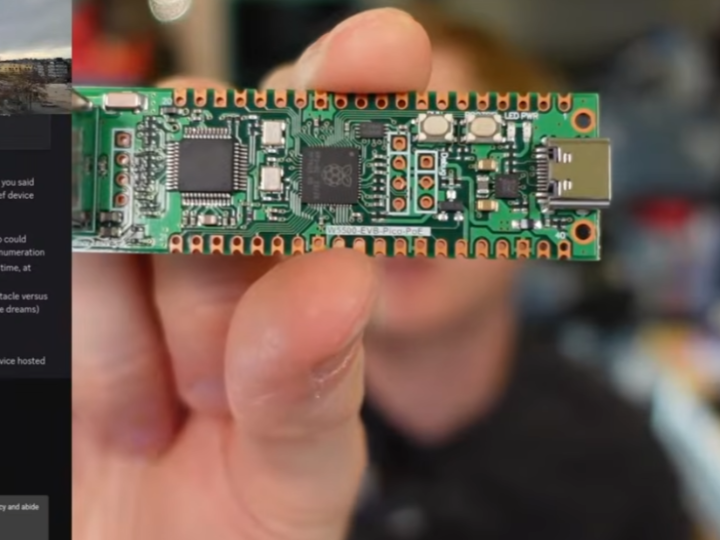

WIZnet - W5500-EVB-Pico-PoE
x 1

How to Build a USB/IP Hardware Test Bridge and Why Use W5500-EVB-PICO for Ethernet Stability?
Summary
This project, presented by an Adafruit engineer, demonstrates how to build a hardware-in-the-loop testing system using a USB/IP bridge on ESP32-P4 while exploring Ethernet-based expansion using W5500-EVB-PICO. The W5500 enables stable, deterministic network communication, complementing USB-based device control in distributed embedded testing environments.
What the Project Does
This video is a technical deep dive session from Adafruit, led by Scott Shawcroft, a core CircuitPython developer. It focuses on a real engineering problem emerging in modern workflows: rapid code generation using LLMs without sufficient validation on actual hardware.
As stated in the stream, large amounts of code are now generated automatically, but verifying whether that code works on real devices remains a critical gap.
To address this, the project builds a hardware-in-the-loop (HIL) testing system that:
- Deploys generated firmware to real devices
- Controls them remotely using USB/IP
- Validates behavior through automated interaction
The system architecture includes:
- USB/IP bridge for remote USB device access
- ESP32-P4 boards acting as isolated test nodes
- Python tools (pyusb, pyserial) for host-side control
The goal is to eliminate dependency on host OS USB stacks and enable scalable, distributed hardware testing.
Where WIZnet Fits
W5500-EVB-PICO Role
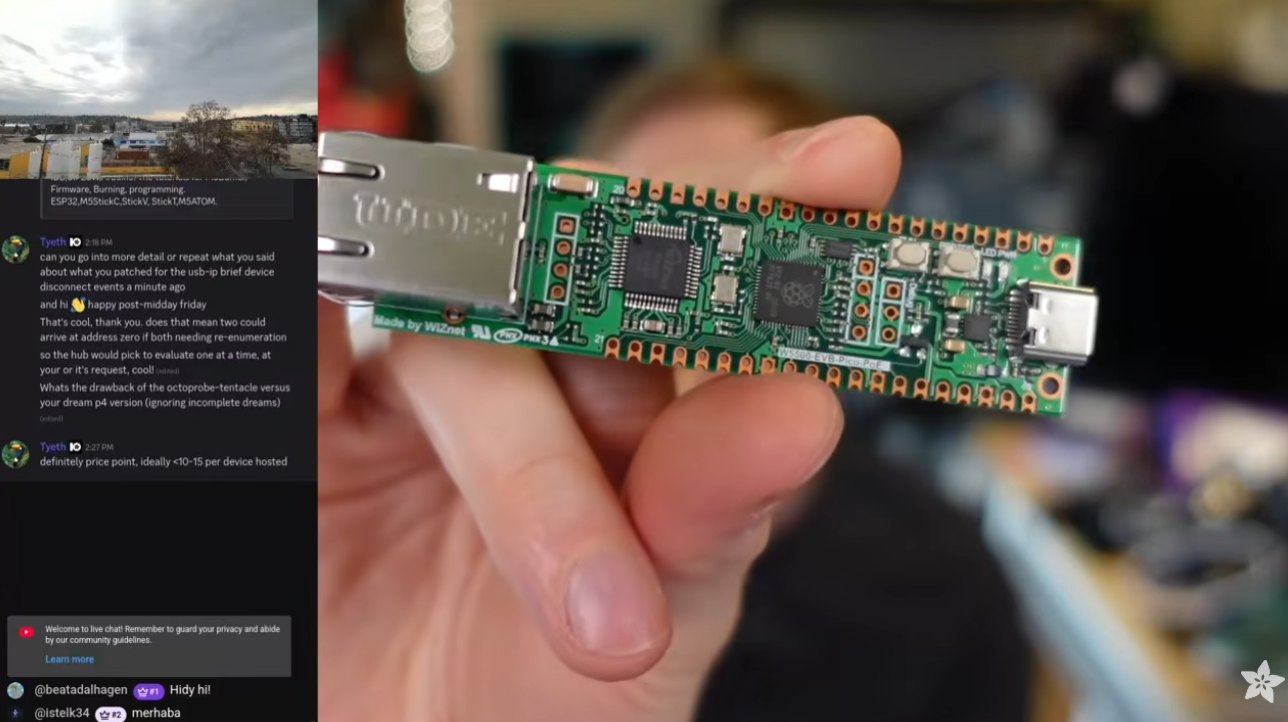
During the development discussion, Scott introduces a W5500-based RP2040 board (W5500-EVB-PICO) as part of expanding the testing infrastructure beyond USB.
He explicitly mentions exploring Ethernet as an alternative transport:
- “I really wanted to do ethernet or Wi-Fi”
Why W5500 Was Mentioned
The mention of W5500 reflects a shift in system design rather than a simple hardware showcase.
1. USB-Centric Limitations
- Tight coupling with host systems
- Dependency on OS-level USB behavior
- Difficult to scale across multiple test setups
2. Wi-Fi Constraints
- Variable latency
- Susceptibility to interference
- Reduced repeatability in automated tests
3. Need for Deterministic Networking
For automated hardware validation, consistent behavior is critical. This is where Ethernet becomes relevant.
W5500 fits this requirement because:
- It provides hardware TCP/IP offload
- It reduces processing burden on microcontrollers like RP2040
- It enables stable, repeatable communication across test nodes
How It Is Used in This Project
The W5500-EVB-PICO is positioned as a network-connected test node within the broader system.
Conceptually, the structure becomes:
- A host system sends commands over TCP/IP
- The W5500-enabled board receives and processes them
- The target device is controlled and validated remotely
Additionally, Scott notes that the board is supported by Zephyr and mentions plans to create a board definition with Ethernet support.
This indicates that the W5500 is intended to be integrated into a standardized RTOS-based testing framework, not just used as a standalone networking add-on.
Implementation Notes
The video does not provide a direct implementation of W5500 within the project. Instead, its role is architectural.
In this context:
- W5500 handles network communication
- The microcontroller handles test orchestration
- The host interacts through Python-based tooling
This separation allows:
- Independent scaling of test nodes
- Reduced reliance on complex OS-level networking
- Consistent behavior across different hardware environments
Practical Tips / Pitfalls
- Use Ethernet for test infrastructure when repeatability is critical
- Avoid mixing unstable USB hubs in automated test setups
- Monitor physical link status to prevent silent failures
- Prefer static IP configurations in CI environments
- Design test nodes to operate independently from host systems
- Combine network-based control with watchdog mechanisms for recovery
FAQ
Q: Why use W5500 in this project?
A: It provides hardware TCP/IP offload and stable Ethernet communication, which is essential for deterministic and repeatable hardware testing environments.
Q: How does W5500 connect to the platform?
A: It connects via SPI, allowing integration with microcontrollers like RP2040 without requiring complex peripherals.
Q: What role does W5500 play here?
A: It acts as the network transport layer, enabling remote control and communication with hardware test nodes.
Q: Can beginners follow this project?
A: It requires knowledge of embedded systems, networking, and hardware interfacing, making it more suitable for intermediate developers.
Q: Why not use Wi-Fi instead of Ethernet?
A: Wi-Fi introduces variable latency and instability, while Ethernet provides consistent timing and reliability, which are critical for automated testing.
Source
- Original Video: https://www.youtube.com/watch?v=bUYch0IhCsE&t=1760s
- Transcript: Provided by user
- Platform: Adafruit Deep Dive (Scott Shawcroft)
Tags
#W5500 #W5500-EVB-PICO #RP2040 #Ethernet #USBIP #HardwareTesting #CircuitPython #EmbeddedSystems #Zephyr #IoT
How to Build a USB/IP Hardware Test Bridge and Why Use W5500-EVB-PICO for Ethernet Stability?
Summary
이 프로젝트는 Adafruit 엔지니어가 ESP32-P4 기반 USB/IP 브리지를 활용해 하드웨어 테스트 자동화 환경을 구축하는 과정을 다룹니다. 동시에 W5500-EVB-PICO를 통해 Ethernet 기반 테스트 노드를 확장하여, USB 중심 제어에 더해 안정적이고 재현 가능한 네트워크 기반 검증 환경을 구성하는 것이 핵심입니다.
What the Project Does
이 영상은 Adafruit의 Scott Shawcroft가 진행한 기술 라이브 스트림으로, CircuitPython 개발 과정에서 발생하는 하드웨어 검증 문제를 해결하기 위한 실제 개발 과정을 다룹니다.
핵심 문제는 다음과 같습니다:
- LLM을 통해 코드 생성 속도는 크게 증가했지만
- 생성된 코드가 실제 하드웨어에서 제대로 동작하는지 검증되지 않는 경우가 많음
이를 해결하기 위해 Scott은 hardware-in-the-loop (HIL) 테스트 시스템을 구축합니다. 이 시스템은:
- 생성된 코드를 실제 디바이스에 업로드하고
- USB/IP를 통해 원격 제어하며
- 실제 동작 결과를 기반으로 검증하는 구조입니다
주요 구성은 다음과 같습니다:
- USB/IP 브리지 → USB 장치를 TCP/IP로 원격 제어
- ESP32-P4 보드 → 독립적인 테스트 노드
- Python(pyusb, pyserial) → 호스트 측 제어 인터페이스
결과적으로, 운영체제의 USB 스택에 의존하지 않고도 여러 디바이스를 동시에 테스트할 수 있는 분산형 하드웨어 테스트 환경을 만드는 것이 목표입니다.
Where WIZnet Fits
W5500-EVB-PICO의 역할
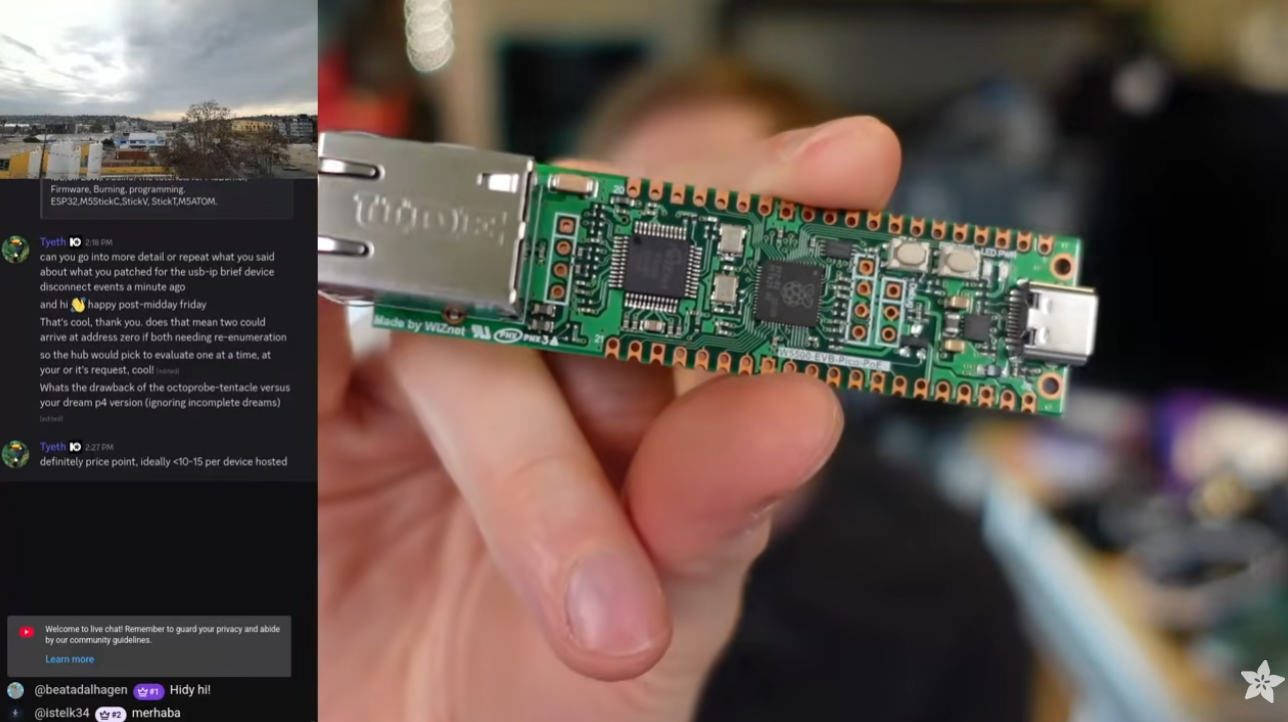
영상 중 Scott은 RP2040 기반 W5500 Ethernet 보드를 소개하며, 테스트 환경을 USB에서 네트워크로 확장하려는 방향을 명확히 합니다.
- “I really wanted to do ethernet or Wi-Fi”
이 발언은 단순한 선택이 아니라, 테스트 시스템 구조를 바꾸려는 의도를 보여줍니다.
왜 W5500이 언급되었는가
1. USB 기반 구조의 한계
- 호스트 OS에 의존적
- USB 스택 변화에 취약
- 테스트 환경 확장 어려움
2. Wi-Fi의 문제
- 지연 시간 변동 (비결정성)
- 환경에 따른 연결 불안정
- 테스트 결과 재현성 저하
3. Ethernet 기반 접근 필요
자동화 테스트에서는 항상 동일한 조건이 중요합니다.
W5500이 적합한 이유:
- 하드웨어 TCP/IP 오프로드로 MCU 부담 감소
- 일정한 네트워크 성능 제공
- 테스트 결과의 재현성 확보
즉,
“테스트 인프라에서는 빠른 것보다 ‘항상 동일하게 동작하는 것’이 더 중요하며, 이를 위해 Ethernet이 필요하다”
어떻게 사용되는가
W5500-EVB-PICO는 이 프로젝트에서 네트워크 기반 테스트 노드로 사용됩니다.
구조적으로는:
- 호스트 시스템이 TCP/IP로 명령을 전송
- W5500 보드가 이를 수신
- 연결된 디바이스를 제어하고 결과를 반환
또한 Scott은 다음과 같이 언급합니다:
- Zephyr RTOS 지원
- Ethernet 기반 보드 정의(board definition) 제작 계획
이는 단순 연결을 넘어서:
→ RTOS 기반 표준 테스트 플랫폼으로 확장하려는 방향
을 의미합니다.
Implementation Notes
영상에서는 W5500을 실제 코드 수준으로 구현하지는 않으며,
테스트 시스템 전체 구조 속에서의 역할을 설명하는 데 집중합니다.
이 구조에서의 역할 분리는 다음과 같습니다:
- W5500 → 네트워크 통신 담당
- MCU → 테스트 로직 실행
- 호스트 → 제어 및 자동화
이러한 구조의 장점:
- 테스트 노드 독립 운영 가능
- OS 의존성 감소
- 대규모 테스트 환경으로 확장 용이
Practical Tips / Pitfalls
- 테스트 자동화에서는 Wi-Fi보다 Ethernet 사용이 유리
- USB 허브 품질에 따라 테스트 안정성이 크게 달라질 수 있음
- 네트워크 링크 상태(물리 연결)를 반드시 확인해야 함
- 반복 가능한 테스트를 위해 고정 IP 설정 권장
- 테스트 노드는 가능한 독립적으로 동작하도록 설계
- 네트워크 장애 대비 watchdog 구성 필요
FAQ
Q: 왜 W5500을 사용하나요?
A: 하드웨어 TCP/IP 스택을 통해 MCU 부하를 줄이고, 자동화 테스트에 필요한 안정적이고 예측 가능한 네트워크 환경을 제공하기 때문입니다.
Q: W5500은 어떻게 연결되나요?
A: SPI 인터페이스를 통해 RP2040과 연결되며, 적은 핀으로 간단하게 통신이 가능합니다.
Q: 이 프로젝트에서 W5500의 역할은 무엇인가요?
A: 테스트 노드를 네트워크에 연결하여 원격 제어와 자동 검증을 가능하게 하는 통신 계층 역할을 합니다.
Q: 초보자도 따라할 수 있나요?
A: 임베디드 개발, SPI 통신, 네트워크 개념에 대한 이해가 필요하며 중급 이상 수준이 적합합니다.
Q: Wi-Fi 대신 Ethernet을 사용하는 이유는 무엇인가요?
A: Wi-Fi는 지연과 안정성이 환경에 따라 달라지지만, Ethernet은 일정한 성능을 제공하여 테스트 결과의 재현성을 확보할 수 있습니다.
Source
- Original Video: https://www.youtube.com/watch?v=bUYch0IhCsE&t=1760s
- Transcript: Provided by user
- Platform: Adafruit Deep Dive (Scott Shawcroft)
Tags
#W5500 #W5500-EVB-PICO #RP2040 #Ethernet #USBIP #HardwareTesting #CircuitPython #EmbeddedSystems #Zephyr #IoT