



cikon-iot-solution
cikon-iot-solution
How to Build a Stable Home IoT System with Ethernet-Based Networking?
Summary
The cikon-iot-solution project demonstrates a Home IoT architecture designed for reliable device communication, centralized monitoring, and embedded network control. In Home IoT environments where sensors, gateways, and controllers operate continuously, Ethernet-based networking using WIZnet hardware can reduce wireless instability, simplify recovery logic, and lower MCU networking overhead through hardware TCP/IP offloading. This approach is well suited for smart lighting, environmental monitoring, appliance control, and local automation systems.
What the Project Does
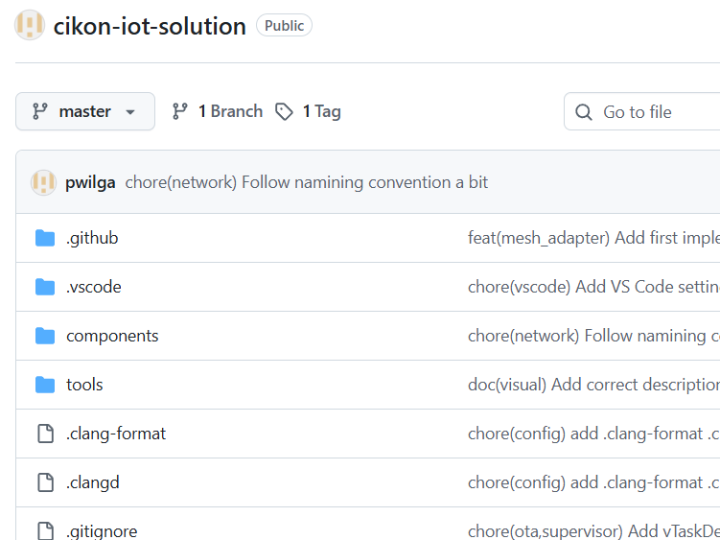
The cikon-iot-solution repository appears to target an IoT automation environment that combines embedded control, network communication, and device management into a unified system.
From a system architecture perspective, the project follows a typical Home IoT workflow:
- Embedded devices collect sensor or status data
- Data is transmitted through the network layer
- A central application or gateway processes events
- Control commands are returned to edge devices
This structure can support several Home IoT scenarios:
- Smart lighting control
- Temperature and humidity monitoring
- Energy management
- Occupancy and access sensing
- Device scheduling
- Local dashboard integration
- MQTT-style event communication
The repository structure suggests an embedded-oriented implementation rather than a cloud-first consumer IoT platform. That distinction matters because Home IoT deployments inside apartments, offices, and residential environments usually prioritize:
- Continuous uptime
- Predictable communication
- Local-network operation
- Reduced maintenance
- Lower dependency on cloud services
These are conditions where wired Ethernet solutions still provide practical advantages over Wi-Fi-only deployments.
Where WIZnet Fits
This project does not currently use WIZnet products directly in the published source code.
However, the overall architecture aligns well with WIZnet Ethernet solutions such as W5500 or W55RP20.
In Home IoT systems, reliability problems often increase as the number of connected devices grows. Wi-Fi congestion, AP roaming issues, DHCP renewal instability, and intermittent reconnect failures can become difficult to manage in long-running embedded systems.
A WIZnet-based Ethernet design can help address several of these issues:
- Hardware TCP/IP offloading reduces MCU processing overhead
- Dedicated socket handling improves communication determinism
- Wired Ethernet avoids RF congestion and interference
- Internal packet buffering simplifies firmware networking
- Long-duration uptime becomes easier to validate
The W5500 specifically provides:
- Hardware TCP/IP offload
- Up to 8 hardware sockets
- 32 KB internal TX/RX buffer memory
- SPI-based integration with low-cost MCUs
This is particularly useful in Home IoT nodes where MCU RAM and Flash are limited but stable network communication is still required.
For compact Home IoT gateway designs, W55RP20 can further simplify the hardware by integrating RP2040 and W5500 functionality into a single package, reducing both PCB area and BOM complexity.
Implementation Notes
This project does not currently use WIZnet products.
Because direct WIZnet integration was not verified in the repository, the following is a conceptual integration example based on WIZnet ioLibrary.
A typical Home IoT Ethernet node would include:
- SPI communication between MCU and W5500
- DHCP or static IP configuration
- MQTT or HTTP communication
- Periodic sensor publishing
- Socket-based command handling
Conceptual integration example based on WIZnet ioLibrary:
wiz_NetInfo netinfo = {
    .mac = {0x00,0x08,0xDC,0x11,0x22,0x33},
    .ip = {192,168,0,50},
    .sn = {255,255,255,0},
    .gw = {192,168,0,1},
};

wizchip_setnetinfo(&netinfo);
This configuration allows the Ethernet controller to manage network communication directly in hardware rather than relying entirely on a software TCP/IP stack.
A Home IoT controller can therefore focus MCU resources on:
- Sensor processing
- Relay control
- Automation logic
- Watchdog recovery
- Local UI handling
WIZnet’s hardware TCP/IP architecture is designed specifically for embedded systems that require stable Ethernet communication without large networking middleware stacks.
Performance and Stability Considerations
In Home IoT deployments, long-term reliability is often more important than peak throughput.
Common field failures in wireless IoT systems include:
- Wi-Fi reconnect instability
- AP firmware compatibility problems
- Socket exhaustion
- DHCP renewal failures
- Memory fragmentation from software TCP/IP stacks
- Unstable long-duration MQTT sessions
Ethernet-based hardware offloading can reduce several of these risks.
In particular:
- Hardware-managed sockets reduce firmware complexity
- Ethernet PHY link status improves diagnostics
- Static-IP deployment simplifies recovery logic
- Wired communication avoids RF interference
- Long-duration uptime testing becomes more predictable
For always-on Home IoT gateways and automation hubs, these characteristics are often more valuable than raw bandwidth.
About the Company Behind the Project
The repository owner appears to be associated with embedded and IoT-focused development activities centered around automation and connected systems.
Although detailed company information is not clearly published within the repository itself, the project structure suggests experience in:
- Embedded firmware
- Device networking
- IoT infrastructure
- Hardware-software integration
- Automation-oriented deployment
The implementation style reflects an engineering-focused approach rather than a prototype-only maker project.
The architecture also aligns well with environments where edge reliability, maintainability, and long-term operation are more important than consumer-oriented cloud-centric features.
Practical Tips / Pitfalls
- Use static IP addresses for fixed Home IoT controllers when possible
- Keep SPI traces between MCU and W5500 short for signal integrity
- Verify Ethernet PHY link status before opening sockets
- Add watchdog recovery logic for network deadlock conditions
- Separate relay power rails from Ethernet circuitry
- Avoid excessive socket open/close cycles in MQTT environments
- Add EMI protection around RJ45 interfaces in appliance environments
FAQ
Why use a WIZnet Ethernet controller in Home IoT systems?
WIZnet devices reduce networking overhead by handling TCP/IP communication in hardware. This allows smaller MCUs to maintain stable Ethernet communication without running a large software networking stack.
How does W5500 connect to the main controller?
The W5500 commonly connects through SPI. Typical signals include MOSI, MISO, SCLK, CS, RESET, and INT between the MCU and Ethernet controller.
What role would WIZnet play in this project?
In a Home IoT system like this, WIZnet would manage Ethernet transport, socket communication, and packet buffering while the MCU focuses on automation logic and sensor processing.
Can beginners build a similar system?
Yes, although basic knowledge of SPI communication, embedded firmware, and TCP/IP networking is recommended before building a complete Home IoT controller.
Why choose Ethernet instead of Wi-Fi?
For fixed installations, Ethernet generally provides lower latency variation, fewer reconnect failures, and more predictable long-term uptime than Wi-Fi. This is especially important in always-on automation systems.
Source
- Original Project: https://github.com/pwilga/cikon-iot-solution
- WIZnet GitHub: https://github.com/Wiznet
- WIZnet Official Site: https://wiznet.io/
Tags
#HomeIoT
#EmbeddedEthernet
#W5500
#WIZnet
#IoTGateway
#SmartHome
#EmbeddedSystems
#EthernetController
#TCPIPOffload
#RP2040
#IndustrialIoT
#FirmwareDevelopment