


bsb lan
BSB to lan
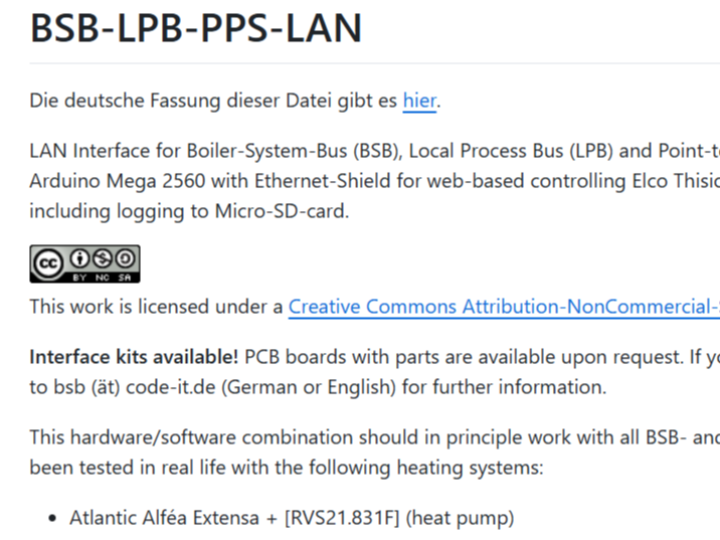
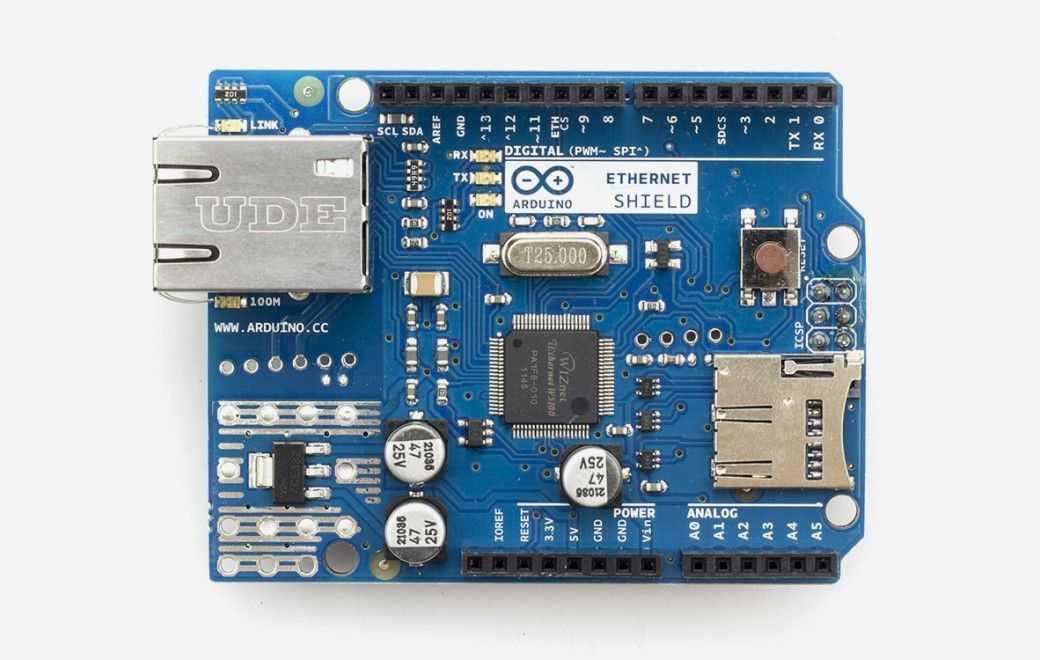
Arduino - Arduino Ethernet Shield
x 1

How to Interface Boiler BSB/LPB/PPS Buses to Ethernet Networks?
Summary
This class of projects converts proprietary boiler communication buses (BSB, LPB, PPS) into IP-based interfaces using microcontrollers with Ethernet connectivity. The goal is to expose internal HVAC data and control points over a network. In such architectures, a WIZnet controller like W5500 serves as a hardware TCP/IP offload engine, enabling stable and deterministic Ethernet communication without burdening the MCU.
What the Project Does
BSB (Boiler System Bus), LPB (Local Process Bus), and PPS (Point-to-Point Signal) are communication protocols used by heating systems—primarily in European boilers and heat pumps—to connect internal modules such as controllers, sensors, and user interfaces.
These buses are:
- Proprietary and undocumented or partially reverse-engineered
- Low-speed, timing-sensitive serial communication lines
- Designed for closed, internal system use—not external integration
A typical LAN bridge project performs three core functions:
- Physical interfacing
Connects to the boiler bus using appropriate electrical adaptation (voltage level shifting, bus transceivers) - Protocol decoding
Interprets raw bus frames into structured parameters such as:- Flow temperature
- Burner status
- Error codes
- Setpoints
- Network exposure
Publishes this data over Ethernet via:- Web interfaces (HTTP)
- APIs for automation systems
- Logging or monitoring endpoints
The result is a system where a traditionally closed heating device becomes accessible like a standard networked IoT device.
Where WIZnet Fits
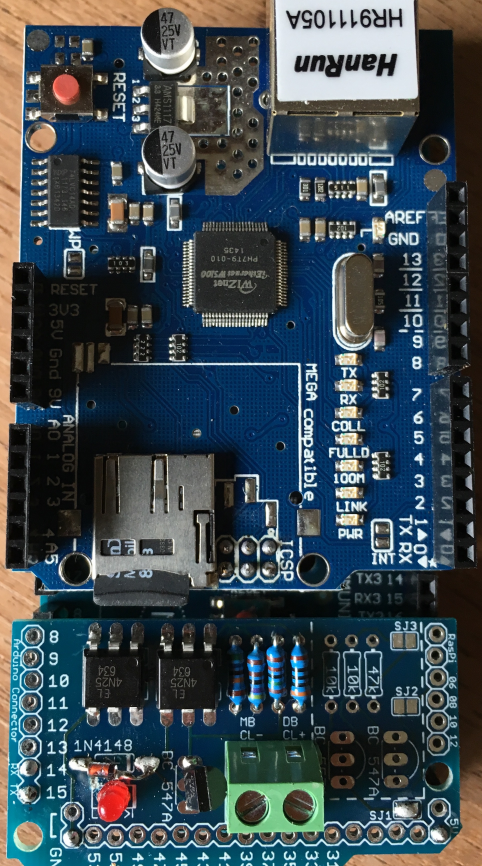
Its role is clear:
- Acts as the network transport layer
- Offloads TCP/IP processing from the MCU
- Handles socket-level communication independently
Why W5500 is a strong fit here
Boiler bus decoding and control logic impose constraints:
- Strict timing requirements for bus communication
- Continuous operation (24/7)
- Limited MCU resources (e.g., Arduino Mega class devices)
W5500 directly addresses these:
- Hardware TCP/IP offload → frees CPU for protocol decoding
- Deterministic Ethernet latency → avoids jitter affecting control logic
- Internal buffering → reduces risk of data loss during bursts
In short, it allows the system to behave like a stable embedded gateway rather than a best-effort IoT node.
Implementation Notes
This repository snapshot does not explicitly expose WIZnet-specific configuration details. Therefore, the architecture is best understood at a system level:
- The MCU runs two tightly coupled loops:
- Bus communication (time-critical)
- Network serving (event-driven)
- Without hardware offload, the network stack can interfere with bus timing
- With a controller like W5500:
- Networking becomes asynchronous and isolated
- The MCU handles only high-level socket events
This separation is particularly valuable in HVAC systems where missed bus timing can lead to incorrect readings or control instability.
Practical Tips / Pitfalls
- BSB/LPB signals are not directly MCU-safe—use proper electrical interfacing
- Avoid blocking operations in firmware; bus timing must remain consistent
- Use static IP for reliable integration with automation systems
- Ensure proper grounding to prevent noise from pumps and relays
- Ethernet cabling is more robust than Wi-Fi in boiler room environments
- Plan for watchdog recovery in case of bus or network lockups
- Consider EMI shielding for SPI lines when using external Ethernet controllers
FAQ
Q: Why convert BSB/LPB/PPS to Ethernet?
A: These buses are closed and not remotely accessible. Ethernet allows integration with modern systems such as dashboards, automation platforms, and remote diagnostics tools.
Q: How does W5500 connect to the system?
A: It interfaces via SPI (MISO, MOSI, SCK, CS) to the MCU, requiring minimal pin usage while providing full Ethernet capability.
Q: What role does Ethernet play in this project?
A: It exposes internal boiler data and control interfaces over IP, enabling monitoring, logging, and remote interaction.
Q: Can beginners follow this project?
A: It requires intermediate knowledge of embedded systems, serial communication, and networking. Hardware interfacing with boiler systems also requires caution.
Q: Why use W5500 instead of Wi-Fi or ENC28J60?
A: W5500 provides hardware TCP/IP offload and stable wired connectivity. Compared to Wi-Fi, it avoids interference and dropouts; compared to ENC28J60, it eliminates the need for a software TCP/IP stack, reducing MCU load.
Why Makers Build BSB/LPB/PPS-to-LAN Bridges (Inferred)
1) Breaking Vendor Isolation
Manufacturers often restrict access to internal data and controls. These projects allow users to bypass proprietary tools and gain direct visibility.
2) Integration with Modern Automation
Home automation systems require IP-based data. Converting legacy buses to Ethernet makes integration straightforward.
3) Remote Monitoring and Control
Users want real-time access to heating performance, error states, and configuration—especially for second homes or distributed systems.
4) Energy Optimization
By logging and analyzing boiler behavior, users can tune efficiency beyond factory defaults.
5) Extending Legacy Equipment Life
Instead of replacing working systems, users add network capability, delaying costly upgrades.
Why Ethernet—and Specifically W5500?
Deterministic Behavior
Heating systems benefit from predictable communication timing. Ethernet provides consistent latency, unlike Wi-Fi.
Environmental Reliability
Boiler rooms are harsh RF environments. Wired Ethernet avoids interference and signal degradation.
MCU Efficiency
W5500 offloads TCP/IP, allowing limited-resource MCUs to focus on real-time bus decoding.
Always-On Stability
These systems run continuously. Ethernet avoids reconnection logic and instability common in wireless systems.
Simplicity and Robustness
Compared to Linux-based gateways:
- Lower power consumption
- Faster startup
- Fewer failure points
W5500 fits this model by providing a compact, self-contained networking solution.
Source
- Original Project: https://github.com/dspinellis/bsb_lan/tree/8b11cb049bb9b9ae3fb72e07e2007a400c96ca50
- License: Refer to repository
Tags
#BSB #LPB #PPS #W5500 #Ethernet #HVAC #BoilerControl #IndustrialIoT #Arduino #BuildingAutomation
How to Interface Boiler BSB/LPB/PPS Buses to Ethernet Networks?
Summary
이 프로젝트 유형은 보일러 및 히트펌프에서 사용하는 BSB, LPB, PPS와 같은 폐쇄형 통신 버스를 이더넷 기반 네트워크로 변환하는 구조를 다룹니다. 마이크로컨트롤러를 중심으로 버스 데이터를 해석하고 IP 네트워크로 노출하며, WIZnet W5500은 하드웨어 TCP/IP 오프로딩을 통해 안정적이고 결정론적인 네트워크 통신을 담당하는 역할로 적합합니다.
What the Project Does
BSB(Boiler System Bus), LPB(Local Process Bus), PPS(Point-to-Point Signal)는 주로 유럽 보일러 및 히트펌프 시스템에서 사용되는 내부 통신 프로토콜입니다. 이들은 컨트롤러, 센서, 사용자 인터페이스 간 데이터를 주고받기 위해 설계된 버스입니다.
이 버스들의 특징은 다음과 같습니다:
- 제조사 중심의 폐쇄형(프로프라이어터리) 프로토콜
- 비교적 저속이지만 타이밍에 민감한 통신 구조
- 외부 시스템 연동을 고려하지 않은 내부 전용 설계
LAN 변환 프로젝트는 이 구조를 외부에 개방하는 브리지 역할을 수행합니다:
- 물리적 인터페이스 구성
보일러 버스에 직접 연결하기 위한 전기적 변환(레벨 시프팅, 트랜시버) - 프로토콜 해석
버스 신호를 해석하여 다음과 같은 데이터를 추출:- 온도 정보
- 버너 동작 상태
- 에러 코드
- 설정값(Setpoint)
- 네트워크 노출
해석된 데이터를 이더넷 기반으로 제공:- 웹 UI
- API
- 모니터링 시스템 연동
결과적으로 기존에는 접근이 제한된 HVAC 장비가 네트워크 기반 IoT 장치처럼 동작하게 됩니다.
Where WIZnet Fits
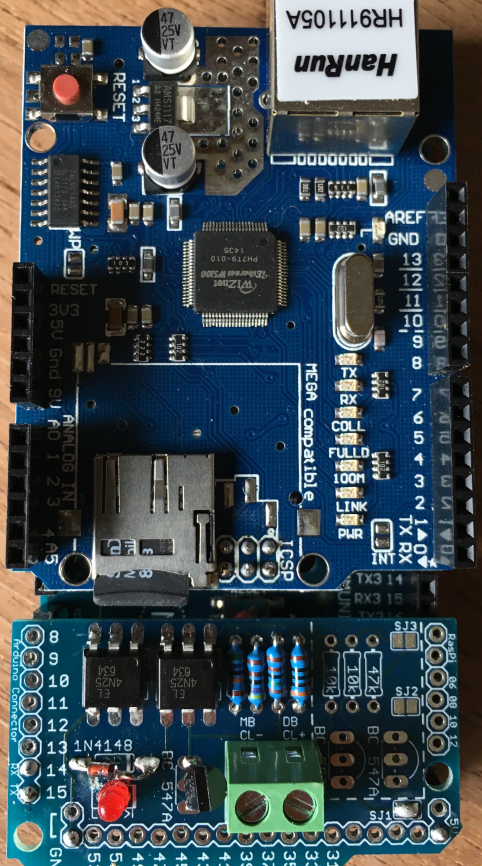
W5500을 사용할 경우 역할은 명확합니다:
- 네트워크 통신을 담당하는 전송 계층 처리 장치
- TCP/IP 스택을 하드웨어에서 처리 (오프로딩)
- 소켓 기반 통신을 MCU와 분리
왜 W5500이 적합한가
보일러 시스템 특성상 다음과 같은 제약이 존재합니다:
- 버스 통신은 정확한 타이밍 유지가 필수
- 시스템은 24시간 항상 동작
- MCU 자원이 제한적 (예: Arduino Mega)
W5500은 이러한 요구를 다음과 같이 해결합니다:
- TCP/IP를 하드웨어에서 처리 → MCU는 버스 해석에 집중
- 유선 이더넷 → 지연 시간 및 연결 안정성 확보
- 내부 버퍼 및 소켓 구조 → 데이터 손실 최소화
즉, 단순한 네트워크 연결이 아니라 안정적인 임베디드 게이트웨이 구조를 가능하게 합니다.
Implementation Notes
이 저장소에서는 WIZnet 칩에 대한 직접적인 설정 코드가 명확히 드러나지 않기 때문에, 시스템 구조 관점에서 이해하는 것이 적절합니다.
- MCU는 두 가지 작업을 동시에 수행:
- 보일러 버스 통신 (실시간, 타이밍 중요)
- 네트워크 응답 처리 (요청 기반)
문제는 소프트웨어 TCP/IP 스택을 사용할 경우:
- 네트워크 처리 중 버스 타이밍이 깨질 수 있음
W5500을 사용할 경우:
- 네트워크 처리가 하드웨어로 분리됨
- MCU는 이벤트 기반으로만 네트워크를 처리
이 구조는 HVAC처럼 타이밍 오류가 곧 오작동으로 이어질 수 있는 시스템에서 매우 중요합니다.
Practical Tips / Pitfalls
- BSB/LPB는 직접 MCU에 연결하면 안 되며 반드시 전기적 변환 회로 필요
- 버스 통신은 블로킹 없이 처리해야 안정성 확보 가능
- 홈 오토메이션 연동 시 static IP 설정 권장
- 보일러 주변은 노이즈가 많으므로 접지 및 차폐 중요
- SPI 기반 Ethernet 사용 시 EMI 영향 최소화 필요
- watchdog을 활용한 장애 복구 설계 권장
- Wi-Fi보다 유선 Ethernet이 장기 안정성 측면에서 유리
FAQ
Q: 왜 BSB/LPB/PPS를 Ethernet으로 변환하나요?
A: 해당 버스는 외부 접근이 불가능한 폐쇄형 구조입니다. Ethernet으로 변환하면 모니터링, 자동화, 원격 제어가 가능해집니다.
Q: W5500은 어떻게 연결되나요?
A: SPI 인터페이스(MISO, MOSI, SCK, CS)를 통해 MCU에 연결되며, 최소한의 핀으로 Ethernet 기능을 구현할 수 있습니다.
Q: 이 프로젝트에서 Ethernet의 역할은 무엇인가요?
A: 보일러 내부 데이터를 IP 기반으로 외부에 노출하여 웹 UI, API, 자동화 시스템과 연동할 수 있게 합니다.
Q: 초보자도 가능한가요?
A: 임베디드 개발, 시리얼 통신, 네트워크 기본 지식이 필요합니다. 또한 보일러 하드웨어 연결은 주의가 필요합니다.
Q: Wi-Fi나 ENC28J60 대신 W5500을 쓰는 이유는?
A: W5500은 하드웨어 TCP/IP 스택을 제공하여 MCU 부하를 줄이고 안정성을 높입니다. Wi-Fi는 간섭 문제가 있고, ENC28J60은 소프트웨어 스택이 필요해 리소스 부담이 큽니다.
Why Makers Build BSB/LPB/PPS-to-LAN Bridges (Inferred)
1) 제조사 종속성 탈피
보일러 제조사는 내부 데이터 접근을 제한하는 경우가 많습니다. 이를 우회하여 사용자 직접 제어 및 모니터링을 가능하게 합니다.
2) 홈 오토메이션 연동
Home Assistant, Node-RED 등은 IP 기반 데이터를 요구합니다. LAN 변환을 통해 기존 시스템을 쉽게 통합할 수 있습니다.
3) 원격 모니터링
외부에서 보일러 상태 확인, 에러 감지, 설정 변경을 가능하게 합니다.
4) 에너지 최적화
운전 데이터를 기록하여 효율 개선 및 비용 절감에 활용할 수 있습니다.
5) 레거시 시스템 확장
기존 장비를 교체하지 않고도 네트워크 기능을 추가할 수 있습니다.
Why Ethernet—and Specifically W5500?
결정론적 통신
HVAC 시스템은 일정한 응답 시간이 중요합니다. Ethernet은 Wi-Fi 대비 지연이 일정합니다.
환경적 안정성
보일러실은 RF 환경이 좋지 않습니다. 유선 Ethernet이 훨씬 안정적입니다.
MCU 자원 절약
W5500은 TCP/IP를 하드웨어에서 처리하여 MCU 부하를 줄입니다.
상시 동작 시스템에 적합
Wi-Fi의 재연결 문제 없이 안정적으로 24시간 운영 가능합니다.
단순하고 견고한 구조
라즈베리파이 같은 Linux 기반 시스템보다:
- 전력 소모 낮음
- 부팅 빠름
- 장애 포인트 적음
Source
- Original Project: https://github.com/dspinellis/bsb_lan/tree/8b11cb049bb9b9ae3fb72e07e2007a400c96ca50
- License: Refer to repository
Tags
#BSB #LPB #PPS #W5500 #Ethernet #HVAC #BoilerControl #IndustrialIoT #Arduino #BuildingAutomation