



Custom W5500 SPI Ethernet Driver for ESP-IDF — Full esp_netif / LwIP Integration
Custom W5500 SPI Ethernet driver for ESP-IDF fully integrated with esp_eth, esp_netif, and LwIP. 2025. Low-level driver layer for production ESP32 Ethernet proj
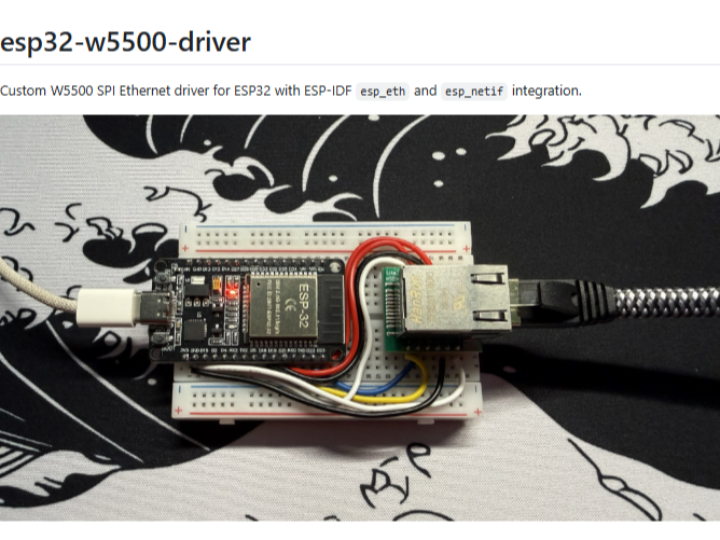
Overview
This project provides a custom W5500 SPI Ethernet driver for ESP-IDF that is fully integrated with ESP32's native esp_eth, esp_netif, and LwIP networking stack. Written in Embedded C, it fills a gap in the ESP-IDF ecosystem: while the official ESP-IDF supports SPI Ethernet via esp_eth, the documentation and example code for W5500-specific driver customization is sparse. This driver provides a clean, production-ready implementation of the W5500 SPI interface at the esp_eth driver layer, enabling all LwIP-based protocols (TCP, UDP, MQTT, HTTP, etc.) to work transparently over W5500 Ethernet.
What This Project Does
- Implements the W5500 SPI Ethernet driver at the
esp_ethabstraction layer - Integrates with
esp_netiffor network interface management (IP assignment, DHCP client) - Connects to the LwIP TCP/IP stack — enabling all standard ESP-IDF network APIs over Ethernet
- Handles W5500 SPI initialization, MAC/PHY configuration, interrupt handling, and frame TX/RX
- 2025 implementation targeting ESP-IDF v5.x
Why a Custom Driver? The official ESP-IDF includes some W5500 support, but custom driver implementations are needed when:
- Specific SPI pin configurations differ from the default
- Fine-tuned interrupt vs. polling mode is required
- Additional W5500 socket management features are needed
- Integration with custom
esp_netifnetwork interfaces is required
Architecture
Application (TCP/UDP/MQTT/HTTP via LwIP APIs)
    ↓
LwIP TCP/IP Stack
    ↓
esp_netif (network interface abstraction)
    ↓
esp_eth (Ethernet driver framework)
    ↓
W5500 SPI Driver (this project)
    ↓
SPI bus → W5500 hardware
Hardware
- MCU: ESP32 (ESP-IDF v5.x)
- Ethernet: WIZnet W5500 (SPI)
- Language: Embedded C
- Framework: ESP-IDF (native, not Arduino)
How to Build
- Clone:
git clone https://github.com/Teja-Tatimatla/esp32-w5500-driver - Set up ESP-IDF v5.x environment:
. $IDF_PATH/export.sh - Configure SPI pins in
menuconfigorsdkconfig - Build:
idf.py build - Flash:
idf.py -p /dev/ttyUSB0 flash monitor
FAQ
Q1. What is the difference between this and the Arduino ETH.h approach? Arduino ETH.h abstracts away all driver details. This project works at the ESP-IDF native layer — lower level, more control, and directly integrated with LwIP. This is the right choice for production firmware using ESP-IDF rather than Arduino.
Q2. Does this support DHCP? Yes. Integration with esp_netif means DHCP client is handled automatically by the LwIP stack, just as it would be for built-in Ethernet PHYs (LAN8720, IP101, etc.).
Q3. Can I use MQTT, HTTP, or WebSockets over this driver? Yes. Once the W5500 driver is registered with esp_netif and LwIP, all standard ESP-IDF network libraries (esp-mqtt, esp_http_client, esp_websocket_client) work transparently over Ethernet exactly as they would over WiFi.
Q4. What SPI speed is supported? W5500 supports SPI up to 80 MHz. ESP-IDF SPI master typically runs at 20–40 MHz for reliable operation with typical PCB traces. Configure via spi_device_interface_config_t.clock_speed_hz.
Key Takeaway
A production-quality ESP-IDF W5500 SPI Ethernet driver that integrates fully with esp_netif and LwIP. This is the foundation layer needed for any serious ESP32 + W5500 project using ESP-IDF — enabling all standard LwIP-based protocols (TCP, UDP, MQTT, HTTP, WebSocket) over wired Ethernet with a clean, maintainable driver architecture.
Source Code: https://github.com/Teja-Tatimatla/esp32-w5500-driver