


BASIX Board with W5500
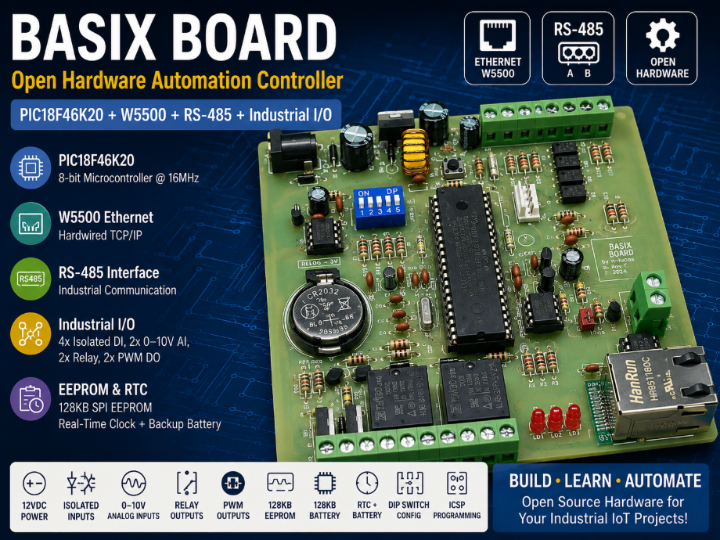
BASIX is an open-hardware PIC18 controller integrating W5500 Ethernet, RS-485, isolated I/O, analog inputs, relays, EEPROM, and RTC for automation.
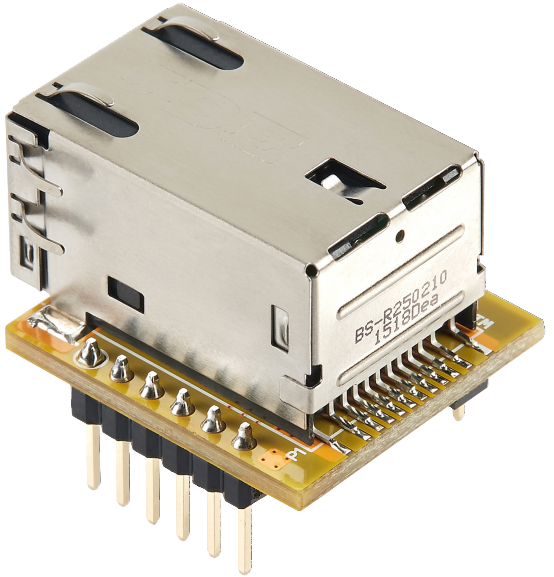
WIZnet - WIZ850io
x 1

👤 AUTHOR
n-lucas
BASIX는 자동화 및 IoT 프로젝트를 위해 개발된 오픈 하드웨어 임베디드 I/O 컨트롤러입니다.
단순히 완성된 보드를 공개하는 것이 아니라 회로도, PCB Layout, Gerber, BOM 및 기술 문서까지 공개하여 사용자가 직접 보드를 제작하고 수정할 수 있도록 설계되었습니다.
🔗 GitHub: BASIX Board GitHub Repository
🎯 PROJECT DESCRIPTION
BASIX Board는 교육, 자동화 시스템 프로토타이핑 및 산업용 통신 인터페이스 학습을 목적으로 개발된 오픈 하드웨어 컨트롤러입니다.
메인 MCU로 Microchip PIC18F46K20을 사용하며, WIZnet W5500 Ethernet Controller, RS-485, RTC, EEPROM과 다양한 산업용 I/O를 하나의 보드에 통합했습니다.
특히 대부분의 부품을 THT(Through-Hole Technology) 방식으로 구성하여 리플로우 장비 없이 일반적인 납땜 인두만으로 직접 조립할 수 있다는 점도 특징입니다.
따라서 BASIX는 단순한 Ethernet 개발보드보다는,
직접 제작하고 회로를 분석하면서 Ethernet과 산업용 I/O를 학습할 수 있는 오픈 자동화 컨트롤러
라는 성격이 강합니다.
Hardware Architecture
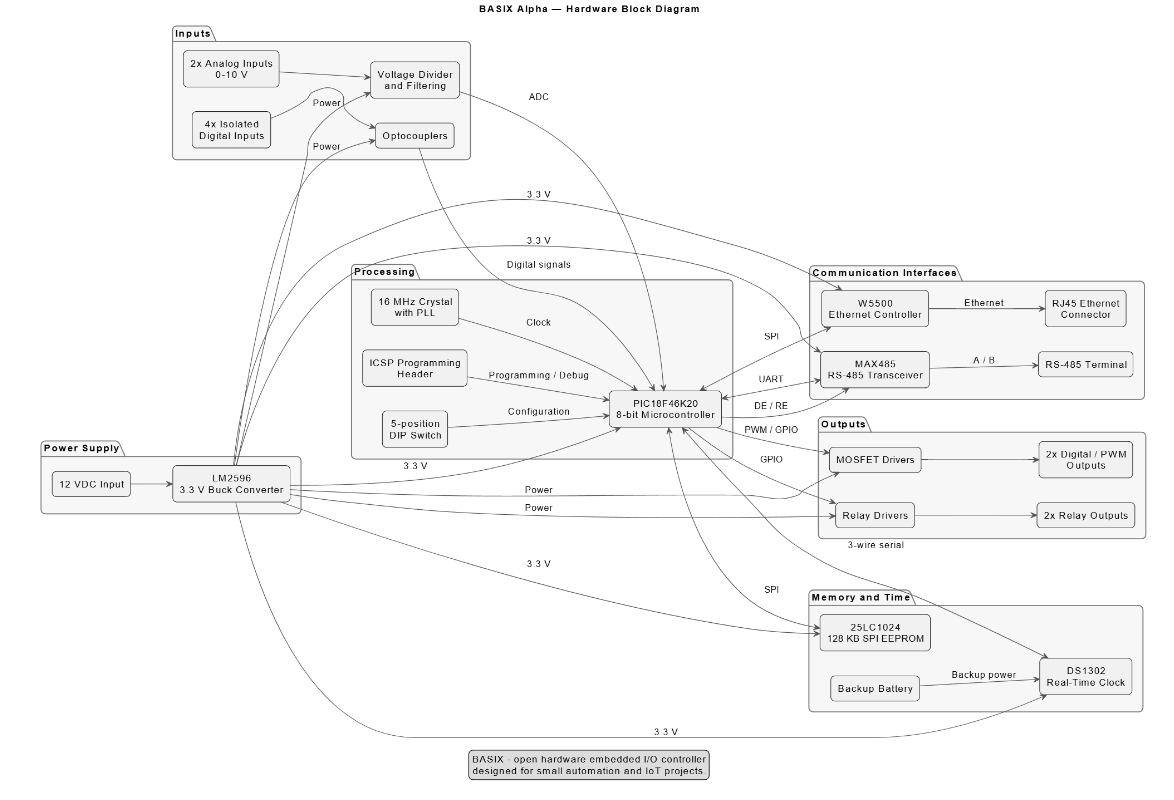
아래 BASIX Alpha Hardware Block Diagram을 보면 전체 시스템이 크게 다음과 같이 구성되어 있습니다.
Power Supply → Inputs → Processing → Communication Interfaces → Outputs → Memory and Time
중앙의 PIC18F46K20이 전체 시스템을 제어하고, W5500과 MAX485를 통해 외부 네트워크 및 Field Device와 연결됩니다.
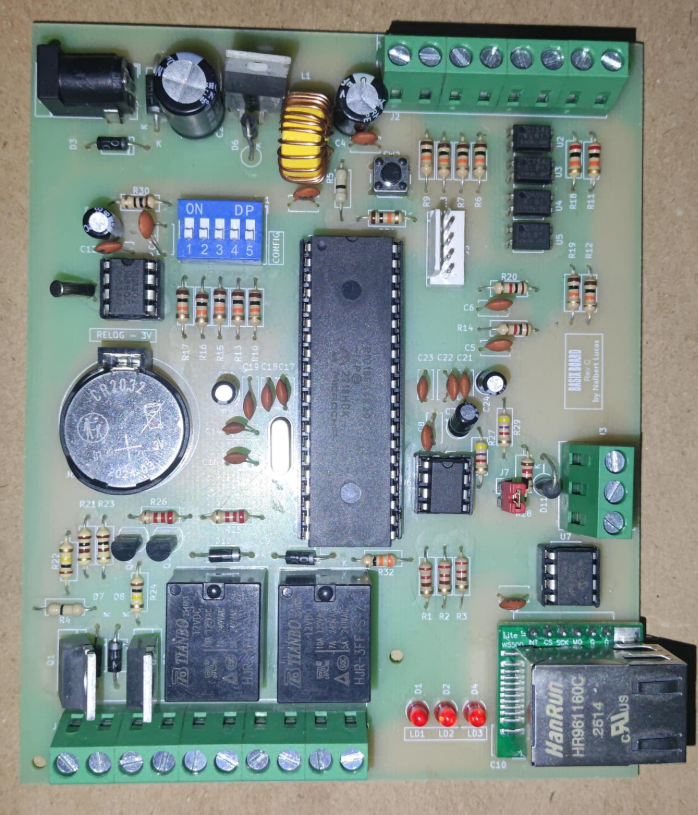
BASIX의 전체 구조를 단순화하면 다음과 같습니다.
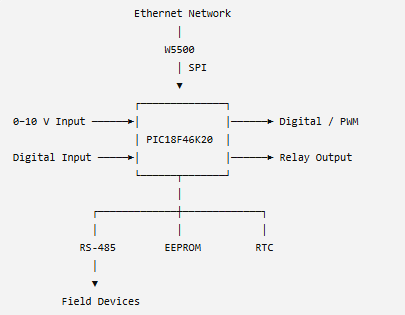
즉, Ethernet Network와 실제 센서 및 Actuator 사이에 PIC18F46K20 기반 Controller가 위치하는 구조입니다.
🧩 COMPONENTS
| Category | Specification |
|---|---|
| MCU | PIC18F46K20 @ 16 MHz crystal with HSPLL (64 MHz FOSC) |
| Ethernet | WIZnet W5500(io module) |
| Industrial Communication | RS-485 |
| Power | 12 VDC |
| RTC | Real-Time Clock (DS1302)+ backup battery |
| External Memory | 128 KB SPI EEPROM(25LC1024) |
| Digital Inputs | 4 × optically isolated inputs |
| Analog Inputs | 2 × 0–10 V inputs |
| Relay Outputs | 2 channels |
| Digital/PWM Outputs | 2 channels |
| Configuration | 5-position DIP switch |
| Indicators | 3 × general-purpose LEDs |
| Programming | ICSP header |
🌐 Why W5500?
BASIX에서 특히 주목할 부분은 PIC18F46K20과 W5500의 조합입니다.
PIC18F46K20은 16 MHz로 동작하는 비교적 리소스가 제한적인 8-bit MCU입니다. 반면 W5500은 TCP, UDP, IPv4, ICMP, ARP 등의 TCP/IP 처리를 하드웨어에서 수행할 수 있는 Ethernet Controller입니다.
따라서 이 구성에서는 MCU가 복잡한 TCP/IP 소프트웨어 스택을 직접 처리하기보다,
               		 Ethernet
              			     │
              ┌────▼───┐
              │  W5500  		   │
              └────┬────┘
                  			 │ SPI
              ┌────▼───────┐
              │		PIC18F46K20 	│
              └────┬───────┘
                		     │
   ┌────────┼───────── ─┐
   │                   	 │                              │
   RS-485   		 Isolated I/O   	RTC/EEPROM
처럼 PIC는 I/O 및 애플리케이션 제어에 집중하고 W5500이 Ethernet/TCP-IP를 담당하는 구조를 만들 수 있습니다.
이 점은 최신 ESP32나 STM32 기반 W5500 프로젝트와 비교했을 때 BASIX의 가장 흥미로운 부분 중 하나입니다.
🧠 ENGINEERING INSIGHT
1. 8-bit MCU + Hardware TCP/IP
최근 IoT 프로젝트는 ESP32와 같은 고성능 MCU를 사용하는 경우가 많지만, BASIX는 PIC18 계열 8-bit MCU를 사용합니다. W5500의 Hardwired TCP/IP 구조를 활용하면 MCU 성능이 제한적인 환경에서도 Ethernet 연결을 구현하기 쉬워집니다.
즉 이 프로젝트는 W5500 하드웨어 TCP/IP 오프로딩의 장점을 명확하게 보여주는 사례라고 볼 수 있습니다.
2. Industrial I/O Design
BASIX는 단순 GPIO 개발보드와 달리 실제 제어 시스템을 고려해
- Optically isolated digital input
- 0–10 V analog input
- Relay output
- PWM output
- RS-485
를 기본 제공하고 있습니다. 특히 0–10 V 입력과 절연 Digital Input은 PLC 및 산업 자동화 환경을 의식한 구성이라는 점에서 일반적인 Maker Ethernet Board와 차이가 있습니다.
3. THT-Based Open Hardware
또 하나의 특징은 대부분의 부품이 THT라는 점입니다. 이는 보드를 최대한 작게 만드는 것보다 직접 조립하고 회로를 이해하는 것에 더 높은 우선순위를 둔 설계입니다. PCB 제작에 필요한 Gerber도 공개되어 있습니다.
🔗 RS-485 Expansion Architecture
BASIX는 RS-485를 단순한 Serial Port로만 사용하는 것이 아니라 확장 모듈 생태계의 기반으로 고려하고 있습니다.
프로젝트에서는 향후 또는 사용자 제작 확장 모듈의 예로 다음을 제시합니다.
- Remote Digital I/O
- Analog I/O
- Relay Expansion
- Environmental Sensors
- Energy Monitoring
- LCD/HMI
- Motor Controllers
- Industrial Protocol Gateways
목표는 여러 모듈이 간단한 RS-485 네트워크를 통해 BASIX와 통신할 수 있는 오픈 확장 생태계를 만드는 것입니다.
이 구조를 시스템 관점에서 보면:
              						    Ethernet
         							            │
       						           [W5500]
                     							│
     						          [BASIX Main]
 							                    │
    						               RS-485
 							                    │
       ┌─────────────┼─────────────┐
       │          						   │							           │
   Remote I/O     			Sensors      				 Relay I/O
       │
Motor /  Automation
처럼 Ethernet-to-Field I/O Gateway 형태로 확장할 수 있습니다.
📂 Open Hardware Resources
이 UCC에서 강조하면 좋은 또 하나의 부분입니다.
GitHub에는 단순한 소스코드뿐만 아니라 다음 자료가 공개되어 있습니다.
| Directory | Contents |
|---|---|
hardware/kicad/ | KiCad schematic, PCB, symbols, footprints |
hardware/gerbers/ | PCB 제작용 Gerber 및 Drill files |
docs/ | Block diagram and schematic |
images/ | Board photo and virtual/3D top view |
🔗 RELATED EXISTING CONTENTS & EXPANSION VALUE
아래 프로젝트들은 W5500 기반 유선 Ethernet, Relay 제어, Digital I/O, 산업용 자동화라는 측면에서 BASIX와 구조적·기능적으로 유사한 사례입니다.
| 순위 | Maker 프로젝트 | MCU / Ethernet | I/O / 주요 기능 | 가장 큰 차이 |
|---|---|---|---|---|
| 1 | PLC-STM32 Maker 페이지 | STM32F407 + W5500 | 12 DI, 16 Relay, RS-485, optional ESP32 Wi-Fi | BASIX보다 훨씬 많은 I/O, RTC/EEPROM/0–10V AI는 없음 |
| 2 | ESP32-S3 Ethernet Relay Board Maker 페이지 | ESP32-S3 + W5500 | 8 DI + 8 Relay, MQTT, SignalK, Victron | 자체 PCB 설계보다 기존 Waveshare 보드의 Firmware/Integration 중심 |
| 3 | ESP32-Based 8-Channel Relay Control System Maker 페이지 | ESP32-WROOM + W5500 | 8 Relay, 74HC595, Wi-Fi + Ethernet | RS-485, Analog/Isolated Input 등이 없음 |
| 4 | Ethernet Gate Controller PCB Maker 페이지 | ESP32-WROOM-32E + W5500 | 3 Dry-contact Relay, Optocoupler, 9–24V, OTA | 범용 자동화가 아니라 Gate Controller라는 특정 목적 |
이 중 BASIX와 가장 유사한 프로젝트는 PLC-STM32입니다. 유선 Ethernet을 기반으로 다수의 Digital Input, Relay Output, Serial Interface를 제공한다는 점에서 구조가 가장 가깝습니다.
ESP32-S3 Ethernet Relay Board는 같은 구조를 MQTT와 IoT 환경으로 확장한 사례이며, 8-Channel Relay Control System은 보다 단순한 DIY형 Ethernet Relay Controller에 가깝습니다.
Ethernet Gate Controller는 Ethernet + Relay 구조를 특정 산업용 제어 목적에 맞게 제품화한 사례로 볼 수 있습니다.
확장 가치
BASIX는 향후 다음과 같은 방향으로 확장할 수 있습니다.
- I/O 확대를 통한 PLC / Remote I/O
- MQTT 및 IoT 기반 원격 제어
- RS-485 및 Isolated I/O 확장
- Analog / Sensor Interface 추가
- 특정 목적의 산업용 Controller 개발
이를 통해 BASIX는 단순한 Ethernet I/O Board를 넘어 산업 자동화, Remote I/O, Building Control, IoT Gateway용 플랫폼으로 확장할 수 있습니다.
📘Conclusion
BASIX는 단순히 PIC MCU에 Ethernet을 추가한 개발보드가 아닙니다.
PIC18F46K20 + W5500 + RS-485 + Industrial I/O + EEPROM + RTC를 하나의 플랫폼에 통합한 오픈 하드웨어 Embedded Controller입니다.
특히 PIC18F46K20이 I/O와 Application Control을 담당하고, W5500이 TCP/IP Ethernet을 담당하는 구조는 8-bit MCU와 Hardwired TCP/IP Controller의 조합이 실제 자동화 시스템에서 어떻게 활용될 수 있는지 보여주는 좋은 사례입니다.
또한 RS-485, 0–10 V Analog Input, Isolated Digital Input 및 Relay/PWM Output을 제공하기 때문에 소규모 자동화, Remote I/O, Ethernet Gateway 및 교육용 Embedded Platform으로 활용할 수 있습니다.
FAQ
Q1. BASIX Board는 어떤 프로젝트인가요?
BASIX는 PIC18F46K20 8-bit MCU와 W5500 Ethernet Controller를 기반으로 한 오픈 하드웨어 Embedded I/O Controller입니다. Ethernet과 RS-485뿐만 아니라 0–10 V Analog Input, Isolated Digital Input, Relay Output, Digital/PWM Output, EEPROM 및 RTC를 하나의 보드에 통합하여 소규모 자동화, Remote I/O 및 IoT 시스템에 활용할 수 있도록 설계되었습니다.
Q2. BASIX에서 W5500은 어떤 역할을 하나요?
W5500은 BASIX의 Ethernet 및 TCP/IP 통신을 담당합니다. PIC18F46K20과 SPI로 연결되며, TCP, UDP, IPv4, ICMP, ARP 등의 TCP/IP 프로토콜을 하드웨어에서 처리합니다. 이를 통해 PIC18F46K20은 복잡한 네트워크 프로토콜 처리보다 I/O 제어와 Application Logic에 더 집중할 수 있습니다.
Q3. 왜 PIC18F46K20과 W5500을 함께 사용하나요?
PIC18F46K20은 리소스가 제한적인 8-bit MCU입니다. W5500은 Hardwired TCP/IP 기능을 제공하므로 Host MCU에서 전체 TCP/IP Stack을 처리할 필요가 없습니다. 따라서 비교적 작은 MCU에서도 Wired Ethernet 기능을 효율적으로 구현할 수 있다는 것이 이 조합의 장점입니다.
Q4. BASIX는 Wi-Fi를 지원하나요?
기본 BASIX 하드웨어의 네트워크 인터페이스는 W5500 기반 Wired Ethernet입니다. Wi-Fi 대신 유선 Ethernet을 사용하기 때문에 고정 설치형 자동화 장치나 안정적인 유선 네트워크가 필요한 시스템에 적합합니다.
Q5. BASIX는 RS-485도 지원하나요?
네. MAX485 Transceiver를 이용한 RS-485 Interface를 제공합니다. PIC18F46K20의 UART와 연결되며 DE/RE 신호를 이용하여 송수신 방향을 제어합니다. 이를 통해 RS-485 기반 센서나 다른 Field Device와 연결할 수 있습니다.
👤 AUTHOR
n-lucas
BASIX is an open-hardware embedded I/O controller developed for automation and IoT projects.
Rather than simply releasing a finished board, the project also provides schematics, PCB layouts, Gerber files, BOMs, and technical documentation so that users can build, modify, and study the board themselves.
🔗 GitHub: BASIX Board GitHub Repository
🎯 PROJECT DESCRIPTION
BASIX Board is an open-hardware controller designed for education, automation system prototyping, and learning industrial communication interfaces.
It is built around the Microchip PIC18F46K20 as the main MCU and integrates a WIZnet W5500 Ethernet Controller, RS-485, RTC, EEPROM, and various industrial I/O interfaces on a single board.
One notable feature is that most components use THT (Through-Hole Technology), allowing the board to be assembled with a standard soldering iron without requiring reflow equipment.
Therefore, BASIX is more than a simple Ethernet development board. It is better described as:
An open automation controller that allows users to build the hardware themselves while learning Ethernet and industrial I/O circuitry.
Hardware Architecture
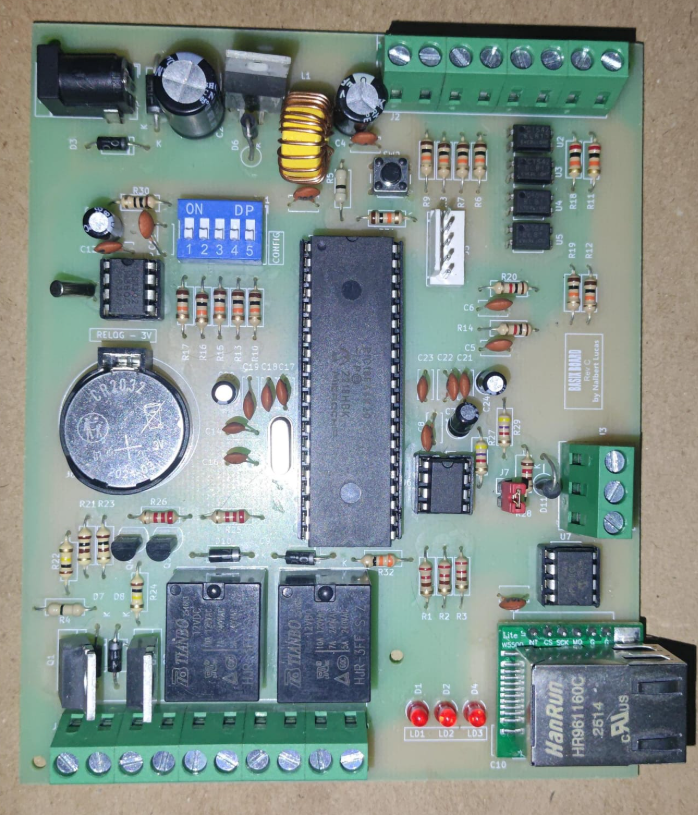
The BASIX Alpha Hardware Block Diagram below shows that the system is largely divided into the following functional blocks:
Power Supply → Inputs → Processing → Communication Interfaces → Outputs → Memory and Time
The PIC18F46K20 at the center controls the overall system and connects to external networks and field devices through the W5500 and MAX485.
The overall BASIX architecture can be simplified as follows.
In other words, a PIC18F46K20-based controller is positioned between the Ethernet network and physical sensors and actuators.
🧩 COMPONENTS
| Category | Specification |
|---|---|
| MCU | PIC18F46K20 @ 16 MHz crystal with HSPLL (64 MHz FOSC) |
| Ethernet | WIZnet W5500 (I/O module) |
| Industrial Communication | RS-485 |
| Power | 12 VDC |
| RTC | Real-Time Clock(DS1302) + backup battery |
| External Memory | 128 KB SPI EEPROM(25LC1024) |
| Digital Inputs | 4 × optically isolated inputs |
| Analog Inputs | 2 × 0–10 V inputs |
| Relay Outputs | 2 channels |
| Digital/PWM Outputs | 2 channels |
| Configuration | 5-position DIP switch |
| Indicators | 3 × general-purpose LEDs |
| Programming | ICSP header |
🌐 Why W5500?
One of the most interesting aspects of BASIX is the combination of the PIC18F46K20 and W5500.
The PIC18F46K20 is a relatively resource-constrained 8-bit MCU running at 16 MHz. In contrast, the W5500 is an Ethernet controller capable of processing TCP/IP protocols such as TCP, UDP, IPv4, ICMP, and ARP directly in hardware.
As a result, instead of requiring the MCU to run and manage a complex software TCP/IP stack, the system can be structured as follows:
               		 Ethernet
              			     │
              ┌────▼───┐
              │  W5500  		   │
              └────┬────┘
                  			 │ SPI
              ┌────▼───────┐
              │		PIC18F46K20 	│
              └────┬───────┘
                		     │
   ┌────────┼───────── ─┐
   │                   	 │                              │
RS-485 Isolated I/O RTC/EEPROMCompared with modern W5500 projects based on ESP32 or STM32 devices, this is one of the most interesting aspects of BASIX.
🧠 ENGINEERING INSIGHT
1. 8-bit MCU + Hardware TCP/IP
Many modern IoT projects use high-performance MCUs such as the ESP32, but BASIX uses a PIC18-series 8-bit MCU. By leveraging the W5500's Hardwired TCP/IP architecture, Ethernet connectivity can still be implemented efficiently even when MCU resources are limited.
This project therefore provides a clear example of the benefits of W5500 hardware TCP/IP offloading.
2. Industrial I/O Design
Unlike a simple GPIO development board, BASIX includes interfaces that are useful in actual control systems:
- Optically isolated digital input
- 0–10 V analog input
- Relay output
- PWM output
- RS-485
In particular, the 0–10 V inputs and isolated digital inputs distinguish BASIX from typical maker-oriented Ethernet boards and reflect a design intended for PLC and industrial automation environments.
3. THT-Based Open Hardware
Another notable feature is that most of the components use THT. Rather than prioritizing the smallest possible PCB size, the design places greater emphasis on easy assembly and understanding of the circuit architecture.
Gerber files required for PCB fabrication are also publicly available.
🔗 RS-485 Expansion Architecture
BASIX treats RS-485 not simply as a serial port, but as the basis for an expandable module ecosystem.
The project suggests future or user-designed expansion modules such as:
- Remote Digital I/O
- Analog I/O
- Relay Expansion
- Environmental Sensors
- Energy Monitoring
- LCD/HMI
- Motor Controllers
- Industrial Protocol Gateways
The goal is to create an open expansion ecosystem in which multiple modules communicate with BASIX through a simple RS-485 network.
From a system-level perspective, this architecture can be represented as:
                   						    Ethernet
         							            │
       						           [W5500]
                     							│
     						          [BASIX Main]
 							                    │
    						               RS-485
 							                    │
       ┌─────────────┼─────────────┐
       │          						   │							           │
   Remote I/O     			Sensors      				 Relay I/O
       │
Motor / Automation📂 Open Hardware Resources
Another important point worth highlighting in this UCC is the amount of hardware documentation made available through GitHub.
The repository provides not only source code but also the following resources:
| Directory | Contents |
|---|---|
hardware/kicad/ | KiCad schematic, PCB, symbols, footprints |
hardware/gerbers/ | Gerber and drill files for PCB manufacturing |
docs/ | Block diagram and schematic |
images/ | Board photo and virtual/3D top view |
🔗 RELATED EXISTING CONTENTS & EXPANSION VALUE
The following projects share similarities with BASIX in terms of W5500-based Ethernet, relay control, digital I/O, and automation applications.
| Rank | Project | MCU / Ethernet | Key Features | Main Difference |
|---|---|---|---|---|
| 1 | PLC-STM32 | STM32F407 + W5500 | 12 DI, 16 Relay, RS-485, optional Wi-Fi | More I/O channels, but no RTC, EEPROM, or 0–10 V analog input |
| 2 | ESP32-S3 Ethernet Relay Board | ESP32-S3 + W5500 | 8 DI, 8 Relay, MQTT, SignalK, Victron | Focused on firmware and system integration using an existing board |
| 3 | ESP32-Based 8-Channel Relay Control System | ESP32-WROOM + W5500 | 8 Relay, 74HC595, Wi-Fi + Ethernet | Simpler design without RS-485, analog input, or isolated input |
| 4 | Ethernet Gate Controller PCB | ESP32-WROOM-32E + W5500 | 3 Relay, optocoupler, 9–24 V, OTA | Optimized for a specific gate-control application |
Among them, PLC-STM32 is the closest project to BASIX, with a similar combination of wired Ethernet, digital inputs, relay outputs, and serial communication.
The ESP32-S3 Ethernet Relay Board shows how this architecture can evolve toward MQTT and IoT applications, while the 8-Channel Relay Control System represents a simpler DIY-oriented implementation.
The Ethernet Gate Controller demonstrates how the same Ethernet + Relay concept can also be adapted to a dedicated industrial application.
Expansion Value
BASIX can be further expanded toward:
- Higher-density PLC / Remote I/O
- MQTT and IoT monitoring and control
- Additional RS-485 and isolated I/O
- Analog and sensor interfaces
- Application-specific industrial controllers
This makes BASIX a flexible platform for industrial automation, remote I/O, building control, and IoT gateway applications.
📘 Conclusion
BASIX is more than a PIC MCU development board with Ethernet added.
It integrates PIC18F46K20 + W5500 + RS-485 + Industrial I/O + EEPROM + RTC into a single open-hardware embedded controller. In particular, the architecture in which the PIC18F46K20 handles I/O and application control while the W5500 handles TCP/IP Ethernet clearly demonstrates how an 8-bit MCU can be effectively combined with a Hardwired TCP/IP Controller in a practical automation system.
With RS-485, 0–10 V analog inputs, isolated digital inputs, and relay/PWM outputs, BASIX can also be used for small automation systems, remote I/O, Ethernet gateways, and embedded-system education.
FAQ
Q1. What kind of project is the BASIX Board?
BASIX is an open-hardware embedded I/O controller based on the PIC18F46K20 8-bit MCU and W5500 Ethernet Controller. It integrates Ethernet and RS-485 together with 0–10 V analog inputs, isolated digital inputs, relay outputs, digital/PWM outputs, EEPROM, and an RTC, making it suitable for small automation, remote I/O, and IoT systems.
Q2. What is the role of the W5500 in BASIX?
The W5500 handles Ethernet and TCP/IP communication for BASIX. It communicates with the PIC18F46K20 through SPI and processes TCP/IP protocols such as TCP, UDP, IPv4, ICMP, and ARP in hardware. This allows the PIC18F46K20 to focus more on I/O control and application logic rather than complex network protocol processing.
Q3. Why are the PIC18F46K20 and W5500 used together?
The PIC18F46K20 is a resource-constrained 8-bit MCU. Because the W5500 provides Hardwired TCP/IP functionality, the host MCU does not need to process the entire TCP/IP stack itself. The main advantage of this combination is that wired Ethernet can be implemented efficiently even with a relatively small MCU.
Q4. Does BASIX support Wi-Fi?
The standard BASIX hardware uses W5500-based wired Ethernet as its network interface.Because it uses wired Ethernet instead of Wi-Fi, it is well suited for fixed automation devices and systems that require stable wired network connectivity.
Q5. Does BASIX support RS-485?
Yes. BASIX provides an RS-485 interface using a MAX485 transceiver. It connects to the PIC18F46K20 through UART, with DE/RE signals controlling the transmit and receive directions. This makes it possible to connect RS-485 sensors and other field devices.
-
Firmware
