



ArtNet to ESP-NOW DMX512 Bridge — ESP32 + W5500 Wireless Lighting System
ESP32 master receives Art-Net over W5500 Ethernet, relays DMX512 wirelessly to slave nodes via ESP-NOW (up to 200m). Slaves output DMX512 via RS-485/XLR. MIT.
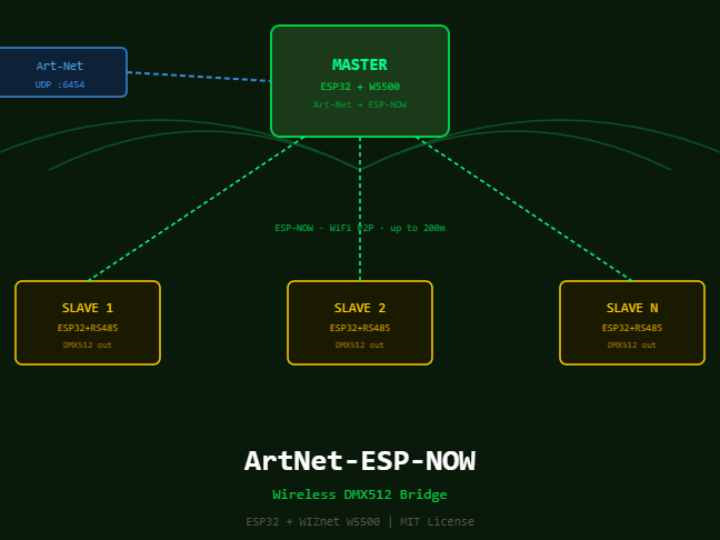
Overview
This project implements a wireless DMX512 transmission system using ESP32 boards. A master node receives Art-Net UDP packets over a WIZnet W5500 Ethernet connection, then relays the DMX512 data wirelessly to multiple slave nodes using ESP-NOW (WiFi peer-to-peer, up to 200 m range). Each slave node outputs physical DMX512 via an RS-485 transceiver and XLR connector — ideal for stage and theatrical lighting where cabling to every fixture is impractical.
System topology
One master connects upstream to any Art-Net software via W5500 Ethernet, then fans out DMX universes wirelessly to up to 20 slave nodes simultaneously.

What this project does
- Master receives Art-Net UDP on port 6454, responds to ArtPoll automatically
- Relays DMX512 data to slave nodes via ESP-NOW broadcast or unicast
- Each slave configures its universe (0–15) via Serial Monitor, saved in NVS flash
- Slave registration: broadcast PKT_REGISTER → master ACK with its MAC
- Keepalive: PING every 2 s; no PONG in 8 s → slave removed; slave resets after 10 s without PING
- Full 512-channel DMX frame split into 3 ESP-NOW chunks (≤200 bytes each)
- Auto-broadcast when multiple slaves share one universe
ESP-NOW packet protocol
All communication uses a compact 5-packet protocol with sequence numbers for deduplication. DMX data is split into 3 chunks to fit within the 250-byte ESP-NOW payload limit.

Hardware used
- Master: ESP32 + WIZnet W5500 module (SPI: CS=GPIO5, RST=GPIO26, MOSI=GPIO23, MISO=GPIO19, SCK=GPIO18)
- Slave: ESP32 + RS-485 transceiver (MAX485/SN75176: DI=GPIO17, DE+RE=GPIO4)
- XLR-3: Pin 1=GND, Pin 2=Data−(B), Pin 3=Data+(A)
- Power: 5V external supply recommended (ESP32 + RS-485 draw)
Hardware wiring & timing
Master and slave wiring details, XLR pinout, and keepalive timing reference for deploying a multi-node system.

Compatible lighting software
- QLC+ (Win/Mac/Linux, free) — set target IP to master, port 6454
- FreeStyler (Windows, free)
- MagicQ onPC (Win/Mac/Linux, free with limits)
- grandMA 3 onPC (free with limits)
FAQ
Q1. What is the maximum range?
Up to 200 m open space. Walls and obstacles reduce this. All nodes must share the same WiFi channel (default: ch 1 in firmware).
Q2. How many slaves are supported?
Up to 20 simultaneously (ESP-NOW peer count limit). Each handles one universe of 512 channels.
Q3. Can I change universe without reflashing?
Yes — send 0–15 via Serial Monitor at 115200 baud. Value is saved in NVS and survives reboots.
Q4. No extra libraries needed?
Correct. Only standard arduino-esp32 core libraries are used (WiFi, esp_now, Ethernet, Preferences, driver/uart).
Key takeaway
ArtNet-ESP-NOW elegantly solves the last-metre DMX cabling problem: a single W5500-equipped ESP32 master bridges a professional Art-Net network to wireless ESP-NOW slaves, each delivering physical DMX512 up to 200 m away — no extra libraries, no complex setup.
Source code: https://github.com/Veselkin/ArtNet-ESP-NOW
-
ArtNet-ESP-NOW
