



W5300 IP 3D Camera over Single Pair Ethernet
W5300 IP 3D Camera over Single Pair Ethernet
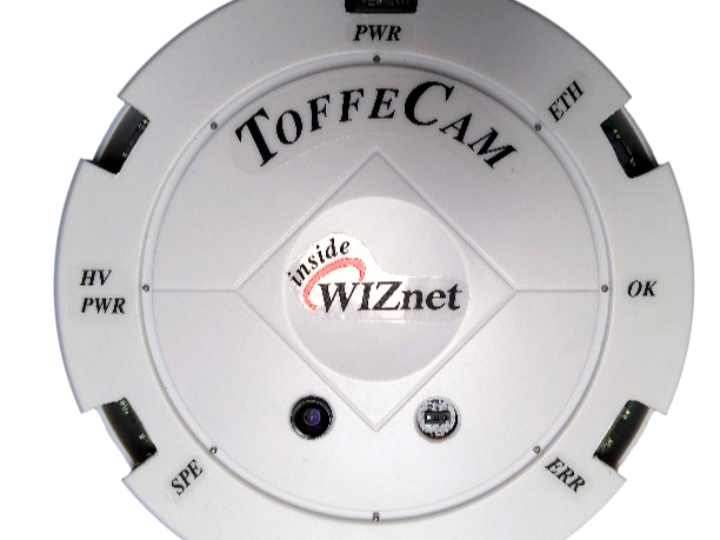
Project Name: W5300 IP 3D Camera over Single Pair Ethernet
Author: Jaroslaw Juda (Poland)
Status: In Progress (Started in 2023)
Project Idea
This is an AI camera system that automatically photographs insects (bees, butterflies, etc.) in fields and counts them. It is designed to provide not just simple 2D images, but also 3D distance and size measurements using a ToF (Time of Flight) sensor.
Key Components
Component Role: WIZnet W5300 TCP/IP Stack + MAC + PHY
Processing: ADI ADIN1100SPE (10BASE-T1L) Physical Layer
PHY: STM32U575 Main MCU (High Performance + Low Power) OV2640 180° Wide-Angle Camera Module
ST VL53L7CX × 7
ToF 3D Distance Sensor (Hemispherical Coverage)

🔌 Role of W5300
In this project, the W5300 serves as a dual physical layer switching hub. [STM32U575 MCU]
3 Specific Features:
Hardwired TCP/IP Stack — The STM32U575 completely delegates TCP/IP processing to the W5300, allowing 100% of MCU computational resources to be focused on image/ToF processing
Dual PHY Support — For short distances, direct connection via UTP 4-wire cable is made using the built-in PHY; for long distances, SPE (10BASE-T1L) operation is performed by connecting the ADIN1100 (ADI) via MII
PoE Interoperability — Supports long-distance remote power supply through a combination of SPE + PoDL
💡 WIZnet Strategic Implications
This project This is virtually the only WIZnet product-based SPE implementation using the combination of W5300 (MAC+TCP/IP) and ADIN1100 (SPE PHY). Although the W5300 does not have a built-in SPE PHY, this project demonstrated that it can interact with an external SPE PHY via the MII interface. Paradoxically, this project shows that if an integrated chip with a built-in SPE PHY, like the W3200, is released, this dual-chip configuration can be replaced with a single chip.
[Q&A]
Q) What are the differences and unique features of the IP Camera created by this author compared to other IP Cameras?
A)
1. Hybrid Imaging System: 2D + 3D (ToF)
The biggest difference is that it does not simply capture visible images (2D), but simultaneously collects 3D data that measures the distance and size of objects.
Utilization of ToF (Time of Flight) Sensors: We have deployed as many as seven STMicroelectronics VL53L7CX sensors. These sensors calculate distance by measuring the time it takes for light to hit an object and return.
Hemisphere Detection: While standard cameras have a limited field of view, this device is designed to detect the entire three-dimensional space in a hemispherical (180-degree) shape by combining seven ToF sensors.
Purposefulness: Rather than simply viewing a screen, it is closer to a 'measurement device' that precisely digitizes data on the number, size, and movement distance of small creatures such as insects.
2. Innovative Transmission Method: Single Pair Ethernet (SPE)
While standard IP cameras use 8-strand (4 pairs) LAN cables, this project utilizes Single Pair Ethernet (10BASE-T1L) technology.
Just Two Wires: Data transmission and Power over Ethernet (PoE) are handled simultaneously using only two copper wires.
Long-Distance Transmission: Although standard Ethernet is limited to 100m, SPE technology (using the ADIN1100 chip) enables communication over distances of up to 1km or more. It is optimized for extensive outdoor installations in fields or forests.
3. Hardware-Based TCP/IP Processing (W5300)
Typical IP cameras place a heavy load on the CPU (software) handling network communication, but this product solves this problem by using the Wiznet W5300 chip.
Zero CPU Overhead: A dedicated hardware chip handles all network communication (TCP/IP stack). Efficiency: Thanks to this, the main processor, the STM32U575, can concentrate all its computational power solely on core logic, such as ToF data calculation and image processing.
4. Optimization for Low Power and Remote Installation
Since the purpose is outdoor ecosystem surveys, significant effort was put into power consumption and ease of installation.
Ultra-low Power MCU: We selected the STM32U5 series, which offers high performance while maximizing power efficiency.
Flexible Power Supply: In addition to local 5V or 24V power, remote power supply via long cables (PoE) is possible, making it advantageous for operation even in remote areas without power grids.
===
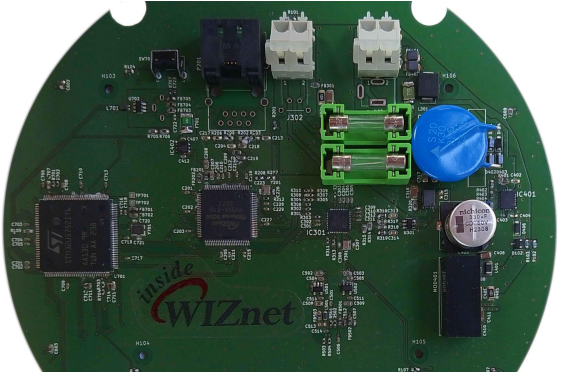
프로젝트명: W5300 IP 3D Camera over Single Pair Ethernet 작성자: Jaroslaw Juda (폴란드) 상태: 진행 중 (2023년 시작)
프로젝트 아이디어
들판의 곤충(벌, 나비 등)을 자동으로 촬영하고 개체 수를 세는 AI 카메라 시스템입니다. 단순한 2D 이미지가 아니라 ToF(Time of Flight) 센서로 3D 거리/크기 측정까지 가능하도록 설계되었습니다.
핵심 구성요소
| 부품 | 역할 |
|---|---|
| WIZnet W5300 | TCP/IP 스택 + MAC + PHY 처리 |
| ADI ADIN1100 | SPE(10BASE-T1L) 물리계층 PHY |
| STM32U575 | 메인 MCU (고성능 + 저전력) |
| OV2640 | 180° 광각 카메라 모듈 |
| ST VL53L7CX × 7개 | ToF 3D 거리 센서 (반구 커버리지) |
관련사이트
https://cdn.hackaday.io/files/1923528229587968/Ethernet%20part%20W5300%203D%20IP%20Camera.pdf
https://hackaday.io/project/192352-3d-ip-camera-over-single-pair-ethernet
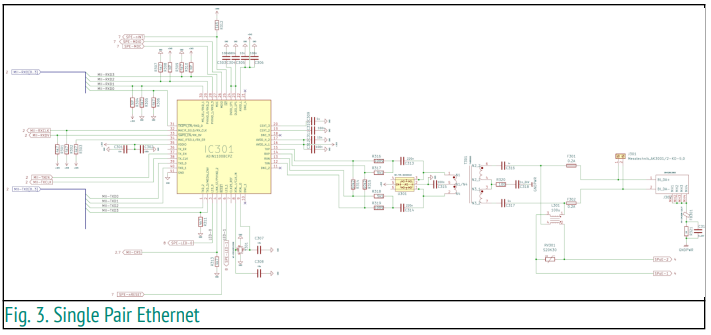
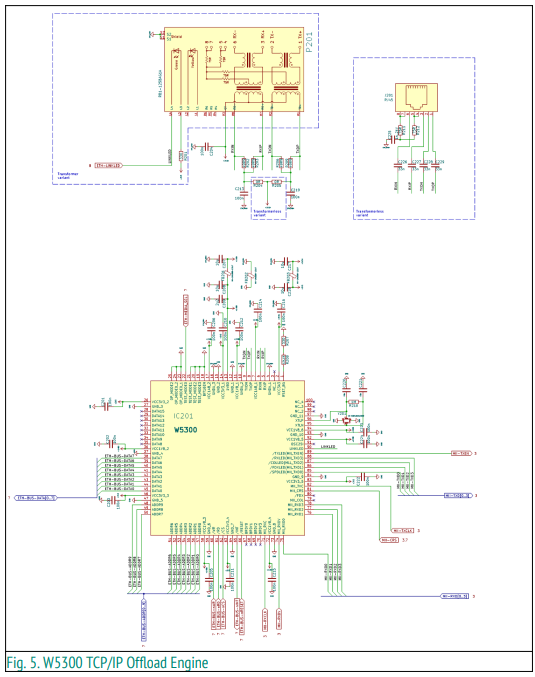
W5300 회로는 내부 및 외부 PHY용 기준 회로의 조합입니다.
모드 전환은 TEST_MODE_0 핀의 ETH-MEDIA-SEL 신호를 통해 이루어집니다.
다음 두 가지 모드 중 하나를 선택할 수 있습니다.
"내부 PHY 모드(정상 작동)" 또는 "크리스탈 클록을 사용하는 외부 PHY 모드".
내부 PHY 모드에서는 제조 단계에서 트랜스포머 옵션과 트랜스포머리스 옵션 두 가지를 선택할 수 있습니다.
트랜스포머 옵션에는 트랜스포머가 내장된 RB1-125BAG1A 소켓이 장착되고,
트랜스포머리스 옵션에는 일반 RJ45 소켓과 커패시터가 장착됩니다.
🔌 W5300의 역할
이 프로젝트에서 W5300은 이중 물리계층 전환 허브 역할을 합니다.
[STM32U575 MCU]
       │
      [W5300]  ←── 하드와이어드 TCP/IP 스택 (CPU 부담 Zero)
    /               \
[직접 PHY]     [MII 인터페이스]
    │                     │
[UTP RJ45]   [ADIN1100 PHY]
단거리 표준        │
  이더넷          [SPE 케이블]
                       장거리 단선 이더넷
구체적 기능 3가지:
- 하드와이어드 TCP/IP 스택 — STM32U575가 TCP/IP 처리를 W5300에 완전히 위임하여, MCU 연산 자원을 100% 이미지/ToF 처리에 집중 가능
- 이중 PHY 지원 — 단거리는 내장 PHY로 UTP 4선 케이블 직결, 장거리는 MII를 통해 ADIN1100(ADI)을 연결하여 SPE(10BASE-T1L) 운용
- PoE 연동 — SPE + PoDL 조합으로 장거리 원격 전력 공급까지 지원
용도
멀티드롭(Multi-drop) 네트워크 구성
하나의 배선 쌍에 최대 4대의 장치를 연결할 수 있는 '멀티드롭' 기능을 지원합니다
여러 대의 카메라를 적은 비용으로 하나의 네트워크망에 묶어 관리해야 하는 환경(예: 긴 복도, 터널 모니터링)에 매우 유용합니다.
💡 WIZnet 전략적 시사점
이 프로젝트는 W5300(MAC+TCP/IP) + ADIN1100(SPE PHY) 조합으로 SPE를 구현한 사실상 유일한 WIZnet 제품 기반 SPE 사례입니다.
W5300은 SPE PHY를 내장하고 있지 않지만, MII 인터페이스를 통해 외부 SPE PHY와 연동이 가능하다는 점을 실증했습니다.
W3200처럼 SPE PHY를 내장한 통합 칩이 나온다면, 이런 이중 칩 구성을 단일 칩으로 대체할 수 있음을 이 프로젝트가 보여주고 있습니다.
[Q&A]
Q) 이 저자가 만든 IP Camera 가 다른 IP Camera 와의 차이점과 특이점들은?
A)
1. 하이브리드 이미지 시스템: 2D + 3D (ToF)
가장 큰 차이점은 단순히 눈에 보이는 영상(2D)만 찍는 게 아니라, 사물과의 거리와 크기를 측정하는 3D 데이터를 동시에 수집한다는 점입니다.
ToF(Time of Flight) 센서 활용: STMicroelectronics의 VL53L7CX 센서를 7개나 배치했습니다. 이 센서는 빛이 사물에 맞고 돌아오는 시간을 측정해 거리를 계산합니다.
전방위(Hemisphere) 감지: 일반 카메라는 화각이 제한적이지만, 이 장치는 7개의 ToF 센서를 조합해 반구(180도) 형태의 입체 공간을 모두 감지하도록 설계되었습니다.
목적성: 단순히 화면을 보는 것이 아니라, 곤충 같은 작은 생명체의 객체 수, 크기, 이동 거리를 정밀하게 데이터화하는 '계측 장비'에 가깝습니다.
2. 혁신적인 전송 방식: Single Pair Ethernet (SPE)
일반 IP 카메라는 8가닥(4쌍)의 LAN 케이블을 사용하지만, 이 프로젝트는 Single Pair Ethernet(10BASE-T1L) 기술을 적용했습니다.
단 두 가닥의 선: 단 2개의 구리선으로 데이터 전송과 전원 공급(PoE)을 동시에 해결합니다.
장거리 전송: 일반 이더넷은 100m가 한계지만, SPE 기술(ADIN1100 칩 사용)을 통해 최대 1km 이상의 거리에서도 통신이 가능합니다. 들판이나 숲속 같은 광범위한 야외 설치에 최적화되어 있습니다.
3. 하드웨어 기반 TCP/IP 처리 (W5300)
보통의 IP 카메라는 CPU(소프트웨어)가 네트워크 통신을 처리하느라 부하가 걸리지만, 이 제품은 Wiznet W5300 칩을 사용해 이 문제를 해결했습니다.
Zero CPU Overhead: 네트워크 통신(TCP/IP 스택)을 전용 하드웨어 칩이 전담합니다.
효율성: 덕분에 메인 프로세서인 STM32U575는 오로지 ToF 데이터 계산과 이미지 처리 등 핵심 로직에만 모든 연산 능력을 집중할 수 있습니다.
4. 저전력 및 원격 설치 최적화
야외 생태계 조사를 목적으로 하기에 전력 소모와 설치 편의성에 공을 들였습니다.
초저전력 MCU: 고성능이면서도 전력 효율이 극대화된 STM32U5 시리즈를 선택했습니다.
유연한 전원 공급: 5V 또는 24V 로컬 전원은 물론, 긴 케이블을 통한 원격 전원 공급(PoE 방식)이 가능하여 전력망이 없는 오지에서도 운영하기 유리합니다.
-
jarjuda
