



Velké porovnání čipů ESP32 – který vybrat pro váš projekt
Velké porovnání čipů ESP32 – který vybrat pro váš projekt
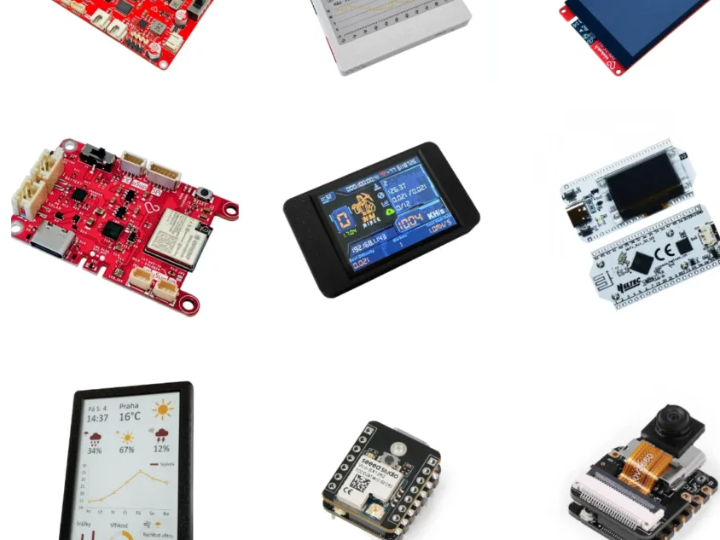
Based on an article from Chiptron, a Czech IT/IoT tech blog, we provide a summary of the ESP32 product family comparison and the role of the W5500 mentioned in the text.
1. Article Summary
This article is a guide that compares and analyzes Espressif’s diverse ESP32 microcontroller family to help users select the most suitable chip for their IoT projects without incurring unnecessary costs.
ESP32 (Original, 2016): It is the most widely used and has a rich ecosystem. It is the only product in the family that supports Bluetooth Classic, which is used for audio streaming or serial communication (SPP). Additionally, it features a built-in 100Mbit Ethernet MAC, allowing you to create a stable wired home assistant node simply by adding an external PHY chip.
ESP32-S2 / S3: The S2 is a single-core chip without Bluetooth that supports native USB-OTG. The successor, the S3, features significantly more powerful performance, a vector accelerator for AI/ML computations, support for up to 8MB of PSRAM, and USB capabilities, making it suitable for camera (ESP32-CAM) or display projects. However, it lacks an Ethernet MAC address.
ESP32-C3: This chip replaces the existing ESP8266 and features the RISC-V architecture and BLE 5.0. With very low power consumption of 5µA during deep sleep, it is ideal for battery-powered IoT sensors used for simple transmission. It does not support Bluetooth Classic.
ESP32-C6 / H2 / C5 (Smart Home): The C6 is advantageous for building smart homes (Matter) by natively supporting Zigbee and Thread along with Wi-Fi 6 (2.4GHz). The H2 has boldly removed Wi-Fi to focus solely on Zigbee/Thread mesh networks and BLE to improve power efficiency. The C5 is the only model in the product family that supports 5GHz Wi-Fi 6.
ESP32-P4 / S31 (Special and Future): The P4 is a high-performance multimedia chip (MIPI display/camera interface, built-in H.264 encoder) but requires an external coprocessor due to the lack of wireless capabilities. The S31 (a model scheduled for release in 2026) is a next-generation high-performance RISC-V chip that integrates Gigabit Ethernet MAC, Wi-Fi 6, Bluetooth Classic, Zigbee/Thread, and AI accelerators.
Software Support: All chips natively support Arduino and the official ESP-IDF, and depending on the nature of the project, developers can choose to develop using ESPHome (Smart Home), MicroPython, etc.
2. The Role of the W5500
In this text, the W5500 is referred to as an external communication expansion module designed to address the limitations of the latest ESP32 variants that lack Ethernet capabilities. Wired Ethernet Function Extension (SPI Method): With the exception of the original ESP32 and the upcoming S31, most of the latest product families (ESP32-S2, S3, C3, C6, H2, C5) do not include internal Ethernet MAC hardware. Therefore, if you require a stable wired internet connection instead of wireless (Wi-Fi) while using these chips, an external SPI Ethernet module such as the W5500 is connected to implement wired network communication.
A Compromise When Selecting Hardware: However, the text points out that using an SPI-based module like the W5500 is a kind of compromise. This is because connecting an external module occupies a portion of the internal SPI bus (communication bandwidth) and introduces the inconvenience of having to implement additional dedicated software libraries.
==========================
체코의 IT/IoT 기술 블로그 Chiptron의 글을 바탕으로, ESP32 제품군 비교 요약과 본문에서 언급된 W5500의 역할을 정리해 드립니다.
1. 글 요약 (Article Summary)
이 글은 다양하게 세분화된 Espressif사의 ESP32 마이크로컨트롤러 제품군을 비교 분석하여, 사용자가 자신의 IoT 프로젝트에 불필요한 비용을 쓰지 않고 가장 적합한 칩을 선택할 수 있도록 돕는 가이드입니다.
ESP32 (오리지널, 2016): 가장 널리 사용되며 에코시스템이 풍부합니다. 제품군 중 유일하게 오디오 스트리밍이나 직렬 통신(SPP)에 쓰이는 블루투스 클래식(Bluetooth Classic)을 지원합니다. 또한 100Mbit 이더넷 MAC이 내장되어 있어 외부 PHY 칩만 추가하면 안정적인 유선 홈 어시스턴트 노드를 만들 수 있습니다.
ESP32-S2 / S3: S2는 블루투스가 없는 단일 코어 칩으로 네이티브 USB-OTG를 지원합니다. 후속작인 S3는 훨씬 강력한 성능, AI/ML 연산을 위한 벡터 가속기, 최대 8MB PSRAM 지원, USB 기능을 갖추고 있어 카메라(ESP32-CAM)나 디스플레이 프로젝트에 적합합니다. 단, 이더넷 MAC은 없습니다.
ESP32-C3: 기존 ESP8266을 대체하는 칩으로, RISC-V 아키텍처와 BLE 5.0을 탑재했습니다. 딥 슬립(Deep sleep) 시 소모 전력이 5µA로 매우 낮아 배터리로 구동되는 단순 전송용 IoT 센서에 이상적입니다. 블루투스 클래식은 지원하지 않습니다.
ESP32-C6 / H2 / C5 (스마트홈향): C6는 Wi-Fi 6(2.4GHz)와 함께 Zigbee 및 Thread를 자체 지원하여 스마트홈(Matter) 구축에 유리합니다. H2는 Wi-Fi를 과감히 제거하고 Zigbee/Thread 메쉬 네트워크와 BLE에만 집중해 전력 효율을 높였습니다. C5는 제품군 중 유일하게 5GHz Wi-Fi 6를 지원합니다.
ESP32-P4 / S31 (특수 및 미래형): P4는 고성능 멀티미디어 칩(MIPI 디스플레이/카메라 인터페이스, H.264 인코더 내장)이지만 무선 기능이 없어 외부 코프로세서가 필요합니다. S31(2026년 발표 예정 모델)은 기가비트 이더넷 MAC, Wi-Fi 6, 블루투스 클래식, Zigbee/Thread, AI 가속기를 모두 집약한 차세대 고성능 RISC-V 칩입니다.
소프트웨어 지원: 모든 칩이 기본적으로 Arduino 및 공식 ESP-IDF를 지원하며, 프로젝트 성격에 따라 ESPHome(스마트홈), MicroPython 등을 선택해 개발할 수 있습니다.
2. W5500의 역할
본문에서 W5500은 이더넷 기능이 없는 최신 ESP32 변종 칩들의 한계를 보완하기 위한 외부 통신 확장 모듈로 언급됩니다.
유선 이더넷 기능 확장 (SPI 방식): 오리지널 ESP32나 출시 예정인 S31을 제외한 대부분의 최신 제품군(ESP32-S2, S3, C3, C6, H2, C5)에는 내부 이더넷 MAC 하드웨어가 포함되어 있지 않습니다. 따라서 이 칩들을 사용하면서 무선(Wi-Fi) 대신 안정적인 유선 인터넷 연결이 필요한 경우, W5500과 같은 외부 SPI 이더넷 모듈을 연결하여 유선 네트워크 통신을 구현하는 역할을 합니다.
하드웨어 선택 시의 타협안(Compromise): 그러나 본문에서는 W5500 같은 SPI 기반 모듈을 사용하는 것이 일종의 타협안이라고 지적합니다. 외부 모듈을 연결하게 되면 내부 SPI 버스(통신 대역폭)를 일부 점유하게 되고, 전용 소프트웨어 라이브러리를 추가로 구현해야 하는 번거로움이 생기기 때문입니다.