


Vaillant eloBLOCK и atmoTEC в умном доме: интеграция через eBUS, ebusd и Home Assistant
Vaillant eloBLOCK & atmoTEC를 Smart Home에 통합하기 — eBUS, ebusd, Home Assistant
WIZnet - W5500
x 1

This is a detailed guide on how to build a smart home by integrating Vaillant boilers (electric model eloBLOCK and gas model atmoTEC) with the open-source software ebusd and Home Assistant (HA).
Based on your request, we have provided an overall summary and outlined the role of the W5500 (USR-ES1).
1. Overall Summary
This article covers the process of building a system that allows users to directly control and monitor the boiler by analyzing eBUS, the boiler's proprietary communication standard.
Key Objectives: Real-time data monitoring (temperature, pressure), checking energy consumption graphs, automation (using cheaper electricity at night), limiting output during peak power, and receiving error notifications.
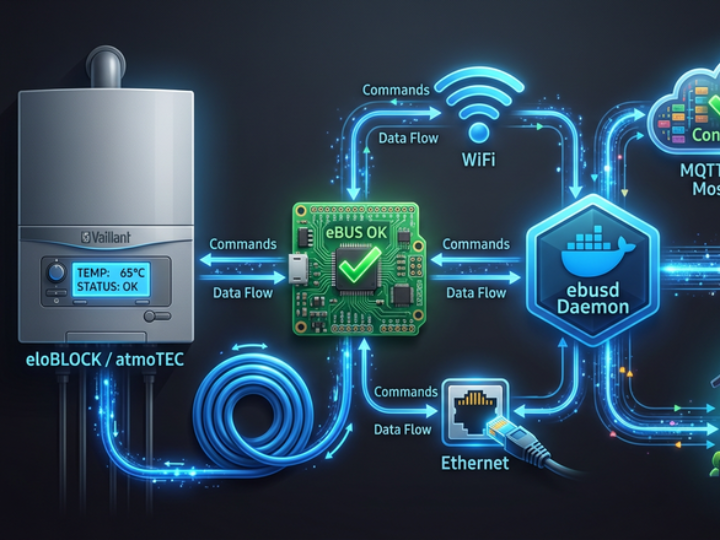
System Configuration: Boiler ↔ eBUS Adapter (Hardware) ↔ ebusd (Data Interpretation) ↔ MQTT (Message Transmission) ↔ Home Assistant (User Interface/Automation).
Key Achievements:
Successfully monitored over 30 parameters.
Boiler control is possible using only software, without a separate hardware thermostat, via the SetModeOverride command.
Implementation of boiler output limiting (power management) via ESP-01S relays or eBUS commands.
Note: The readable data range varies depending on the boiler's firmware version (SW), and some newer functions require a process of directly finding register addresses.
2. Role of W5500 (USR-ES1 Module)
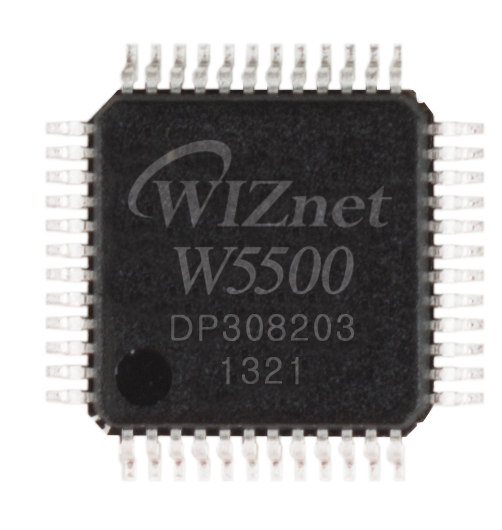
In this text, the USR-ES1 module based on the W5500 chipset is mounted on the eBUS adapter (Shield v5) and handles wired Ethernet communication.
Stable Data Transmission: The eBUS protocol is highly sensitive to timing and jitter during data transmission. While Wi-Fi can experience latency depending on the wireless environment, the W5500 minimizes this through a wired connection.
Network Bridge: It transmits data interpreted by the eBUS adapter, which processes the boiler's analog signals, to the local network (LAN), enabling ebusd to receive data from a remote server (such as a PC with Docker or HA installed).
Low Latency: Eliminates driver latency and Wi-Fi instability associated with USB adapters, enhancing real-time synchronization performance with the boiler.
===
Vaillant 보일러(전기 모델 eloBLOCK 및 가스 모델 atmoTEC)를 오픈소스 소프트웨어인 ebusd와 Home Assistant(HA)에 통합하여 스마트 홈을 구축하는 방법에 대한 상세 가이드입니다.
요청하신 내용을 바탕으로 전체 요약과 W5500(USR-ES1)의 역할을 정리해 드립니다.
1. 전체 내용 요약
이 글은 보일러의 전용 통신 규격인 eBUS를 분석하여 사용자가 직접 보일러를 제어하고 모니터링할 수 있는 시스템 구축 과정을 다룹니다.
핵심 목적: 실시간 데이터 모니터링(온도, 압력), 에너지 소비 그래프 확인, 자동화(야간 저렴한 전기 사용), 전력 피크 시 출력 제한, 에러 알림 수신.
시스템 구성: 보일러 ↔ eBUS 어댑터(하드웨어) ↔ ebusd(데이터 해석) ↔ MQTT(메시지 전송) ↔ Home Assistant(사용자 인터페이스/자동화).
주요 성과:
30개 이상의 파라미터 모니터링 성공.
SetModeOverride 명령을 통해 별도의 하드웨어 온도 조절기 없이 소프트웨어만으로 보일러 제어 가능.
ESP-01S 릴레이 또는 eBUS 명령을 통한 보일러 출력 제한(전력 관리) 구현.
특이사항: 보일러의 펌웨어 버전(SW)에 따라 읽을 수 있는 데이터 범위가 다르며, 일부 최신 기능은 직접 레지스터 주소를 찾는 과정이 필요함.
2. W5500 (USR-ES1 모듈)의 역할
글에서 W5500 칩셋 기반의 USR-ES1 모듈은 eBUS 어댑터(Shield v5)에 장착되어 유선 이더넷(Ethernet) 통신을 담당합니다.
안정적인 데이터 전송: eBUS 프로토콜은 데이터 전송 시 타이밍과 지연(Jitter)에 매우 민감합니다. Wi-Fi는 무선 환경에 따라 지연이 발생할 수 있는데, W5500은 유선 연결을 통해 이를 최소화합니다.
네트워크 브릿지: 보일러의 아날로그 신호를 처리하는 eBUS 어댑터가 해석한 데이터를 네트워크망(LAN)으로 쏴주어, 멀리 떨어진 서버(Docker나 HA가 설치된 PC)에서 ebusd가 데이터를 수신할 수 있게 합니다.
낮은 지연 시간(Low Latency): USB 어댑터 방식에서 발생하는 드라이버 지연이나 Wi-Fi의 불안정성을 제거하여, 보일러와의 실시간 동기화 성능을 높입니다.